
Adult diaries are personal journals that help you reflect, process emotions, and improve mental well-being through regular, intentional writing. Unlike teenage diaries that log daily events, personal journals for adults function as tools for self-discovery, emotional regulation, and creative expression. Research confirms that expressive writing benefits for anxiety and depression emerge gradually over weeks of consistent practice. The payoff is real, but only if you stick with it long enough to let it work. This guide covers formats, prompts, privacy, and habit-building so you can start writing with confidence.
What are the key formats and styles of adult diaries?
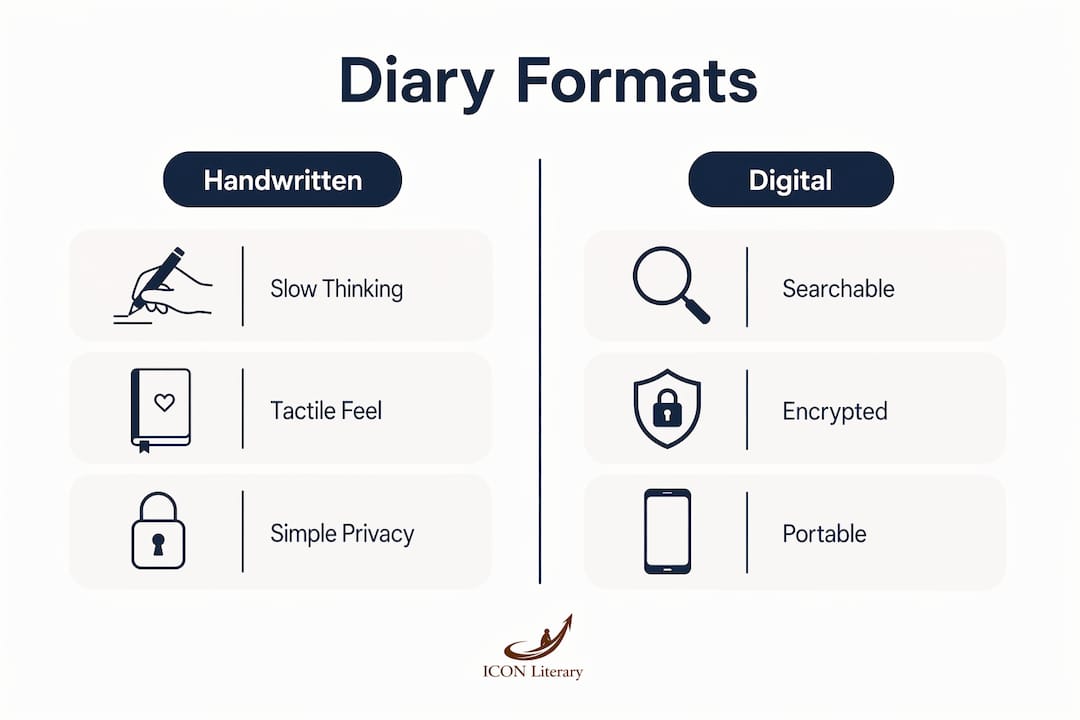
Adult diaries come in more formats than most people realize. The right format is the one you will actually use, not the one that looks most impressive on a shelf.
Handwritten journals remain the most popular format. Writing by hand slows your thinking down, which helps you process emotions more carefully. A blank notebook, a dotted-grid journal, or a lined diary all work equally well. The physical act of writing creates a sensory connection to your thoughts that typing rarely replicates.

Digital journals offer search, encryption, and portability. Premium digital journaling apps in 2026 offer privacy-focused encryption with pricing tiers around $4.99/month or a $79 lifetime purchase. That pricing model suits adults who want the convenience of their phone without sacrificing security.
Guided journals remove the blank page problem entirely. They come pre-loaded with prompts, reflection questions, and structured sections. These work especially well for adults new to journaling who find freeform writing intimidating.
Creative diaries go beyond text. Adults who incorporate visuals like comics or sketches into their journals experience more joy and emotional accessibility than those who stick to text alone. This finding surprises most people, but it makes sense. Drawing a moment forces you to observe it differently.
Here is a quick breakdown of format strengths:
- Handwritten notebooks: Best for deep reflection, no screen distraction, tactile satisfaction
- Digital apps: Best for search, encryption, and writing on the go
- Guided journals: Best for beginners or anyone who struggles with the blank page
- Creative or visual diaries: Best for adults who think in images or want a more playful practice
- Audio diaries: Best for people who process thoughts better by speaking than writing
Pro Tip: Try one format for two weeks before switching. Most people abandon journaling because they switch formats too quickly, not because journaling does not work for them.
How do structured writing prompts enhance adult diary journaling?
The blank page is the single biggest barrier to consistent journaling. Situation-specific prompts help you find an authentic voice and make writing feel approachable rather than performative.
Generic prompts like "write about your day" produce generic entries. Therapeutic and self-reflective prompts do something different. They redirect your thinking from what happened toward what it meant and what you can do about it. That shift is where the real mental health benefit lives.
Research shows that structured expressive writing reduces anxiety more effectively than unstructured freewriting. The mechanism is straightforward. Unstructured writing can spiral into rumination, replaying negative events without resolution. A well-designed prompt interrupts that loop and points your thinking toward insight.
Effective adult diary writing prompts share three qualities. They are specific enough to give you a starting point. They are open enough to let your real thoughts emerge. And they push you past surface-level description toward emotional honesty.
"The most useful prompts don't ask what happened. They ask what you learned, what you felt in your body, or how you would act differently. That pivot from event to meaning is where journaling stops being a log and starts being a tool."
Strong prompt categories for daily reflection for adults include:
- Emotional processing: "What feeling am I carrying today, and where do I feel it physically?"
- Gratitude with specificity: "Describe one moment from today using only sensory details."
- Values clarification: "What did I do today that I am proud of, and why does it matter to me?"
- Future self: "What would the version of me I want to become do differently this week?"
- Conflict resolution: "What is one situation I keep replaying? What would letting it go actually look like?"
AI journaling tools take prompt personalization further. These tools adapt to your writing history, ask follow-up questions, and surface patterns you might not notice yourself. That level of personalization is genuinely useful for adults who want more than a static list of questions.
Pro Tip: Rotate through at least three different prompt categories each week. Using the same type of prompt repeatedly narrows your self-reflection and reduces the long-term benefit.
What are privacy best practices for adult diaries, especially digital ones?
Privacy is not a secondary concern for diary writers. It is the foundation of honest writing. You will not write truthfully if you fear someone else reading your entries.
Physical diaries offer straightforward privacy options. A locked diary, a journal stored in a locked drawer, or a notebook kept in a private location all work. The risk with physical diaries is loss or theft, not data breaches.
Digital diaries carry different risks. Privacy-conscious writers prefer on-device encryption and avoid apps that sync data to the cloud or use entries for AI training. That preference is well-founded. Any app that stores your data on external servers creates exposure, regardless of how trustworthy the company appears today.
| Privacy feature | Physical diary | Digital journal app |
|---|---|---|
| Encryption | Not applicable | On-device or end-to-end |
| Access control | Physical lock or hidden storage | Password, PIN, or biometric |
| Data breach risk | Low (theft only) | Moderate to high without encryption |
| Backup options | Manual copying | Encrypted local backup |
| Cloud syncing | Not applicable | Avoid unless encrypted |
The safest digital journaling setup uses on-device encryption with no cloud syncing and no data sharing with third parties. If an app's privacy policy is vague about how it handles your entries, treat that vagueness as a red flag.
Pro Tip: Before downloading any journaling app, search its name alongside "privacy policy" and "data sharing." Read the data retention section specifically. That one paragraph tells you everything.
What practical habits help adults maintain a consistent diary routine?
Consistency is the variable that separates adults who benefit from journaling and those who abandon it after two weeks. The habit itself matters more than the quality of any single entry.
Five-minute sessions, practiced three to four times per week, outperform longer daily sessions for building a sustainable habit. That finding runs counter to the "write every day" advice you see everywhere. Shorter, more frequent sessions reduce the psychological weight of sitting down to write. They also make it easier to restart after a break.
Here is a practical system for building the habit:
- Anchor journaling to an existing routine. Morning coffee, an evening wind-down, or a lunch break all work. Habit stacking links the new behavior to something you already do automatically.
- Set a five-minute timer. Write until it goes off. Stop when it does, even if you are mid-thought. This trains your brain to associate journaling with a defined, manageable commitment.
- Use a prompt on days when you feel stuck. Keep a list of three to five go-to prompts somewhere visible. The blank page loses its power when you have a fallback.
- Write in sensory detail, not broad summaries. Specific, concrete details reduce the pressure to produce a perfect narrative. "The coffee was too hot and I burned my tongue" is a better diary entry than "I had a rough morning."
- Skip perfectionism entirely. Your diary is not a performance. Crossed-out words, incomplete sentences, and bad days all belong there. The goal is honesty, not polish.
- Track your streak loosely. A simple checkmark on a calendar works. You are not trying to build a perfect record. You are building a relationship with the practice.
Consistent journaling benefits compound over time. Adults who quit early miss the therapeutic payoff that typically appears after several weeks of regular writing. Staying with the practice through the awkward early phase is the single most important thing you can do.
Pro Tip: If you miss three or more days in a row, write a single sentence about why. That sentence counts as an entry and restarts your momentum without the guilt of a "failed" streak.
Key Takeaways
Adult diaries work best when you combine a format you enjoy, prompts that push past surface-level thinking, strong privacy practices, and a low-friction habit built around short, frequent sessions.
| Point | Details |
|---|---|
| Format matters | Choose handwritten, digital, guided, or visual formats based on what you will actually use consistently. |
| Prompts reduce anxiety | Structured prompts shift thinking from rumination to emotional processing, producing stronger mental health benefits than freewriting. |
| Privacy is foundational | Use on-device encryption for digital diaries and avoid apps that sync entries to the cloud without protection. |
| Short sessions win | Five-minute sessions three to four times per week build habits more effectively than longer daily writing. |
| Benefits take time | Therapeutic benefits from expressive writing emerge over weeks, so staying consistent through the early phase is critical. |
What I have learned from years of watching adults pick up a diary
Most adults approach journaling with the wrong mental model. They picture a teenager writing "Dear Diary" at the top of a page and cataloging the day's events. That image makes journaling feel juvenile, which is exactly why so many adults never start or quit quickly.
The adults I have seen get the most from their journals treat them more like a thinking partner than a record. They write to figure out what they actually believe, not to document what already happened. That shift in purpose changes everything about how the practice feels.
The visual diary finding genuinely surprised me. Adults who add sketches, comics, or even rough doodles to their entries consistently report more joy in the process than those who write only in text. That joy matters because it is what keeps people coming back. A practice you enjoy is a practice you sustain.
The blank page barrier is real, but it is also overrated as an obstacle. Every adult I have seen push through the first two weeks of journaling with a set of good prompts stops fearing the blank page. The fear is mostly anticipatory. Once you are writing, it dissolves.
The emotional processing piece is where meaningful journaling for grown-ups separates itself from simple diary keeping. Writing about what you felt is useful. Writing about what that feeling is telling you, and what you plan to do about it, is transformative. That second layer is what the best prompts unlock.
— Derek
A good place to start your journaling practice
Starting a journaling practice is easier when you have the right notebook or journal in hand. The physical object matters more than most people expect. A journal that feels good to write in gets opened more often than one that does not.

A has curated a selection of quality adult diaries and journals across formats, from guided journals with built-in prompts to clean notebooks for freeform writing. Whether you prefer a structured approach or a blank page you fill on your own terms, the right format is available. Browse the full journal selection and pick the one that fits how you actually think and write. The best diary is the one you will use.
FAQ
What is the difference between a diary and a journal for adults?
A diary typically records daily events in chronological order, while a personal journal for adults focuses on reflection, emotional processing, and self-discovery. Both formats offer mental health benefits, but journals tend to produce deeper insight through structured prompts and intentional writing.
How often should adults write in their diary?
Three to four sessions per week, each lasting about five minutes, builds a more sustainable habit than writing every day. Short, frequent sessions reduce the psychological weight of the practice and make it easier to maintain over time.
Are digital diaries as private as handwritten ones?
Digital diaries can be equally private when they use on-device encryption and avoid cloud syncing. Apps that store entries on external servers or use data for AI training carry higher privacy risk than a locked physical notebook.
What are the best adult diary writing prompts for beginners?
Prompts that ask about specific sensory moments, emotions felt in the body, or one thing you would do differently work well for beginners. These prompts are concrete enough to start writing immediately and open enough to let honest thoughts emerge.
How long does it take to see mental health benefits from journaling?
Research on expressive writing shows that benefits for anxiety and depression typically emerge over several weeks of consistent practice. Quitting in the first two weeks means missing the delayed therapeutic payoff that regular journaling produces.