
An emotional themes cataloging system is a structured method for identifying, categorizing, and organizing emotions and emotional patterns found in children's literature to build emotional literacy. The system assigns standardized categories and nuanced descriptors to feelings that appear within stories, giving educators, parents, and librarians a consistent way to select and discuss books. Foundational frameworks like the 402 standard and the MPAI-MMC standard provide the classification backbone. A, the brand behind Socko the Flamingo with Tennis Shoes, applies this kind of thinking to help adults spark meaningful conversations about big feelings with children.
What is an emotional themes cataloging system?
An emotional themes cataloging system organizes the feelings present in a story into a structured, searchable framework. Rather than labeling a book simply as "sad" or "happy," the system maps emotions with precision, using identifiers, valence scales, and arousal levels to describe what a character experiences and why.
The 402 standard catalogs 402 distinct human emotions organized across 17 families, including identifiers, valence, arousal scales, and bodily location maps for consistent emotional identification. That level of detail matters because children's emotional experiences rarely fit into a single word. A child reading about a character who loses a pet may feel grief, longing, guilt, and love all at once.
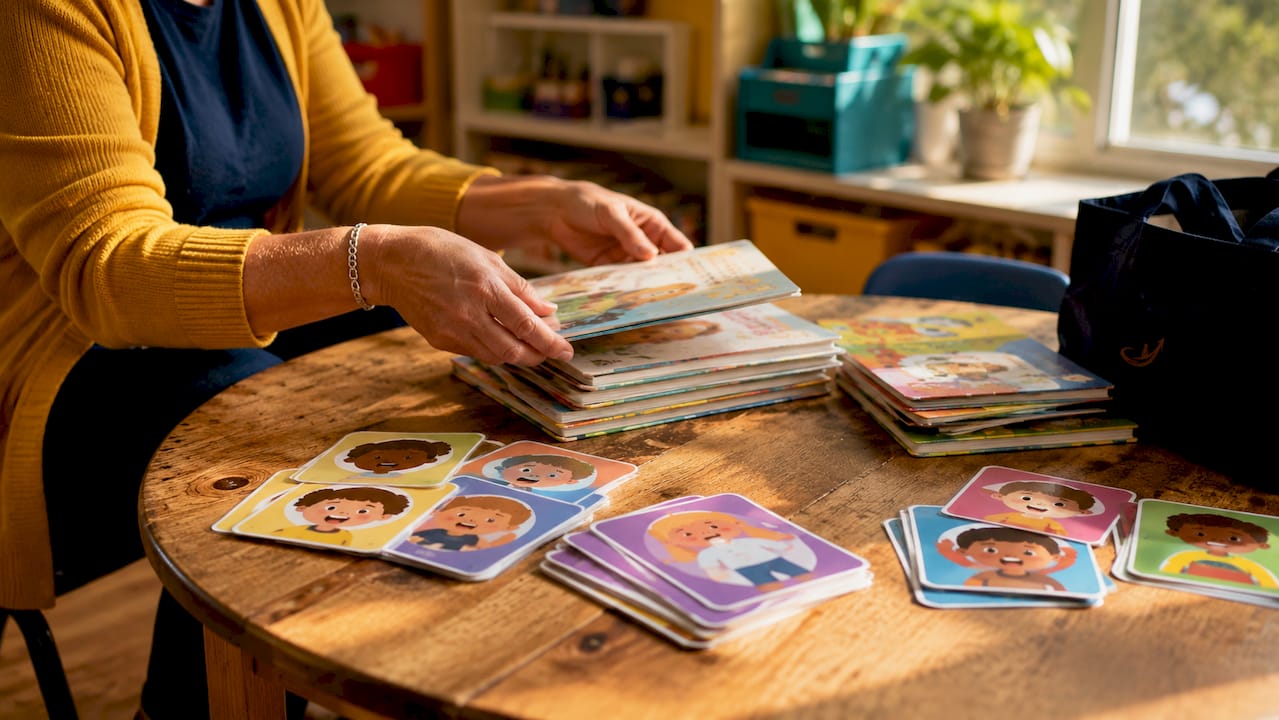
The MPAI-MMC V2.4 standard takes a parallel approach. It defines emotional cataloging systems using a categories table that identifies primary emotions and an adjectival table for nuanced subcategories, enabling precise mapping. For example, the primary category "ANGER" branches into subcategories like "furious," "irritated," or "resentful." This structure lets librarians tag a picture book not just as containing anger, but as depicting the specific shade of anger a child is most likely to recognize in their own life.
Emotion classification itself remains a contested area in affective science, evolving from basic discrete emotion models toward expanded, nuanced frameworks. That evolution directly shapes how cataloging systems are built and updated.
How are emotional themes classified and organized?
Two main models drive emotional theme classification: discrete emotion models and dimensional models. Discrete models assign emotions to fixed categories, such as joy, fear, sadness, anger, surprise, and disgust. Dimensional models place emotions on continuous scales, typically valence (pleasant to unpleasant) and arousal (calm to excited). Most modern cataloging systems blend both approaches.
| Classification method | Structure | Best use case |
|---|---|---|
| Discrete emotion model | Fixed named categories (joy, fear, anger) | Quick tagging for storytime selection |
| Dimensional model | Valence and arousal scales | Nuanced emotional mapping for curriculum design |
| Hierarchical model (402 standard) | 17 families, 402 named emotions | Deep indexing for library databases |
| Adjectival subcategory model (MPAI-MMC) | Primary + adjectival nuance table | Precise character emotion analysis |
The 402 standard's 17 emotion families give catalogers a clear starting point. Each family groups related emotions, so a librarian searching for books about "social emotions" can find stories covering shame, pride, embarrassment, and admiration within one cluster. The MPAI-MMC adjectival table then adds the fine detail that makes a catalog genuinely useful for classroom discussion.
Pro Tip: When building a classroom library catalog, start with the 17 emotion families from the 402 standard as your top-level tags. Add one or two adjectival subcategories per book to capture emotional nuance without overwhelming the system.
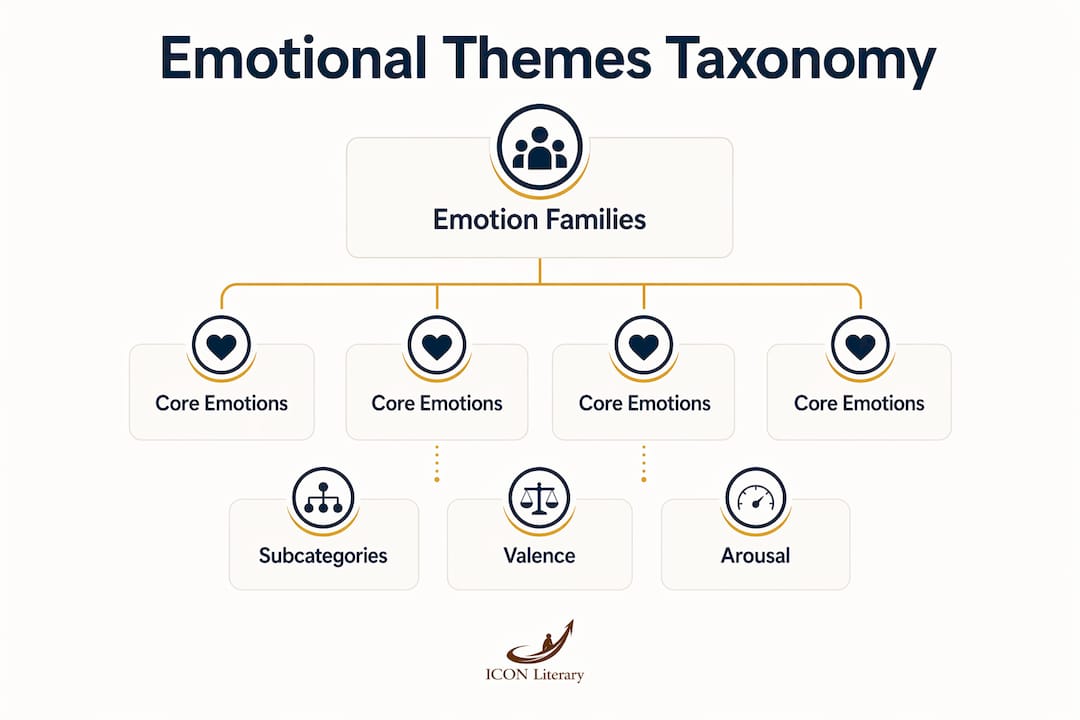
Dimensional models are especially useful when selecting books for children at different developmental stages. A kindergartner benefits from high-arousal, clearly valenced emotions like excitement or fear. An older child can engage with low-arousal, ambiguous emotions like melancholy or ambivalence. Mapping books along these scales helps educators choose stories that match where a child is emotionally.
How do you detect and index emotional themes in stories?
Detecting emotional themes in children's literature requires more than reading a book and guessing its mood. Researchers and librarians use two main approaches: lexicon-based tools and hybrid computational methods that combine topic modeling with semantic similarity.
The LIWC2022 lexicon is a validated psycholinguistic tool that organizes keywords into emotional and sociocultural categories, enabling emotional theme detection within texts without requiring annotated emotion datasets. LIWC2022 includes 62 validated lexical categories, covering everything from positive emotion words to words signaling social relationships or biological processes. That breadth makes it practical for analyzing picture book text, where vocabulary is limited but emotionally loaded.
Hybrid methods go further. The Behavioral and Emotional Theme Detection (BET) framework separates thematic topic detection from emotional theme detection, allowing mixed or contrasting emotions to coexist within narratives with graded similarity scores rather than fixed labels. A story about a child's first day of school might score high on both excitement and anxiety simultaneously. That probabilistic representation reflects how children actually experience stories.
Key steps in emotional theme detection and indexing:
- Text extraction: Pull the full text of the book, including dialogue and narration.
- Lexicon matching: Run the text through a tool like LIWC2022 to flag emotion-related words and phrases.
- Topic modeling: Use latent semantic analysis to identify the broader thematic context surrounding each emotional signal.
- Similarity scoring: Assign graded scores to each detected emotion rather than forcing a single label.
- Hierarchical tagging: Map scores to the relevant emotion family and subcategory in your chosen classification framework.
- Review and refine: A human reviewer confirms that the detected themes match the story's actual emotional arc.
Pro Tip: For librarians without computational tools, a simplified version of this process works well. Read the book, list every emotion word you notice, then group those words into the 17 emotion families. That manual pass gives you a reliable emotional index for storytime planning.
Emotional themes are not fixed story attributes. They are contextual and relational properties detected by combining explicit lexicons with latent semantic analysis to enhance detection in narratives. A word like "quiet" carries grief in one scene and contentment in another. Context-sensitive indexing captures that difference.
How do you apply emotional cataloging to support literacy?
Applying an emotional themes cataloging system in a classroom or library setting transforms how adults guide children through books. The system moves educators beyond asking "How did that make you feel?" toward structured conversations that build genuine emotional vocabulary.
Hierarchical and multidimensional emotional maps help children identify and understand complex feelings through stories. When a child sees that a character's behavior connects to a specific emotion family, such as "social emotions," they begin to recognize the same patterns in their own relationships. That recognition is the foundation of emotional literacy.
A practical numbered process for implementation:
- Select a classification framework. Choose the 402 standard for deep indexing or the MPAI-MMC adjectival model for classroom-level tagging.
- Catalog your existing collection. Tag each book with its primary emotion family and one or two adjectival subcategories.
- Organize books by emotional theme. Create sections or bins labeled by emotion family, such as "fear and courage" or "belonging and loneliness."
- Plan read-alouds around emotional themes. Choose books that match the emotional experiences your students are navigating.
- Use the catalog during discussion. Reference the tags to help children name what a character feels and connect it to their own experience.
- Update the catalog regularly. Add new books and refine tags as your understanding of the collection deepens.
Emotional cataloging in educational settings benefits from hierarchical structures linking emotions to life values and social contexts to foster true emotional literacy. A book about jealousy, for example, connects to values like fairness and belonging. Naming that connection during storytime gives children a richer framework for understanding why they feel what they feel.
A, through Socko the Flamingo with Tennis Shoes, models this approach directly. The character's experiences with belonging and self-acceptance map onto specific emotion families, giving educators a ready-made entry point for emotional theme discussions.
What are the challenges in cataloging emotional themes?
Cataloging emotional themes is not a simple tagging exercise. Several real challenges require careful handling to keep a catalog accurate and useful.
Effective emotional cataloging accounts for universal biological patterns and culture-specific linguistic nuances to avoid misclassification. Cross-linguistic differences in expressing emotions, such as whether a language uses verbs or adjectives to describe feelings, affect how accurately a catalog captures emotional experience across diverse populations. A library serving multilingual families needs to account for these differences when building its catalog.
| Challenge | Best practice |
|---|---|
| Cultural variation in emotion expression | Use frameworks that separate biological emotion patterns from linguistic labels |
| Rigid one-to-one emotion-story mapping | Assign graded scores; allow multiple emotion tags per book |
| Mixed emotions within a single narrative | Apply the BET framework's probabilistic approach to coexisting emotions |
| Oversimplified flat emotion lists | Use hierarchical models linking emotions to social context and life values |
| Cataloger bias | Include a review step with multiple readers before finalizing tags |
Avoiding rigid one-to-one emotion-story mappings is the single most important best practice. A picture book about moving to a new home contains grief, excitement, fear, and hope. Forcing it into one emotional category loses the richness that makes it valuable for discussion. Multidimensional emotional theme representation acknowledging mixed emotions within the same story better reflects lived experience and supports richer literacy discussions.
Practitioners find that focusing on 2–4 primary emotional triggers provides more leverage in emotional growth than cataloging every emotional episode individually. Applied to children's literature, this means identifying the two or three dominant emotional threads in a book rather than trying to tag every feeling mentioned.
Key Takeaways
An emotional themes cataloging system works best when it combines a structured classification framework, context-sensitive detection methods, and hierarchical organization that links emotions to social context and life values.
| Point | Details |
|---|---|
| Use a proven framework | The 402 standard and MPAI-MMC provide reliable, detailed classification structures for emotional cataloging. |
| Allow multiple emotion tags | Assign graded scores and multiple tags per book to capture mixed emotions accurately. |
| Connect emotions to context | Link emotion tags to life values and social situations to build true emotional literacy. |
| Focus on core emotional triggers | Catalog 2–4 dominant emotional themes per book rather than every emotional moment. |
| Account for cultural diversity | Adapt cataloging language to reflect the linguistic and cultural backgrounds of your readers. |
Why structured emotional cataloging changed how I think about storytime
The first time I mapped a picture book collection against an emotion family framework, I expected it to feel mechanical. It did not. What surprised me was how quickly the catalog revealed gaps. An entire shelf of books covered fear and courage. Almost nothing addressed ambivalence or the specific ache of feeling left out without knowing why.
That gap matters because children live in those harder-to-name emotions constantly. A flat list of "happy, sad, angry, scared" does not give a child the vocabulary to say, "I feel proud of myself but also embarrassed that I care so much." Structured cataloging, especially systems that map emotions to life values and social context, makes those conversations possible.
My strongest recommendation for educators and librarians is to resist the urge to keep the catalog simple for simplicity's sake. A two-tier system, primary emotion family plus one adjectival subcategory, takes almost no extra time and returns dramatically better results during discussion. Children respond to precision. When you hand a child a book and say, "This one is about the kind of loneliness that comes from feeling different," they lean in.
A's Socko the Flamingo with Tennis Shoes does exactly this kind of work through story. The character's humor and imagination create emotional entry points that a catalog can identify, tag, and connect to a child's real experience. That connection is where emotional literacy actually grows.
— Derek
Books that bring emotional themes to life for children
Children build emotional literacy fastest when they read stories that name and explore feelings with honesty and warmth. A curated collection of picture books organized by emotional theme gives parents, teachers, and librarians a ready-made tool for sparking those conversations.
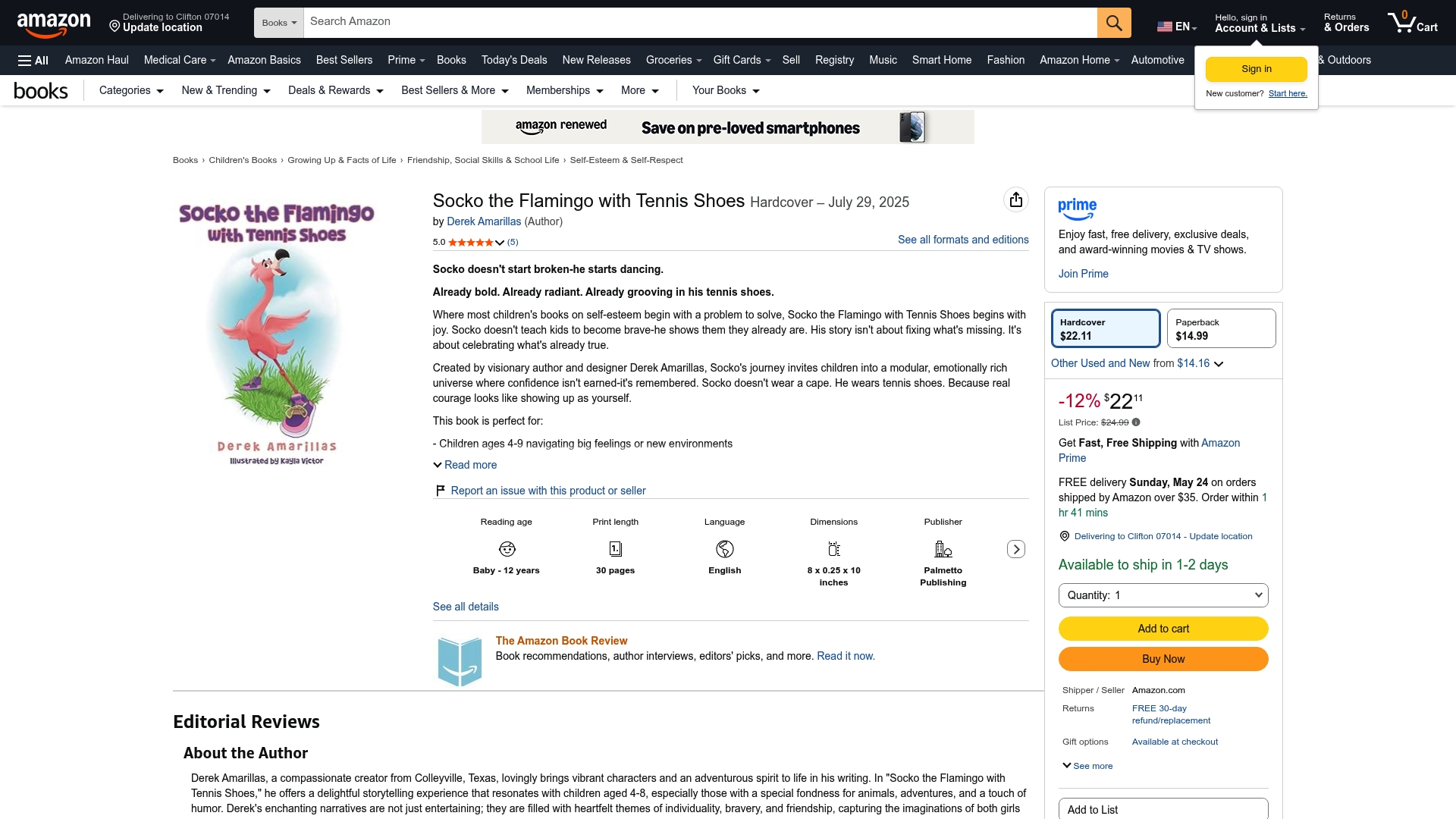
A's Socko the Flamingo with Tennis Shoes is one example of a character-driven story that maps directly onto emotion families like belonging, self-acceptance, and social courage. For a broader selection of children's books organized around emotional literacy themes, the curated collection at A's marketplace offers titles chosen specifically to support the kinds of conversations this article describes. Whether you are building a classroom library or stocking a home bookshelf, starting with emotionally themed books is the most direct path to helping children name and understand their feelings.
FAQ
What is an emotional themes cataloging system?
An emotional themes cataloging system is a structured method for identifying, classifying, and organizing emotions found in children's literature using standardized frameworks like the 402 standard or MPAI-MMC. It gives educators and librarians consistent tags to select and discuss books by emotional content.
How many emotions does the 402 standard include?
The 402 standard catalogs 402 distinct emotions organized across 17 families, each with identifiers, valence, arousal scales, and bodily location maps for precise emotional identification.
Can a single children's book have more than one emotional theme?
Yes. The BET framework represents emotions probabilistically, allowing multiple emotional themes to coexist within the same narrative with graded similarity scores rather than a single fixed label.
What is LIWC2022 and how does it help with emotional theme indexing?
LIWC2022 is a validated psycholinguistic lexicon with 62 lexical categories that detects emotion-related language in texts without requiring pre-labeled datasets. It serves as a practical tool for identifying emotional themes in picture book text.
Why does cultural diversity matter in emotional cataloging?
Cross-linguistic differences in how emotions are expressed, such as verb-based versus adjective-based emotional language, affect cataloging accuracy. Effective systems separate universal biological emotion patterns from culture-specific linguistic labels to avoid misclassification across diverse reader populations.