
Not every book with a feelings-related cover actually builds social-emotional skills. Many parents, teachers, and caregivers assume that the "SEL" label on a children's book is enough of a guarantee, but SEL-labeled books don't automatically produce better outcomes. Knowing how to assess SEL book quality means looking beyond a smiling character on the front cover. It means applying real criteria: how well the book integrates SEL themes, whether its language fits the developmental stage of a 3-to-8-year-old, and whether it reflects the lived experiences of the children who will read it.
Table of Contents
- Key Takeaways
- How to assess SEL book quality: start with the right framework
- Rubric criteria: themes, narrative, and delivery
- Developmental and engagement factors
- Cultural sensitivity and authentic representation
- Putting the rubric to practical use
- My honest take on what most people get wrong
- Find vetted SEL books that meet the bar
- FAQ
Key Takeaways
| Point | Details |
|---|---|
| SEL labels aren't quality proof | A book marketed as SEL may still fail to deliver meaningful skill-building without strong theme integration. |
| Use a rubric-based approach | Scoring books across multiple dimensions gives you an objective way to compare and select titles confidently. |
| Match content to CASEL competencies | Aligning books to recognized SEL competency clusters keeps your selections focused and effective. |
| Developmental fit matters | Language, illustrations, and concepts must match the cognitive and emotional stage of children ages 3-8. |
| Cultural authenticity goes deeper than visuals | Characters' identities should shape the story and emotional logic, not just appear on a cover. |
How to assess SEL book quality: start with the right framework
The phrase "social-emotional learning" gets used broadly, so it helps to ground your evaluation in a recognized structure. CASEL organizes SEL competencies into five clusters: self-awareness, self-management, social awareness, relationship skills, and responsible decision-making. These aren't abstract categories. They describe specific behaviors children practice, like naming their emotions, managing frustration, showing empathy, cooperating with peers, and thinking through choices.
When you pick up a new SEL picture book, your first job is to identify which of these competencies the book actually addresses. A book about a child who learns to share after a conflict touches relationship skills. A story about a character who feels anxious before a big event and learns to breathe through it addresses self-management. Specificity matters because clear, competency-aligned goals prevent the vague "be kind" messaging that sounds good but teaches children very little.
Here is a simple checklist to run through before reading a book in depth:
- Does the story address at least one of CASEL's five competency clusters explicitly?
- Does the main character model a skill rather than just talk about a value?
- Is the emotional challenge at the center of the plot realistic for a child aged 3-8?
- Does the resolution involve a skill the child can practice themselves?
- Are SEL concepts introduced through action and story rather than through lectures or definitions?
If a book fails on more than two of these points, it may be more of a moral lesson than a genuine SEL tool.
Rubric criteria: themes, narrative, and delivery
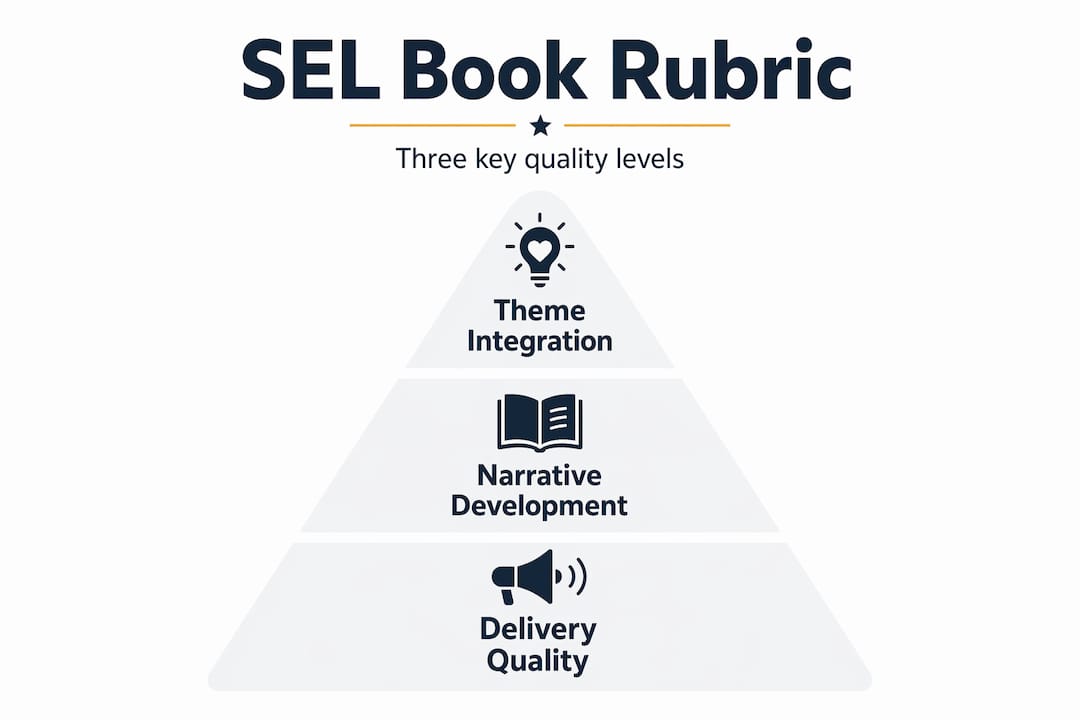
The single most important distinction in evaluating SEL books is the difference between the presence of an SEL theme and the quality of its delivery. A book can feature a character who gets angry and calms down, but if the calming strategy appears in one sentence without context or practice, the theme is present but barely delivered. SEL theme integration significantly predicted SEL outcomes in children (β = 0.292, p = .032), which tells us that how the theme is woven into the narrative is what actually moves the needle.
A solid rubric for evaluating this covers three dimensions.
| Rubric dimension | What to look for | Red flag |
|---|---|---|
| Theme integration | SEL skill woven through plot, not mentioned once and dropped | Skill only appears in the resolution |
| Character development | Character visibly grows or practices a skill | Character is told what to do with no internal change shown |
| Narrative structure | Emotional arc that builds and resolves authentically | Problem disappears too quickly or too conveniently |
Beyond structure, artistic quality and cultural authenticity are part of the delivery equation. Illustrations that contradict the emotional tone of the text confuse young readers. A story about sadness illustrated with bright, cheerful colors sends mixed signals. Children aged 3-5 especially rely on visual cues to process emotional content, so mismatched artwork undermines even a well-written story.

Pro Tip: Before scoring a book's theme integration, read the story once straight through for your own emotional response. If the emotional arc feels forced or unearned to you as an adult, it almost certainly will not land with a child.
Developmental and engagement factors
A book that covers the right SEL competency but uses language a five-year-old cannot access is not a quality book for that child. Age-appropriate language, engaging illustrations, and interactive prompts are all critical factors when assessing social emotional learning resources for the 3-to-8 age range. This group spans enormous developmental variation. A book perfect for a seven-year-old may be completely abstract for a three-year-old.
When evaluating developmental fit, consider these specific factors:
- Vocabulary: Are emotional words defined through context and story rather than through text definitions? Words like "frustrated" or "overwhelmed" need story scaffolding, not dictionary entries.
- Concept load: Does the book introduce one SEL concept per story, or try to cover three at once? Young children absorb one clear idea far better than a packed curriculum.
- Illustration-text alignment: Do the images reinforce and expand on what the words say? For pre-readers aged 3-5, the illustrations are the text.
- Pacing: Does the story allow emotional moments to breathe, or does it rush past the feelings to get to the lesson?
Interactive elements are not a bonus. They are a core quality indicator. Practice opportunities embedded in the story support children's internalization of SEL skills in a way that passive reading cannot. These can be questions printed at the bottom of a page, a character who pauses to ask the reader a question, or a brief reflection prompt at the end of a chapter.
Books that align practice moments to emotional peaks in the narrative are particularly effective. A book about fear of the dark that includes a breathing exercise right at the moment the character is most scared gives children a replicable tool, not just a story. That is the difference between reviewing SEL literature for entertainment value and selecting it for skill development.
Pro Tip: When choosing books for read-aloud sessions, prioritize titles with at least one embedded question or pause point that lets children connect the story moment to their own experience before the plot moves forward.
Cultural sensitivity and authentic representation
Token diversity and authentic representation are not the same thing. A book that features a character from a different cultural background but treats that identity as visual decoration fails the authenticity test. Authentic representation requires that a character's identity actually shape their emotional responses and coping strategies in ways that are plausible and specific to their experience.
When assessing cultural sensitivity in an SEL book, work through these questions:
- Does the character's cultural identity influence how they experience or name their emotions?
- Are community, family structure, or cultural practices shown as sources of strength rather than just background detail?
- Does the story avoid requiring the culturally diverse character to conform to a dominant cultural norm in order to resolve the problem?
- Could a child from that background see themselves in this story without it feeling like a caricature?
- Has the book been reviewed or recommended by members of the community it depicts?
Cultural authenticity in SEL literature matters for practical reasons. Children connect most deeply to stories that reflect their own lived experience. When a book's emotional logic is culturally relevant, children are more likely to apply the SEL skills it models to real situations in their own lives.
Putting the rubric to practical use
Knowing the criteria is one thing. Applying them quickly and consistently is what makes evaluation useful in the real world. Here is a step-by-step approach you can adapt for any setting, whether you are a classroom teacher reviewing a stack of new titles or a parent choosing books at the library.
- Do a cover-to-cover preview. Read the entire book once without stopping. Note your overall emotional reaction and whether the narrative arc feels complete and authentic.
- Read again for SEL mechanics. On the second read, focus on skill mechanisms: coping strategies shown, emotional vocabulary used, consequences depicted, and practice opportunities offered. This dual-read approach surfaces quality details you will miss in a single pass.
- Score each rubric dimension. Use a simple 1-to-3 scale for theme integration, character development, developmental fit, engagement elements, and cultural authenticity. Total your scores.
- Compare scores across titles. When choosing between books on similar SEL topics, scores help you move past gut feeling and make a decision grounded in criteria.
- Cross-check with interactive engagement. A high-scoring book that lacks any practice prompts may still benefit from your adding discussion questions before or after reading. Resources on making children love reading often include reflection strategies you can layer onto existing books.
- Revisit books seasonally. A book about managing disappointment lands differently at the start of the school year than it does after a child has experienced a setback. Repeated use with intention deepens SEL impact.
The rubric-based quantitative method offers something informal browsing cannot: an objective basis for comparison across multiple SEL and literary dimensions. It takes a little practice, but it becomes fast and instinctive after you have applied it to a dozen titles.
My honest take on what most people get wrong
I have seen educators and parents spend real time and money on SEL bookshelves that ultimately don't move anything for children. The culprit is almost always the same: selecting for topic rather than quality. A book about anger exists. A book about how to move through anger using a specific, teachable strategy is what you actually need.
The marketing around SEL books has gotten sophisticated. Covers feature diverse characters, warm color palettes, and endorsements from educators. None of that tells you whether the book's theme integration predicts outcomes or whether it just performs wellness. I have read picture books that are technically about emotional regulation but do not show a single concrete coping tool. A child reading that book learns that feelings exist. They do not learn what to do with them.
What I have found genuinely useful is treating the second read as diagnostic. Read for the story first. Then read as if you are the child in the hardest moment of your day. Does this book give you something you could actually use? If the answer is no, it doesn't matter how beautiful the illustrations are.
The other thing I would push back on is the assumption that one great SEL book is enough. The real benefit comes from building a library of titles that collectively cover multiple CASEL competencies, feature authentic representation across different identities, and offer varied practice mechanisms. No single book carries all of that. Your job is to curate, not just select.
— Derek
Find vetted SEL books that meet the bar
If you want to skip the guesswork and start with titles that have already been evaluated for quality, A has you covered. Socko the Flamingo with Tennis Shoes was built from the ground up to teach emotional literacy, belonging, and self-acceptance through story, humor, and imagination. It is the kind of book that holds up under a rubric review because the SEL themes are embedded in the character's experience, not bolted on as a lesson.
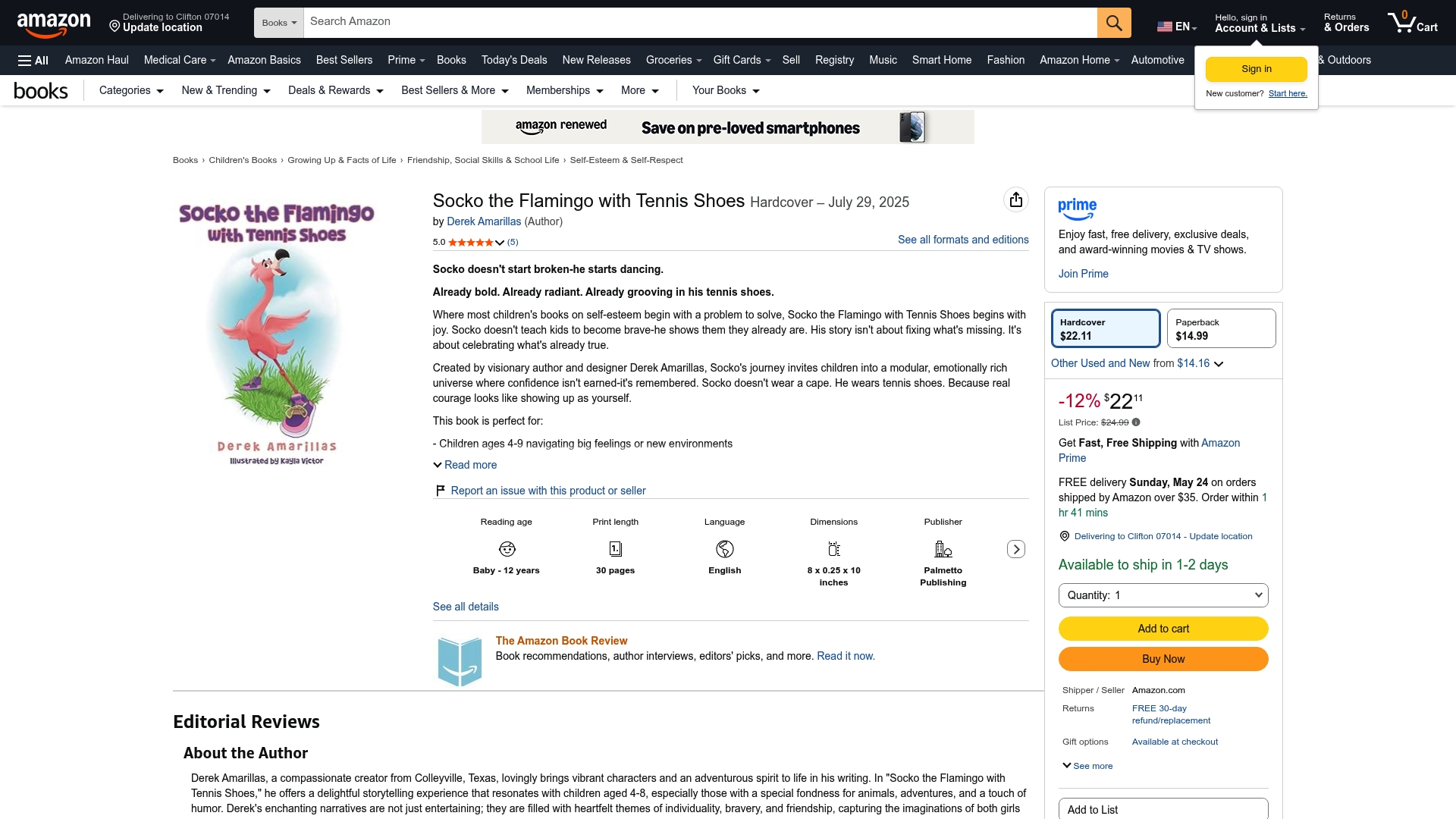
Whether you are stocking a classroom library, building a home reading corner, or looking for a gift that genuinely supports a child's emotional development, you can find Socko's books and explore titles designed to spark real conversations about big feelings and identity. These are books worth reading twice.
FAQ
What makes a good SEL book for young children?
A good SEL book integrates a specific competency through its plot and characters, uses age-appropriate language, and includes at least one opportunity for children to practice or reflect on the skill shown. Theme integration, not just theme presence, is the key quality indicator.
How many times should you read an SEL book before selecting it?
Read it twice: once for the emotional arc and overall narrative, and a second time specifically to identify SEL skill mechanisms such as coping strategies, emotional language, and practice prompts. The second read reveals quality details the first pass misses.
What criteria for SEL book quality matter most?
The strongest criteria are theme integration depth, character development, developmental appropriateness for the target age, cultural authenticity, and the presence of embedded practice opportunities aligned with emotional story moments.
Do SEL-labeled books always improve children's outcomes?
No. Research confirms that effectiveness varies based on intervention quality and how books are used, not just their label. Careful evaluation using a rubric is the only reliable way to separate effective titles from superficially labeled ones.
How do you evaluate cultural sensitivity in an SEL book?
Check whether a character's cultural identity genuinely shapes their emotional experience and coping responses, not just their appearance. Cultural authenticity means the story's emotional logic reflects the character's specific background in a meaningful and plausible way.