
An SEL book club for kids is a structured group reading experience designed to build social and emotional skills through story, discussion, and play. Children ages 3–8 are at a critical window for developing empathy, self-regulation, and communication. When you create an SEL book club for kids, you give them a safe space to practice those skills without a test at the end. The CASEL framework, which defines five core social-emotional competencies, provides the strongest foundation for this kind of program. Add child-led routines, rotating roles, and creative activities, and you have a format that keeps young readers coming back.
How to create an SEL book club kids will actually want to attend

The single biggest mistake adults make with children's book clubs is running them like a classroom. A predictable, child-led routine is the fix. Kid-led routines reduce anxiety and keep young children focused on meaning and feelings rather than uncertainty. When kids know exactly what comes next, they stop worrying about being called on and start actually engaging with the story.
The most effective meeting structure runs 30–40 minutes and follows three clear beats:
- Best line or weirdest moment (5 minutes). Each child shares one line or moment from the book that surprised or delighted them. No wrong answers exist here. This opener signals immediately that the club is a judgment-free zone.
- Kid-led questions (15 minutes). Every child brings two questions to the meeting. They ask, not the adult. This single shift transfers ownership from the facilitator to the group and builds communication skills in real time.
- Creative segment (10 minutes). The group does something with the book rather than just talking about it. Fan casting, alternate endings, or drawing a scene all count. Creative responses replace comprehension questions and prevent the discussion from feeling like a quiz.
Pro Tip: Assign rotating roles before each meeting. Titles like "Story Map Maker" or "Slang Detective" give shy children a defined job that does not require them to speak spontaneously. The role does the talking for them.
For children who are still hesitant, pair them with a more confident peer for the question segment. Predictability in the routine is the scaffolding. Once kids trust the structure, participation follows naturally.
How do the five CASEL competencies fit into a kids book club?
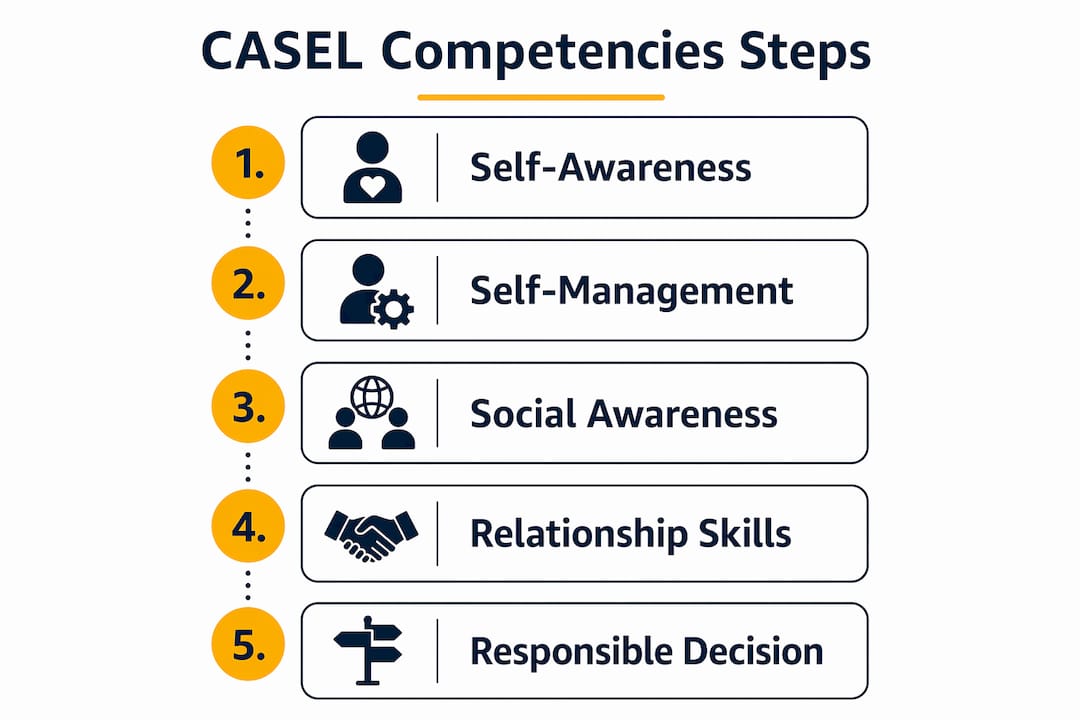
The CASEL framework defines five competencies that cover the full range of social and emotional development: self-awareness, self-management, social awareness, relationship skills, and responsible decision-making. Each one maps directly onto book club activities without any extra planning.
- Self-awareness. Ask children to name the emotion a character feels in a specific scene. Books with expressive illustrations, like those featuring characters dealing with embarrassment or excitement, make this concrete for ages 3–5.
- Self-management. Use a talking stick or visual timer during discussions. Visual and physical reminders help children wait their turn and follow multi-step routines without adult prompting at every step.
- Social awareness. Role-play a scene from the book from a different character's point of view. This is one of the fastest ways to build empathy in children ages 6–8 because it requires them to hold two perspectives at once.
- Relationship skills. Rotating leadership roles like "Meeting Host" or "Question Keeper" put relationship skills into practice rather than just discussion. Practiced behaviors build competency faster than talking about them ever will.
- Responsible decision-making. Present a dilemma from the story and ask the group to vote on what the character should do. Debriefing the vote teaches children to weigh options and consider consequences.
Programs like Zippy's Friends, which is anchored in CASEL competencies, show measurable gains in self-regulation when stories and interactive activities work together. Your book club does not need a formal curriculum to get similar results. Consistent, intentional activities tied to the five competencies are enough.
Pro Tip: Post a simple one-page visual of the five competencies near the meeting space. Children as young as 5 can learn to name which skill they practiced after each session. That reflection step doubles the learning.
What kinds of books and activities work best for SEL reading programs?
Book selection is where many well-meaning clubs go wrong. The best SEL books for kids ages 3–8 center on emotions, relationships, or decisions. They feature characters who face recognizable problems and do not always get it right the first time. Imperfect characters teach more than perfect ones.
Criteria for a strong SEL book club pick:
- The main character experiences a clear emotion the child can name.
- The story shows a problem being solved through communication or empathy, not just luck.
- The illustrations carry emotional information, which matters for pre-readers ages 3–5.
- The ending leaves room for discussion rather than wrapping everything up neatly.
Mixed reading levels are common in groups that span ages 3–8. The solution is simple: read the book aloud before the meeting, or use an audio version. Removing forced oral reading lowers performance anxiety and keeps struggling readers fully engaged in the discussion. The Squidge's Treasure Chest Book Club, designed for ages 6–8, uses trivia, vocabulary games, crafts, and group reflection without any required reading aloud. That model works.
| Activity type | SEL competency targeted | Best age range |
|---|---|---|
| Alternate ending writing or drawing | Responsible decision-making | 5–8 |
| Character emotion charades | Self-awareness | 3–6 |
| Role-play a scene | Social awareness, empathy | 5–8 |
| Talking stick discussion | Self-management, relationship skills | 4–8 |
| Fan casting with pictures | Creative expression, communication | 6–8 |
Crafts and games tied to the book's theme work especially well for ages 3–5, who need movement and hands-on activity to stay regulated. A simple craft, like making a paper mask of a character's emotion, gives younger children a physical anchor for the abstract concept of feelings.
Practical steps to start and sustain a kids book group
Starting is easier than sustaining. Most children's book clubs lose momentum after the third or fourth meeting. The clubs that last share three habits: clear expectations from day one, consistent routines, and adult support that stays in the background.
- Set expectations in the first meeting. Explain the three-part structure and the rotating roles. Let children help name the roles. Ownership of the format increases buy-in immediately.
- Use visual aids from the start. A simple poster showing the meeting flow, a talking stick, and a feelings chart on the wall give children the tools to self-regulate independently. Early self-regulation skills predict later academic and social success, so building them now pays forward.
- Involve parents and caregivers. Send a one-page summary after each meeting. Include the book title, the SEL skill practiced, and one conversation starter for home. This extends the learning beyond the club and keeps families connected.
- Troubleshoot low participation early. If a child stops contributing, check the role assignment first. A child who is quiet during open discussion often thrives when given a specific job. Adjust before assuming disinterest.
- Schedule for consistency, not frequency. A monthly meeting that always happens is more valuable than a weekly meeting that gets canceled. Predictability in scheduling mirrors the predictability in the routine itself.
For age-appropriate communication strategies that support how you frame discussions for different developmental stages, matching your language to the child's level makes every activity land better.
Key takeaways
A child-led SEL book club built on the CASEL framework, predictable routines, and creative activities gives children ages 3–8 the safest and most effective environment to practice social and emotional skills.
| Point | Details |
|---|---|
| Use a three-part routine | Structure meetings as best line, kid-led questions, and a creative segment to reduce anxiety. |
| Embed all five CASEL competencies | Map each activity to self-awareness, self-management, social awareness, relationship skills, or decision-making. |
| Remove forced oral reading | Let children engage through discussion and creative tasks, not performance, to include all reading levels. |
| Assign rotating roles | Titles like Story Map Maker give shy children a defined job that builds confidence without pressure. |
| Sustain with visual aids and parent updates | Talking sticks, feelings charts, and weekly summaries keep children regulated and families engaged. |
What running these clubs actually taught me
The first time I watched a six-year-old run a book club question round, I realized the adult's job is mostly to get out of the way. Children this age are far more capable of leading a conversation than most adults give them credit for. The structure does the heavy lifting. Your job is to set it up and then trust it.
The clubs that struggle are almost always the ones where the adult keeps jumping in to correct or redirect. Silence feels uncomfortable, so facilitators fill it. Resist that. A five-second pause after a child's question is not dead air. It is thinking time, and thinking time is where SEL actually happens.
One thing I would tell every parent or teacher starting out: do not wait until you have the perfect book list or the perfect space. A rug, a talking stick, and one good picture book are enough. The magic is in the repetition of the routine, not the production value of the meeting. Children who attend consistently, even imperfect meetings, build real skills over time.
The other underrated move is letting children pick the books at least some of the time. When a child chooses the story, they arrive at the meeting already invested. That investment is worth more than any carefully curated SEL curriculum. Blend structure with flexibility, and the club will outlast your expectations.
— Derek
Books and resources to get your SEL book club started
A, the brand behind Socko the Flamingo with Tennis Shoes, creates picture books built specifically for conversations about big feelings, belonging, and self-acceptance. Socko's stories give children ages 3–8 a character who is funny, relatable, and genuinely different, which makes the emotional discussions feel natural rather than forced.

If you are building out your SEL reading program for kids, Socko the Flamingo with Tennis Shoes is a strong first pick for your club's opening session. The book's humor lowers the emotional stakes while the story opens the door to real talk about identity and belonging. You can find it along with additional resources on Amazon. Pair the book with the three-part meeting structure above and you have a complete first session ready to run.
FAQ
What is an SEL book club for kids?
An SEL book club for kids is a structured group where children read and discuss books that build social and emotional skills like empathy, self-regulation, and communication. It uses the CASEL framework as a guide and replaces traditional comprehension questions with creative, child-led activities.
What age is best for starting a kids book group?
Children as young as 3 can participate in a picture-book-based SEL club with adult support. Ages 5–8 handle the kid-led question format most independently, though the three-part routine works across the full 3–8 range with minor adjustments.
How do you reduce anxiety in a children's book club?
Predictable routines and removing forced oral reading are the two most effective anxiety reducers. When children know the meeting structure and are never put on the spot to read aloud, participation increases across all confidence levels.
How often should a kids book club meet?
Monthly meetings that happen consistently outperform weekly meetings that get canceled. Consistency in scheduling reinforces the same self-regulation benefits as consistency in the meeting routine itself.
Which CASEL competency is easiest to start with?
Self-awareness is the most accessible starting point for ages 3–8 because it connects directly to naming emotions in story characters. Activities like emotion charades or pointing to a feelings chart require no reading ability and work immediately in a first session.