
Selection criteria for SEL books are defined standards that help parents, educators, and librarians choose children's books that effectively build social and emotional skills. When you apply what are selection criteria SEL books frameworks to your collection, you filter out titles that look good on the surface but fail to deliver real emotional learning. The strongest criteria draw from CASEL's five core competency domains, developmental research, and culturally responsive evaluation methods. Frameworks like the Indianapolis Public Library's materials selection policy and CASEL's SEL Program Guide show that documented selection criteria reduce bias and build skill-aligned collections.
What are selection criteria for SEL books?
Selection criteria for SEL books are a structured set of standards used to evaluate whether a children's book genuinely supports social-emotional development. They go beyond "this book is about feelings" to ask whether the content aligns with recognized competency frameworks, suits the child's developmental stage, and works in the setting where it will be used.
The foundation of any strong SEL book selection process is alignment with CASEL's five competencies: self-awareness, self-management, social awareness, relationship skills, and responsible decision-making. A book about a child managing frustration maps to self-management. A story about a character recognizing a friend's sadness maps to social awareness. Without this mapping, you end up with a shelf of "feelings books" that overlap in theme and leave skill gaps.
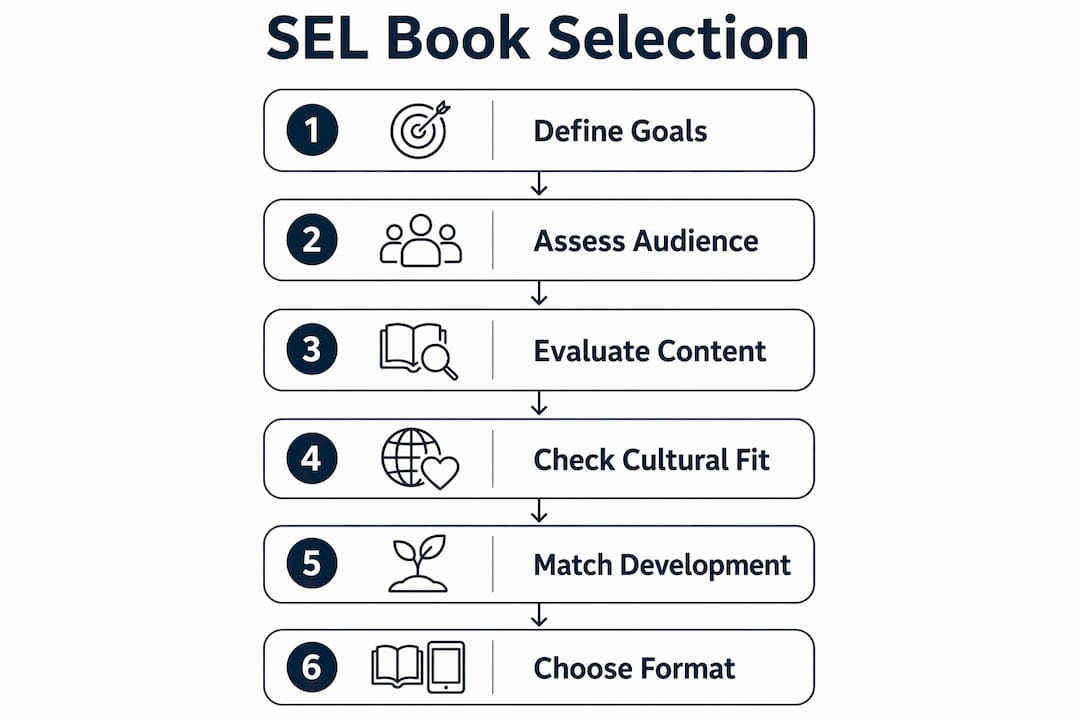
The core categories of SEL book selection criteria include:
- CASEL competency alignment: Does the book target a specific, named social-emotional skill?
- Developmental appropriateness: Is the text complexity and emotional concept suited to ages 3 to 8?
- Author and publisher credibility: Is the content grounded in child development research or professional expertise?
- Cultural responsiveness: Does the book represent diverse identities with dignity, not as teaching props?
- Format and usability: Is the book durable, accessible, and practical for classroom, library, or home use?
- Currency: Does the content reflect current understanding of emotional health and inclusive norms?
Pro Tip: Build a one-page checklist from these six categories before you walk into a bookstore or browse online. Scoring each title against the same rubric takes under five minutes and prevents impulse selections that duplicate themes you already own.
Library selection checklists confirm that purpose, audience fit, author credibility, timeliness, and format suitability are the non-negotiable pillars of any quality collection. For SEL books specifically, these pillars translate directly into skill-building outcomes for children aged 3 to 8.
How do cultural responsiveness and equity influence SEL book selection?
Cultural responsiveness is not a bonus criterion. It is a core filter that determines whether a book is emotionally safe for every child in your classroom or library. A book that teaches empathy while centering only one cultural experience of emotion sends a quiet but powerful message to children who do not see themselves in the story.
Culturally responsive SEL book selection requires evaluating who the story comforts versus who it corrects. If the child who looks different from the main character is always the one learning a lesson while the dominant-culture character models the "right" behavior, the book reinforces hierarchy rather than belonging. This is a structural problem, not a surface one, and it requires a repeatable preview lens rather than a one-time gut check.
Use these four questions as your equity preview lens for every SEL title:
- Who gets comforted and who gets corrected? Track which characters receive empathy from adults in the story and which receive redirection or shame.
- How do adults respond to children's emotions? Problem-solving responses build safety. Shame-based responses teach children to hide feelings rather than name them.
- Are language and dialect portrayed with respect? Non-standard dialects and non-English phrases should appear as assets, not as markers of deficiency.
- How is conflict resolved? Resolution methods reflect cultural values. A book that treats one resolution style as universally correct erases the validity of other approaches.
"Judging SEL books solely on overt teaching misses subtle emotional norms in stories, highlighting the importance of equity-focused preview criteria including comfort versus shame dynamics." (Culturally Responsive SEL Book Preview)
Pro Tip: Apply this four-question lens to every new title you consider, not just books that appear to address diversity. Emotional norms are embedded in all stories, including those featuring animals or fantasy characters.
The goal is a collection where every child sees their emotional experience as valid and recognized. That outcome requires repeated critical appraisal, not a one-time diversity audit.

Matching SEL books to developmental stages and real use cases
Choosing a book with the right emotional theme is only half the work. The book also needs to match where children actually are in their emotional development, and it needs to fit the specific moment you plan to use it.
Age-based developmental matching
Basic emotional concepts with expressive illustrations suit children aged 3 to 4, who are just beginning to name feelings. Clear, simple themes and explicit emotion-labeling work best for ages 4 to 7, when children are building vocabulary for internal states. By age 7 to 8, children can engage with more nuanced stories involving perspective-taking and conflict resolution across relationships. Selecting a book pitched above or below a child's emotional skill level reduces engagement and limits the conversation you can build around it.
Mapping books to CASEL skill domains and use moments
The most practical approach is to map each title you own or consider to a specific CASEL competency and a specific use moment. A use moment is the real-world situation where you will read the book: morning meeting, a conflict debrief, a transition routine, or a one-on-one check-in. This prevents the common problem of owning fifteen books about anger and nothing about friendship repair.
Consider these practical selection factors:
- Reusability: A high-utility book works across multiple use moments and discussions, not just one scenario. Small collections benefit from titles that can be reused in different contexts rather than one book per unique challenge.
- Text-to-illustration balance: For ages 3 to 5, illustrations carry most of the emotional meaning. Choose books where the art independently communicates the feeling being taught.
- Discussion scaffolding: The best SEL books include natural pause points where you can ask "What do you think she's feeling right now?" without interrupting the narrative flow.
- Format durability: Board books for preschool settings, paperback for home libraries, and hardcover for classroom shelves that see daily use.
- Accessibility: Consider large print, bilingual editions, and audio companion options for diverse learners.
| CASEL competency | Developmental focus (ages 3-8) | Ideal use moment |
|---|---|---|
| Self-awareness | Naming and identifying emotions | Morning meeting, check-in |
| Self-management | Calming strategies, impulse control | After conflict, transition time |
| Social awareness | Perspective-taking, empathy | Group discussion, read-aloud |
| Relationship skills | Sharing, communication, repair | Conflict debrief, partner work |
| Responsible decision-making | Consequences, problem-solving | Classroom meeting, one-on-one |
How do library policies and SEL program standards compare?
Formal library selection policies and school SEL program standards approach book selection from different angles, but they share more overlap than most educators realize. Understanding both helps you build a collection that satisfies institutional requirements and instructional goals at the same time.
| Criterion | Library selection policy | SEL program standard |
|---|---|---|
| Relevance | Subject fits collection scope and community need | Book targets a named CASEL competency |
| Authority | Author or publisher has recognized expertise | Content grounded in child development research |
| Currency | Content reflects current knowledge | Emotional norms align with contemporary SEL research |
| Demand | Community interest and programming support | Teacher or parent usability in real settings |
| Accessibility | Age-appropriate shelving and format options | Diverse learner formats, bilingual editions |
| Equity | Representation across identities and experiences | Culturally responsive emotional norms |
Public library selection policies emphasize age and developmental appropriateness for children's materials, authoritative content, currency, demand, and gap-filling within the collection. SEL program standards from frameworks like CASEL add implementation feasibility as a distinct criterion, recognizing that a book's instructional value depends on whether educators can actually use it in their setting.
Written selection policies matter because they create consistency across selectors and over time. When a librarian, a classroom teacher, and a parent coordinator all use the same documented criteria, the collection grows in a coherent direction rather than reflecting whoever made the last purchase. Pre-set selection criteria reduce subjective bias and ensure that every title earns its place based on skill alignment, not personal preference.
One area where the two frameworks diverge is self-published and newer format titles. Library policies typically apply closer scrutiny to self-published works, requiring stronger evidence of quality and demand. SEL program standards focus more on content alignment and usability, which means a well-researched self-published SEL title can score well on program criteria even if it faces higher barriers in formal library acquisition.
Key takeaways
Strong SEL book selection requires aligning titles to CASEL competencies, developmental stages, and culturally responsive equity standards before any book earns a place in your collection.
| Point | Details |
|---|---|
| CASEL competency alignment | Map every book to a specific skill domain to avoid theme overlap and skill gaps. |
| Developmental matching | Choose text complexity and emotional concepts suited to children aged 3 to 8 by stage. |
| Cultural responsiveness | Evaluate who gets comforted versus corrected in each story using a repeatable preview lens. |
| Policy-based consistency | Use documented selection criteria to reduce bias and build a coherent, skill-aligned collection. |
| Reusability over volume | Prioritize high-utility titles that work across multiple use moments rather than single-scenario books. |
Why I think most SEL collections are built backwards
Most educators and librarians I talk to start with a list of recommended titles and work backward to justify why each book belongs. That approach produces collections that are wide but shallow. You end up with books that cover the same three emotions from slightly different angles and nothing that addresses the harder relational skills like conflict repair or perspective-taking under stress.
The approach that actually works is to start with your CASEL competency map and your specific use moments, then find books that fill the gaps. A focused collection of fifteen titles that each serve a distinct skill and a distinct moment outperforms a shelf of fifty books with overlapping themes. Effective SEL selection maps each book to a targeted skill and a specific practical use case. That principle sounds obvious until you audit a real collection and find six books about anger and nothing about friendship repair.
The cultural responsiveness piece is where I see the most well-intentioned mistakes. Educators add books featuring characters of diverse backgrounds and consider the equity work done. But surface representation without evaluating the emotional norms embedded in the story can actually reinforce the idea that certain children's emotional responses need more correction than others. The preview lens questions are not optional extras. They are the difference between a collection that builds belonging and one that quietly undermines it.
Update your criteria annually. SEL research moves, cultural norms shift, and the children in your care change. A selection policy that was current three years ago may now reflect outdated assumptions about emotional expression or conflict resolution. Treat your criteria as a living document, not a one-time setup.
— Derek
Find SEL books that meet every criterion
A has built its picture-book world around exactly the standards described in this article. Socko the Flamingo with Tennis Shoes teaches emotional literacy, belonging, and self-acceptance through humor and imagination, hitting CASEL competencies in self-awareness and social awareness while keeping the tone genuinely fun for children aged 3 to 8.
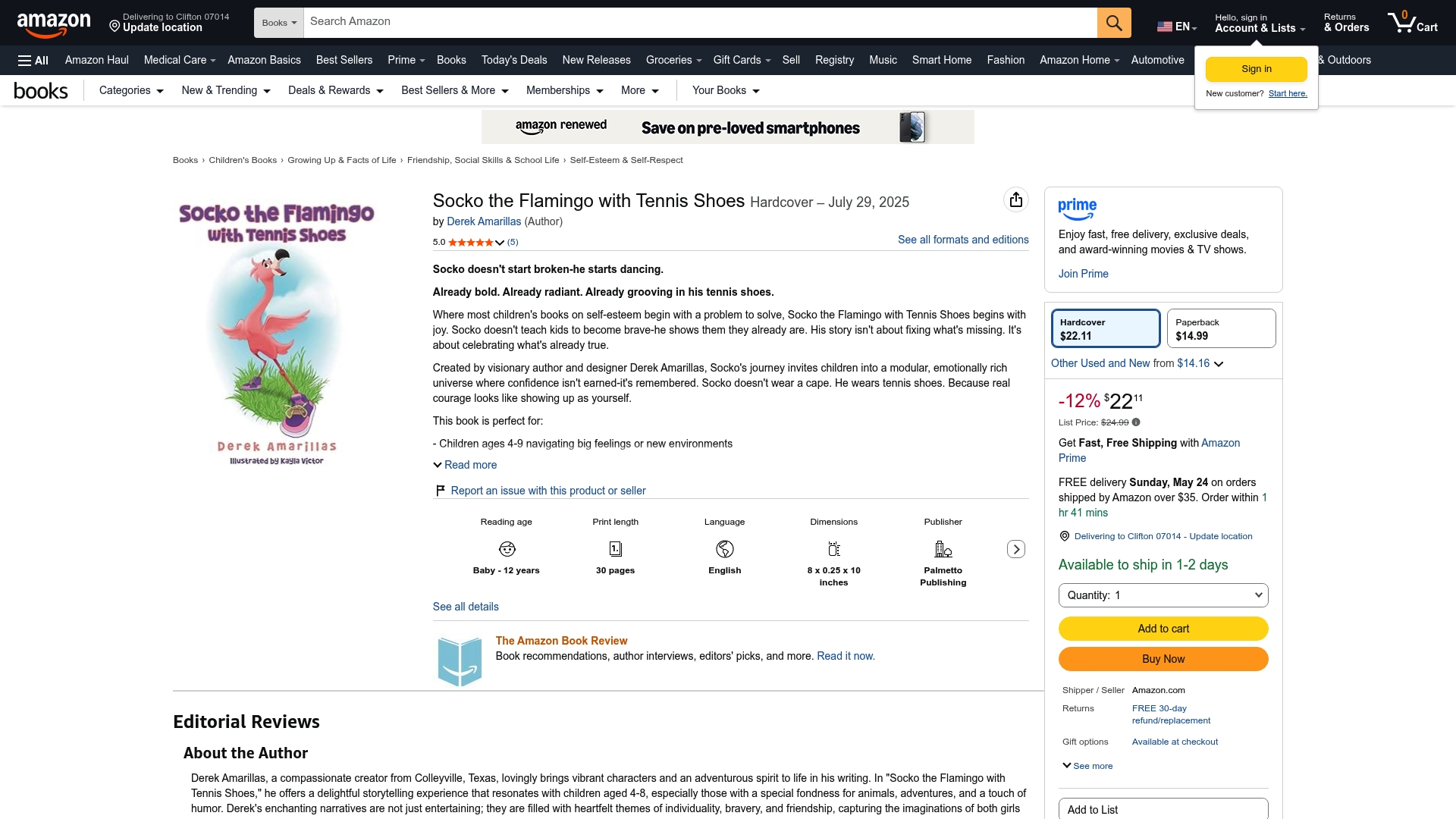
If you are ready to apply these SEL book selection guidelines to a real purchase, Amazon offers the widest range of titles with customer reviews, age-range labels, and detailed product descriptions that make it easy to cross-check each book against your criteria before you buy. You can browse SEL titles and filter by age range, theme, and format to build a collection that actually covers the full CASEL competency map. Use the criteria in this article as your checklist and you will spend less time second-guessing and more time reading.
FAQ
What are the main selection criteria for SEL books?
The main criteria are CASEL competency alignment, developmental appropriateness for the target age group, author credibility, cultural responsiveness, and format usability. Library selection policies add relevance, currency, and demand as additional filters for building quality collections.
How do I know if an SEL book is developmentally appropriate for ages 3 to 8?
Match text complexity and emotional concept to the child's stage: expressive illustrations with simple emotion-naming for ages 3 to 4, and clear themes with explicit labeling for ages 4 to 7. Developmental research shows that books pitched above a child's emotional skill level reduce engagement and limit discussion.
Why does cultural responsiveness matter in SEL book selection?
Cultural responsiveness determines whether a book is emotionally safe for every child, not just the majority. Equity-focused preview criteria reveal hidden emotional norms, including who gets comforted versus corrected, that surface-level diversity checks miss entirely.
How many SEL books does a classroom or library collection need?
A focused collection of fifteen to twenty titles that each map to a distinct CASEL competency and use moment outperforms a larger collection with overlapping themes. High-utility titles reused across multiple situations deliver more learning retention than single-scenario books.
Should self-published SEL books be held to different standards?
Self-published SEL titles warrant closer evaluation of author credentials and content accuracy, as formal library policies apply stricter scrutiny to works without traditional publisher vetting. Apply the same CASEL alignment and cultural responsiveness criteria you would use for any title, and look for evidence of child development expertise in the author's background.