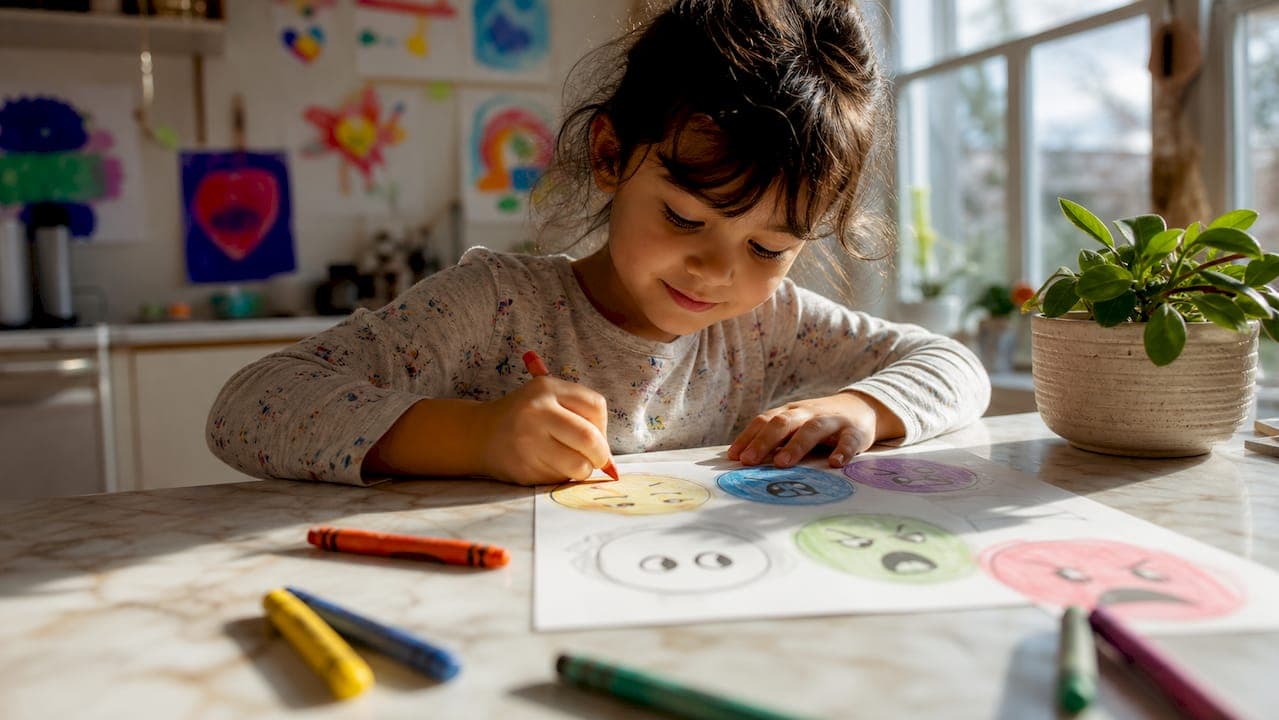
The fastest way to teach a child emotional vocabulary is a ready-to-print set of emotions coloring pages that pairs labeled faces with diverse characters and simple discussion prompts. Icon Literary's printable emotional-literacy pack fits that need directly: it spans 20 pages, covers ages 3 to 8, and includes core feelings like happy, sad, angry, and scared alongside broader words like calm and jealous. Download the PDF, print it on standard paper, and you're ready to start a conversation in minutes.
TL;DR:
- Using simple, labeled emotion pages tailored for ages 3 to 8 helps children recognize feelings quickly through clear facial expressions and minimal detail.
- Pairing coloring activities with direct, age-appropriate questions during engagement enhances emotional vocabulary and self-awareness.
- Selecting pages with bold outlines for toddlers or scenes with context and nuanced words for older children ensures age-appropriate learning.
- Customizing pages around specific feelings or classroom moments can deepen understanding and personalize emotional literacy lessons.
- Small, consistent practices, such as pulling out a single emotion page during moments of difficulty, are more effective than complex lesson plans.
Table of Contents
- Where To Download Emotions Coloring Pages Right Now
- How To Turn Coloring Time Into an Emotional Literacy Lesson
- Matching the Design to Your Child's Age and Goal
- Printing Tips That Save Ink and Paper
- Why Icon Literary Designs Emotion Pages the Way We Do
- Make Your Own: Customizing Emotions Coloring Pages
- Beyond the Crayons: Activities That Deepen Emotional Understanding
- The Psychological Case for Coloring as Emotional Expression
- Talking to Kids About Feelings Without It Feeling Forced
- Get Icon Literary's Emotions Printable Pack Today
- Where Else To Find Free Emotion Pages
- A Final Word on Starting Small
- Sources
Where To Download Emotions Coloring Pages Right Now
You don't need to hunt for hours. Icon Literary's downloadable pack was built specifically for the 3 to 8 age range, with line weights that scale from bold single faces for toddlers to more detailed scenes for kindergartners and early readers. Every page comes with a suggested prompt, so a parent or teacher isn't left guessing how to start the conversation.
Beyond that pack, a handful of source types consistently deliver quality free material:
- Public-broadcaster worksheets: Sites like PBS Parents publish click-to-print "draw your feelings" activities designed for home and classroom use, no sign-up required.
- Educator and creator blogs: Many independent sites offer free PDF sets sized for US Letter and compatible with A4, typically running 15 to 36 pages per collection.
- Established art brands: Crayola's emotion-themed pages lean into character-driven scenes that pair naturally with storytelling.
Across these sources, expect single-page PDF downloads. Most print cleanly at standard letter size, and file sizes stay small enough to email to a classroom list or drop into a shared drive without complaint.
How To Turn Coloring Time Into an Emotional Literacy Lesson
A blank feelings face means nothing until you attach language to it. The activity that works best is simple enough for a 3-year-old and flexible enough for a classroom of 25.
- Pick one page and one word. Show the child the face before they color it and name the emotion out loud together.
- Ask a grounding question. "When did you feel this way today?" works for a 5-year-old; "What does your body do when you feel this?" works better for a toddler who doesn't yet have the words for memory recall.
- Color while talking, not after. The conversation should happen during the activity, not as a debrief once the crayons are put away.
- Share or display. In a classroom, a quick partner share or a spot on the mood chart turns an individual activity into a group habit.
For toddlers, keep the prompts concrete: "Show me your angry face" works better than abstract questions about causes. Early-elementary kids can handle "why" questions and can compare two emotions on the same page. Therapists and counselors often adapt the same pages for one-on-one sessions, using the coloring itself as a low-pressure way to open dialogue without demanding direct eye contact or verbal answers up front.
Pro Tip: Pair the coloring activity with a two-minute calm-down technique, like slow breathing or a "5-4-3-2-1" senses check, right after the child names a harder emotion like angry or scared. The pairing teaches kids that naming a feeling isn't the end goal. It's a step toward managing it.
Matching the Design to Your Child's Age and Goal
Not every emotions coloring page serves the same purpose, and picking the wrong complexity level can undercut the lesson before it starts. A toddler staring at a six-panel scene with subtle facial cues will disengage fast. A second grader handed a single giant smiley face will find it boring.
For toddlers and preschoolers, look for:
- Bold outlines and a single face per page, nothing competing for attention
- High contrast between features so expressions read instantly
- Three to five starter emotions rather than a full vocabulary set
For early-elementary kids, look for:
- Scenes with context (a child dropping ice cream, a kid opening a gift) rather than isolated faces
- Nuanced emotion words like frustrated, proud, or nervous mixed in with the basics
- Optional labeled words, useful for early readers but worth skipping if the goal is pure visual recognition
Labeling matters more than it seems. A labeled word next to a face turns the page into a matching exercise, which is great for vocabulary building but can shortcut the harder work of reading facial cues independently. For inclusion, prioritize sets with a range of skin tones, hairstyles, and abilities represented, and avoid pages with cluttered backgrounds or overwhelming detail if you're working with a sensory-sensitive child.
Printing Tips That Save Ink and Paper
Getting a page from screen to table shouldn't be complicated. Set your printer to "actual size" or 100% scaling rather than "fit to page," which can distort line weight on detailed designs. Most sets print cleanly on US Letter, and the leading free PDF collections are already built for both US Letter and A4, so international classrooms don't need to reformat anything.
A few habits stretch a single set much further:
- Laminate your favorite pages and reuse them daily with dry-erase markers for quick mood check-ins
- Print in draft or grayscale mode when ink is tight; bold outline designs hold up fine without full color
- Use tablet or touchscreen coloring apps for a no-print option during travel or waiting rooms
- Choose designs with thick, easy-grip coloring zones for younger children still developing fine motor control
Why Icon Literary Designs Emotion Pages the Way We Do
Every design choice in an emotional-literacy printable is a trade-off. Simplicity helps a toddler recognize an emotion in half a second. Nuance helps an 8-year-old build a vocabulary that actually matches the complexity of what they feel.
We start with five or six core faces, drawn with strong, contrasting expressions, because a 3-year-old needs instant recognition before they need vocabulary. From there, we layer in words like frustrated, proud, or nervous over time, so the same child at seven is working with a richer emotional language than they had at three. Representation isn't an afterthought either. If a child never sees a face that looks like theirs on the page, the lesson lands differently.
That progression mirrors how vocabulary naturally expands in early childhood: a handful of strong, contrasting expressions first, then ten to fifteen nuanced terms added gradually over the following years. It's also why our pack pairs each page with a short prompt rather than leaving the sheet to speak for itself.
Make Your Own: Customizing Emotions Coloring Pages
Store-bought and downloadable sets cover most needs, but there's real value in building a page around a specific child or classroom moment. If a student is struggling with a particular feeling, like jealousy after a sibling's birthday, a custom page built around that exact scenario lands harder than a generic printable ever could.

Start simple: draw a basic face outline, or trace one from an existing page, and leave the expression blank for the child to fill in themselves based on how they say they feel. This flips the activity from "identify the emotion I drew" to "show me your own version of angry," which often reveals more about how a child processes feelings than a pre-drawn face ever will.
For classrooms, consider building a rotating set tied to your curriculum calendar. A back-to-school week might focus on nervous and excited, while a unit on friendship might lean into jealous, proud, and disappointed. You can also invite kids to co-create pages, sketching their own face shapes or choosing which scene accompanies a given emotion. Older kids can design pages for younger siblings or classmates, which doubles as a lesson in empathy and teaching.
Even small customizations, adding a name, a favorite color scheme, or a familiar setting like a classroom or backyard, make a page feel personal rather than generic, and personal is what sticks.
Beyond the Crayons: Activities That Deepen Emotional Understanding
Coloring pages open the door, but they work best as one piece of a broader emotional literacy routine rather than a standalone fix. Pairing them with other activities reinforces the same vocabulary through different channels, which helps it actually stick.
Reading picture books that center a character's emotional journey gives kids a narrative version of the same lessons a coloring page teaches in isolation. A story where a character feels left out and works through it models both the feeling and a path forward, something a single static image can't fully capture. Role-play is another strong pairing: acting out a scenario where a toy gets broken or a friend says something hurtful lets kids practice the words in a low-stakes setting.
Simple physical tools help too. A DIY emotion wheel, a mirror for practicing facial expressions, or a "feelings jar" where kids draw a random emotion to discuss at dinner all extend the same core skill. For families or classrooms working with a therapist, visual and interactive tools like Therapy Canvas can structure these conversations further, especially for kids who need a more guided format than open-ended coloring provides.
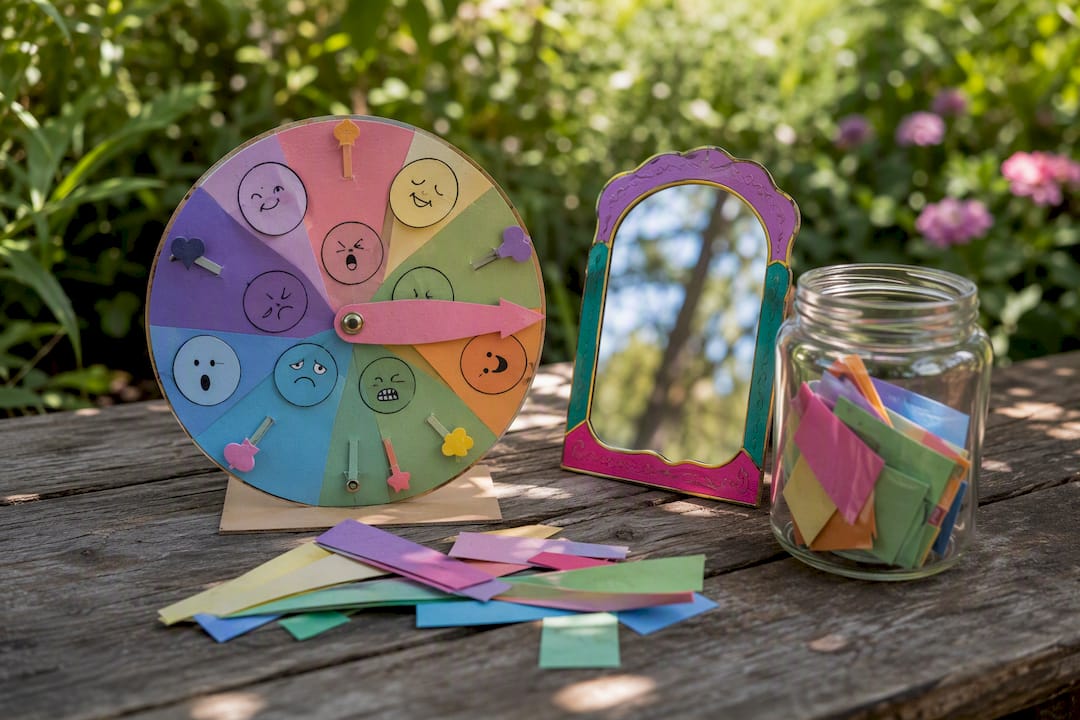
Music and movement also count. Songs about feelings, or simple movement games where kids physically act out an emotion, activate different learning pathways than a seated coloring activity. None of these replace the coloring page. They build on it.
The Psychological Case for Coloring as Emotional Expression
There's a reason coloring shows up so often in therapy offices and classrooms alike: it gives a child something to do with their hands while their mind works through something harder to say out loud. For a kid who doesn't yet have the vocabulary to explain why they're upset, a crayon and a face to fill in lowers the pressure considerably compared to a direct question like "why are you angry?"
The activity itself seems to matter, not just the finished picture. Active engagement, actually coloring a face while naming the emotion, appears to help kids connect visual cues to emotion words more effectively than passively looking at a picture and being told what it represents. That's a meaningful distinction for anyone designing a lesson: handing a child a finished picture and explaining it teaches less than handing them a blank face and asking them to bring it to life themselves.
Coloring also offers a built-in regulation function. The repetitive motion of filling in a shape can be genuinely calming, which is part of why so many pages designed for anxiety lean into that repetitive, low-stakes structure rather than demanding fast decisions or complex fine motor work. A child who's dysregulated doesn't need a complicated art project. They need something simple enough to do without thinking, while a calmer adult sits nearby asking easy questions.
None of this makes coloring a substitute for professional support when a child is genuinely struggling. It works as a daily, low-cost tool for building the vocabulary and self-awareness that make bigger conversations easier down the road.
Talking to Kids About Feelings Without It Feeling Forced
The coloring page is just the entry point. What you say while a child is coloring matters more than the page itself, and a lot of adults freeze up here because they're worried about saying the wrong thing.
Start with observation, not interrogation. "I noticed you picked red for the angry face" opens a door more gently than "Why are you angry?" which can feel like an accusation to a young child. Follow their lead: if a child wants to talk while coloring, let the conversation happen mid-activity rather than saving it for a formal debrief. If they'd rather color in silence, that's fine too. The activity still does its job.
Avoid correcting a child's answer. If a 6-year-old says they feel "mad" when an adult would call it "disappointed," let the simpler word stand. Vocabulary expands over time, and correcting a child mid-conversation shuts the exchange down faster than almost anything else.
For classrooms, a group mood chart works well as a low-pressure entry point: each child colors a face that matches how they feel that morning and adds it to a shared display. No one has to explain their choice unless they want to. That single design choice, optional explanation, removes most of the anxiety kids feel about being put on the spot in front of peers.
Reading a feelings-focused book together before or after a coloring session gives quieter kids a script to borrow from when they don't have their own words yet.
Get Icon Literary's Emotions Printable Pack Today
There are plenty of free worksheets scattered across the internet, and they're worth using. But if you want a set built specifically for a full progression, toddler-friendly faces through nuanced vocabulary for early-elementary kids, without stitching together five different PDFs from five different sites, Icon Literary's pack does that in one download.

The pack includes 20 pages spanning core emotions and broader vocabulary, each with a suggested discussion prompt, and it's designed for the 3 to 8 age range specifically, not stretched thin across every developmental stage at once. Teachers and childcare providers can use a single purchase across a full classroom, which makes it a practical pickup for anyone managing group activities rather than just a single child at home. Pair it with a feelings corner in your classroom and you've got a reusable emotional check-in system that costs nothing extra to run day to day. Visit Icon Literary to download the pack and start your first check-in this week.
Where Else To Find Free Emotion Pages
- PBS Parents offers click-to-print worksheets built for home and classroom use.
- Monday Mandala publishes free PDF sets sized for both US Letter and A4.
- Crayola provides character-driven pages designed to pair with storytelling.
- My Kid Colors lists inclusive sets that scale in complexity across a full collection.
A Final Word on Starting Small
Kids don't need a perfect lesson plan to start building emotional vocabulary. They need one page, one honest question, and an adult willing to sit with whatever answer comes back, even if it's "I don't know." That single practice, repeated a few times a week, does more for a child's emotional development than an occasional elaborate activity ever will.
Try this: keep one emotions coloring page taped inside a kitchen cabinet or a classroom folder, and pull it out for five minutes whenever a feeling comes up that's hard to name. Small and consistent beats big and rare every time.
— Derek Amarillas
Sources
- Emotions Coloring Pages (Free PDF Printables)
- Draw Your Feelings | Kids Coloring Pages
- Colorful Emotions Free Coloring Page