Mood-based organization arranges books by the feelings they evoke rather than by author, genre, or alphabetical order. For luxury collectors, this transforms a shelf from storage into something closer to a self-portrait. The system is intuitive, deeply personal, and far more useful than it sounds when you actually try it. Limiting emotional categories to a small number keeps the whole thing from collapsing under its own nuance.
Table of Contents
- How to organize feelings books into a library display that actually works
- How a hybrid display balances emotion with practical access
- Why the psychology behind emotional curation runs deeper than aesthetics
- Why mental clarity matters more than the right bins or labels
- Best practices for your luxury book library organized by feelings
- Key Takeaways
How to organize feelings books into a library display that actually works
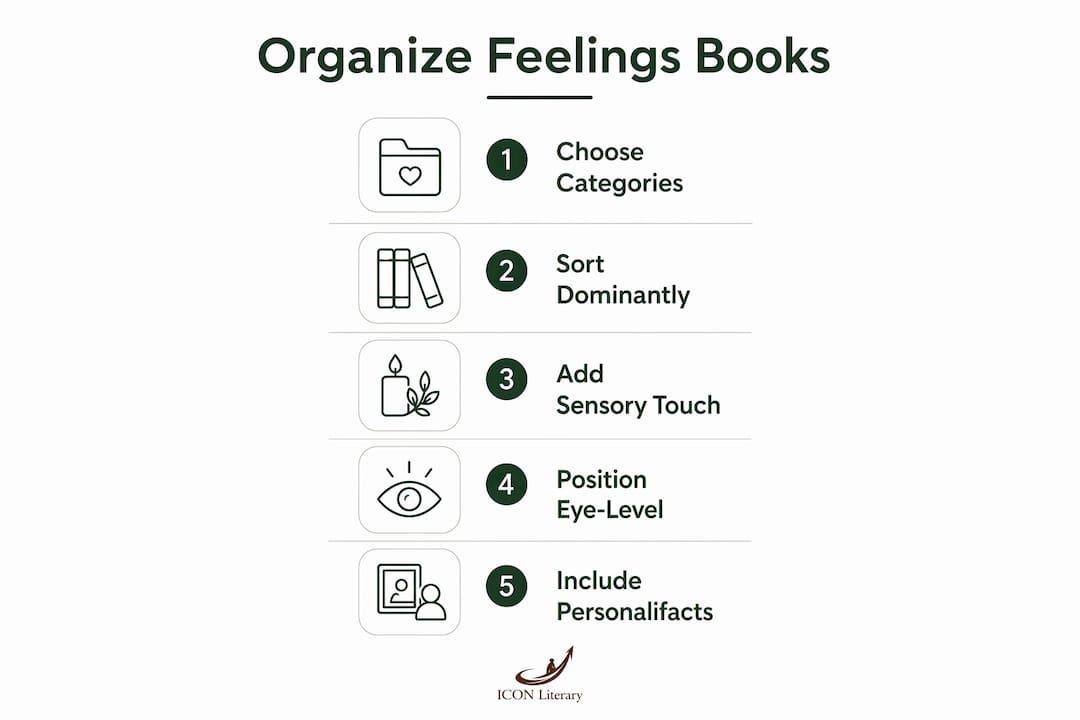
Start by walking your collection without any predetermined categories in mind. Pick up books and ask one question: what does this feel like? Not what genre it belongs to, not whether it won awards. Just the feeling. Let natural clusters form before you name them.
Common emotional categories collectors land on include:
- Comfort reads: Books you return to when you need reassurance, often re-reads
- Brain food: Dense nonfiction that rewards slow attention
- Edge-of-your-seat: Thrillers and page-turners you finish in one sitting
- Beautiful sentences: Kept for the prose itself, regardless of subject
- Light and bright: Fast, funny, undemanding reads for low-energy days
- Heavy and hard: Important, emotionally taxing books you're glad you read
- Rainy day reads: Atmospheric, immersive, slow-burn stories
Your categories will differ. Maybe you have a shelf for "books I want to press into strangers' hands" or "books that got me through something." That specificity is the point. Mood-based organization is deeply subjective, which means no one else can navigate your system, and that's fine for a personal collection.
When a book fits two moods, assign it to the dominant one. Don't agonize. If the decision takes more than thirty seconds, just pick one and move on. The system is supposed to feel intuitive, not exhaustive.

How a hybrid display balances emotion with practical access
Most serious collectors find that a pure mood-only system gets unwieldy past a few hundred volumes. The solution is a hybrid approach: keep the bulk of your collection organized by author or series for easy retrieval, then dedicate specific feature shelves to mood zones.
Here's how to build that structure:
- Keep complete author runs and series together so you can find a specific title without remembering what mood you assigned it
- Designate two or three feature shelves as rotating mood zones, refreshed seasonally or whenever your reading life shifts
- Group signed copies and special editions in their own dedicated spots where they can be seen and appreciated daily
- Rotate seasonal reads to the front as the calendar changes: winter reads in December, atmospheric titles in autumn
Sensory elements do real work in mood zones. Warm, directional lighting on a "comfort reads" shelf signals something different than cool overhead light on a "brain food" section. Scent, though subtle, can anchor a mood zone: cedar or sandalwood near heavier literary titles, something lighter near your bright reads. Color grouping within a mood zone adds visual coherence without sacrificing the emotional logic underneath.
Pro Tip: Position your primary mood feature shelf at eye level. The books you see first are the books you reach for. Placing your most emotionally resonant titles at that height creates a daily encounter with the part of your collection that matters most.
Why the psychology behind emotional curation runs deeper than aesthetics
Organizing by emotion is what Faith Roberson calls soul work: a form of radical self-awareness that asks not just "what do I own?" but "what do I actually need?" When you arrange a shelf by feeling, you're mapping your own emotional life onto a physical space.
Bibliotherapy formalizes this instinct. The concept, explored at Seattle's Oh Hello Again bookstore, holds that reading the right book at the right moment can console and guide people through emotional turbulence. Organizing your personal library by feelings applies the same logic at home: instead of browsing by genre, you browse by what you need right now.
Benefits collectors report from emotional curation include:
- Discovering books they'd forgotten they owned, now visible in a new context
- Breaking rigid browsing habits that kept them returning to the same familiar titles
- Feeling a stronger personal connection to the collection as a whole
- Identifying books kept out of obligation rather than genuine desire
That last point matters. Emotional curation exposes when books are held onto because of an imagined version of yourself rather than your actual reading life. A shelf of dense theory you haven't opened in years might belong in the "aspirational" category or out the door entirely.
Keep your mood categories limited. Too many categories make the distinctions too subtle to maintain as your collection grows.
A bookshelf arranged emotionally also invites serendipitous discovery, placing a children's classic next to literary fiction because both belong to the same feeling. That recontextualization is one of the most underrated pleasures of this approach. You can explore more about emotional literacy in libraries and how institutions apply similar principles at scale.
Why mental clarity matters more than the right bins or labels
The most common mistake collectors make is buying organizational tools before doing the emotional work. Professional organizer and author of Before the Bins, Tiffany Claytor, argues that disorganization stems from overwhelm and emotional attachment, not from a shortage of containers. The bins come last.
Before you touch a single shelf, work through these questions:
- Which books do you reach for repeatedly, and which ones have you avoided for years?
- Are any books here because you feel you should want to read them?
- Does your current collection reflect who you are now, or who you were five years ago?
- Which titles genuinely bring you pleasure when you see their spines?
Small, intentional actions outperform dramatic overhauls. Reorganizing one shelf at a time, rather than pulling everything off every surface at once, keeps the process from becoming another source of overwhelm. The emotional themes cataloging approach used in educational settings applies here too: start with broad categories, then refine.
Personal narrative belongs in the display itself. A small object, a photograph tucked behind a spine, or a handwritten label can anchor a mood zone to a specific memory or period of your life. That kind of storytelling within the physical space turns a library into something genuinely irreplaceable.
Pro Tip: When a book feels hard to categorize, that friction is information. Difficulty placing a title often signals that you've outgrown it, or that it belongs to a version of yourself you're no longer sure you want to curate.
Best practices for your luxury book library organized by feelings
Mood-based organization works best when treated as a living system rather than a one-time project. A few principles hold across every collection:
- Start with 5–7 emotional categories and resist the urge to add more as the collection grows; specificity beyond that threshold becomes impossible to sustain
- Use a hybrid structure so author and series organization handles retrieval while mood zones handle discovery and emotional resonance
- Label sections mentally or with temporary markers so the system can shift as your emotional relationships with books change over time
- Refresh mood shelves seasonally to keep the display alive and aligned with where you actually are, not where you were when you last reorganized
- Prioritize mental preparation before any physical reorganization; clarity about what you want from your collection makes every subsequent decision faster
- Let the display tell your story by incorporating personal objects, rotating featured titles, and allowing the collection to reflect your current reading life rather than an archived one
The benefits of curated emotional displays extend beyond aesthetics. A library organized by feelings becomes a space you actually use, return to, and find comfort in, rather than one you admire from a distance and rarely touch.
Key Takeaways
Mood-based organization works best when collectors limit emotional categories to 5–7, combine them with author-based retrieval in a hybrid structure, and treat mental clarity as the prerequisite for any physical reorganization.
| Point | Details |
|---|---|
| Limit mood categories | Keep emotional categories to 5–7; more than that and distinctions become too subtle to maintain. |
| Use a hybrid structure | Organize the bulk of your collection by author or series, then dedicate feature shelves to mood zones. |
| Mental clarity first | Emotional attachment and overwhelm drive disorganization; address those before buying any organizational tools. |
| Refresh displays seasonally | Rotate mood shelves as your reading life shifts to keep the collection aligned with your current emotional state. |
| Let the system stay personal | Mood assignments are subjective and can change; use flexible or mental labels so the system evolves with you. |
Icon Literary builds emotionally resonant, collectible literary experiences for collectors who believe a shelf should say something. Explore the world of Icon Literary and discover stories designed to be kept, displayed, and felt.