
Start tonight with three books: The Color Monster by Anna Llenas (ages 3–6) for naming emotions through color, When Sophie Gets Angry by Molly Bang (ages 4–8) for watching a child move through rage and back to calm, and Breathe Like a Bear by Kira Willey (ages 3–6) for hands-on calming tools. Read them using dialogic shared reading: pause at emotional moments, point to a character's face, and ask one open question before turning the page.
- The Color Monster — Anna Llenas (ages 3–6): Sorts tangled feelings into colors; perfect first step for labeling.
- When Sophie Gets Angry — Molly Bang (ages 4–8): Shows a full anger arc, from explosion to recovery, without a lecture.
- Breathe Like a Bear — Kira Willey (ages 3–6): Teaches breathing and body-based calming moves kids can practice in the moment.
Pick one, sit down together, and try this tonight: before you open the cover, ask your child, "What do you think this character is feeling right now?" That single question is where emotional literacy begins.
Table of Contents
- Why does reading feelings books together actually help?
- Two types of feelings books every home library needs
- How to run a simple dialogic read-aloud routine
- What prompts work for ages 3–5 vs. 6–8?
- The best read-aloud feelings books for ages 3–8
- Quick follow-up activities to practice what you read
- What to do when a story triggers a big reaction
- Key Takeaways
- The case for slowing down the story
- Icon Literary's emotional story collections
- Sources and suggested further reading
Why does reading feelings books together actually help?
The American Academy of Pediatrics and Reach Out and Read both recommend shared reading of feelings-focused books as a direct path to emotion recognition, empathy, and coping skills. The research behind that recommendation is specific: picture books contain more emotion words than typical child-directed speech, so a read-aloud session exposes children to vocabulary they simply won't hear in everyday conversation. An ERIC-indexed study on emotion vocabulary development found that instruction during shared book reading supports children's ability to label, discuss, and regulate feelings.
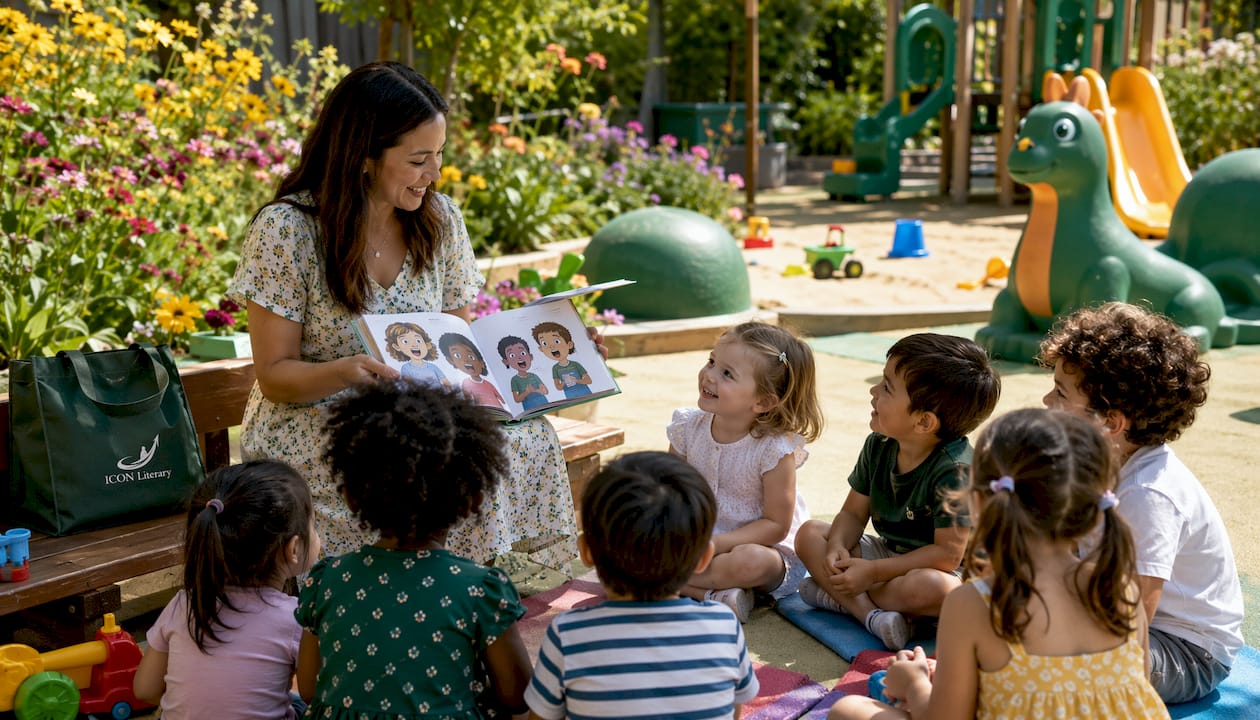
A longitudinal study in Italian preschools found significant improvements in emotion comprehension scores across two consecutive years of shared reading aloud, with gains in both emotional and language skills. Scholastic research adds a practical data point: 90% of parents agree books create opportunities for conversation, and 31% of children say a book has specifically helped them understand their feelings. What caregivers can expect to see over weeks of consistent reading: more words for emotions, a greater ability to name what a character (or they themselves) are feeling, and early signs of perspective-taking.
The benefits of reading emotional books extend beyond vocabulary. When a child watches Sophie rage and then recover, they are rehearsing emotional regulation in a low-stakes setting. The story does the heavy lifting; you just have to pause and ask.
Two types of feelings books every home library needs
Feelings books fall into two practical categories, and mixing both is what builds complete emotional literacy.
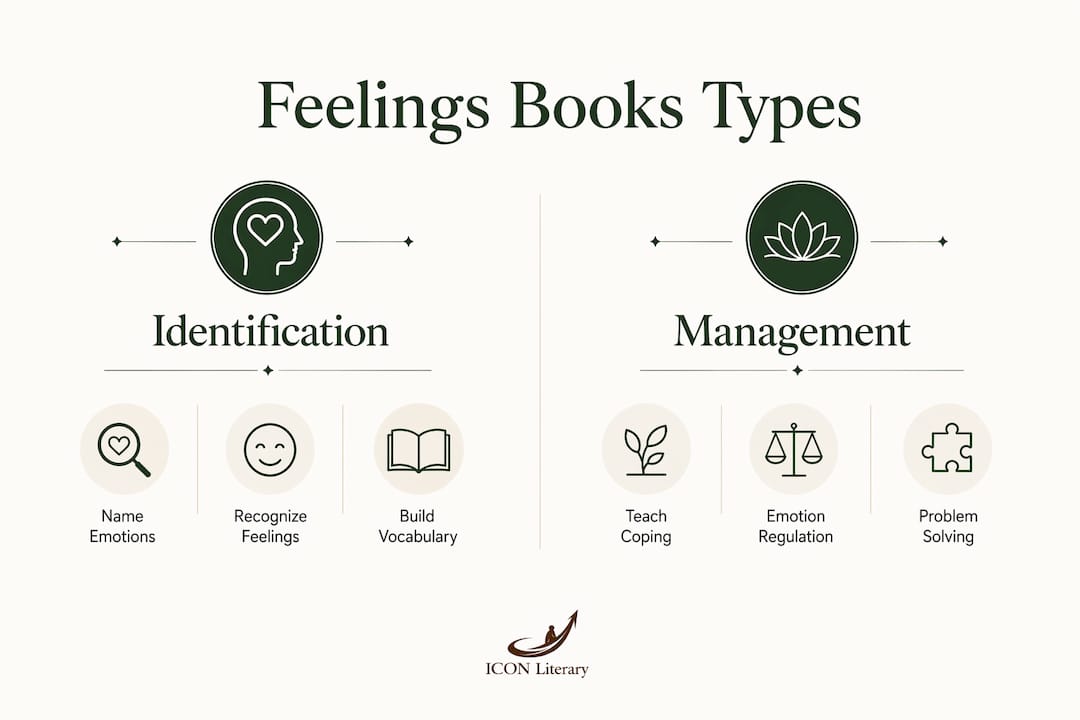
| Feature | Identification books | Management books |
|---|---|---|
| Core purpose | Name and recognize emotions | Teach coping tools and strategies |
| Strongest age | 3–5 (labeling, mirroring) | 5–8 (applying, problem-solving) |
| What to look for | Vivid facial expressions, color coding, simple labels | Breathing scripts, step-by-step calming sequences, character modeling recovery |
| Example titles | The Color Monster, The Feelings Book, My Many Colored Days | Breathe Like a Bear, Listening to My Body, When Sophie Gets Angry |
Categorizing feelings books into identification and management types helps caregivers build reading plans that teach both emotion naming and coping strategies. Neither type alone is enough. A child who can name "frustrated" but has no tools for what to do next is only halfway there.
How to mix both in a weekly routine:
- Monday/Wednesday: an identification book to build vocabulary and recognition
- Friday: a management book to practice a calming tool from the story
- Rotate titles every two to three weeks so the emotional vocabulary keeps expanding
How to run a simple dialogic read-aloud routine
Dialogic shared reading produces stronger gains in emotional vocabulary than passive read-alouds. The difference is the adult's behavior: questions, scaffolding, and stopping to discuss.
The five-step routine:
- Preview (1 minute): Look at the cover together. Ask, "What feeling do you think we'll see in this story?"
- Read aloud with pauses: Stop at each emotional moment. Don't rush to the next page.
- Ask two open questions: One literal ("What is the character feeling right now?") and one inferential ("Why do you think she feels that way?").
- Model your own feeling: Share a brief, honest moment: "I felt really angry once when something I worked hard on didn't go the way I planned."
- Practice one tool: If the book offers a calming strategy, do it together before closing the book.
Script you can use tonight (works with almost any feelings book): "Look at her face. What do you see? … Yeah, she looks really [mad/sad/scared]. I wonder what made her feel that way. Has anything ever made you feel like that?"
Pro Tip: Use your face and voice as instruments. Exaggerate the character's expression when you read. Children who don't yet have the words for an emotion will often recognize it in your face first — that recognition is the bridge to naming it.
Stopping mid-story to discuss emotions is more effective than finishing the narrative straight through. The triadic interaction of adult, child, and book works best when the book anchors the emotion and the adult scaffolds the conversation in real time.
What prompts work for ages 3–5 vs. 6–8?
Match the question to where the child actually is developmentally, not where you wish they were.
Ages 3–5: label, mirror, choose
- "Point to the character who looks sad."
- "Can you make that face? Show me what angry looks like."
- "Is she happy or scared right now?"
- "What color would this feeling be?"
- "What does your tummy feel like when you're nervous?"
Keep prompts present-tense and concrete. Offer two choices when a child gets stuck. Mirroring facial expressions physically is especially powerful at this age.
Ages 6–8: infer, reflect, problem-solve
- "Why do you think he felt that way, even though nothing bad happened?"
- "What could she have done differently when she got so angry?"
- "Have you ever felt two feelings at the same time? What was that like?"
- "If you were the character's friend, what would you say to help?"
- "What do you think will happen to her feelings by the end of the story?"
These prompts build perspective-taking and early metacognition. At this age, children can begin connecting a character's internal state to their own experience and to possible solutions.
The best read-aloud feelings books for ages 3–8
A balanced shelf mixes identification and management books across the full age range. Every title below is available in the US through major retailers and most public libraries.
| Title & Author | Type | Best Age | How to use it |
|---|---|---|---|
| The Color Monster — Anna Llenas | Identification | 3–6 | Pause at each color jar; ask which color matches the child's feeling today |
| The Feelings Book — Todd Parr | Identification | 3–5 | Read one page at a time; invite the child to add their own "I feel…" sentence |
| My Many Colored Days — Dr. Seuss | Identification | 3–6 | Use the color-mood pairings as a daily check-in ritual |
| Today I Feel Silly — Jamie Lee Curtis & Laura Cornell | Identification | 3–6 | Let the child spin the mood wheel at the back; discuss what changed the character's feeling |
| The Way I Feel — Janan Cain | Identification | 3–6 | Study the illustrations closely; ask the child to describe what they see in the character's body |
| When Sophie Gets Angry — Molly Bang | Management | 4–8 | Pause at the peak of Sophie's anger; ask what she could try before she runs outside |
| Breathe Like a Bear — Kira Willey | Management | 3–6 | Do each breathing exercise together as you read; keep the book near the calm-down corner |
| I Am Peace — Susan Verde, illus. Peter H. Reynolds | Management | 5–8 | Read slowly; pause for the mindfulness moments and breathe together |
| Listening to My Body — Gabi Garcia | Management | 5–8 | Ask the child to notice their own body sensations after each page |
| A Little Spot of Feelings — Diane Alber | Identification + Management | 4–8 | Use the spot characters to name and then problem-solve feelings across multiple sessions |
On diversity and family relevance: Look for books that reflect your child's background, family structure, and cultural context. When a child sees themselves in a character, the emotional connection deepens. The emotional themes in gift book selection framework is a practical starting point for matching titles to your family's specific needs. Public libraries often carry culturally diverse titles not found in big-box stores.
Quick follow-up activities to practice what you read
Keep these short. Five to ten minutes is enough. The goal is to make the emotional moment from the book feel real and usable, not to turn storytime into a lesson.
- Feelings charades (5 min): Take turns acting out an emotion from the book without words. The other person guesses. Works especially well after identification books.
- Calm-down corner practice (5–10 min): After reading Breathe Like a Bear or I Am Peace, set up a small corner with a pillow and a pinwheel. Practice one breathing exercise from the book together.
- Emotion drawing (10 min): Ask the child to draw how the character felt at the beginning vs. the end of the story. Then ask them to draw how they feel right now.
- "I feel…" sentence starters (3 min): Go back and forth: each person completes the sentence "I feel ___ when ___." Model first so the child sees it's safe.
Weeknight storytime template: Read one book (10 min) → one open question → one activity from the list above (5 min). Done in under 20 minutes.
Pro Tip: Read about feelings when your child is already calm, not mid-meltdown. Practicing coping tools in a regulated state means they're far more likely to access those tools when things actually get hard.
What to do when a story triggers a big reaction
Sometimes a book lands harder than expected. A character's loss, fear, or rage hits close to home, and your child cries, shuts down, or gets angry. That's not a failure of the book or the reading session. It means the story connected.
Do:
- Stop reading. Sit with the feeling. "I can see this part really got to you. That makes sense."
- Validate before explaining. "It's okay to feel sad about that."
- Follow the child's lead on whether to keep reading or close the book.
- Return to the book another day when both of you are calm.
Don't:
- Minimize ("It's just a story, don't worry").
- Push through the narrative to finish.
- Treat the reaction as a behavior problem.
- Immediately pivot to a lesson or moral.
The AAP guidance is clear: read about feelings when the child is calm, and practice coping strategies in calm moments so they're accessible under stress. If strong reactions to stories persist or seem disproportionate, a pediatrician or child therapist is the right next step.
Key Takeaways
Reading aloud feelings books together, using dialogic prompts and a short follow-up activity, is one of the most research-supported ways to build emotional vocabulary and coping skills in children ages 3–8.
| Point | Details |
|---|---|
| Start with three books | The Color Monster, When Sophie Gets Angry, and Breathe Like a Bear cover naming, managing, and calming. |
| Use the dialogic routine | Preview, pause, ask two questions, model a feeling, practice one tool — every session. |
| Mix identification and management | One type names emotions; the other teaches what to do with them. Both are needed. |
| Match prompts to age | Ages 3–5 need labeling and mirroring; ages 6–8 are ready for inference and problem-solving. |
| Icon Literary resources | Icon Literary's catalog and blog offer emotionally resonant story collections and discussion guides to extend the practice. |
The case for slowing down the story
Most caregivers read too fast. The instinct is to keep the narrative moving, to hold the child's attention, to get to the end. But the emotional payoff in a feelings book lives in the pause, not the plot.
What the research actually shows is that the adult's behavior during reading matters as much as the book itself. Stopping at a character's face, naming what you see, sharing a brief moment of your own experience — these are the moves that transfer emotional vocabulary from the page to the child's actual life. A book read straight through is entertainment. A book read with intention is practice.
The other thing caregivers underestimate: children don't need a different book every week. Rereading the same title three or four times, with slightly different questions each time, often produces more growth than cycling through a new title every session. The child already knows the plot; now they can go deeper into the feeling.
Icon Literary's emotional story collections
Icon Literary crafts emotionally resonant stories and world-building experiences designed to spark genuine connection between readers of all ages. For caregivers looking to extend the read-aloud practice beyond a single shelf, the Icon Literary catalog offers curated story collections built around emotional themes, discussion prompts, and printable activities you can use right after reading. The studio's approach to storytelling prioritizes emotional depth and craft over formula, which means the books and resources you find there are designed to hold a child's attention and yours. Browse the full catalog or visit the Icon Literary home page to see current collections and member resources.
Sources and suggested further reading
The claims in this article draw from peer-reviewed research, AAP guidance, and educational organization resources. Every source below is freely accessible and worth bookmarking.
- HealthyChildren.org / AAP: The AAP's recommended reading list for feelings and resilience, with guidance on timing and caregiver approach.
- Frontiers in Psychology, 2025: Narrative review of shared book reading as a context for social-emotional learning; the primary source for the dialogic method described in this article.
- ERIC / Emotion Vocabulary Study: Research on how shared book reading builds emotion vocabulary in preschool children.
- Scholastic Family Read-Aloud: Practical read-aloud techniques and the parent/child survey data cited above.
- Kindergarten Cafe / Social-Emotional Read-Alouds: Educator-focused guidance on the identification vs. management book taxonomy.
- Ricerche di Pedagogia e Didattica: Longitudinal study on shared reading aloud and emotional comprehension in preschool children.