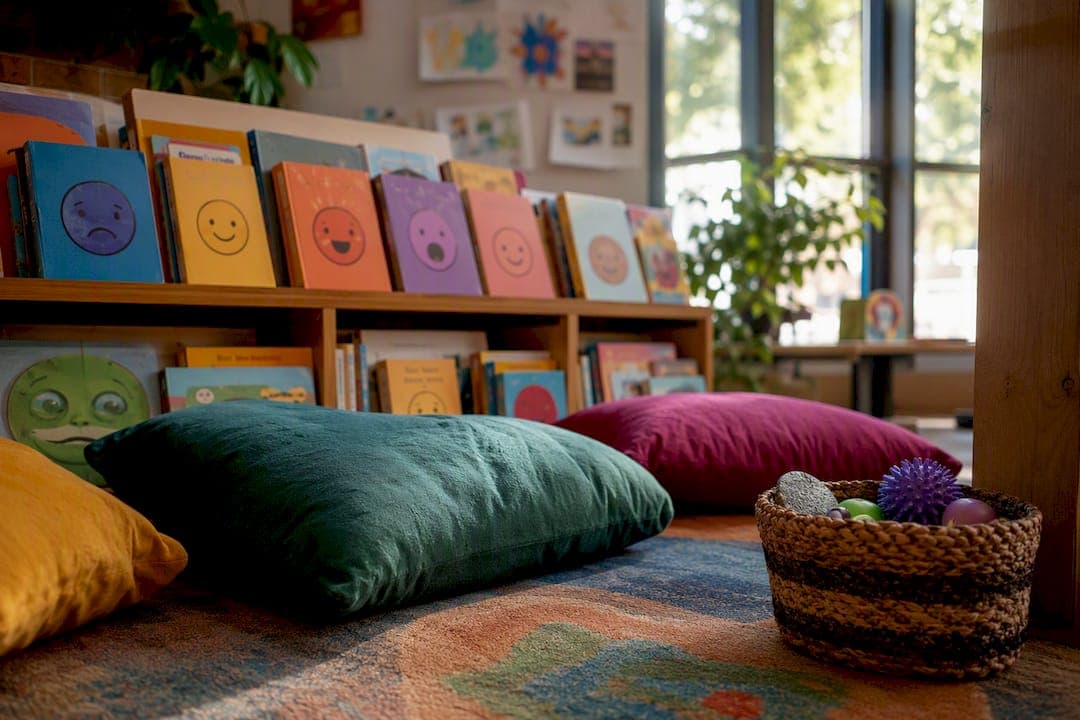
A feelings corner is a designated spot where a child goes to name a big emotion and practice calming down, not a timeout in disguise. The single design rule that matters most: it has to be predictable, non-punitive, and stocked with tools a child can reach and use alone. Here's the fast version before we get into setup and scripts.
- Seat: a floor cushion, small chair, or beanbag
- Visuals: a laminated feelings chart and a simple "calm-down menu"
- Sensory tools: 2 to 3 options (stress ball, textured fabric, glitter jar)
- Activity options: a breathing card, a short coloring sheet, a picture book
- Timer: a visual sand timer set for 3 to 5 minutes
Pro Tip: Name the corner something neutral, like the "Calm Spot" or "Peace Place." Anything that sounds like a punishment ("time-out chair") undermines the whole design before a child sets foot in it.
Key Takeaways
A feelings corner works when it's predictable, child-accessible, and used as a regulation tool rather than a consequence.
| Point | Details |
|---|---|
| Keep the toolkit small | Stock 2 to 3 sensory tools plus a feelings chart, not a cluttered bin of options. |
| Practice before it's needed | Teach and role-play the corner during calm moments, not mid-meltdown. |
| Never use it as punishment | Frame it as a tool, like a fire extinguisher for feelings, not a timeout. |
| Adapt for setting and age | Adjust sight lines, seating, and sensory tools for home, classroom, and developmental stage. |
| Add a resource this week | Icon Literary's picture books and SEL activity kits give kids language to name feelings. |
Table of Contents
- Why a Feelings Corner Supports Emotional Regulation and SEL
- How Do You Set Up a Feelings Corner Step by Step?
- Adapting the Design for Home, Classroom, Age, and Neurotype
- How Do You Teach Children to Use the Corner?
- Common Mistakes That Undermine a Feelings Corner
- What Does the Research Say About Calming Spaces?
- Sources
Why a Feelings Corner Supports Emotional Regulation and SEL
Children can't reason their way out of a meltdown, but they can learn to recognize the early signs and reach for a tool. A well-designed corner builds four skills at once:
- Self-awareness (naming what "mad" or "overwhelmed" feels like in the body)
- Downregulation (breathing, squeezing, rocking, until the nervous system settles)
- Choice-making (picking a strategy instead of waiting for an adult to fix it)
- Smoother group flow (one child self-regulating instead of derailing a whole classroom or dinner)
The neuroscience behind this is straightforward: kids regulate better when they perceive their environment as safe and consistent, and that perception shifts their nervous system toward a state where learning and emotional independence are actually possible. Used inconsistently, or as a consequence for bad behavior, a "calm corner" does the opposite. It becomes just another thing to fear. Developmentally appropriate early childhood practice treats self-regulation as a taught skill, not an innate trait, and a feelings corner is one of the simplest tools for teaching it.
How Do You Set Up a Feelings Corner Step by Step?
Building a feelings corner learning space doesn't require a Pinterest budget or a spare room. It requires intention, in this order.
- Define the purpose and rules first. Decide whether it's for self-initiated breaks, adult-suggested breaks, or both, and write one simple rule: "This is a place to calm down, not a punishment."
- Choose the location. In a classroom, pick a spot with sight lines so you can supervise without hovering, away from high-traffic paths. At home, a quiet corner of a bedroom or living room works, ideally somewhere the child can retreat to without feeling cut off from the family.
- Add seating and soft surfaces. A cushion, rug, or small tent softens the space and signals "this is different from the rest of the room."
- Assemble the toolkit. Emotion cards, a breathing visual (like a printable "hoberman sphere" breathing card), 2 to 3 sensory items, and a couple of picture books that model feelings vocabulary.
- Add visuals and a timer. A feelings chart at eye level and a visual timer keep the space usable for kids who can't yet tell time.
- Set expectations out loud, then practice them during a calm moment, not mid-meltdown.
Materials checklist (low-cost first):
- Free or printable feelings chart and calm-down menu
- A soft item from home (blanket, stuffed animal)
- One or two dollar-store sensory tools (stress ball, pinwheel for breathing)
- Optional upgrades: a glitter calm-down jar, a weighted lap pad, a themed book collection
A sample script for introducing it: "This is our Calm Spot. When your body feels big feelings, like mad or worried, you can come here to breathe and feel better. It's not a punishment. It's a tool, like a fire extinguisher for feelings." Cap visits at 3 to 5 minutes for preschoolers and up to 10 for older elementary kids, then check in.
Pro Tip: Model using the corner yourself once in a while. "I'm feeling frustrated, I'm going to sit in the Calm Spot for a minute" teaches more than any lecture.
Adapting the Design for Home, Classroom, Age, and Neurotype
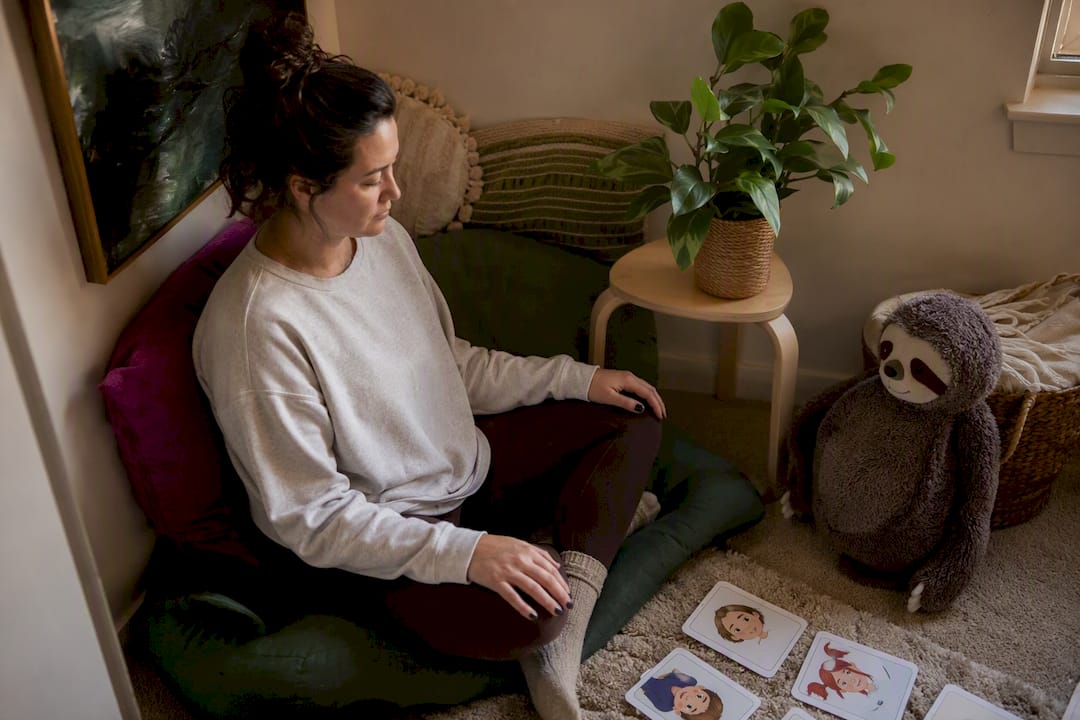
A classroom feelings corner and a home one solve slightly different problems. In a classroom, you're managing 15 to 25 kids, so sight lines matter: position the corner where you can see it from anywhere in the room, but use a low bookshelf or curtain to give a sense of privacy. At home, the opposite tension applies. Kids want privacy but not isolation, so a corner near a common room, rather than a closed bedroom, usually works better for younger children.
- Sensory tuning: dim or warm lighting beats overhead fluorescents; soft textures (fleece, faux fur) over scratchy fabric; skip strong scents entirely, since sensory sensitivities vary widely
- Color: low-stimulation palettes (soft blues, greens, muted neutrals) support calm better than bright primary colors, according to design guidance on calming spaces in schools
- Accessibility: keep toolkit bins at a height any child can reach, and rely on picture-based visuals for nonverbal or pre-reading kids
- Safety: use washable cushions and fabrics, secure any lamps or string lights, and wipe down shared sensory tools between uses
If you're building the physical space and want a deeper dive into how color affects mood, this practical guide to color psychology in home design breaks down which tones actually calm a room versus which ones just look nice in photos.
Pro Tip: For a two-year-old, "seating" might just mean a soft rug. For an eight-year-old, add a small desk for drawing or journaling. The corner should grow with the child, not stay frozen at its original design.
How Do You Teach Children to Use the Corner?
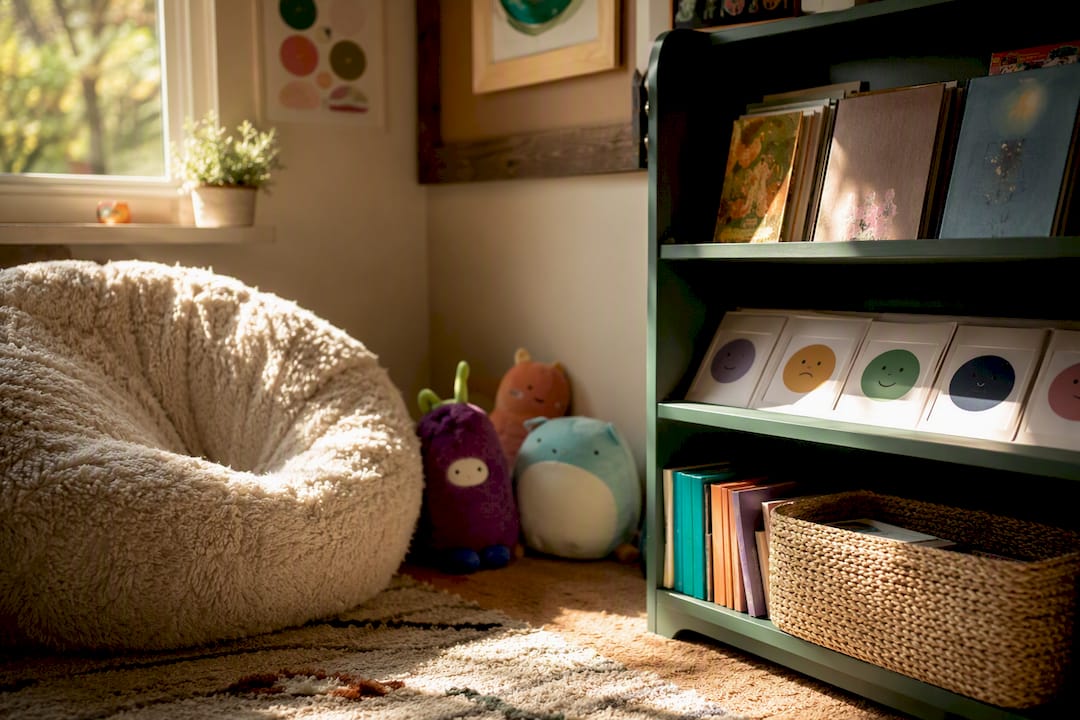
A feelings corner nobody uses is just decoration. Teaching it takes a short, deliberate lesson, not a one-time announcement.
Sample lesson (10 minutes, during a calm part of the day):
- Introduce the space and its one rule.
- Name three feelings together using the chart (happy, mad, worried).
- Practice one breathing strategy as a group, in the corner, before anyone needs it.
- Role-play: "Show me what you'd do if you felt frustrated." Let a child act it out.
- Praise the attempt, not just the outcome.
Scripts help adults stay consistent. To invite: "I notice your hands are in fists. Would the Calm Spot help?" To model: "I'm going to breathe with the pinwheel until I feel steadier." To check in afterward: "How's your body feeling now? What did you try?"
- Start with full adult guidance for the first few weeks
- Shift to a gentle verbal reminder once the child recognizes their own cues
- Eventually let the child choose the corner unprompted, which is the actual goal
Fading support too fast backfires. Fading it not at all keeps the child dependent on an adult noticing every time.
Common Mistakes That Undermine a Feelings Corner
The fastest way to sabotage a feelings corner is to send a child there as punishment. The moment it becomes "go sit and think about what you did," it stops being a regulation tool and starts being something to avoid or resent.
- Don't overstuff it with ten different sensory toys; two or three well-chosen tools beat a cluttered bin
- Don't leave a young child unsupervised there for long stretches, especially early on
- Do revisit the toolkit every few months and swap out items the child has outgrown
- Do treat the corner as one part of a broader emotional-literacy routine, not a cure-all
Watch for red flags that go beyond typical big feelings: regression in previously mastered skills, persistent withdrawal even after calming attempts, or escalation every time the child visits the corner. These patterns are worth raising with a pediatrician, school counselor, or child therapist rather than solving with more sensory bins.
What Does the Research Say About Calming Spaces?
The evidence behind this design isn't just intuition. Peer-reviewed work on children's emotional climate makes the mechanism explicit:
Consistent, warm, and predictable environments shift a child's nervous system toward states that support learning and emotional autonomy, while inconsistent or punitive use of "calm" spaces can trigger the opposite stress response.
That finding, from a neuroscientific perspective on emotional climate, lines up with early education guidance recommending multiple accessible learning centers with explicitly taught routines, and with practical classroom guidance describing calm-down corners as spaces stocked with soft seating and visual supports. The Child Mind Institute adds a specific mechanism: naming a feeling out loud, paired with a concrete strategy, is what actually builds a child's regulation skill over time.
What I've Noticed Actually Works
Most feelings corners fail not because the design is wrong, but because adults expect it to work immediately without practicing it during calm moments first. Build it, teach it while nobody's upset, then let it get a little messy and imperfect. That's when it starts doing its job.
Where to Find Tools That Fit Your Feelings Corner
A quick disclosure: this next part is promotional. Icon Literary makes the emotional vocabulary work easier, not harder, with picture books, activity kits, and downloadable SEL tools built around characters kids actually want to revisit, rather than generic worksheets. If you're stocking a toolkit and want a book that models naming feelings in story form, pairing a read-aloud feelings book with the corner gives kids language they can borrow when words are hard to find on their own. Browse the full collection of books, card decks, and activity kits at Icon Literary and add one resource to your corner this week.
Sources
- Neuroscientific perspective on emotional climate (DOI)
- Learning centers and stations in early childhood classrooms (Texas Education Agency)
- Calm Down & Quiet Corner
- Child Mind Institute article on helping kids self-regulate
- Calming Spaces in Schools and Classrooms (Wested PDF)