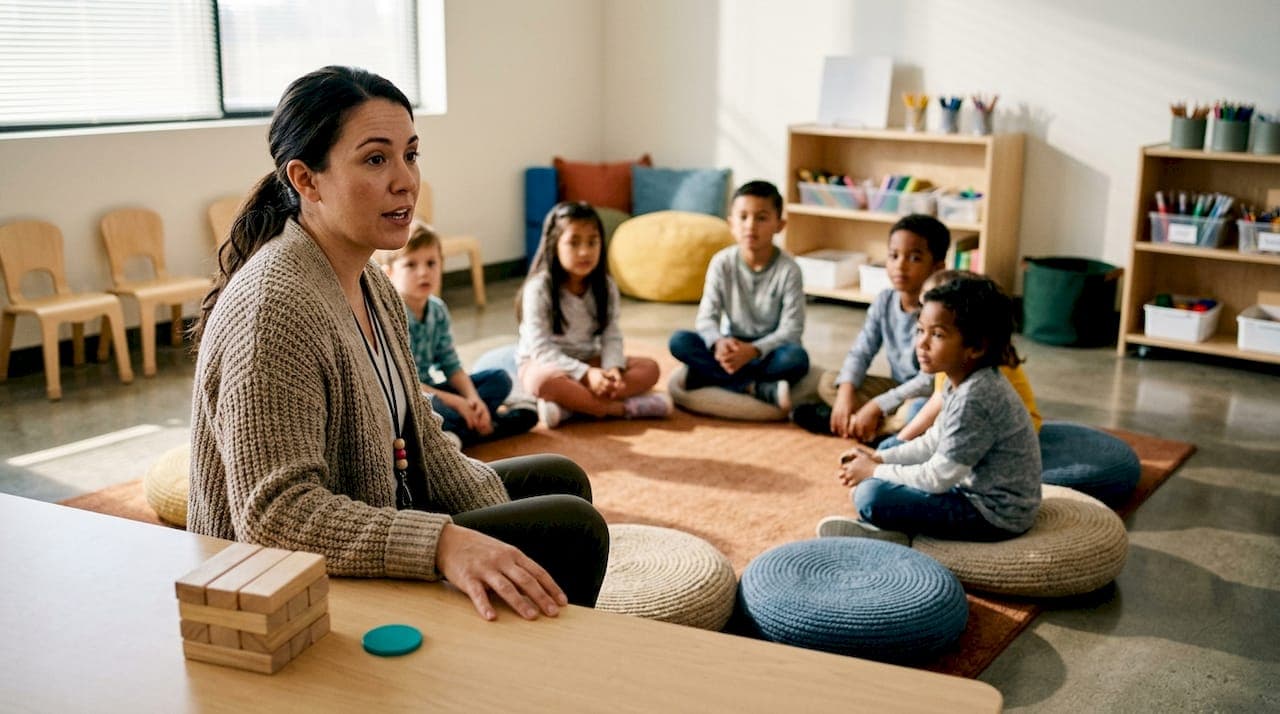
This page gives you copy-ready morning meeting questions grouped by purpose, plus the four-part structure they fit into and quick tips for making sure every student can join in. You'll find sample scripts, timing guidance, and inclusion adaptations you can use the same day, along with links to deeper teacher resources.
TL;DR:
- Consistent response rotation and honest modeling are more effective for building community than the specific prompts used.
- Rotating response modes, such as partner talk and written answers, ensures all students participate and prevents monopolization of discussion.
- Emphasizing the four-part structure and participation choices usually yields better engagement than focusing on finding the perfect question.
- Mixing categories of prompts across the week maintains fluency and prevents routine fatigue for students.
- A predictable routine, combined with varied response methods and honest modeling, fosters genuine connection and engagement in morning meetings.
Table of Contents
- 1. Categorized Questions You Can Copy Today
- 2. Where Each Question Fits in the Four-Part Meeting
- 3. Making Morning Meeting Work for Every Learner
- 4. Five Ready-to-Copy Sample Meetings
- 5. Tips From the Classroom
- What Actually Matters in a Morning Meeting
- Sources
- FAQ
1. Categorized Questions You Can Copy Today
The best morning meeting questions serve a specific purpose rather than filling time. According to WeAreTeachers' collection of morning meeting prompts, open-ended questions produce far more meaningful sharing than yes-or-no prompts, so almost everything below asks students to explain, choose, or imagine rather than just answer.
SEL and connection prompts help students name feelings and feel seen.
- What is one word for how you're feeling right now, and why that word?
- Tell us about someone who helped you this week.
- What is something small that made you smile recently?
Planning and anticipation prompts get students mentally ready for the day ahead.
- What is one thing you're looking forward to today?
- If today had a theme song, what would it be and why?
- What is one goal you have for this morning?
Creative and critical-thinking prompts work well for partner talk or quick debate.
- If you could add one rule to our classroom, what would it be?
- Would you rather explore space or the ocean floor, and why?
- What invention do you wish existed?
Fun and energizer prompts loosen the room up fast.
- What's your go-to lunch order if money didn't matter?
- Cats or dogs, and defend your answer in one sentence.
- What's the silliest thing you've seen this week?
Week-open and week-close prompts bookend the five days with reflection.
- Monday: What's one thing you want to accomplish this week?
- Friday: What's the best thing that happened this week?
Mix categories rather than repeating the same type every day to help build fluency through a predictable routine, as recommended in The Daily Habit That Actually Builds Fluency. A Monday planning question followed by a Wednesday SEL check and a Friday reflection keeps the routine predictable without feeling repetitive.
2. Where Each Question Fits in the Four-Part Meeting
Morning Meeting follows four sequential parts, and knowing which question type belongs where keeps the whole routine moving. According to Responsive Classroom, a typical elementary meeting runs 20 to 30 minutes total.
- Greeting (roughly 5 minutes): Use a quick connection or fun prompt as students greet each other by name.
- Sharing (roughly 5 to 10 minutes): This is where SEL and creative prompts do the most work, since students explain rather than just answer.
- Group activity (roughly 5 to 10 minutes): Fun and energizer questions translate naturally into a short game or movement break here.
- Morning message (roughly 5 minutes): Planning prompts fit best, tying the question directly to the day's academic goal.
Rotate how students respond so the same three voices don't dominate every day: some days aloud, some days with a partner, some days in a journal, some days on a sticky note, and some days as silent reflection. This single habit does more for engagement than adding new questions.
Pro Tip: Always model your own answer first, especially for SEL prompts. Students share more honestly when they've seen you go first.
Avoid yes-or-no phrasing wherever possible, and scaffold wording down for younger grades: "What are you excited about?" works for third grade, while "Show me a face for how you feel" works better for kindergarten.

3. Making Morning Meeting Work for Every Learner
A meeting only builds community if every student has a real way to participate. Responsive Classroom's guidance on inclusion and equity recommends setting clear listening norms and offering participation choices rather than requiring the same response from everyone.
- Offer an "air-five" or thumbs-up as a nonverbal option alongside speaking aloud.
- Let students write or draw their answer on a sticky note instead of saying it out loud.
- Adapt question wording for English learners with simpler sentence starters and visual supports.
- Use student-preferred names and neutral group language instead of gendered terms like "boys and girls."
Pro Tip: Teach the participation choices explicitly with an interactive model: "Today you can share aloud, whisper to a partner, or hold up your journal. Watch me pick one first."
4. Five Ready-to-Copy Sample Meetings
Each script below covers a greeting, one question, a short activity, and a morning message tied to that day's learning goal.
- K to 2: Greet with names and a wave, ask "Show me a face for how you feel today," pair-share with a partner, and close with a morning message read aloud together.
- Grades 3 to 5: Greet in a circle, ask a planning question like "What's one thing you want to finish today?", have students turn and talk, then tie the morning message to the day's reading or math focus.
- Middle school advisory: Welcome students as they arrive, acknowledge one positive from yesterday, ask a creative or SEL prompt, and post a brief written message with the day's schedule.
- 10 minute fast version: Greeting (2 minutes), one quick SEL or fun question answered in one word each (3 minutes), a 3 minute stretch or game, and a 2 minute written message.
- Virtual friendly version: Greet by name in the chat, use breakout pairs for the question, run a quick poll as the group activity, and post the message in the chat and on screen.
- Keep each script visible on a slide or poster so substitutes can run the same routine.
- Swap the question daily, but keep the four-part order the same for predictability.
5. Tips From the Classroom
Morning meetings work best when the routine feels human, not scripted. Three habits make the biggest difference: model your own answer honestly before asking students to share, rotate response modes so quiet students get a fair turn, and always connect the morning message back to something students are actually learning that day. For quick, ready-made SEL moments that slot into the sharing or message portion, Some teacher blogs have 10-minute SEL plans worth adapting.
— Derek Amarillas
What Actually Matters in a Morning Meeting
The question bank matters less than most teachers assume. What separates a meeting that builds real community from one that feels like a box to check is the response rotation and the willingness to model honestly, not the cleverness of any single prompt. Conventional advice leans hard on finding "the perfect question," but action-research literature points to consistency and genuine participation as the stronger drivers of belonging and engagement.

If you're starting from scratch, prioritize the four-part structure and the participation choices before you worry about variety in your questions. A predictable routine with three solid question types beats a novel prompt every day with no consistent shape behind it. Once the structure is second nature to your class, expanding your question bank becomes the easy part, not the hard one.
Sources
Start with Responsive Classroom's overview of Morning Meeting and its 80 Morning Meeting Ideas PDF, then browse WeAreTeachers' full prompt collection and the ERIC action-research literature on outcomes.
- Morning Meeting: A powerful way to begin the day | Responsive Classroom
- 200+ Morning Meeting Questions To Start the Day Off Right | WeAreTeachers
FAQ
What are some good things to discuss in a morning meeting?
Good topics include feelings check-ins, plans for the day, and light creative or fun prompts that get students talking without pressure. Mixing SEL, planning, and playful questions across the week keeps the routine from feeling repetitive.
What are some fun questions to ask at a morning meeting at work?
Simple either-or questions, favorite foods, or "what made you smile this week" work well because they're quick and low-stakes for adult groups too. The same open-ended principle applies: avoid yes-or-no phrasing so people actually elaborate.
What are the four components of a morning meeting?
The four sequential parts are greeting, sharing, group activity, and morning message, as described by Responsive Classroom. A full meeting following this structure typically runs 20 to 30 minutes.
How to make morning meetings fun?
Rotate response modes like partner talk, journaling, and sticky notes so the routine doesn't feel identical every day, and mix in energizer or silly questions alongside the SEL prompts. Short group activities between sharing and the morning message also help keep energy up.