
An emotional check-in is a brief moment where someone names a feeling, rates how strong it is, and picks one next step. The fastest version takes 60 seconds: name it, rate it one to five, choose a coping action. A 5-minute version adds a follow-up question or a shared activity. This article gives you a full menu of these ideas, plus how to fit them into a school day or home routine without turning them into paperwork.
TL;DR:
- Digital tools can scale check-ins for many students but may compromise privacy unless responses are kept confidential, especially for younger children.
- Visual aids like feelings wheels or mood meters are most effective for preschoolers and young elementary students who lack advanced emotional vocabulary.
- Short, daily check-ins lasting 60 seconds or less are more effective and sustainable than longer sessions, especially when integrated into existing routines.
- Using body-based prompts instead of words can elicit more honest responses from children who tend to give automatic answers like "fine."
- Pattern tracking over weeks should be separate from daily check-ins, with the latter focusing on present feelings and the former on emotional trends.
Table of Contents
- What Is an Emotion Check-In, and Why Does Naming Feelings Help?
- Why Check-Ins Matter for SEL, Resilience, and Classroom Climate
- Check-In Ideas You Can Use Today, by Age and Format
- How to Build Check-Ins Into a Routine Without Turning Them Into Paperwork
- Icon Literary Resources That Support These Practices
- What Teachers and Counselors Get Wrong About Check-Ins
- Ready-Made Check-In Tools From Icon Literary
- Sources
- FAQ
What Is an Emotion Check-In, and Why Does Naming Feelings Help?
A check-in can run two ways: a quick present-moment ritual (how do you feel right now?) or an ongoing tracker that logs patterns over days or weeks. Both matter, but for daily classroom or home use, the quick ritual wins because it takes almost no setup and still delivers a real effect.
That effect has a name: affect labeling. Research behind the 60-second check-in ritual popularized by ILTY shows that putting a feeling into words lowers the brain's threat response, essentially calming the alarm system before it escalates. The Yale Mood Meter, developed as part of the RULER framework, builds on the same idea by giving people a shared vocabulary instead of a blank stare when someone asks "how are you?"
Common formats include:
- Feelings wheels — a dial or chart with emotion words radiating from a center point
- Mood Meter grids — four color-coded quadrants for energy and pleasantness
- Charts or scales — simple 1 to 5 intensity ratings, often paired with a face or color
- Journals or trackers — for spotting patterns over a week or month rather than a single moment
Why Check-Ins Matter for SEL, Resilience, and Classroom Climate
Emotional check-ins map directly onto core social-emotional learning competencies, especially self-awareness and self-management, the skills CASEL's signature practices point to as reliable places to start. A student who can name frustration before it becomes a shove is practicing exactly the skill SEL programs try to build.
The practical payoff shows up fast. Teachers who run daily check-ins report catching problems earlier, whether that's a kid who's quietly anxious about a test or one who's had a rough morning at home. Communication improves too. Kids who lack the words for "overwhelmed" often act it out instead, and a shared vocabulary gives them another option.
Public-health guidance backs the habit side of this. CDC stress resources note that brief practices of a few minutes can measurably reduce stress, and daily consistency matters more than session length. That's good news for anyone worried they don't have time: a 60-second check-in done every day beats a 20-minute one done twice a month.
Check-In Ideas You Can Use Today, by Age and Format
Here's the part you actually came for: ideas you can run tomorrow morning, adapted for different ages and different amounts of time.
1. The 60-second name-it-and-move-on ritual
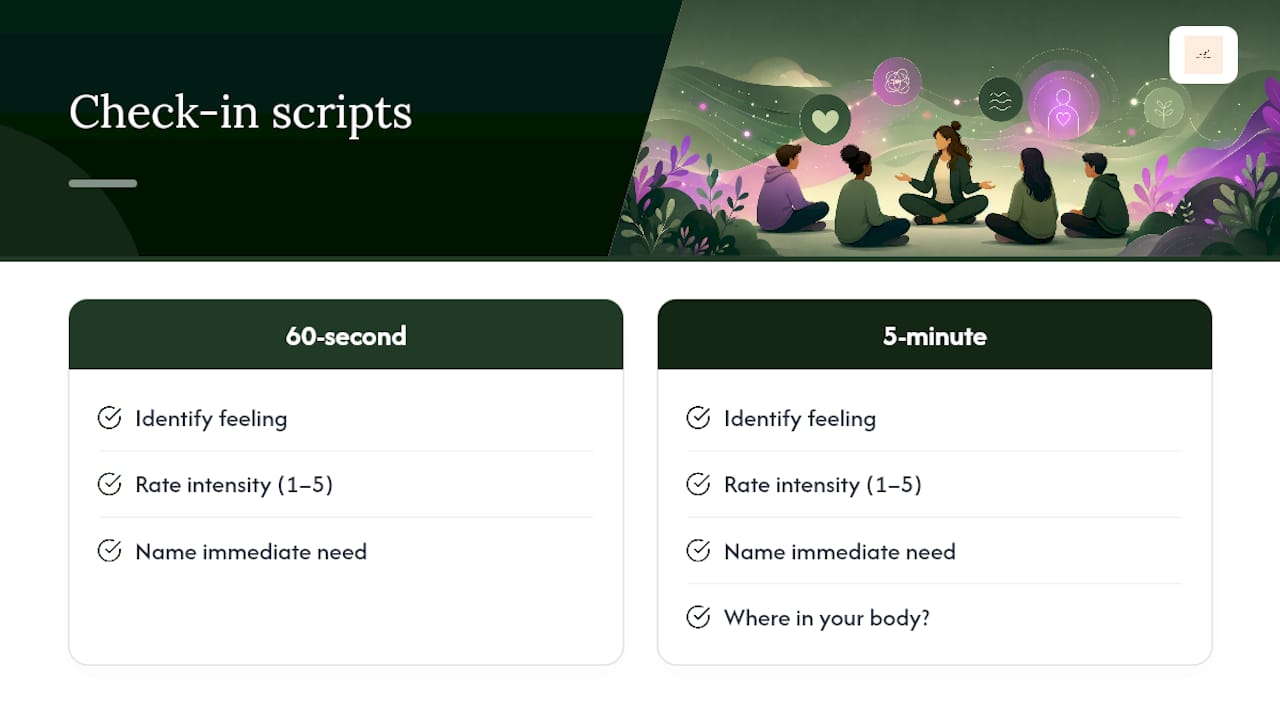
Ask three questions in sequence: What are you feeling? How strong is it, one to five? What's one thing you need right now? This is the fastest version of the ILTY check-in framework, and it works for a whole classroom line, a single kid at drop-off, or yourself before a hard meeting.
2. The 5-minute scripted check-in
Extend the same three questions with a body-based follow-up: "Where do you feel that in your body?" Then close with a coping choice from a short menu like those paired with breathing-with-music activities in early childhood music education (breathe, draw, walk, talk). This version works well for a small group or a one-on-one counseling moment.
3. Mood Meter or feelings-wheel pointing
Kids point to a color or word instead of speaking, which lowers the pressure for reluctant talkers. A feelings wheel activity can run in under two minutes and works well for visual learners or kids still building emotional vocabulary.
4. Sticky-note mood board
Everyone writes one word or draws one face on a sticky note and adds it to a board on the way into the room. No talking required, and you get a visual snapshot of the whole group's mood in seconds.
5. The feelings corner
A dedicated low-traffic spot with a wheel, some fidget tools, and a "how I'm feeling" prompt card gives kids a place to self-regulate before rejoining the group. Full setup guidance for building a feelings corner that kids actually use covers placement, materials, and rules for who can visit and when.
6. Check-in jars
Kids drop a colored token or a written card into a jar that matches their mood. It's silent, fast, and gives you a quick visual read without singling anyone out.
7. Feel-cards and spinners
A deck of cards or a spinner labeled with feelings and prompts turns the check-in into something closer to a game, which works especially well for reluctant middle schoolers who'd rather do anything than answer a direct question about their feelings.
8. Partner share
Pair kids up for 30 seconds each to share one word and one reason. This builds the same self-awareness skill while adding a peer-connection element that solo check-ins skip.
9. Exit ticket check-in
A one-line prompt on the way out the door ("One word for how today went") captures a moment without slowing down the transition.
Format matters as much as content. Digital tools (apps, shared docs, quick polls) scale easily across a large group and create a record, but paper and low-tech tools protect privacy better for younger kids and avoid screen fatigue. If you do go digital, make sure responses aren't visible to classmates unless the activity is designed to be shared.
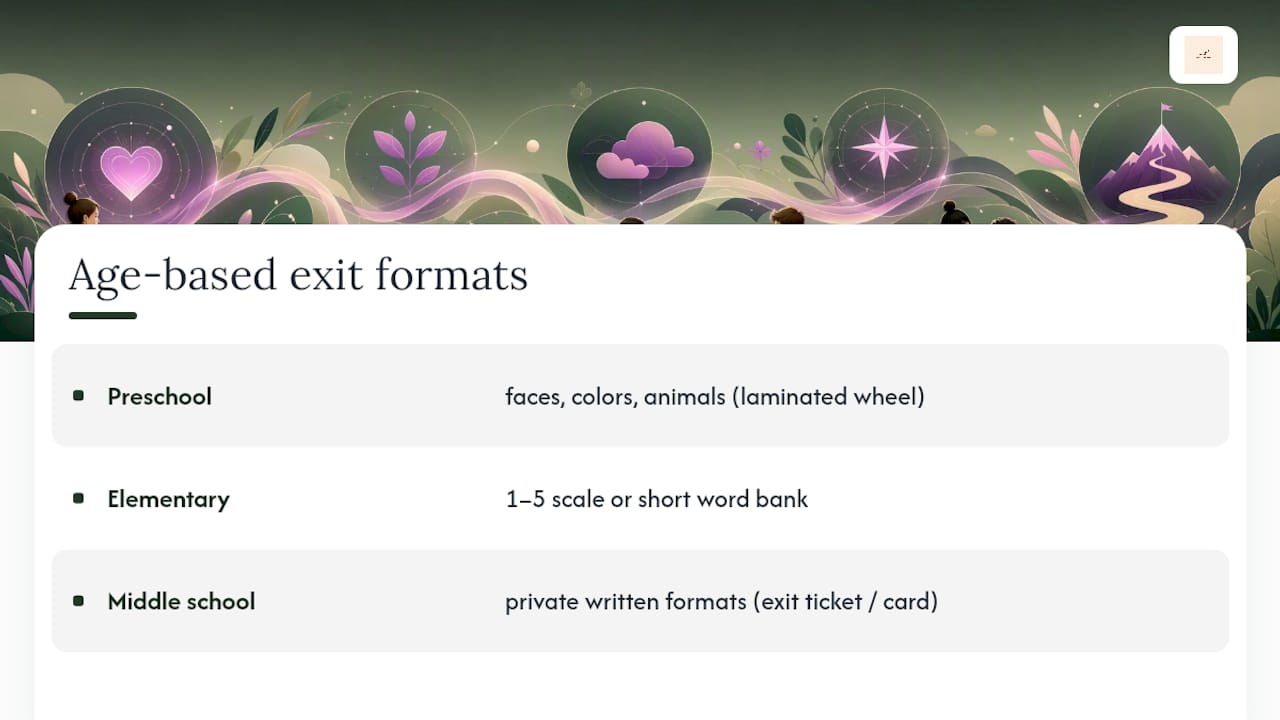
Age adaptations matter too. Preschoolers need faces, colors, or animals instead of words, so a laminated wheel with three or four simple options beats a 20-word chart. Elementary kids can usually handle a 1 to 5 scale and a short word bank. Middle schoolers often respond better to written or private formats (an exit ticket, a quiet card drop) than to speaking out loud in front of peers.
Pro Tip: If a kid says "fine" every single time, switch the question to a body sensation instead of an emotion word: "Does your body feel tight, heavy, or buzzy right now?" That sidesteps the automatic "fine" response and often gets a more honest answer.
How to Build Check-Ins Into a Routine Without Turning Them Into Paperwork
Habit-stacking beats scheduling from scratch. Attach the check-in to something that already happens every day: morning circle, the first two minutes after recess, or the walk to the car. The NIH emotional wellness toolkit points to consistency, not intensity, as the factor that actually builds resilience over time.
Question design matters more than most people expect:
- Keep it neutral. "How are you feeling?" beats "Are you okay?" because the second one implies something is wrong.
- Rotate prompts weekly so kids don't slide into autopilot answers.
- Avoid follow-up questions that sound like an interrogation ("Why do you feel that way?" can wait until later, one-on-one).
Every classroom or household needs a basic safety protocol. If a child reports a 4 or 5 intensity rating tied to something like fear, hopelessness, or a specific person, that's a signal to follow up privately, not in front of the group, and to loop in a counselor or the appropriate adult the same day.
Decide upfront whether you're tracking patterns over time or just noticing the present moment. Both are useful, but mixing them muddies the purpose. A quick daily ritual works best as a present-focused snapshot. Save the tracking and pattern-spotting for a weekly or biweekly review, where you can look back over check-ins without asking kids to relive every hard day one at a time.
Pro Tip: If buy-in is low, let the group choose the check-in method for a week. Ownership over the format often matters more to older kids than the format itself.
Icon Literary Resources That Support These Practices
Icon Literary's blog builds out several of the tools mentioned above in more detail, written for the same audience running these check-ins daily. Feelings wheel activities walks through quick, under-two-minute setups for classrooms and homes. Design a feelings corner covers layout and materials for a self-regulation space kids will actually use. Read-aloud storytime for emotional literacy pairs picture books with check-in prompts for younger learners.
Any of these resources adapts into a 60-second or 5-minute script: pick one prompt, one visual tool, and one coping menu item, then run it the same way every day for a week before rotating.
Editorial oversight for this piece comes from Derek Amarillas.
What Teachers and Counselors Get Wrong About Check-Ins
Keep it short and model the language yourself first. When an adult says "I'm feeling a little frustrated, about a 3," kids learn the format faster than from any instruction sheet.
Don't let a check-in become surveillance. If kids sense their answers get reported to parents or used against them, they'll start answering "fine" every time, and you lose the entire point of the exercise.
Small tweaks raise buy-in fast: let kids pass without answering, rotate who leads the check-in, and never make it the thing you do only when someone's already in trouble.
— Derek Amarillas
Ready-Made Check-In Tools From Icon Literary
Building a feelings wheel, a check-in script, and a set of prompts from scratch takes real time, time most teachers and caregivers don't have between lesson planning and everything else on a Tuesday. Some activity kits, feelings wheels, and read-aloud picture books are designed specifically for ages 3 to 8, so the vocabulary and visuals match what a preschooler or early elementary kid can use.

A single kit typically maps directly onto a 5-minute check-in script: use the included feelings wheel for the naming step, the intensity scale for the rating step, and the paired activity card for the next-step or coping action. That's three steps solved by one product instead of three separate searches for printables online. Downloadable bundles, printable templates, and physical kits are all available on the Icon Literary storefront, where you can browse by age range and pick a starting kit for your classroom or home this week.
Sources
- Marc Brackett | Yale Medicine profile
- Emotional Check-In: A 60-Second Daily Ritual | ILTY
- NIH emotional wellness toolkit
FAQ
How Long Should an Emotion Check-In Take?
The fastest version takes about 60 seconds (name the feeling, rate it, pick a next step); a scripted version with a follow-up question runs closer to 5 minutes.
What's the Best Question to Start a Check-In?
Ask "What are you feeling right now?" instead of "Are you okay?", since the second phrasing implies something is already wrong and can shut kids down.
How Do I Get Past "I'm Fine" Answers?
Switch to a body-sensation prompt like "Does your body feel tight, heavy, or buzzy?" which sidesteps the automatic "fine" response many kids default to.
Are Digital or Paper Check-Ins Better for Privacy?
Paper and low-tech tools like sticky notes or check-in jars generally protect privacy better for younger kids, while digital tools scale faster for larger groups but need visibility settings checked first.
What Tools Work Well for Younger Kids Who Don't Have Emotion Vocabulary Yet?
Visual tools like a feelings wheel or a Mood Meter grid let preschoolers point instead of speak, and Icon Literary's read-aloud picture books pair story characters with feelings to build vocabulary gradually.