
Run this today: a 15-second nonverbal greeting, a one-word check-in, and a two-minute partner activity covers all four Morning Meeting components in under 10 minutes. This article organizes dozens of morning meeting SEL activities by component (greeting, sharing, group activity, message), gives you three ready-to-run timed routines, and adapts each for K through 8. The Responsive Classroom model anchors the structure, the Mood Meter and one-word weather checks handle the sharing piece, and a few tools from Icon Literary round out the read-aloud and prompt-card options if you want something ready-made.
TL;DR:
- A 15-second greeting, a one-word check-in, and a two-minute partner activity can cover all four Morning Meeting components in under 10 minutes.
- Using visual aids like charts and simplified prompts helps younger students engage without pressure, while older students can handle written reflections and student-led segments.
- Nonverbal cues and rotating roles deepen engagement and reduce off-task behavior, making routines predictable and manageable for teachers.
- Incorporating emotion vocabulary through stories, prompts, or character-driven cards enhances emotional literacy and can be easily added to existing routines.
- Consistent timing, signals, and a focus on relationship-building over novelty increase the likelihood that the routine will become a sustainable, effective classroom practice.
Table of Contents
- Morning Meeting SEL Activities Organized by Component
- Three Timed Routines You Can Run Tomorrow
- Adjusting SEL Morning Meeting Activities by Grade
- Running Morning Meetings So They Actually Stick
- Common Morning Meeting Mistakes and How to Fix Them
- What the Research and Classroom Practice Actually Show
- Templates and Resources Worth Bookmarking
- Why Most Morning Meeting Advice Undersells the Message Component
- Bring a Feelings Vocabulary Boost Into Your Morning Meeting
- Sources
- FAQ
Morning Meeting SEL Activities Organized by Component
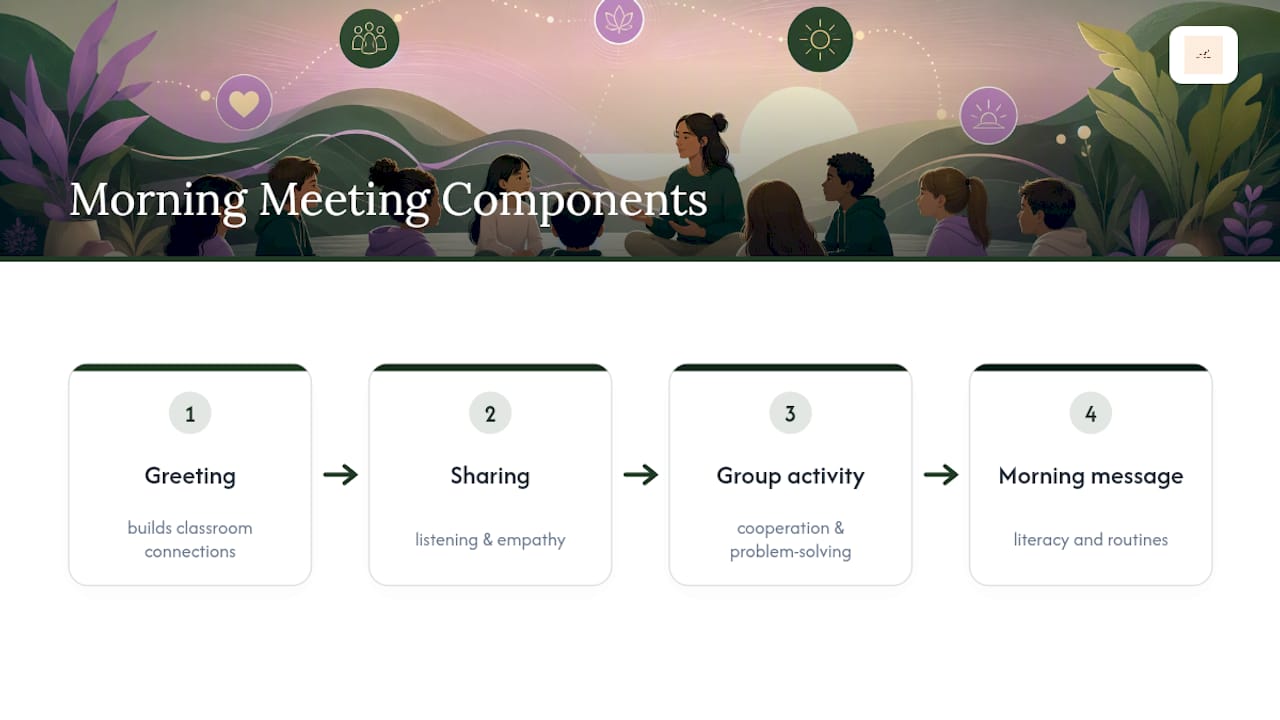
Responsive Classroom built the framework most schools now use for morning meetings: four sequential components — greeting, sharing, group activity, and morning message. Each piece trains a different skill set, so the strongest morning meetings pull from all four rather than leaning on one favorite game every day.
Greetings that actually build connection
A greeting takes 60 to 90 seconds and sets the emotional tone for everything after it. Rotate through these so it never turns into a mechanical roll call:
- Name and gesture: student says their name paired with a movement (wave, fist bump, spirit fingers); the group echoes both.
- Multilingual hello: post five greetings in different languages on a chart; students pick one to use that week.
- Silent nod circle: no talking, just eye contact and a nod around the circle. Great for high-energy Mondays.
- Compliment pass: each student gives the next person a specific, kind observation ("You helped me find my pencil yesterday").
- Partner high-five wave: students greet two different partners in 30 seconds, forcing quick mixing.
- Question greeting: "Good morning, [name]. What's your favorite season?" Rotates through the circle with a new question each day.
- Cross the circle: a student calls a category ("if you have a pet") and matching students cross to swap seats while greeting each other.
- Echo clap greeting: greeter claps a rhythm, the group claps it back before saying good morning.
- Sign language greeting: teach one sign a week (hello, friend, kind) and use it as the standard greeting.
- Roll the ball: a soft ball gets rolled or tossed with a name attached, adding a light physical challenge to the verbal greeting.
Sharing and check-in options that don't eat the clock
This is where most of the emotional literacy work happens, and it's also where meetings run long if you don't set a hard limit. The Mood Meter, one-word weather reports, and color-coded feelings charts are the three most common formats, and each takes under two minutes for a full class.
- One-word weather check: "I'm feeling sunny, stormy, or foggy today," with a quick why if time allows.
- Mood Meter placement: students place a sticky dot or magnet on a four-quadrant chart (energy vs. pleasantness) as they enter.
- Rose, thorn, bud: one good thing, one hard thing, one thing to look forward to. Written on sticky notes for students who don't want to speak aloud.
- Gratitude go-around: "One thing I'm thankful for this morning."
- Feelings wheel spin: a spinner lands on a feeling word, and the student who lands it tries to name a time they felt that way.
- Two-minute journal prompt: a single sentence starter ("Today I need...") written silently, no sharing required.
- Thumbs check: thumbs up, sideways, or down for a quick temperature read without singling anyone out.
- Exit ticket flip: students flip a card from happy to worried on their desk as a nonverbal ongoing signal all morning.
- Color card check-in: green, yellow, red cards placed in a basket, giving you a fast visual scan of the room's mood.
- Silent nod share: for days when talking feels like too much, a simple head nod at a feeling word posted on the board counts as participation.
The feelings circle model from UC Berkeley's Greater Good in Education breaks the check-in into four steps: ask what feelings are, ask what they feel like in the body, go around the circle, then expand vocabulary with more complex feeling words as the year goes on. That structure works well as a scripted starting point if your class is new to naming emotions. Icon Literary's emotion check-in scripts offer a similar bank of 60-second to 5-minute versions you can rotate through without reinventing the wheel each week.
Group activities that teach cooperation
Group activities run two to five minutes and are where problem-solving and teamwork actually get practiced, not just discussed.
- Human knot: a classic for building physical cooperation and patience.
- Silent line-up: order the class by birthday month without talking.
- Partner mirror: one student moves slowly, the partner mirrors every motion.
- Group count to 20: the class counts to 20 one number at a time with no signal for who goes next; if two people speak at once, start over.
- Yes, and... story: build a group story one sentence at a time, each student adding on. Printable game collections offer more structured versions of these if you want step-by-step instructions on hand. A quick emotion sorting activity also works well here, since it doubles as a group task and a vocabulary builder.
Using the morning message with purpose
The morning message is the most underused of the four components. Most teachers write a simple greeting and skip the SEL potential entirely. Instead, embed a feeling word of the day, a reflection question tied to yesterday's group activity, or a preview line that connects to the day's academic content ("Today we're reading about a character who feels left out. Have you ever felt that way?"). That single sentence turns a routine announcement into an emotional literacy bridge for the rest of the day.
Three Timed Routines You Can Run Tomorrow
Pick the routine that fits your schedule and follow it step by step. Each one pulls directly from the activity bank above.
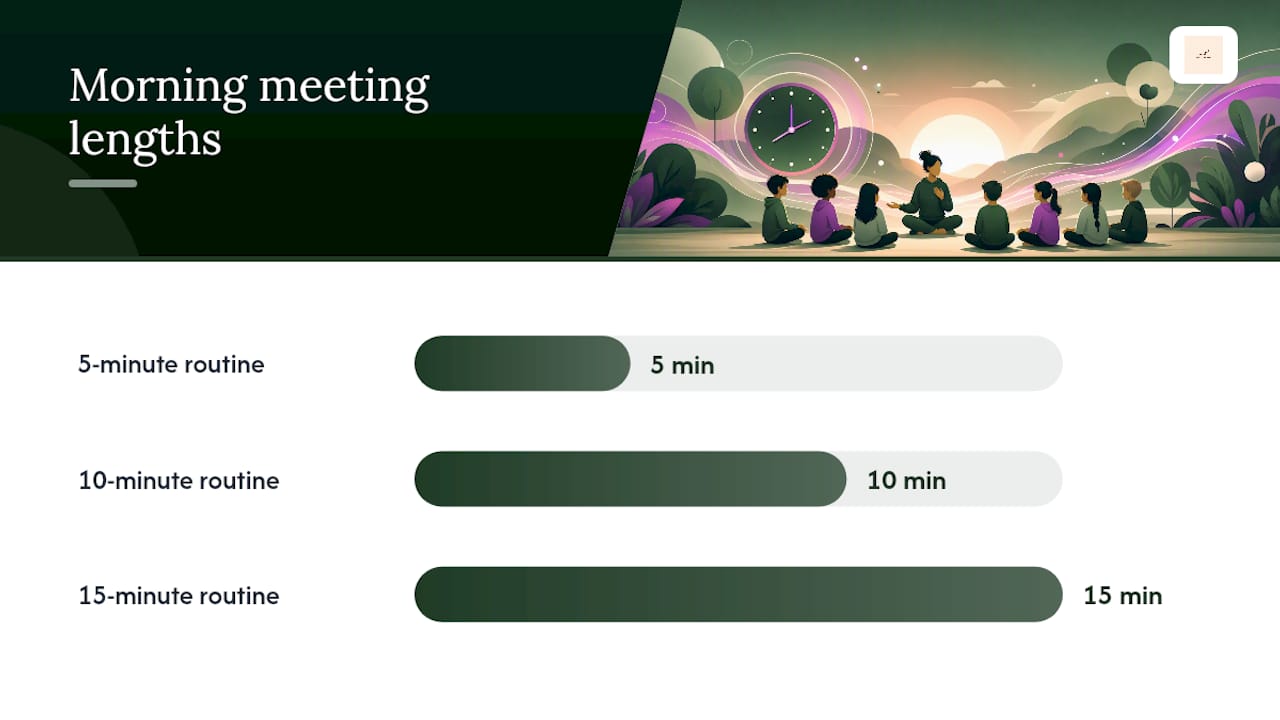
1. The 5-minute version
- Greeting (30 seconds): silent nod circle.
- Check-in (90 seconds): one-word weather report.
- Group activity (2 minutes): partner mirror.
- Message (1 minute): teacher reads a two-sentence message with a feeling word highlighted.
2. The 10-minute version
- Greeting (1 minute): compliment pass.
- Sharing (3 minutes): Mood Meter placement, then two volunteers explain their placement.
- Group activity (4 minutes): human knot or yes, and... story.
- Message (2 minutes): message includes a reflection question tied to yesterday's activity.
3. The 15-minute version
- Greeting (2 minutes): multilingual hello, rotating through the week's chart.
- Sharing (5 minutes): rose, thorn, bud with written option for reluctant sharers.
- Group activity (5 minutes): a longer cooperative task, like a class-wide story build or a short read-aloud discussion.
- Message (3 minutes): message previews academic content and links it to an SEL theme for the week.
These match the 10-minute frameworks and question banks many teacher resource sites recommend as starting templates, then let you stretch or compress based on the day.
Pro Tip: Post the routine's timing on a visible clock or timer chart so students see the countdown themselves. It reduces "how much longer" questions and builds their own sense of time ownership.
For transitions between steps, a consistent nonverbal cue (a chime, a specific song clip, a raised hand) works better than a verbal "okay, next" every time. Students pick up the pattern within a week and the meeting keeps moving without you talking over it.
Adjusting SEL Morning Meeting Activities by Grade
The same activity structure can serve a kindergarten class and an eighth-grade advisory period. What changes is the scaffolding, not the format.
- K to 2: use visual charts for the Mood Meter instead of asking for verbal explanations, and have the teacher model the first two or three shares before opening it up. One-word weather works well here because it removes the pressure of a full sentence.
- Grades 3 to 5: students can write a short reflection before sharing aloud, and check-ins can expand into more specific feeling words instead of basic categories like happy or sad. This is a good age to introduce a feelings wheel for vocabulary building.
- Middle school: shift toward written or small-group formats since whole-class sharing often feels exposed at this age. Let students facilitate sections of the meeting themselves, and swap some verbal shares for anonymous digital or paper check-ins.
The core adjustment principle: keep the structure identical across grades, but change the cognitive load, not the format. Younger students get visual prompts and teacher modeling; older students get written reflection or student-led facilitation replacing teacher language.
For English learners, pair verbal prompts with visuals or a bilingual chart, and allow gesture-based responses as valid participation, not a lesser substitute. For neurodiverse students, always offer a non-verbal or written alternative to speaking aloud, and never make eye contact or physical greeting types mandatory. A feelings corner setup with visual supports gives these students a consistent reference point every morning rather than reinventing expectations daily.
Pro Tip: If a student consistently passes on sharing, don't call on them directly the next day either. Offer a private written option instead. Forcing a share after an opt-out teaches avoidance, not trust.
Running Morning Meetings So They Actually Stick
A predictable start and stop signal does more for classroom management than any single activity choice. Nonverbal cues — a chime, a specific 10 to 12 second song clip, or a raised hand — reduce off-task behavior because students learn the cue fast and stop needing verbal redirection.
- Assign rotating student roles: greeter, timekeeper, and recorder. Ownership goes up when a student, not the teacher, is watching the clock.
- Keep materials low-prep: a deck of prompt cards, a printed feelings chart, and a visible timer cover 90% of what you need.
- Fold in a 90-second feelings wheel activity once a week to build emotion vocabulary without adding a new routine.
- Use a checklist taped inside your planner: signal ready, greeting, share, activity, message, transition cue.
Educator burnout is a real factor in whether any classroom routine survives past October, and tools like Signal Engine's educator wellness platform exist specifically because staff check-ins matter as much as student ones. A meeting you can run on autopilot after the first two weeks is a meeting that survives a hard semester.
Common Morning Meeting Mistakes and How to Fix Them
The single most common failure mode: the meeting slides into attendance-taking or announcements and loses its SEL purpose entirely. If the only thing happening is roll call and a schedule readout, you've lost the component that builds belonging and self-awareness.
- Fix: protect at least one sharing and one group activity every single day, even a 90-second version, rather than skipping to the message when time is short.
- Forcing shares: a student who opts out shouldn't be pressured or singled out; offer a nonverbal or written alternative instead so belonging doesn't hinge on speaking aloud.
- Teacher talk-over: if you're narrating every transition and answering your own check-in question first, students learn to wait you out instead of participating. Let silence sit for a few seconds before jumping in.
- Stale prompts: reusing the same three questions all year drains engagement fast. A rotating weekly focus — belonging on Monday, self-awareness Tuesday, empathy Wednesday, growth mindset Thursday, reflection Friday — keeps the meeting fresh and deliberately covers different SEL skills across the week.
What the Research and Classroom Practice Actually Show
Responsive Classroom's four-component structure isn't just a nice organizing idea. It's the model most widely adopted in American elementary schools, and it exists because greeting, sharing, group activity, and morning message each train a distinct skill: social greeting, verbal expression, cooperative problem-solving, and literacy or academic preview. Skip one component regularly and you lose whatever skill it was building.
Fairfax County Public Schools' six-week SEL calendar is worth studying even if you don't teach in that district, because it shows how to scaffold morning meeting content across the opening weeks of school rather than treating every day as identical. Early weeks lean harder on relationship-building; later weeks introduce more complex feeling vocabulary and problem-solving tasks.
The strongest morning meetings treat relationship-building as the priority over academic content in those first weeks. Psychological safety has to come before a class can do its best academic thinking, and a meeting that skips straight to curriculum previews on day one skips the part that makes the rest of the year work.
Icon Literary's read-aloud and printable SEL materials come out of the same instinct: kids absorb emotional vocabulary faster through story and object than through direct instruction. A prompt card or a short picture book character becomes a stand-in for a feeling that's hard to name directly, which is exactly the gap a morning meeting sharing component is trying to close.
Templates and Resources Worth Bookmarking
A handful of pages cover almost everything you'll need to plan a semester of morning meetings without starting from scratch.
- Responsive Classroom's Morning Meeting hub: background reading on the four-component model.
- FCPS's six-week SEL calendar: a real district template for the start of the year.
- 200 morning meeting questions and routines: a large question bank plus sample weekly plans.
- Feelings circle practice script: step-by-step language for building emotion vocabulary.
- Emotional themes cataloging system: a planning tool for organizing weekly SEL themes in advance.
Why Most Morning Meeting Advice Undersells the Message Component
That's backwards. The message is the one component that can carry academic content and emotional vocabulary at the same time, and it's the piece most teachers write on autopilot.
The bigger issue with conventional advice is the assumption that more novelty equals more engagement. It doesn't. A rotating weekly focus works because it's predictable in structure and varied in content, not because every day brings a brand new game. Teachers who chase a fresh icebreaker daily burn out faster than the ones who commit to a five-day rhythm and adjust only the prompt.
If you take one thing from this, prioritize the transition signal and the message line before you worry about finding the perfect check-in question. A meeting that runs on time, every time, teaches students more about safety and predictability than any single clever activity ever will.
— Derek Amarillas
Bring a Feelings Vocabulary Boost Into Your Morning Meeting
Prompt cards from a multidisciplinary creative studio give you a stack of character-driven prompts built to spark exactly the kind of feelings vocabulary conversation a morning meeting sharing circle needs, without requiring you to write a new question every week.

Try this as a 30 to 60 second addition to tomorrow's meeting: pull one card from the deck, have the class name the character's feeling out loud, then ask one student to connect it to their own one-word check-in. It slots directly into the sharing or group activity slot without adding prep time. Duckwave Decks run $7 as a one-time purchase, and if you want a broader set of character worlds to pull from for read-alouds later in the week, the full Icon Literary catalog includes Socko's Universe and other activity packs. Start with one deck, preview a card before your next meeting, and see how the class responds.
Sources
- Morning Meeting | Responsive Classroom
- Social and Emotional Learning (SEL) in the First Six Weeks: Elementary School
- 200 Morning Meeting Questions and SEL Routines to Build Classroom Culture
- Feelings circle: an SEL Kernels practice for second grade — Greater Good in Education (UC Berkeley)
FAQ
What Are the Four Components of a Morning Meeting?
Greeting, sharing, group activity, and morning message make up the Responsive Classroom model most schools use. Each component trains a different skill, from social greeting habits to cooperative problem-solving.
How Long Should a Morning Meeting Last?
Ten minutes covers all four components at a workable pace for most elementary classrooms, though a tight 5-minute version and a fuller 15-minute version both work depending on your schedule. Quick-routine frameworks are built around this same 10-minute target.
What Do I Do if a Student Refuses to Share?
Offer a nonverbal or written alternative instead of calling on them again the next day. Forcing participation after an opt-out teaches avoidance rather than trust, and belonging shouldn't depend on speaking aloud.
What's a Quick SEL Check-In I Can Start Tomorrow?
A one-word weather report ("I'm feeling sunny, stormy, or foggy") takes under two minutes for a full class and needs zero materials. The Mood Meter is a close second if you want a visual placement option instead of a verbal one.
Does Icon Literary Have Morning Meeting Materials?
Icon Literary's Duckwave Decks work as prompt cards for feelings vocabulary shares during the sharing or group activity portion of a morning meeting. The decks are $7 as a one-time purchase, with additional activity packs available in the full catalog.