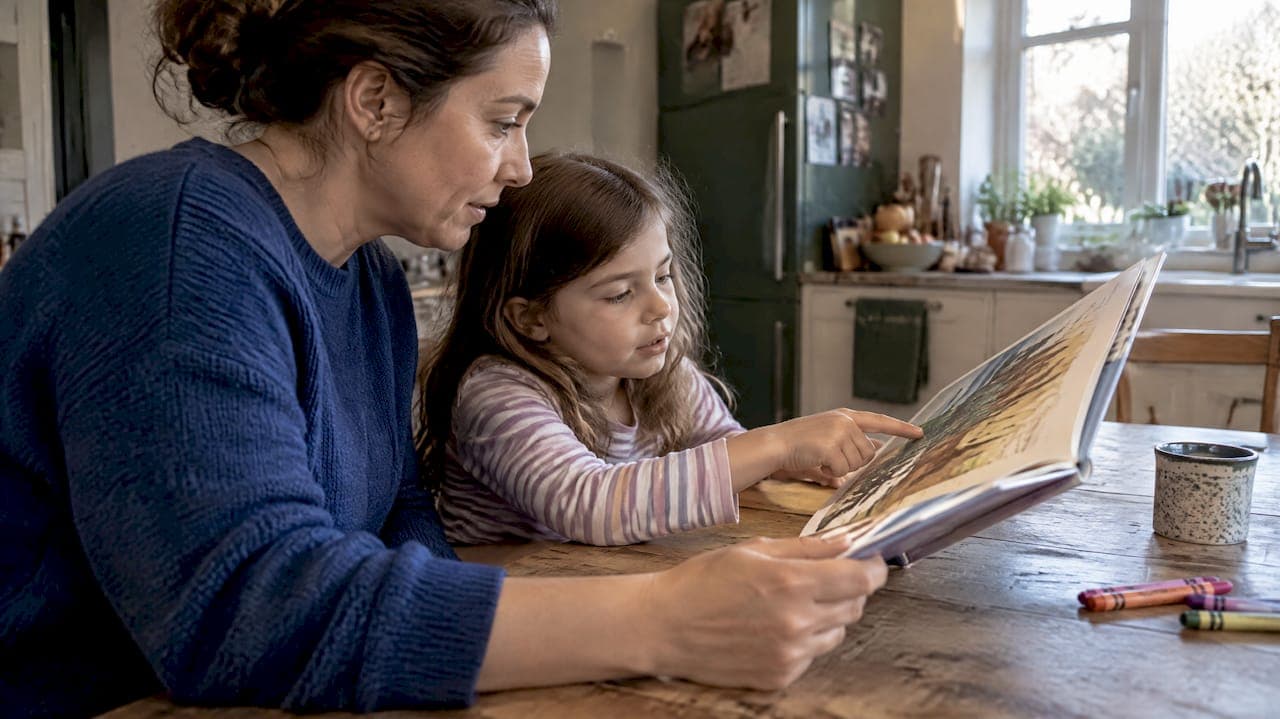
Book companion activities are short, adaptable exercises that extend a read-aloud so a story turns into real practice with vocabulary, comprehension, and social-emotional skills. They work for parents, educators, and therapists, and most take just 5 to 20 minutes to set up and run. The activity bank below gives you ready-to-use options you can match to any book on your shelf.
TL;DR:
- Vocabulary building activities reinforce target words through acting out or matching, with low prep and quick turnaround times around five minutes.
- Activities can be scaled in complexity by adjusting language, sequence steps, and motor demands, accommodating children from ages 3 to 8.
- Repeating a three-step vocabulary routine over several days with sentence frames and partner shares yields better word retention than single explanations.
- Ready-made activity kits like Duckwave Decks provide quick prompts and materials to implement activities efficiently, saving time on preparation.
- Most activities last between 5 and 20 minutes and can support IEP goals in areas like sequencing, social-emotional development, and expressive language.
Table of Contents
- 1. Activity Types to Match Any Reading Goal
- 2. How to Adjust Activities by Age and Ability
- 3. The Research Behind Evidence-Based Read-Aloud Routines
- 4. Building a Ready-to-Use Book Companion Pack
- 5. Twelve Ready-to-Use Book Companion Activities
- 6. Aligning Book Companions with IEP Goals and Therapy Sessions
- 7. Designing Book Companions with Compassion and Play
- 8. A Ready-Made Shortcut for Busy Parents and Educators
- FAQ
- Sources
1. Activity Types to Match Any Reading Goal
Book companion activities fall into a handful of categories, and picking the right one depends on what you want a child to practice. Some need almost no prep, while others ask for a few extra materials on hand.
- Vocabulary building: Pull three target words from the book and act them out together (low-prep, 5 minutes); works best for expanding word knowledge during or right after reading.
- Sequencing and retell: Use picture cards from the story to rebuild the plot in order (prep-heavy if you make your own cards, 10 minutes); strongest for comprehension and narrative structure.
- Comprehension prompts: Ask one prediction question before reading and one reflection question after (low-prep, 5 minutes); effective for checking understanding without breaking story flow.
- Crafts: Build a paper-plate mask of a main character (prep-heavy, 20 minutes); good for engagement and fine motor practice.
- Movement: Act out a character's journey across the room (low-prep, 10 minutes); useful for kinesthetic learners and restless groups.
- Sensory exploration: Match a texture bin to a setting in the book, like sand for a beach scene (prep-heavy, 15 minutes); helpful for sensory-seeking children and younger preschoolers.
- AAC-friendly choice activities: Offer a picture choice board for "how did the character feel?" (low-prep, 5 minutes); essential for nonverbal or emerging communicators.
Vocabulary and comprehension activities tend to work best right after reading, while sensory and movement options shine when a child needs a break from sitting still.
2. How to Adjust Activities by Age and Ability
The same book companion activity can serve a three-year-old and a seven-year-old if you adjust three things: how complex the language is, how many steps the sequence has, and how much movement it demands.
- Language complexity: Swap multi-clause questions for one-word or two-word prompts with younger children.
- Sequence length: Trim a five-step retell down to three main events for early learners.
- Motor demands: Replace cutting and gluing with pointing or stacking for children who need lighter fine motor tasks.
- Supports: Add picture cards, sentence frames ("The character felt ___ because ___"), or gesture prompts so children can respond without relying on full sentences.
- AAC-friendly options: Offer choice boards, model responses with a partner first, and bring in tactile manipulatives like story stones or textured cards for children who communicate nonverbally.
Pro Tip: Keep one "home base" activity format you use every week, then only change the book and vocabulary, so kids spend their energy on the content instead of relearning the routine.
3. The Research Behind Evidence-Based Read-Aloud Routines
A lot of book companion activities borrow from a three-step vocabulary routine studied in early literacy research: introduce a word with a kid-friendly definition, give the child a real chance to use it, then check understanding later rather than just once. According to REL West's teaching routine for academic vocabulary, this includes sentence frames, partner shares, and matching exercises that return to the word across several days, not just one sitting.

A three-step routine, repeated over days rather than minutes, supports stronger word retention than a single explanation. This is the backbone of the IES/REL West vocabulary routine.
Interactive read-alouds follow a similar layered structure: a first pass for surface-level plot questions, a second for inferential "why" questions, and sometimes a third for deeper thematic discussion, according to the Joyful Reading planning guide.
Short, repeated opportunities to say a new word out loud, sometimes called "miles on the tongue," help children hold onto that word with more confidence, especially when they're learning English alongside a home language.
A quick gesture, a group chorus of the word, and a one-line sentence frame fit into about five to seven minutes after reading.
4. Building a Ready-to-Use Book Companion Pack
A complete book companion pack does not need to be complicated. Reading Rockets models this well with its reading adventure pack format, which pairs fiction with nonfiction and layers in hands-on extensions.
- Parent or caregiver info sheet: Explains the goal of the pack in plain language so adults at home know what to reinforce.
- Book pairing: One fiction title plus a nonfiction companion on the same topic broadens vocabulary and real-world connections.
- Three to five activities: A mix of vocabulary, comprehension, and hands-on tasks covers different learning styles in one sitting.
- Materials list: A short list avoids last-minute scrambling for supplies.
- Home extension: A simple take-home task carries the learning past the original session.
Match each activity to one specific goal, whether that is a new vocabulary word or a social-emotional check-in, so the pack stays focused instead of sprawling.
5. Twelve Ready-to-Use Book Companion Activities
These activities cover the full range from vocabulary to sensory play, and each one adapts easily for a classroom, a living room, or a therapy session.
- Word detective: Goal: build vocabulary. Steps: pick two target words, define them simply, hunt for them again on a reread. Materials: the book. Adaptation: use picture cards for nonreaders.
- Story chain retell: Goal: sequencing. Steps: lay out four picture cards, place them in order, retell the story using them. Materials: printed scene cards. Adaptation: reduce to three cards for younger children.
- Predict and check: Goal: comprehension. Steps: pause mid-book, guess what happens next, confirm after finishing. Materials: none. Adaptation: offer two picture choices instead of an open question.
- Feelings map: Goal: SEL. Steps: draw the character's face at three story points, label each feeling, connect it to a time the child felt the same way. Materials: paper, crayons. Adaptation: use a feelings choice board for nonverbal learners.
- Texture bin match: Goal: sensory exploration. Steps: fill a bin with materials from the setting, let the child explore, connect textures to the story. Materials: sand, fabric, or rice. Adaptation: supervise closely with children who mouth objects.
- Character role-play: Goal: social communication. Steps: assign roles, act out one scene, swap roles and repeat. Materials: simple props optional. Adaptation: model lines first for hesitant speakers.
- Family extension task: Goal: home-school connection. Steps: send home one question, have the family discuss it at dinner, report back the next day. Materials: a printed prompt card. Adaptation: translate the prompt for multilingual households.
- Act it out: Goal: comprehension through movement. Steps: pick a key action from the book, move across the room doing it, name the action aloud. Materials: open space. Adaptation: seat-based gestures for limited mobility.
- AAC choice board: Goal: expressive communication. Steps: present three picture options for a story question, point or vocalize a choice, confirm with a model. Materials: a printed choice board. Adaptation: laminate for durability and reuse.
- Mini-book maker: Goal: creative retell. Steps: fold paper into a four-page book, draw one scene per page, narrate the story aloud. Materials: paper, markers. Adaptation: pre-draw outlines for children who need visual support.
- Sound and gesture chorus: Goal: vocabulary retention. Steps: choose a target word, pair it with a gesture, repeat chorally three times. Materials: none. Adaptation: slow the pace for children still building oral language.
- Cozy nook check-in: Goal: emotional safety. Steps: create a quiet corner, open with a calm-down tool, invite one sentence about how the book connected to real life. Materials: a cushion or blanket. Adaptation: keep the ritual identical every session for predictability.
6. Aligning Book Companions with IEP Goals and Therapy Sessions
Book companion activities map onto common IEP objectives without much extra planning. A retell activity can target sequencing goals, a feelings map can support social communication objectives, and a choice board can document expressive language progress.
- Checklists: Mark whether a child used a target word or completed a step independently.
- Thirty-second probes: Record one quick response per session to track growth over time.
- Anecdotal notes: Jot a single sentence describing what happened, useful for session notes without heavy paperwork.
- Home-school handoff: Send the parent info sheet and one simple home task so progress continues outside the session.
Pairing a probe with a consistent activity format makes it easier to see real change across weeks rather than guessing from memory.
7. Designing Book Companions with Compassion and Play
We think a lot about what makes a companion activity feel like play instead of homework. We design our companion materials around emotional literacy first, aesthetics second, and lesson structure last, because kids engage more honestly when a book does not feel like it is teaching at them. One of our favorite formats pairs a feelings-based story moment with an open-ended art prompt, letting a child respond however fits them that day.
— Derek Amarillas
8. A Ready-Made Shortcut for Busy Parents and Educators
Building a full activity bank from scratch takes time most parents, teachers, and therapists do not have. Our Duckwave Decks give you themed card sets built around our original story worlds, so you get prompts, vocabulary cues, and SEL discussion starters without assembling your own materials.

| What you get | Best for | Price |
|---|---|---|
| Duckwave Decks | Parents and educators wanting ready-made prompts | price details are available on the pricing page |
| Socko's Universe catalog | Readers wanting a wider library of companion downloads | Price available on request |
Each deck pairs with storybooks, allowing users to pull a card and run an activity in minutes instead of building one from scratch. Browse the full Icon Literary catalog to see which world fits your reader best.
FAQ
What age group are book companion activities best for?
Book companion activities work well from preschool through early elementary, roughly ages 3 to 8, since you can adjust language complexity and motor demands for each stage. Younger children benefit from shorter sequences and picture supports, while older children can handle multi-step retells and open-ended discussion.
How long should a book companion activity take?
Most activities run between 5 and 20 minutes, depending on prep level and group size. A vocabulary chorus or a quick prediction prompt takes about 5 minutes, while a craft or sensory bin activity can run closer to 20.
Can book companion activities support IEP goals?
Yes, activities like sequencing retells, choice boards, and role-play map directly onto common objectives for expressive language, social communication, and sequencing. Therapists can pair these with simple data tools like checklists or quick probes to track progress session by session.
What is the three-step vocabulary routine?
The three-step routine involves introducing a word with a student-friendly definition, giving the child a real opportunity to use it, and checking understanding again later rather than only once, based on REL West's research. This spaced approach supports stronger retention than a single explanation during the read-aloud.
Are Duckwave Decks a good fit for therapy sessions?
These decks can work as a supplement for therapists who want ready-made prompts tied to original story worlds, especially for SEL and expressive language goals. Each deck costs a one-off small fee and pairs naturally with the feelings-based activities described above.
Sources
- Teaching routines for academic vocabulary in grades preK–1 (IES / REL West video)
- Reading adventure pack example (Reading Rockets)