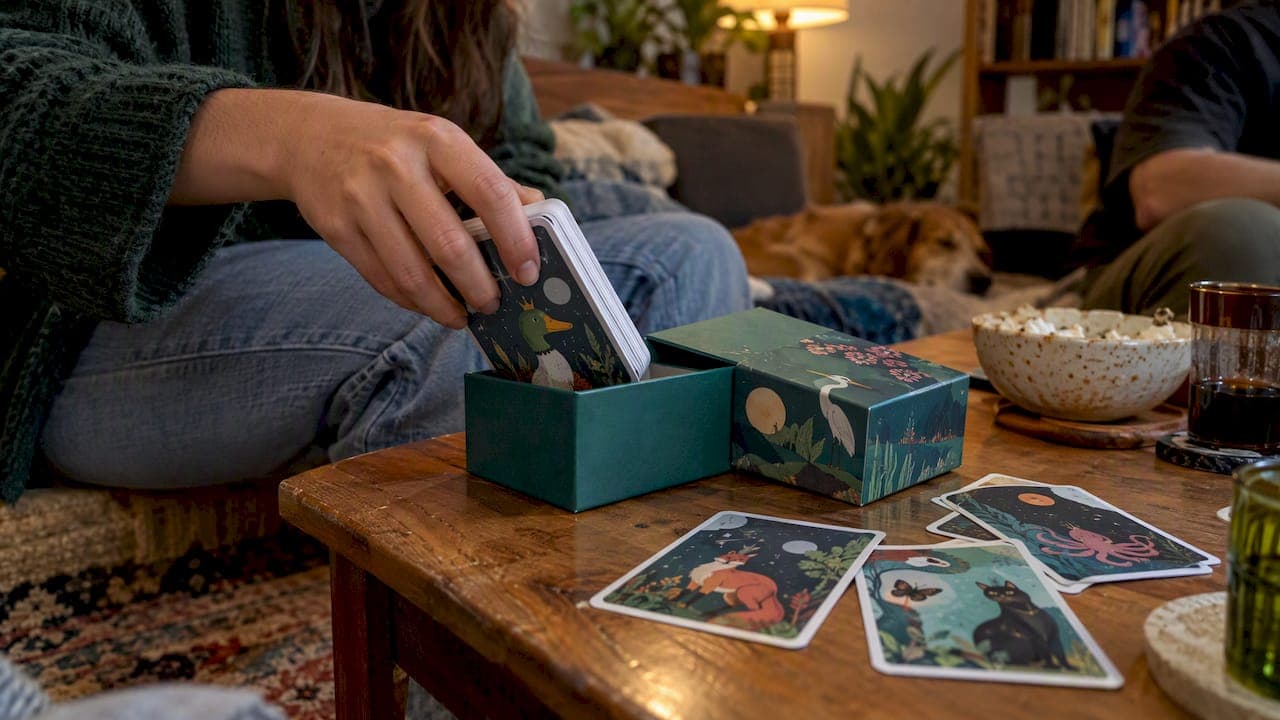
The best approach to card deck storage uses three tools together: deck boxes for the decks you play often, labeled long boxes or binders for everything in bulk, and archival sleeves or top-loaders for your valuable singles. This system scales from a handful of decks to hundreds, and it stays easy to maintain. Below, we'll walk through the containers, materials, and small habits that make it work, plus some low-cost and creative options you can set up today.
TL;DR:
- Measure a sleeved deck before buying a box, leave clearance for the lid, and choose a rigid latch over a soft pouch for travel.
- Store bulk cards in long boxes with dividers, sort by color or set, and keep side labels visible after shelving.
- Protect valuable singles with archival inner sleeves and an outer sleeve; choose polypropylene or polyethylene rather than rigid PVC for storage over time.
- Store cards away from direct sunlight, at stable temperatures below 70°F, and between 35% and 50% relative humidity where possible.
- Use one inbox for unsorted cards, choose a filing rhythm you can maintain, and keep labels on box sides so they remain visible.
Table of Contents
- 1. Quick list: practical storage ideas for every collection size
- 2. Compact solutions for active decks and travel
- 3. Systems for bulk collections: boxes, binders, and digital inventory
- 4. Protection and preservation: sleeves, top-loaders, and safe materials
- 5. Space-saving shelving and display ideas
- 6. DIY and budget-friendly card organizers you can make today
- 7. A low-friction organizing workflow you can keep up
- 8. Icon Literary's educator-tested display and storage guidance
- 9. Author's short example system to model
- Themed decks worth adding to your shelf
- FAQ
- Sources
1. Quick list: practical storage ideas for every collection size
Here's a fast scan of options, so you can match one to your actual space and habits before reading further.
- Single-deck boxes: best for decks you carry to game night.
- Vertical card holders: best for quick access to two or three active decks on a desk.
- Long boxes with dividers: best for bulk commons and duplicates.
- 9-pocket binders: best for valuable singles you want to flip through and show off.
- Labeled plastic bins: best for grouping multiple small boxes by game or set.
- Photo storage totes: best for travel or temporary overflow.
- Kallax cube hacks: best for a shelf system that doubles as a room feature.
- Wall shelves: best for displaying a few favorite decks at eye level.
- Tabletop display cases: best for showing off a single standout deck.
Pick based on how often you play, how much you travel, and whether you want anything visible at all.
2. Compact solutions for active decks and travel
Padded or magnetic deck boxes protect the cards you reach for most, and they hold up to being tossed in a bag. Vertical table holders work well if you rotate between two or three decks during a session, since you can see and grab what you need without digging. Short trays are a good middle ground when you want decks upright but don't need full magnetic closures.
- Keep a written deck list taped inside or attached to the box so you always know what belongs there.
- Choose a box with a bit of extra depth if your cards are sleeved, since sleeved cards run thicker than bare ones.
- Favor rigid-latch boxes for travel over soft pouches, which can crush corners in a bag.
Pro Tip: Measure your deck with sleeves on before buying a tight-fit box. Standard sleeves add noticeable bulk, and a box sized for bare cards often won't close.
3. Systems for bulk collections: boxes, binders, and digital inventory
Once your collection grows past a few decks, splitting it into three groups makes everything easier to find: active decks you play, bulk commons and duplicates, and display-worthy singles. This mirrors what serious collectors recommend, since separating active decks from bulk storage keeps your shelf usable instead of a single overwhelming pile.
- Use long or 1,000-count boxes with dividers for bulk, sorted by color or set.
- Keep one binder per category for valuable singles you want to browse without unsleeving them.
- Add a small tokens box, since loose tokens and dice tend to scatter without a dedicated spot.
Digital inventory tools add a useful layer on top of physical filing. Scanning or importing your collection into an app helps you see what you already own before you buy more, and tools built for this purpose pull real-time data to keep your records accurate as your shelves change.
4. Protection and preservation: sleeves, top-loaders, and safe materials
Layered protection works best for cards you care about keeping in good shape. Start with an inner archival sleeve, add a standard sleeve for everyday handling, and reserve rigid top-loaders or slabs for your highest-value singles. This is the same approach described in professional preservation guides, which pair archival "perfect-fit" sleeves with a second outer layer for play.
Material matters as much as the layering. Rigid PVC holders can off-gas acidic vapors over time, and polypropylene (PP) or polyethylene (PE) sleeves are the safer industry standard for long-term storage.
Beyond the sleeve, your storage environment plays a role too. Keep boxes and binders out of direct sunlight, aim for stable temperatures below 70°F, and hold relative humidity between 35% and 50% where your space allows it.
5. Space-saving shelving and display ideas
If you're short on space, a few household staples do double duty as card storage. IKEA Kallax cubes hold long boxes and binders at a consistent size, drawer inserts keep loose singles from sliding around, and photo storage totes work as an affordable stand-in for purpose-built boxes.
- Adapt factory inserts or cut foamcore trays to fit your box dimensions exactly.
- Arrange boxes so spines or side labels face outward for quick scanning.
- Reserve open shelf space for a handful of favorite decks, keeping the rest in closed, protected storage.
Board game storage hacks built around modular cube shelving translate directly to card collections, since the same vertical arrangement that organizes board game boxes keeps card boxes upright and visible.
6. DIY and budget-friendly card organizers you can make today
You don't need custom furniture to build a working system. A few simple projects cover most needs:
- Wooden deck box: a basic open-top box sized to your card dimensions, finished with a light sand to avoid snags.
- Foamcore dividers: cut strips to fit inside a long box, spaced to separate sets or colors.
- 4x6 photo totes: repurposed for travel decks, since they're sized close to standard card dimensions already.
When measuring for sleeved cards, add a small clearance gap so the box still closes without forcing the lid. Upcycle household containers for bulk or overflow storage, but switch to purpose-built boxes for anything you plan to display or protect long-term.
7. A low-friction organizing workflow you can keep up
The simplest system is the one you'll actually maintain. Start with an "inbox," a single container where new or unsorted cards land until you have time to file them. Collectors who manage large collections recommend starting with an honest count of what you own and sorting by a method you'll stick with, since color-first sorting tends to be easier to maintain than a more elaborate system.
- Set a filing rhythm, such as after game night, once a week, or whenever the inbox fills up.
- Pick one sort order and stay with it, placing labels on the side or spine so they're readable when boxes are shelved.
- Photograph your most valuable singles and keep a basic digital backup of your inventory.
Pro Tip: Label placement matters more than label style. Side or end labels stay visible once boxes are shelved, while lid labels disappear the moment boxes stack.
8. Icon Literary's educator-tested display and storage guidance
We've worked with teachers and parents to shape display approaches that hold up in classrooms: low shelving height so kids can reach decks safely, child-safe materials, and clear labels for quick retrieval. Themed decks can stay both collectible and classroom-ready with modest protective choices like sturdy boxes and simple sleeves. Our card deck display and dream cards guides walk through both in detail.

9. Author's short example system to model
Our own shelf runs on four pieces: an inbox tray for anything new, long boxes sorted by color for bulk, one binder for rare singles, and a tray for whatever deck is in active rotation. This mix works because each piece has one job, so nothing competes for the same space. The lesson worth copying: a system survives only when it stays simpler than your willingness to keep up with it.
— Derek Amarillas
Themed decks worth adding to your shelf
If you're building a collection that doubles as a classroom resource or a shelf centerpiece, themed decks can bring original character-driven art to a format that fits the storage systems above without any special handling. Socko's Universe offers another option of collectible decks suitable for the same shelf or display case.
| Product line | Best for | Price |
|---|---|---|
| Duckwave Decks | Collectors and classrooms wanting original character art | $7 one-off |
| Socko's Universe | Collectors wanting more display-friendly themed decks | Price details available on the website |
Browse the full lineup in our card deck catalog and find the deck that fits your shelf.
FAQ
Where should I store my cards?
Keep decks you play often in deck boxes within easy reach, and store bulk cards in labeled long boxes or binders on a shelf out of direct sunlight. Valuable singles belong in archival sleeves or top-loaders for added protection.
What are some creative ideas for a wedding card box?
A wedding card box can be built from a decorated long box, a repurposed photo tote, or a simple wooden box with a slotted lid, styled to match the event. The same principles apply as with any card storage: a sturdy container, a clear slot or opening, and a stable spot away from heat or direct sun.
What do you store in a deck box?
A deck box typically holds one active, ready-to-play deck, often with sleeves already on the cards. Many players also tuck in a written deck list so the contents are easy to confirm at a glance.
What is the proper order for a deck of cards?
There's no single universal order, since different games and collectors use different systems. Picking one consistent method, such as sorting by color or suit, and sticking with it is more useful long-term than following a strict traditional sequence.
Sources
- How to organize a card collection — Foilio
- MTG sleeving & storage guide — Scrytics
- How to manage an MTG collection — TurnZero HQ