
This guide gives you ready-to-run emotion sorting activities for toddlers through preschoolers, including feelings-column mats, scenario cards, and photo-matching games. You will also find setup steps, adaptations for children with autism or language delays, and ways to pair each emotion label with a coping strategy. Some emotion card decks and feelings-wheel practices are used throughout, so every activity connects labeling to real regulation.
TL;DR:
- Matching real photos of children’s faces to emotion words helps toddlers and preschoolers build their basic emotion vocabulary rapidly.
- Sorting activities should incorporate coping strategies alongside emotion labels to teach children how to manage their feelings effectively.
- Using laminated cards with Velcro or magnets increases durability and allows quick setup for repeated activities, keeping children engaged over time.
- Activities should be adapted for children with autism or language delays through predictable structures, visual supports, and sensory-friendly materials.
- Incorporating emotion sorting into daily routines like morning check-ins or transitions fosters consistent emotional awareness without adding stress.
Table of Contents
- Emotion Sorting Activities You Can Run Today
- Materials, Prep, and Storage That Make Activities Last
- Adapting Emotion Sorting for Different Ages and Abilities
- Turning Sorting Into a Regulation Tool
- Fitting Emotion Sorting Into the Daily Routine
- Facilitation Techniques That Deepen the Activity
- Emotional Expressions Look Different Across Cultures
- Talking Through the Sort, Not Just Grading It
- Tracking Progress Without Turning It Into a Test
- Starting With Faces Before Anything Else
- Why Play Beats Instruction Here
- Try a Ready-Made Deck Before You Build Your Own
- Sources
- FAQ
Emotion Sorting Activities You Can Run Today
Emotion sorting activities generally split into two types: matching facial expressions to labels, or categorizing lived experiences into positive and negative feelings, so kids learn to tell joy apart from stress instead of lumping every big feeling together. Here are ten you can set up in the next ten minutes.
- Photo-face matching. Goal: build a basic emotion vocabulary. Show a set of real child photos showing happy, sad, angry, scared, and excited faces; the child matches each to a printed word card. Works for ages 2 to 4. Materials: 10 to 15 laminated photo cards, 5 word cards. Adaptation: for nonverbal children, skip the words entirely and sort face to face using two identical decks.
- Feelings-column mat. Goal: sort recognized emotions into named categories. Lay out a mat with five columns, hand the child a stack of face or scenario cards, and have them place each card in its column. Ages 3 to 6. Materials: printed mat, 20 cards, small bin per column. Adaptation: reduce to three columns (happy, sad, mad) for younger toddlers.
- Scenario sorting cards. Goal: connect situations to feelings, not just faces. Read a short scenario ("Your tower fell down"), and the child picks the matching emotion card. Ages 4 to 6. Materials: 15 scenario cards, emotion card set. Adaptation: for older kids, add mixed-emotion scenarios where two feelings apply at once.
- Feeling to strategy match. Goal: pair an emotion with a coping tool. The child sorts an emotion card, then picks a matching strategy card (deep breath, squeeze a pillow, ask for a hug). Ages 4 to 6. Materials: emotion deck, coping-strategy icon cards. Advanced sorting like this teaches kids to manage reactions to real triggers, according to Your Therapy Source, rather than stopping at the label.
- Color code feelings. Goal: build a quick visual shorthand. Assign each emotion a color, then have the child sort colored pom poms or blocks into matching emotion-labeled cups. Ages 2 to 4. Materials: colored objects, labeled cups. Adaptation: pair colors with simple hand signs for children with limited verbal output.
- Charades and role play. Goal: practice reading body language, not just faces. One child acts out an emotion; others sort it into the right category on a shared mat. Ages 4 to 6. Materials: none required beyond the mat. Adaptation: for shy kids, let them point to a card instead of performing.
- Story sequencing with emotion cards. Goal: track how feelings change across an event. Lay out three to four story panels and have the child slot in the emotion card that fits each moment. Ages 5 to 6. Materials: story sequence cards, emotion deck. This mirrors the trigger mapping used in classroom SEL interventions, per Mentally Healthy Schools.
- Sensory sorting. Goal: link physical sensation to emotional state, which supports emotional understanding as explained in this parent's guide to sensory play and child development. Sort textured objects (soft, spiky, smooth) into bins labeled with feelings they evoke for that child. Ages 2 to 5. Materials: fabric swatches, textured toys, labeled bins.
- Animated-inspired printable game. Goal: use familiar characters to lower the stakes. A printable board where kids move a token to the emotion zone that matches a drawn card. Ages 4 to 6. Materials: printable board, spinner or dice, character cards.
- Fridge version at home. Goal: make sorting part of daily life with zero setup. Magnet-backed emotion cards go on the fridge; kids move their name magnet to the feeling that fits after school. Ages 3 to 6. Materials: magnet sheet, laminated cards. This low-barrier format works well for families precisely because it slots into a transition that already happens daily, notes Oh Hey Let's Play.
Pro Tip: Skip the "right or wrong" language entirely. If a child sorts "excited" into the same bin as "scared," ask what happened in their body instead of correcting the placement. Mixed feelings are often the accurate answer, not a mistake.
Materials, Prep, and Storage That Make Activities Last
You do not need premade decks to start. A laminator, a sheet of Velcro dots, and a set of printed photo cards get you most of the way there. Magnetic tape turns any card set into a fridge or whiteboard activity, which matters more than it sounds because kids sort more willingly when the format changes even slightly.
- Laminate cards for daily handling; they survive spills and small hands far longer than plain paper.
- Use Velcro dots on mats and cards so sorting feels tactile, not just visual.
- Add magnets to the back of a second card set for a whiteboard or fridge version.
- Sort cards into labeled bins or zip pouches by activity, not by emotion, so setup takes seconds.
- For classrooms, print two or three duplicate sets so small groups can work in parallel.
Pro Tip: Rotate three or four card sets on a two-week cycle instead of using one deck forever. Novelty matters more than variety of content. The same ten cards, reintroduced after a break, often generate more engagement than ten brand-new ones.
Adapting Emotion Sorting for Different Ages and Abilities
Toddlers do best with two or three emotion choices and image-only prompts. Words can wait. Once kids reach late preschool, add mixed-emotion cards and open-ended prompts like "tell me about a time you felt this."
Children with autism or language delays often respond better to structured, predictable formats. A two-deck approach, pairing emotion word cards with separate question or task cards, gives children with autism a clear next step instead of an open-ended ask.
- Toddlers: two to three emotions max, images only, no reading required.
- Older preschoolers: mixed-emotion cards, open story prompts, journaling starters.
- ASD supports: visual schedules, predictable card order, sensory-friendly materials.
- Kinesthetic learners: build in movement, like walking to a floor mat instead of sitting at a table.
- Caregivers: keep a short reusable script on hand ("I wonder if you felt...") rather than improvising each time.
Turning Sorting Into a Regulation Tool
Labeling an emotion is only half the activity. The other half is choosing what to do about it, which is where feeling-to-strategy match cards and calm-down choice boards come in.
- Feeling to strategy match cards pair each emotion with two or three coping options a child picks from.
- Calm-down choice boards let kids point to a strategy instead of being told what to do.
- Journaling prompts work for kindergarten-age kids who can write a few words or draw a picture.
Sorting activities that fold in a coping step give children a concrete move to make instead of a reaction to suppress. Activity packs built around this idea often combine emotion images with coping icons, letting caregivers build a simple choice menu a child can return to under stress, according to Your Therapy Source.
Fitting Emotion Sorting Into the Daily Routine
Morning check-ins and transition times are the easiest places to slot this in, and they take under two minutes once the routine sticks.
- Morning check-in: each child sorts one card into "how I feel right now" before circle time starts.
- Transition script: "Before we line up, show me one card that matches your morning."
- Classroom stations: rotate a sorting mat through centers so every child gets a turn without a whole-group pause.
Card decks work best as short, repeated rituals rather than one-time lessons, which is why an emotion-of-the-day routine tends to stick better than a single big activity, per Challenge to Change. Icon Literary's emotion check-in scripts give you ready-made language if you would rather not write your own.
Facilitation Techniques That Deepen the Activity
How you talk during sorting matters more than which cards you use. Swap "what emotion is this?" for "I wonder if..." and you shift the activity from a test to a conversation.
- Use curiosity stems: "I am wondering if your body felt tight when that happened."
- Ask where the feeling shows up physically, not just what to call it.
- Name mixed feelings out loud when a child hesitates between two cards, instead of forcing one answer.
A curiosity-driven stance that asks about bodily sensations, rather than demanding a single correct label, tends to draw out more detail than direct questioning, according to Hamish & Milo. Icon Literary's feelings wheel activities offer short scripts built on this same approach.
Emotional Expressions Look Different Across Cultures
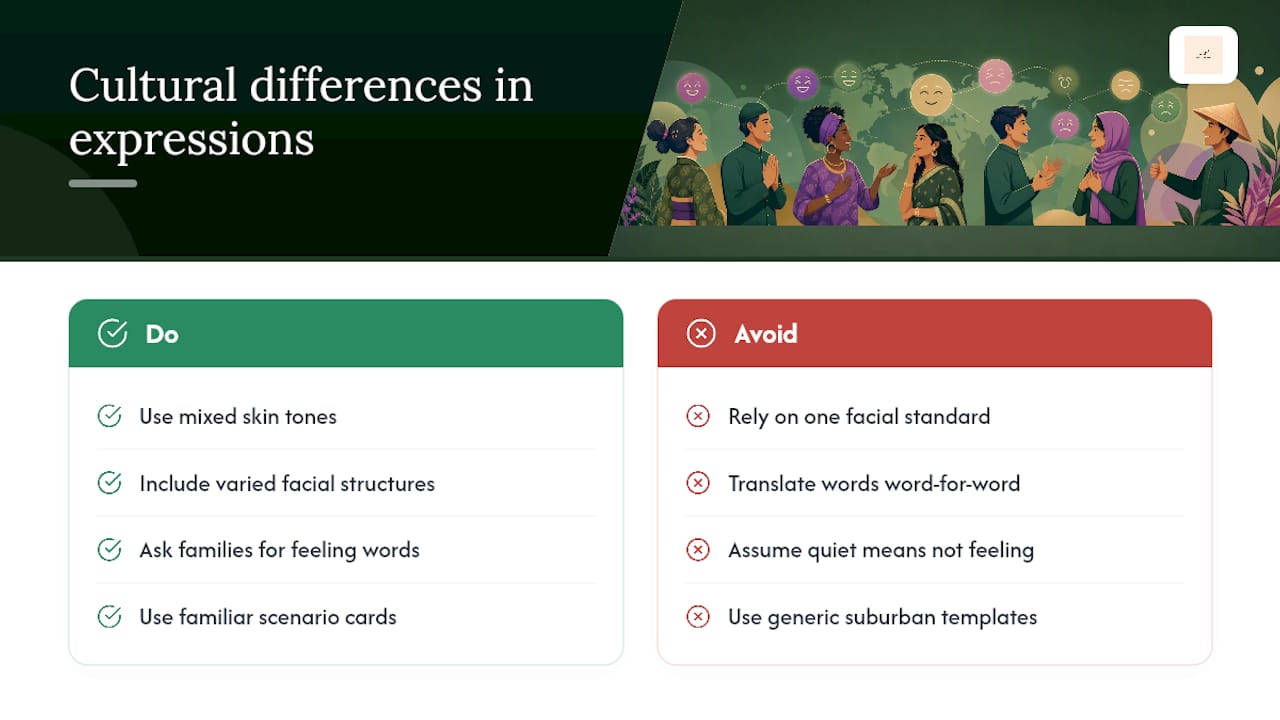
A sorting mat built entirely around one facial expression standard will miss plenty of real kids. Eye contact during a "happy" story, for instance, is expected in some households and considered rude in others. Volume matters too: loud, expressive grief or excitement is normal in some families and unusual in others, and a quiet response to a scary scenario is not automatically a sign a child does not feel it.
Skin tone and facial structure also change how expressions read on a printed card. A photo deck built from a narrow range of faces can quietly teach kids that only certain faces "count" as happy or scared, which undercuts the whole point of the activity. When you build or buy a deck, look for a mix of skin tones, family structures, and settings, not just a mix of expressions.
Language matters as much as imagery. Some households use different words for shame, pride, or grief than the standard five-emotion set (happy, sad, angry, scared, excited) covers, and translating a scenario card word for word can flatten a feeling that has more nuance in a child's home language. Ask families what words they use at home for big feelings and fold those into your scenario cards where you can.
Bring in scenario cards that reflect different family structures, holidays, and daily routines, not just a generic classroom or suburban household. A child sorting a scenario that actually resembles their life engages faster than one working from an unfamiliar template, and the sorting activity teaches more when the material feels recognizable.
Talking Through the Sort, Not Just Grading It
The conversation after a child places a card matters more than whether the placement was "correct." Ask an open question before you ask a closed one: "What happened right before you felt that?" gets you further than "Is that the right card?"
During the activity, narrate what you notice instead of judging the answer: "You picked scared for that one. I wonder what part felt scary." This keeps the child talking rather than second-guessing the placement.
After sorting, revisit one or two cards together and ask the child to expand. "Tell me more about the mad one" often surfaces a story the initial sort did not capture. For kids who struggle to verbalize, offer a menu: "Was it more like a little mad or a big mad?"
Avoid rushing to the next card. A slower pace with three cards discussed in depth teaches more than twenty cards sorted in silence. If a child gives an answer that surprises you, resist correcting it. The goal is accurate self-report, not agreement with your expectation. Close each session with a simple recap, naming the feelings that came up without ranking them, so the child leaves with a sense that all of it was worth talking about.
Tracking Progress Without Turning It Into a Test
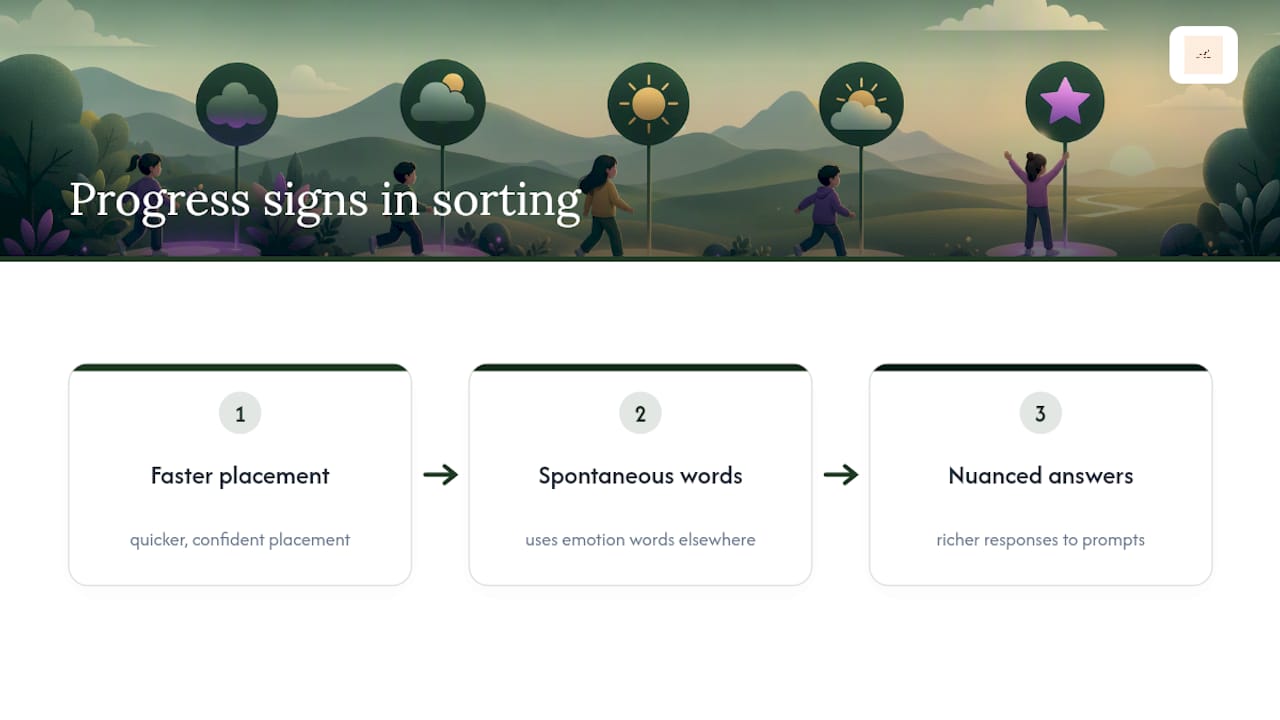
You do not need a formal assessment to know whether a child's recognition skills are growing. Watch for three shifts over a few weeks: faster, more confident card placement, spontaneous use of emotion words outside the activity, and more nuanced answers when you ask a follow-up question.
Keep a simple running note, even a sticky note in a folder, logging which emotions a child sorts easily and which ones they hesitate on. Scared and excited get confused often in early sorting, since both involve a racing heart, and that confusion resolving over time is a real marker of progress.
Watch for language transfer, too. A child who starts saying "I feel frustrated" during a puzzle, days after sorting that word on a card, is showing you the activity worked. That transfer matters more than perfect sorting accuracy during the activity itself.
Starting With Faces Before Anything Else
Before sorting scenarios or pairing strategies, most kids need practice with the basics: matching a face to happy, sad, angry, scared, and excited. These five cover most of what a toddler or young preschooler encounters daily, and they are the right starting set before adding subtler labels like frustrated or proud.
Use real photos before illustrations when you can. A cartoon face can exaggerate features in ways that do not always transfer to real expressions a child sees on a parent or classmate. Once a child reliably matches real photos, illustrated cards become a useful second layer rather than the only layer.
Expect scared and excited to get mixed up early on, since both show wide eyes and an open mouth in a lot of source photos. That confusion is normal, not a sign the activity is not working, and it usually resolves once you add the body-sensation question ("does your tummy feel jumpy, or does your heart feel fast?").
Why Play Beats Instruction Here
Kids sort feelings more honestly when it feels like a game than when it feels like a lesson. Story and play strip out the pressure to get it "right," which is exactly when children start naming what they actually feel instead of what they think an adult wants to hear. Start with one activity, watch what your child or class responds to, and build from there instead of trying every activity in one week.
— Derek Amarillas
Try a Ready-Made Deck Before You Build Your Own
A Duckwave Decks starter set provides illustrated emotion cards, scenario prompts, and printable extras built around original characters, so the sorting activity is already designed, not assembled at your kitchen table at 9 p.m.
That combination fits parents who want something artful enough to keep on the coffee table and teachers who need materials that survive a classroom without looking like a worksheet. The Duckwave Decks run $7 as a one-off purchase. This makes it an easy first buy if you are not sure a printed deck will stick with your child's routine yet. If you would rather explore the fuller catalog first, including Socko's Universe, browse the Icon Literary catalog and start with one printable before committing to a full kit.
Sources
- 5 fun ways to use an emotions card deck with kids — Challenge to Change
- Emotion card activities — Hamish & Milo
- Emotion cards — Autism Teaching Strategies
FAQ
What are the 5 C's of emotional intelligence?
Definitions vary across sources, but a common version covers self-awareness, self-regulation, social awareness, relationship skills, and responsible decision making. Emotion sorting activities build the first two directly by giving kids practice naming a feeling and choosing a coping response.
What are some fun activities about emotions?
Photo-face matching, feelings-column mats, charades, and scenario-sorting cards all work well and take under ten minutes to set up. A printed feelings wheel or an illustrated deck like Duckwave Decks can turn any of these into a repeatable game rather than a one-off worksheet.
Can emotional dysregulation cause anger outbursts?
Yes. When a child cannot identify or name a big feeling, that unprocessed emotion often surfaces as an outburst instead. Pairing emotion labels with a coping strategy, as described above, gives kids a concrete step to take before frustration turns into a meltdown.
How do I sort out my feelings?
Start by naming the emotion out loud, then ask where it shows up in your body, a technique that works for kids and adults alike. From there, matching that feeling to a specific coping action, like a breathing exercise or a short walk, turns the label into an actual plan.