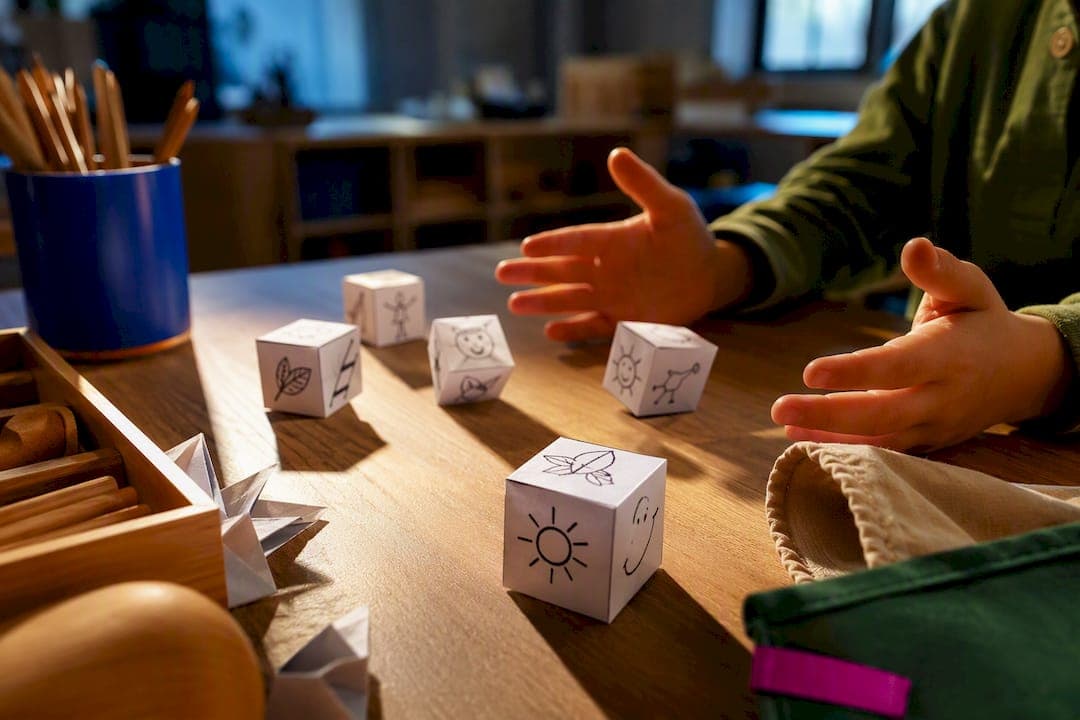
This page gives you ready-to-use story cube prompts, ten playable game formats, and step-by-step DIY templates you can build at home or in a classroom. Story cubes jumpstart storytelling fast, support social-emotional learning through low-pressure practice, and adapt easily across young children through pre-teens. Jump to the prompt list below to start rolling right away.
TL;DR:
- Using fewer prompts, such as three cubes per story, helps reduce anxiety and encourages more creative storytelling for reluctant participants.
- Building a set from basic templates with setting, character, and item categories is inexpensive, easy, and tailored to different age groups and skill levels.
- Incorporating story cube activities into lessons can develop vocabulary, sequencing, perspective-taking, and emotional literacy in a low-pressure format.
- Limiting choices and starting with simple phrases like "Once upon a time" can help overcome writer's block and boost confidence for nervous storytellers.
- Printable resources and ready-made decks are available for quick setup, enabling versatile storytelling and SEL activities without requiring crafting skills.
Table of Contents
- Story Cubes Ideas: 30 Prompts to Roll and Play
- 10 Ways to Play: Rules, Timing, and Quick Variations
- DIY Story Cube Templates You Can Build Today
- Teaching Skills and SEL Through Story Cubes
- Getting Unstuck When the Cubes Feel Intimidating
- Icon Literary's Take on Cube-Style Prompts in the Workshop
- Downloads and Guides Worth Bookmarking
- Sources
Story Cubes Ideas: 30 Prompts to Roll and Play
Story cube prompts work best when they are short, specific, and easy to picture. You don't need a physical set to start. Grab paper, write one word or image per square, fold it into a cube, and you have a working prompt generator in ten minutes.
Here are 30 prompts sorted by category, ready to write onto blank cubes or call out loud during play.
Characters:
- A grumpy dragon who lost its voice
- A detective who is afraid of the dark
- A talking backpack with opinions
- A shy robot learning to dance
- A grandmother who used to be a pirate
Settings:
- A treehouse floating above the clouds
- An abandoned lighthouse during a storm
- A candy shop that closes at midnight
- A school bus stuck in quicksand
- The inside of a snow globe
Items:
- A key that only opens on Tuesdays
- A map with one corner missing
- A jar of bottled laughter
- A broken umbrella that predicts weather
- A letter never meant to be opened
Actions:
- Someone discovers they can talk to animals
- A character loses something important in the wind
- Two rivals must share one bicycle
- A quiet kid gives a surprising speech
- Someone finds a door where a wall used to be
Emotions:
- A character feels proud but tells no one
- Someone apologizes without saying "sorry"
- A friend feels left out at recess
- A character calms down after a big mistake
- Someone feels brave for the first time
Genres and tone shifts:
- Retell the scene as a mystery
- Retell it as a fairy tale
- Retell it in five sentences only
- Add a talking object as narrator
- Set the whole story underwater
For younger children or English-language learners, swap words for pictures, or pair a simple English word with its translation on the same face. That small change turns story cube activities into a bilingual vocabulary game without losing the storytelling core.
You don't need all 30 prompts every session. Pick a few prompts at a time. A small group of cubes keeps beginners focused; more cubes give older kids or adult writers more to weave together. If you're hunting for more age-specific material, storytelling prompts sorted by age go deeper into what works for toddlers versus tweens.
10 Ways to Play: Rules, Timing, and Quick Variations
How you structure the game matters as much as the prompts themselves. Time limits, player count, and turn order all change what kind of story comes out. Here are ten formats worth trying, each adaptable in seconds.
- Solo warm-up (1 player, 5 minutes): roll a few cubes, write or say a short story within a time limit.
- Round robin (3 to 6 players, 15 minutes): each person adds one sentence based on a new roll, building one shared story.
- Beginning, middle, end (2 to 5 players, 10 minutes): roll three cubes for the opening, three for the middle, and three for the resolution, a structure that mirrors common Rory's Story Cubes gameplay guidance.
- Timed sprint (any group, 3 minutes): one roll, one minute to plan, two minutes to tell it out loud.
- Silent story (2 or more, 10 minutes): players act out the roll with no talking; others guess the plot.
- Six-word story (any group, 5 minutes): compress the whole roll into exactly six words.
- Collaborative chain (4 to 8 players, 20 minutes): pass the cubes around a circle, each person continuing where the last left off.
- Genre remix (2 to 4 players, 15 minutes): roll once, then retell the same result as comedy, then horror, then fairy tale.
- Interview format (pairs, 10 minutes): one player rolls and answers questions about the story as if they lived it.
- Digital spin (solo or remote groups, 5 minutes): use a story wheel app to spin images and record narration when a physical set isn't handy, useful for blended or remote classrooms.
For quiet or reluctant participants, drop the player count to two and let them narrate to a partner instead of a group. Facilitator scripts that model a finished sample story before asking kids to try their own tend to lower resistance in the first few minutes, a trick worth borrowing whether you're running a classroom or a living room game night.
DIY Story Cube Templates You Can Build Today
Building your own set costs almost nothing. Blank cube templates print on regular paper, fold along the seams, and glue or tape shut. For durability, use cardstock, or laminate the finished cube if it's going into regular classroom rotation.
Educators generally organize DIY cubes into three categories: setting, character, and item. That three-part split gives every roll a built-in narrative engine, since a story practically writes itself once you know where it happens, who's in it, and what object matters.
- Setting examples: forest, spaceship, kitchen, underwater cave, castle attic
- Character examples: knight, scientist, talking cat, lost tourist, tiny giant
- Item examples: compass, cracked mirror, glowing stone, old photograph, empty bottle
Build one cube per category, or mix all three onto a single six-sided die if you want faster, simpler rolls for younger kids. A printable template and full prompt list from Scottish Book Trust covers this exact three-category structure with ready-made word banks.
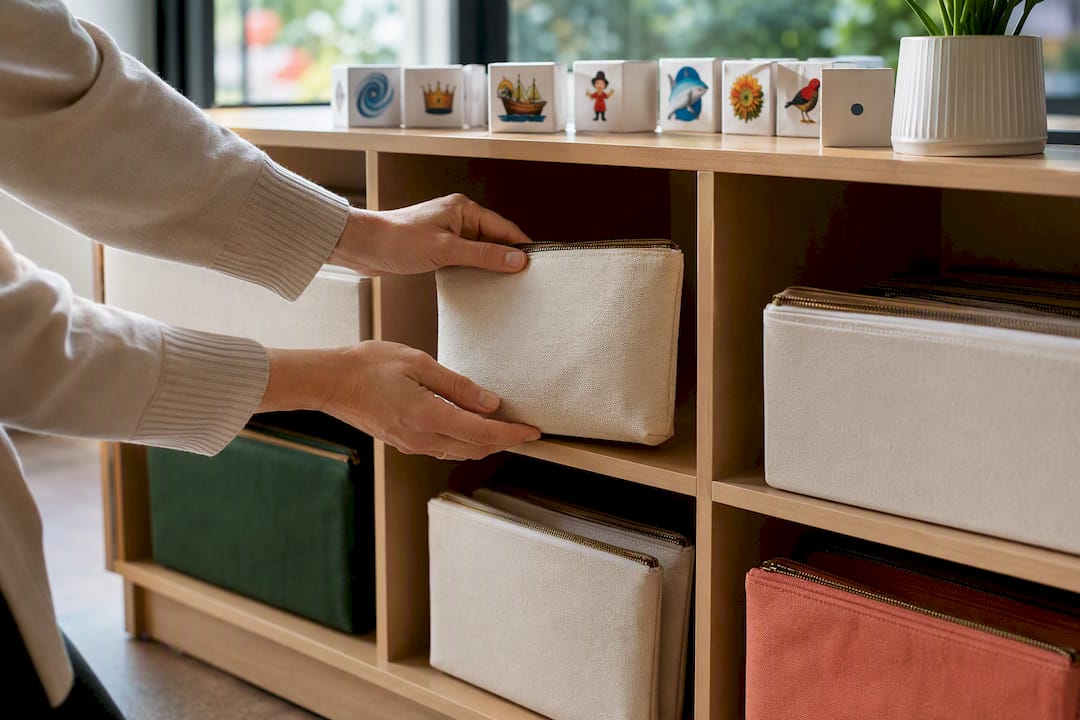
For a class set, number each cube on the bottom so damaged or lost pieces are easy to replace. Store sets in labeled zip pouches, and consider large-print or picture-based faces for younger or emerging readers.
Teaching Skills and SEL Through Story Cubes
Story cube activities do more than entertain. Mapped correctly, they build vocabulary, sequencing, perspective-taking, and emotional literacy, all inside a format that feels like play rather than a worksheet.
Four short lesson formats worth trying:
- Vocabulary builder (10 minutes): roll one cube per new word learned that week; students must use all the words in one story.
- Sequencing practice (15 minutes): use the beginning, middle, end structure and ask students to explain why each roll fits its position.
- Perspective swap (15 minutes): tell the same roll twice, once from the hero's point of view and once from a side character's.
- Feelings check (20 minutes): use a themed set focused on emotions, then ask which character felt something strong and what helped them feel better.
Custom sets built around SEL themes work especially well for children ages 3 to 8, since targeted vocabulary or feelings-based cubes let educators aim at specific emotional-language goals without turning the activity into a test. Keep the framing low-pressure: pair students for sharing before asking anyone to speak to the whole group, and close with a simple reflection question rather than a grade. For more structured SEL pairing ideas, hosting a storytime built around emotional literacy offers additional lesson scaffolding.
Getting Unstuck When the Cubes Feel Intimidating
Blank-page anxiety hits kids and adults alike. The fix is almost always the same: lower the number of choices, not the number of ideas.
Start with a stock phrase like "Once upon a time" and accept the very first idea that comes to mind. That single rule removes the pressure to find the "right" answer before speaking, which is often what stalls a nervous storyteller. Reducing choice to three cubes instead of nine tends to increase creative output for reluctant writers rather than limiting it.
Pro Tip: Give storytellers an odd, unrelated object to work into their plot halfway through. Naming a small problem for the character to solve almost always breaks the freeze faster than asking "what happens next?"
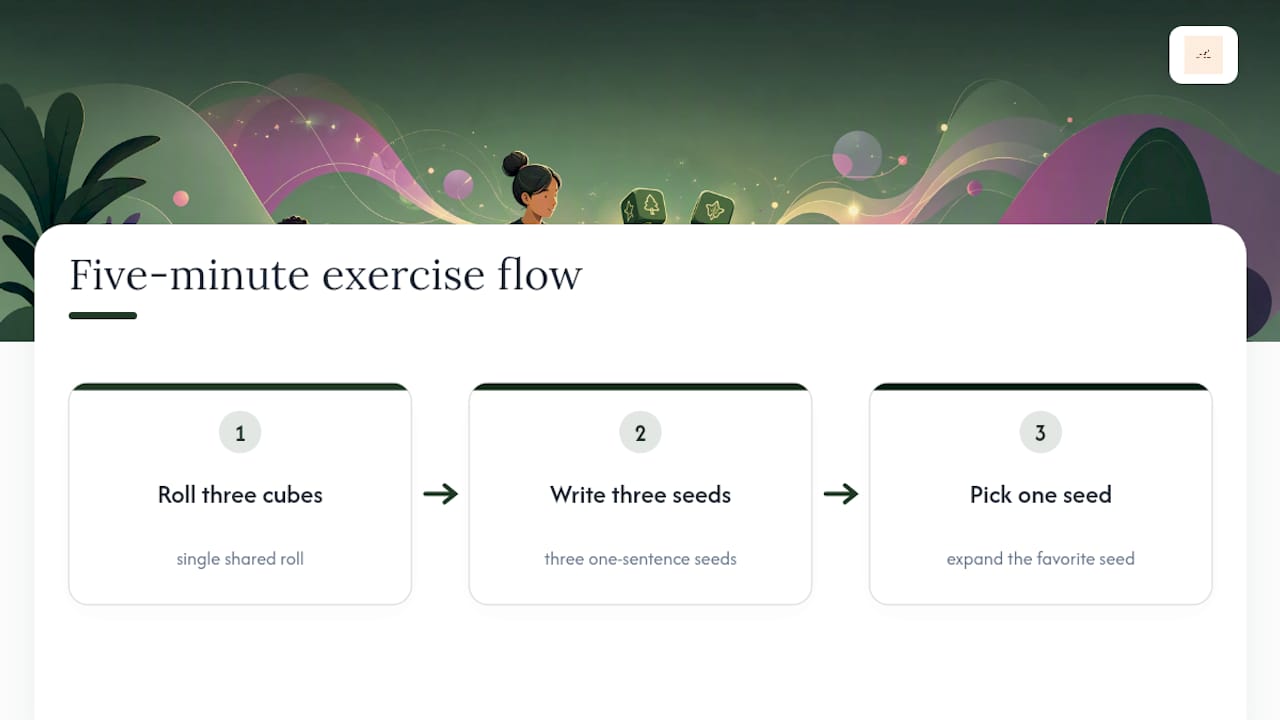
Try this five-minute exercise: roll three cubes, generate three separate one-sentence story seeds from the same roll, then pick a favorite to expand.
Icon Literary's Take on Cube-Style Prompts in the Workshop
Running a quick cube-style prompt round in a workshop setting consistently surfaces stories kids wouldn't have volunteered on their own. The three-category structure, setting, character, item, does the heavy lifting, because it removes the "what do I write about" stall entirely. The workshop builds its own activity kits and card decks around a similar principle: give a child just enough structure to feel safe, then get out of the way.
— Derek Amarillas
Downloads and Guides Worth Bookmarking
The Scottish Book Trust template, CADL's ways-to-play PDF, and Imagine Forest's how-to guide all offer printable templates and extra activity variations.
If you want ready-made prompts and SEL-focused activity kits without cutting and folding paper yourself, Icon Literary's collection of storytelling decks and kits is built for exactly this kind of low-pressure, high-payoff play. Pair a physical deck with a feelings wheel activity for a session that covers both story structure and emotional check-ins in under 20 minutes.
Sources
- Make your own story cube - Scottish Book Trust
- Story Cubes Game guide and DIY ideas - Imagine Forest
- Story Cubes ways to play - CADL