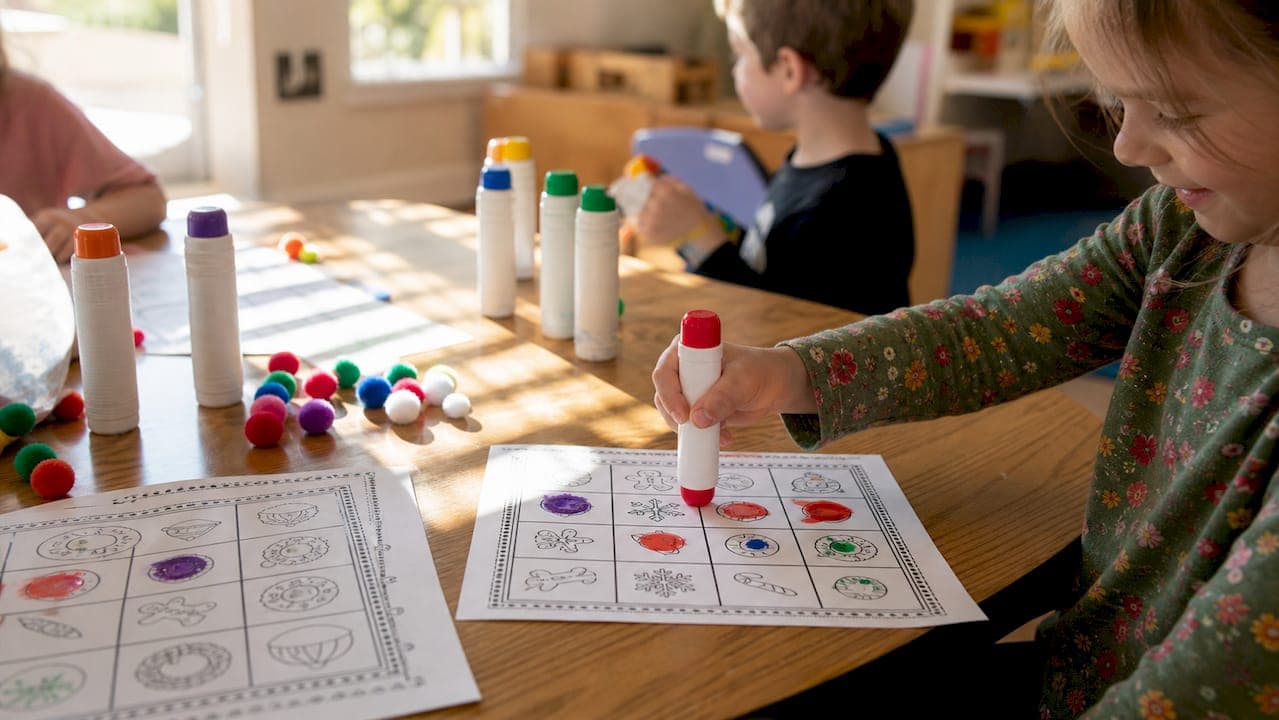
For classroom Christmas bingo that's ready to print and play today, download Icon Literary's printable Christmas Bingo pack. It's built for Pre-K through 2nd grade and works equally well as a small-group holiday center, a whole-class party game, or a five-minute vocabulary warm-up before winter break.
Here's what you need to know before you print:
- Best ages: Pre-K through 2nd grade (differentiation tips below for each level)
- Ideal uses: Small-group literacy centers, whole-class holiday parties, transition-time warm-ups
- Recommended markers: Do-A-Dot markers (bingo daubers) for Pre-K, Unifix cubes or bingo chips for K–2
- Teacher-tested source for small-group play: Pre-K Pages recommends this format specifically for young children who are still building multi-step listening skills
Key Takeaways
Classroom Christmas bingo is one of the lowest-prep, highest-engagement holiday activities available for Pre-K through 2nd grade, and a ready-to-print pack eliminates the biggest barrier: setup time.
| Point | Details |
|---|---|
| Download a ready-made pack | Icon Literary's printable pack includes unique boards, calling cards, and an ink-saver B&W version. |
| Core supplies | Do-A-Dot markers for Pre-K; Unifix cubes, bingo chips, or pom-poms for K–2; cardstock if laminating. |
| Group size strategy | Groups of 4–6 for Pre-K; whole-class works for K–2 with a document camera for calling cards. |
| Time per round | A single round runs 10–20 minutes; extension activities add 2–5 minutes with no extra prep. |
| Icon Literary pack | Download at iconliterary.com for a classroom-licensed, SEL-friendly printable set ready for ages 3–8. |
Table of Contents
- What supplies do you need for classroom Christmas bingo?
- How to print and prep your bingo set
- How do you set up and run the game in class?
- How bingo supports classroom goals and keeps behavior on track
- What theme and skill variations can you use to differentiate?
- Where can you download a ready-to-print classroom pack?
- Quick extension activities that stretch bingo into a learning moment
- What a real classroom moment looks like
- The Icon Literary Christmas Bingo pack is ready when you are
- Sources
What supplies do you need for classroom Christmas bingo?
Gather these before your print run. Nothing here is hard to find, and most of it is probably already in your supply closet.
Printables:
- Color version for parties or keepsake cards
- Black-and-white version for large classes or quick practice rounds (saves significant ink)
- Print on cardstock if you plan to laminate; copy paper works fine for single-use sessions
Markers and manipulatives:
- Do-A-Dot markers (bingo daubers): best for Pre-K because they eliminate the frustration of pieces sliding around and double as a fine motor activity
- Bingo chips, pom-poms, or buttons: easy to distribute and collect for K–2
- Unifix cubes: an inexpensive classroom staple that works perfectly as a bingo marker and is already in most early-elementary rooms
Laminating supplies (optional but worth it):
- Standard laminating pouches and a pouch laminator
- Dry-erase markers for laminated boards (test the brand before class — some wipe cleanly, others need a damp cloth)
Pro Tip: Set up one shared manipulatives bowl per table group rather than distributing individual bags. It cuts setup time in half and gives students a natural reason to practice sharing before the game even starts.
How to print and prep your bingo set
Total prep time for 30 cards runs about 20–30 minutes if you laminate, or under 10 minutes for a single-use print run. Here's the workflow.
Printer settings: Select "fit to page" or "scale to fit" so cards print without cropping. Single-sided printing is standard; duplex only makes sense if you're printing a calling-card reference sheet on the back of a student instruction page.
Color vs. black-and-white: Color boards work well for party days when the card itself becomes a keepsake. The black-and-white version is the smarter call for a class of 25 or more — ink costs add up fast, and students can color the squares as a pre-game warm-up activity, which buys you setup time.
Cutting and laminating workflow:
Print → trim cards along the border lines → laminate → test your dry-erase marker on one card before distributing the set. That test step takes 30 seconds and prevents a mid-game scramble when you discover the markers don't wipe cleanly.
Class-size planning: Print at least one unique board per student. For whole-class play with 20–30 students, packs that include 30 unique boards mean no two students are covering the same squares at the same time, which keeps the game competitive. For team play or centers, duplicate sets work fine — just seat teammates far enough apart that they can't see each other's boards.
A parent volunteer or a reliable student helper can handle the trimming step while you prep the calling cards. Assign it the morning of the party and it's done before lunch.
How do you set up and run the game in class?
Setup takes about five minutes once your cards are printed. Run through this sequence and you'll be calling the first square within ten minutes of handing out boards.
- Arrange seating for visibility. Students need a clear sightline to you (the caller) and a flat surface for their board and markers. Carpet squares work for Pre-K; desks or tables for K–2.
- Distribute boards and markers. Hand out one board per student (or per pair for partner play). Place the manipulatives bowl at the center of each table.
- Shuffle and display the calling cards. Hold them up or place them under a document camera so the whole class can see each image as you call it.
- Model the routine — twice. Call a square, show the image, and demonstrate finding and covering it on your own board. Do this two or three times before real play begins. Students who see the routine modeled make far fewer errors during the game.
- Call, find, cover. Draw a card, name the image clearly, and give students five to ten seconds to find and cover it. Repeat.
- Check the winner. When a student calls "Bingo," read back their covered squares aloud against your called list. This takes 20 seconds and prevents disputes.
- Reset or continue. For a second round, students clear their boards and play resumes. Laminated boards make this instant.
Winning patterns by age:
- Pre-K: Four corners only — simple enough to check at a glance
- Kindergarten: Single horizontal or vertical line
- 1st–2nd grade: T-shape, L-shape, or full blackout for longer rounds
Ties: If two students call Bingo simultaneously, give both a prize or run a 60-second speed round between them using only their boards. Either option resolves the tie in under two minutes.
How bingo supports classroom goals and keeps behavior on track
Bingo earns its place in the classroom because the rules are minimal. That simplicity reduces anxiety and lets children focus on listening and matching rather than figuring out how to play, which is why Pre-K Pages recommends it as an ideal entry-point group game for young learners.
Learning objectives this game directly supports:
- Listening and following multi-step directions (call → find → cover)
- Visual discrimination (matching a called image to the correct square)
- Vocabulary building with seasonal or holiday words
- Turn-taking and self-regulation while waiting for the next call
- Belonging and group participation, especially for quieter students who thrive in low-stakes games
Classroom management by group size:
- Pre-K: Groups of 4–6 with an adult nearby. Model the routine three times before play.
- Kindergarten: Groups of 6–10 or whole-class with a document camera for calling cards.
- 1st–2nd grade: Whole-class works well; partner play adds a cooperative layer.
For Pre-K specifically, a parent volunteer or an older-student buddy at each table makes a measurable difference. They can redirect a child who loses a marker without stopping the game for everyone else.
Pro Tip: Run a three-minute bingo round during transition time — right after morning meeting or before lunch — as a low-prep listening check. Call five images and note which students consistently find them. It's an informal vocabulary snapshot that takes no extra prep.
What theme and skill variations can you use to differentiate?
The base Christmas bingo card becomes a different game entirely with a small content swap. Here are the most useful variants and who they fit.
Skill-based variants:
- Sight-word bingo: Replace images with Dolch or Fry words. Works for late kindergarten through 2nd grade.
- Letter-sound matching: Caller says a sound; students find the letter. Pre-K through kindergarten.
- Math-facts bingo: Caller reads an equation; students cover the answer. 1st–2nd grade.
- Seasonal vocabulary: Keep holiday images but add the word label beneath each — a quick vocabulary-plus-reading layer for early readers.
Theme variants for inclusivity:
- Swap Christmas-specific images for winter symbols (snowflakes, mittens, hot cocoa) to keep the game accessible for all students. The Girl Creative's bilingual English/Spanish pack is a strong option for multilingual classrooms and requires no extra prep.
- Multicultural December calendar vocabulary (Hanukkah, Kwanzaa, Diwali symbols if the timing fits) broadens participation and opens a natural conversation.
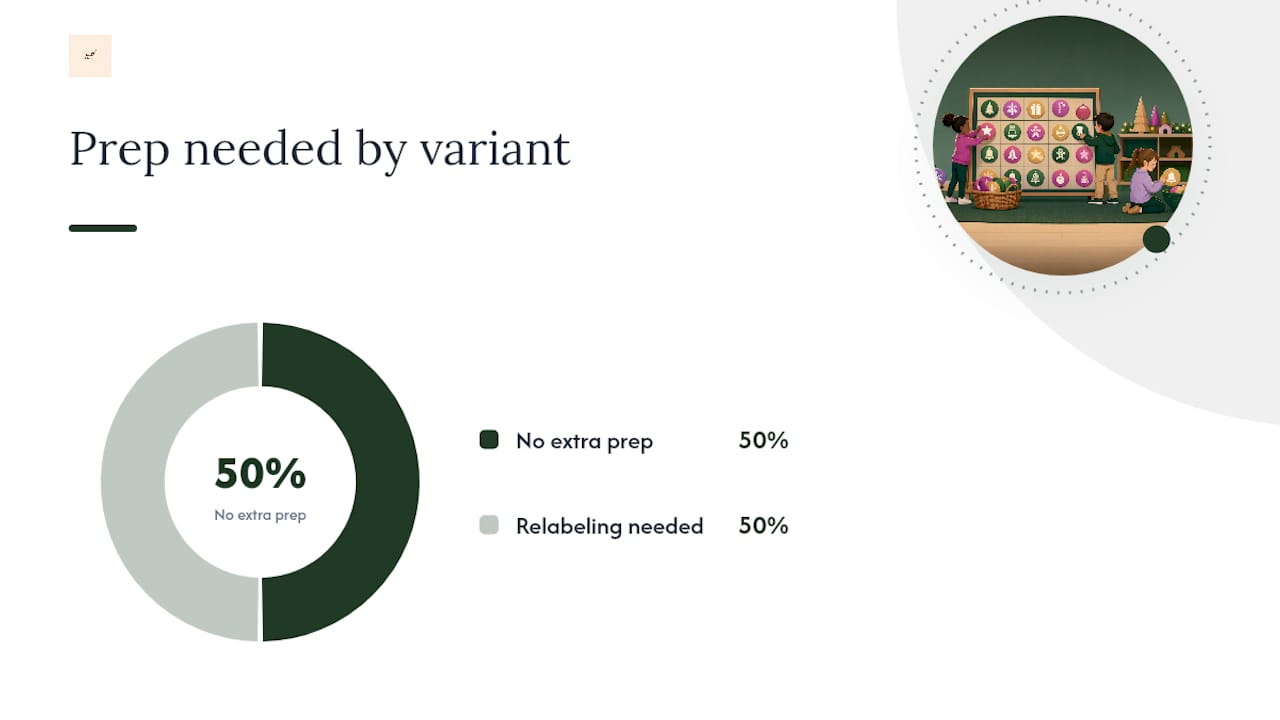
| Variant | Best age range | Extra prep time | Learning goal |
|---|---|---|---|
| Classic picture bingo | Pre-K–K | None | Visual matching, listening |
| Sight-word bingo | K–2nd grade | 5–10 min to relabel | Reading fluency |
| Letter-sound bingo | Pre-K–K | 5 min to relabel | Phonemic awareness |
| Math-facts bingo | 1st–2nd grade | 5–10 min to relabel | Number fluency |
| Winter/neutral theme | Pre-K–2nd grade | None (swap pack) | Inclusivity, vocabulary |
| Bilingual bingo | Pre-K–2nd grade | None (use bilingual pack) | Dual-language vocabulary |
Converting the base pack for any of these variants takes under ten minutes: open the editable file, swap the image labels or add word overlays, and reprint only the boards that need updating.
Where can you download a ready-to-print classroom pack?
Icon Literary's printable Christmas Bingo pack is the recommended download for classroom use. It's designed with early-elementary classrooms in mind, includes both color and black-and-white versions, and comes with calling cards and teacher notes in the download folder.
What to expect in the download:
- Multiple unique bingo boards (enough for a full class)
- A matching calling-card sheet
- Black-and-white ink-saver version
- Teacher tips PDF with setup notes and differentiation ideas
Before distributing copies beyond your own classroom, check the license terms in the download folder. Most classroom printable licenses cover single-class use. If you're sharing across multiple classrooms or grade levels, look for a school-license option or confirm with the publisher directly.
For teachers who want to build a fully custom set, Canva's editable Christmas bingo templates let you swap images, add word labels, or adjust the grid size directly in the browser before printing. No design experience needed.
Quick extension activities that stretch bingo into a learning moment
The calling cards alone are worth keeping after the game ends. Here's how to get more mileage from the same printable:
- Flashcard review: Shuffle the calling cards and hold them up one at a time. Students name the image or word before you confirm. Takes two minutes and reinforces vocabulary from the game.
- Exit ticket: After the game, each student points to three squares on their board and says the word aloud to a partner. You circulate and listen for accurate vocabulary use.
- Memory bingo: Flip all boards face-down after a round. Caller describes an image without naming it ("it's red and white and you hang it on a tree"). Students flip their board to check. Works well for 1st–2nd grade.
- Picture-to-word match: Print the calling cards twice. Students match image cards to word cards as a center activity using the same holiday vocabulary from the game.
- Rotate the caller role: Let a student call the next round. Listen for how they describe each image — it's an informal speaking and vocabulary assessment with zero extra prep.
- Speed round: Set a 60-second timer. Caller draws as fast as possible; first student to cover five squares wins. High energy, low prep, and a natural end-of-party closer.
Pair the vocabulary from the game with a conversation-sparking picture book to extend the holiday theme into a read-aloud or discussion activity.
What a real classroom moment looks like
The first time I ran a holiday bingo game during a December transition block, I expected chaos. What I got instead was twenty minutes of genuine focus — students who rarely raised their hands were covering squares and calling out answers with real confidence. The game's structure did the work. Because the rules were simple, children who usually needed extra support could participate without modification.
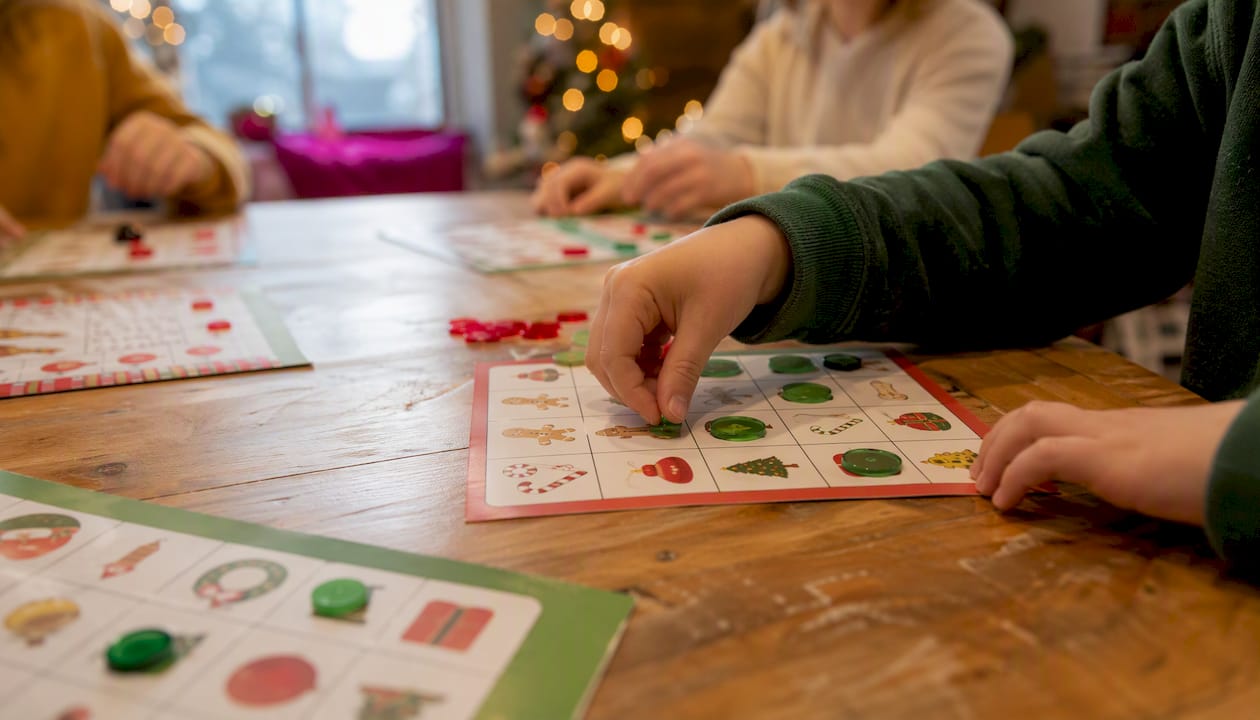
That's the quiet value of a well-designed printable: it creates belonging without singling anyone out. Adapt the pack for your classroom culture — swap images, add word labels, run it in small groups if your class needs that — and it becomes something your students ask for again.
The Icon Literary Christmas Bingo pack is ready when you are
Teachers who want a classroom-ready pack without building one from scratch will find exactly that at Icon Literary. The download includes unique bingo boards, a calling-card sheet, an ink-saver black-and-white version, and teacher notes — everything in one folder, ready to print before the bell rings.
What you get instantly:
- Full-color and black-and-white board versions
- Calling cards (print and cut or display digitally)
- Teacher tips for setup, differentiation, and classroom management
- Classroom license for single-class use
Visit the Icon Literary catalog to grab the pack, or browse the full Icon Literary collection for additional SEL-aligned activity kits and printables designed for ages 3–8. Download, print, and play — your class is ready.
Sources
Pre-K Pages is the strongest teacher-facing resource for small-group bingo play: it covers supplies, ink-saving options, and classroom management for Pre-K and kindergarten specifically. The Best Ideas for Kids offers a free pack with 30 unique cards and a calling sheet, with setup tips for larger groups. The Spruce Crafts aggregates multiple free sets so you can match the tone — party-friendly or curriculum-aligned — to your classroom. For bilingual classrooms, The Girl Creative's English/Spanish pack requires no extra prep. Always check the license terms on any free printable before distributing beyond your own class.
Supply sources: Cardstock (Hammermill or Astrobrights at most office supply stores), laminating pouches (standard 5-mil letter size), and Do-A-Dot markers are all available at Target, Walmart, Amazon, and most teacher supply stores. Unifix cubes are a standard classroom manipulative available through school supply catalogs.
- Printable Christmas Bingo - Pre-K Pages
- Christmas bingo card templates - Canva
- Printable Christmas Bingo Game – in English and Spanish - The Girl Creative
- Christmas Bingo (Free Printable) - The Best Ideas for Kids