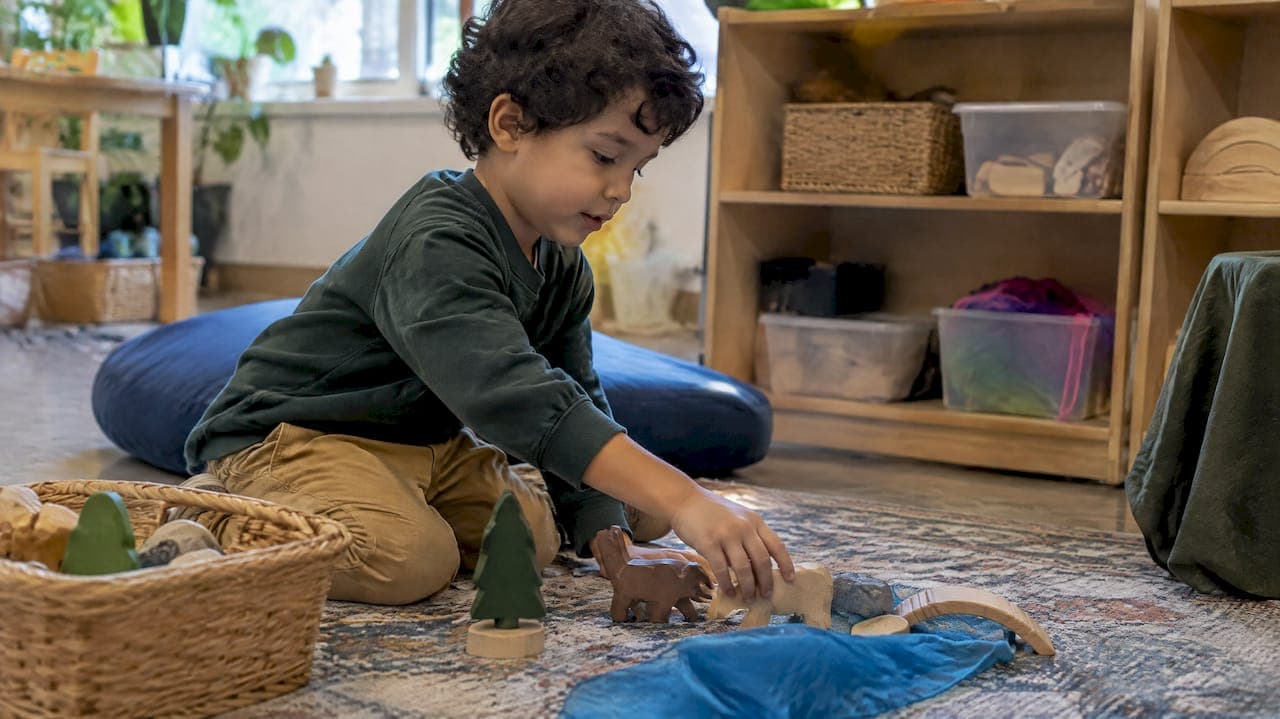
A classroom storytelling center is a dedicated space with a story tub, a few props, and a short routine that gets kids talking, retelling, and acting out stories together. The fastest way to start is simple: set out a story tub, give each child time to dictate a short story, then build in time later for the class to act it out. We'll walk through the research, the setup, and three routines you can run this week.
TL;DR:
- A 2013 review of 11 studies involving 687 toddlers and preschoolers linked retelling practice with gains in comprehension, vocabulary, receptive language, and early literacy.
- A trial with 430 kindergarten students found tiered oral narrative instruction improved story generation over usual teaching; struggling retellers benefit from focused small groups.
- Keep each dictated story to one page, then reserve a 20 to 30 minute weekly block for improvised dramatization rather than scripted lines.
- Start with a tub, reusable props, blank paper, and one framework; Five Finger Retell gives English learners a structure for organizing spoken stories.
Table of Contents
- Why storytelling centers work: evidence and learning goals
- What a storytelling center looks like and low-cost setup options
- Three ready-to-run routines with step-by-step timings and scripts
- Structuring instruction: scheduling, tiered support, and classroom management
- Professional development and ready resources teachers can use right away
- What teachers get wrong about storytelling centers
- How Icon Literary resources fit into your storytelling center
- FAQ
- Sources
Why storytelling centers work: evidence and learning goals
The research on story retelling is encouraging if you're trying to justify classroom time to an administrator. A 2013 meta-analysis of 11 studies covering 687 toddlers and preschoolers found that retelling practice significantly improved story comprehension, expressive vocabulary, receptive language, and early literacy skills.
687 children across 11 studies showed measurable gains in comprehension and vocabulary from retelling practice alone, according to the Reading Rockets review. That's a meaningful signal for a routine that costs almost nothing to run.
Larger trials back this up at scale. A randomized controlled trial reviewed by ERIC involving 430 kindergarten students found that a tiered oral narrative curriculum produced greater growth in personal story generation than business-as-usual instruction. A related trial involved 313 students and used a comparable curriculum structure.
For your own classroom, three outcomes are worth tracking: retell quality (does the story have a clear sequence and characters), vocabulary growth (are new words showing up in later retells), and participation (are quieter students speaking up during the routine).

What a storytelling center looks like and low-cost setup options
A storytelling center doesn't need a budget line. Most teachers build one from items they already have or can gather in a weekend: a plastic tub, fabric scraps, and a basket of small objects.
- Story tub or box: a container holding loose parts like figurines, fabric, and small props that spark character and setting ideas.
- Props and costume pieces: hats, capes, or simple accessories that help kids physically become a character during dramatization.
- Story stones or story cubes: painted stones or printed dice with images that prompt plot elements like setting, problem, or character.
- Clipboards, paper, or a simple voice recorder: for dictation, sketching, or recording a retell before it's performed.
- A rug, mat, or cushions: a defined spot that signals "this is story time," even in a shared classroom corner.
Grade level changes the shape of the center more than the materials inside it. Preschool classrooms do best with fewer choices and more teacher proximity, since young children need help holding a story idea in mind. Elementary classrooms can handle a rotating station with picture prompts and short dictation slips. For older students, the center can shift toward independent small-group work, with story cubes or structured retell cards replacing teacher-led dictation.
If space is tight, a rolling cart with labeled bins works as well as a fixed corner. Our guide on teaching story structure by grade breaks down specific material choices for each age band, including dictation and acting adjustments.
A quick checklist to copy into your lesson plan: pick one container, fill it with a few props, add a stack of blank dictation slips, and choose one retell framework before the first session.
Three ready-to-run routines with step-by-step timings and scripts
These three routines cover dictation, independent practice, and guided small-group work, so you can rotate based on the week's focus.
- Story dictation into dramatization: during choice time, give each child time to dictate a short story to you or a volunteer while you write it down word for word. Later that day or week, set aside a 20 to 30 minute block where the class acts out a few of the dictated stories, with you narrating and children playing the roles. Improvised acting works better than scripted lines, since young children respond to the story's rhythm more naturally than memorized words.
- Story stones or story cubes station: set up a small table with a bin of story stones and a laminated prompt card ("Roll three stones: who is in your story, where are they, what problem happens?"). Students work independently or in pairs, and can extend the activity by drawing their story or retelling it to a partner. Our story cubes ideas post has a range of prompts and games you can drop straight into this station.
- Guided retell station: pull a small group and use a structured framework like Somebody-Wanted-But-So or the Five-Finger Retell, where each finger represents a story element (character, setting, problem, events, ending). These frameworks give English language learners and students who struggle with open-ended retelling a concrete scaffold to organize their thoughts before speaking.
Pro Tip: Limit dictation to one page per child so group time stays efficient and every student gets a turn.
Structuring instruction: scheduling, tiered support, and classroom management
A storytelling center only sustains itself if the schedule fits your week without becoming one more thing to squeeze in. Most teachers find a mix works best: short daily micro-sessions for dictation or story stones, paired with one longer weekly block for dramatization, supported by STEM storytelling examples for parents and educators.
- Daily rotation: a short activity with story stones or dictation built into existing center time.
- Weekly dramatization: one 20 to 30 minute block, ideally on a day with fewer transitions, for the class to act out stories from that week.
- Tiered support: whole-class routines work for most students, but a small group that needs more scaffolding can get extra sessions using a structured curriculum approach, similar to tiered oral narrative models that pull struggling retellers into focused small-group instruction.
- Formative checks: a short retell rubric (sequence, characters, problem, ending) takes little time per child and tracks growth over weeks.
- Management during dramatization: role cards assigned before acting begins cut down on arguments over who plays what, and a clear "narrator pauses the action" signal keeps transitions calm.
This structure keeps the center running without requiring a new block of instructional time every day.
Professional development and ready resources teachers can use right away
You don't need a full curriculum overhaul to start. PD options range from a free one-hour introductory webinar to multi-session workshops for teams ready to build shared practice, and in-district coaching for schools wanting sustained support over time.
- Short webinars: a single session that introduces participatory storytelling methods, often free, aimed at classroom teachers new to the approach.
- Multi-session workshops: structured programs, sometimes running five sessions over two weeks, for teachers ready to build a full routine with feedback.
- In-district residencies: ongoing coaching for schools scaling the practice across multiple classrooms or grade levels.
- Free classroom assets: printable prompt cards, retell rubrics, and activity templates that let you start without waiting on a workshop slot. Our storytelling prompts by age and SEL storytelling approaches posts are good starting points.
What teachers get wrong about storytelling centers
Teachers often chase a big, polished project when what actually builds language skill is repetition. A one-off diorama or elaborate puppet show feels impressive, but a brief dictation routine repeated regularly can teach vocabulary and sequencing over time.
Our rule of thumb: pick tactile, durable materials and prompts you can reuse weekly, not novelty items that need replacing after one lesson. Don't wait for a perfect set of story stones or a polished script. Start with cardboard props and a stack of blank paper, then adjust as you see what your students respond to.
— Derek Amarillas
How Icon Literary resources fit into your storytelling center

Our Duckwave Decks, priced at $7 as a one-off purchase, can be used as a starting point for dictation and dramatization. Socko's Universe can also be used with the guided retell station described above.
- Use Duckwave Decks during choice time.
- Use Socko's Universe for small-group retells.
- Swap in printables when a story stones station needs fresh prompts.
Browse the full Icon Literary catalog to preview downloadable printables before your next planning period.
FAQ
What is a classroom storytelling center?
A classroom storytelling center is a dedicated space, often a story tub or small station, paired with a short routine like dictation or story stones that helps students build oral language and retelling skills. It usually includes props, prompts, and a defined spot for storytelling practice.
How long should a storytelling routine take?
A dictation session typically runs a short time, while a full class dramatization block runs 20 to 30 minutes. Shorter daily sessions with story stones or cubes can take as little as 10 minutes.
What research supports storytelling in classrooms?
A meta-analysis of 11 studies with 687 toddlers and preschoolers found retelling practice improved comprehension and vocabulary. A separate randomized trial with 430 kindergarten students found tiered narrative curricula produced greater growth in story generation than standard instruction.
What materials do I need to start a storytelling center?
A story tub with a few props, some fabric scraps, blank paper for dictation, and a rug or mat to mark the space are enough to begin. Story stones or cubes can be added once the basic routine is running smoothly.
How do I support English language learners during retells?
Structured frameworks like Somebody-Wanted-But-So or the Five-Finger Retell give ELLs a concrete structure to organize their thoughts before speaking. Pairing these frameworks with visual prompt cards can further reduce the language demand of open-ended retelling.
Sources
- Children’s Story Retelling as a Literacy and Language Enhancement Strategy | Reading Rockets
- Eric
- Storycenter