
The prompts that work best fall into four types: character, place, problem, and picture. Each one gives a child just enough structure to start without boxing in their imagination. If you need something right now, here are three you can use tonight or tomorrow morning:
- Character prompt: "A tiny dragon is afraid of fire. What does she do at her first campfire party?"
- Place prompt: "You find a door in your closet that leads to a city made entirely of bread. What's the first thing you eat?"
- Problem prompt: "Your dog can suddenly talk, but only when nobody else is listening. What's the first secret he tells you?"
Read one aloud at bedtime, or hand it to a student as a five-minute warm-up before a longer writing block. If you want a stack of prompts already organized by age and ready to grab without prep, Icon Literary's storytelling prompt card deck covers that exact need for parents and classrooms alike.
Key Takeaways
The most reliable storytelling prompts for kids combine a simple structure (character, place, or problem) with age-matched length and a low-stakes way to start.
| Point | Details |
|---|---|
| Match format to age | Use single-goal character prompts for K–2 and theme-driven or perspective prompts for high schoolers. |
| Pick ambiguous images | Choose picture prompts with emotion or unusual detail so kids invent different stories from one photo. |
| Lower the stakes first | Start with oral retelling, drawing, or a timed sprint before asking for a full written draft. |
| Adapt by time available | Stretch or shrink the same prompt for a 5-minute warm-up or a multi-day writing project. |
| Grab ready-made cards | Icon Literary's storytelling prompt card deck offers age-organized prompts for quick classroom or bedtime use. |
Table of Contents
- Storytelling Prompts for Kids by Age and Grade
- Types of Storytelling Prompts and When to Use Each
- Picture Prompts: Choosing Images That Spark Real Ideas
- Teacher-Tested Strategies for Reluctant Writers
- Adapting One Prompt for Any Amount of Time
- Warm-Up Question Prompts That Get Kids Talking First
- Sample Prompt Lists You Can Copy Right Now
- Why Icon Literary Builds Prompts Around Emotional Literacy
- Try Icon Literary's Ready-Made Storytelling Prompt Cards
- Frequently Asked Questions
- Sources
Storytelling Prompts for Kids by Age and Grade
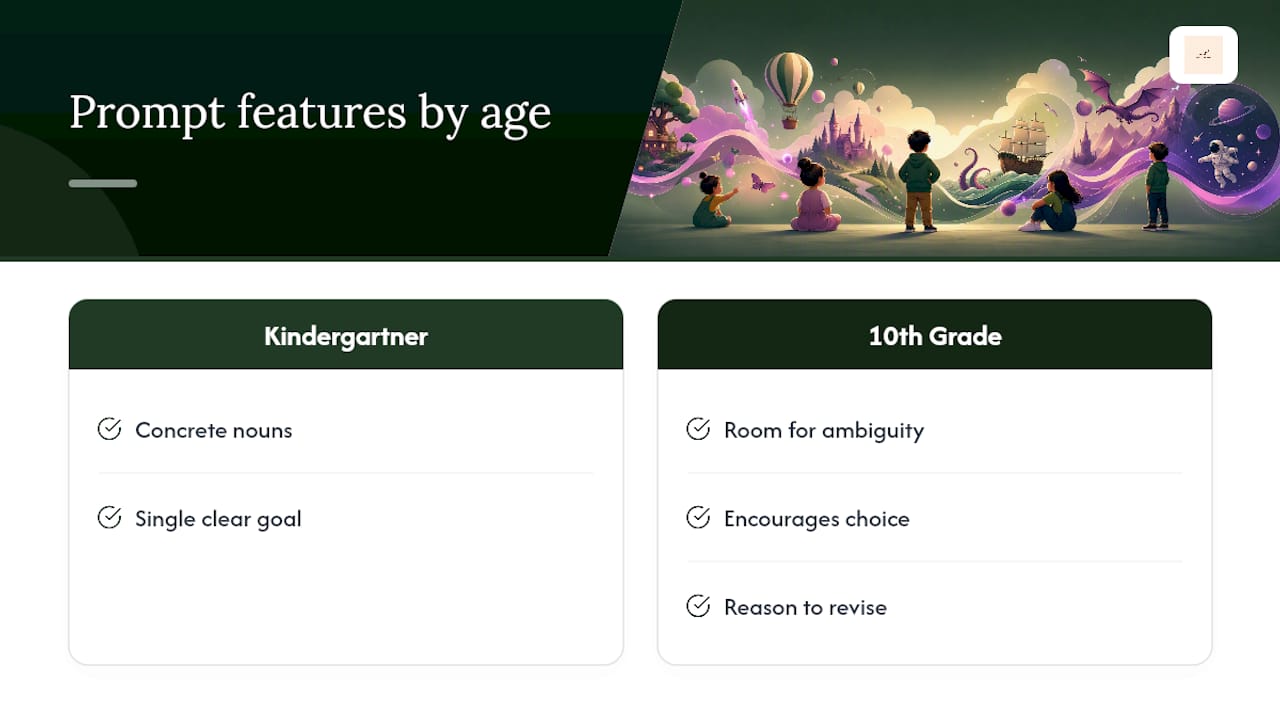
A prompt written for a kindergartner and a prompt written for a tenth grader are not the same tool, even when they share a theme. Younger children need concrete nouns and a single clear goal. Older students need room for ambiguity, choice, and a reason to revise. Here's how that plays out across grade bands.
K–2: keep it concrete and short
Early learners do best with prompts built on one character, one goal, and one funny obstacle. Educators sometimes call this the "Who, What, Why Not" formula, and it works because it matches how young children already tell stories out loud, before they can write them down.
- A bunny loses her favorite red boot in the mud. What does she do?
- A grumpy cloud wants to make it rain candy, but keeps making it rain socks instead.
- Your stuffed animal comes alive at night and wants a snack. What does it pick?
Pair these with drawing. Have the child draw the scene first, then dictate the story to you or narrate it out loud while you jot down key words. This single-character, single-problem structure removes the blank-page fear that trips up even confident young writers, according to advice from Medium's Illumination publication on overcoming blank-page anxiety.
Grades 3–5: add a beginning, middle, and end
By third grade, most kids can hold a simple arc in their heads. Prompts here should nudge toward a full mini-story rather than a single scene.
- A kid discovers their backpack can teleport them anywhere, but only once a day. Where do they go, and what goes wrong when they try to come back?
- The class hamster escapes during a test. Tell the story from the hamster's point of view.
- You wake up and everyone in town is speaking backward. How do you figure out what's happening?
Use these as a 10 to 15 minute warm-up if you just want fluency practice, or stretch them into a full writing project with a rough draft, a peer share, and a final illustrated copy.
Middle school: introduce real conflict and choice
Middle schoolers respond to prompts that force a decision, not just an event.
- Your best friend asks you to lie for them. You have thirty seconds to decide. What do you say?
- A stranger gives you a key that opens any lock, but warns you it will open one door you shouldn't touch. Write what happens.
- Tell the same short scene twice: once from the winner's point of view, once from the loser's.
These work well with peer-sharing circles, where students trade drafts and mark one line they wish they'd written themselves.
High school: push toward theme and form
Older students can handle prompts that ask them to experiment with structure or perspective, not just plot.
- Write a story told entirely through text messages between two people who haven't spoken in five years.
- Describe your hometown as if you'll never see it again.
- Retell a fairy tale from the villain's perspective, but make the villain sympathetic without making them right.
These fit well as multi-day projects with drafting, workshop feedback, and a final polished piece, an approach Edutopia's grade-level prompt collection recommends for building both stamina and craft over a semester.
Types of Storytelling Prompts and When to Use Each
Not every prompt format serves the same purpose, and picking the wrong one for the moment is a common reason kids stall out, as explained in Types of Child-Focused Storytelling That Build Real Imagination.
- Character prompts hand the child a personality and ask what that person or creature would do. Use these for character-study units or when you want kids to practice voice. Example: "A superhero who is terrified of heights has to save someone from a rooftop."
- Setting prompts ask writers to build a world first and let plot follow. Use them for descriptive writing practice. Example: "Describe a school where the hallways rearrange themselves every hour."
- First-line prompts give a single opening sentence and nothing else. These are fast, ideal for a two-minute warm-up. Example: "The letter had been sitting under my bed for eleven years."
- Problem prompts center on a conflict that needs solving, which makes them the strongest choice for building plot structure. Example: "The town's only bridge collapses the night before the big festival."
- Picture prompts use an image instead of words entirely, which is especially useful for group storytelling and English language learners who may need fewer language barriers to start.
Picture Prompts: Choosing Images That Spark Real Ideas
Not every photo makes a good writing prompt. The images that generate the most interesting stories share four traits: ambiguity, emotion, action, and an unusual detail that makes a kid ask "wait, why is that there?" Ambiguity matters most. A crystal-clear photo of a dog on a leash tells its own story and leaves nothing for a child to invent. A photo of an empty leash lying in the grass does the opposite work, according to WeAreTeachers' collection of picture writing prompts, which notes that the best teaching images should produce noticeably different stories from different students.
A simple before, during, and after question sequence keeps kids from freezing when you show them an image:
- Before: "What do you notice first? What do you think happened right before this moment?"
- During: "Who else might be in this scene but not in the picture?"
- After: "What happens in the next five minutes?"
Slide decks work well for whole-class warm-ups since you can flash one image, ask the three questions out loud, and give students two minutes to jot notes before writing. Printed picture cards work better for small groups or independent stations. The New York Times Learning Network's picture prompt archive organizes images by genre, which makes it easy to build a weekly rotation instead of hunting for a new photo every Monday.
Pro Tip: For a reluctant writer, cover half the image with a sticky note and only reveal it after they've written their first guess. The reveal becomes a mini-reward and often unlocks a second, better idea.
Teacher-Tested Strategies for Reluctant Writers
Low-stakes entry points matter more than clever prompts. A kid who's scared of the blank page won't care how good the prompt is if the first thing they see is a lined sheet of paper and a 20-minute deadline.
- Start oral, not written. Have the student tell the story out loud first, even just to a partner, before writing a word.
- Draw before you write. A quick sketch of the character or scene lowers the pressure of starting with text.
- Use a story jar. Fill a jar with slips for character, place, and problem; let kids pull one of each and combine them randomly.
- Run timed sprints. Five minutes, no stopping, no erasing. The goal is words on the page, not a finished story.
Scaffolds help too. A sentence stem like "The strangest thing about my day was..." gives a nervous writer a running start. Paragraph frames (introduce the character, state the problem, describe one attempt to fix it) work well for students who understand story structure but freeze when facing an open page. For English language learners, picture prompts remove much of the vocabulary barrier that word-based prompts create, and for students with fine-motor challenges, dictation or speech-to-text tools let the story flow without the physical strain of handwriting.
Pro Tip: Lowering the stakes with visuals, short prompts, and real choice increases participation more reliably than raising the difficulty ever does.
Adapting One Prompt for Any Amount of Time
The same prompt can stretch or shrink depending on what you have available.
- 5 minutes: Oral only, or a single sentence written on a sticky note.
- 15 to 20 minutes: A full short draft, no revision, shared aloud if time allows.
- Multi-day project: Draft, peer feedback, revision, and an illustrated final copy.
For groups, try pair-share (two kids trade prompts and tell each other's stories back), round-robin (each student adds one sentence before passing the paper), or a story chain that travels around the whole classroom. At home, the same prompt works as an independent journal entry, a shared family story time activity, or a project where parent and child co-author alternating paragraphs.
Warm-Up Question Prompts That Get Kids Talking First
Sometimes the fastest way into a story isn't a prompt at all. It's a question. Before handing a child a full writing task, ask something small and specific: "What's the bravest thing you've ever seen someone do?" or "If you could talk to one animal for a day, which one and why?" These warm-up questions work as verbal icebreakers that prime a child's imagination before the pressure of a page ever enters the picture.

Combine a warm-up question with a picture prompt for a stronger start. Show the image, ask the question out loud, give kids thirty seconds to answer verbally, then hand them the writing prompt. That verbal rehearsal step matters more than most teachers expect. Kids who talk through an idea before writing tend to produce longer, more detailed drafts than kids who go straight from image to blank page.
For a weekly routine, rotate through a small bank of five or six warm-up questions so kids start to recognize the format and stop needing instructions repeated. Pair the questions with a consistent visual, like a slide with the image on one side and the question on the other, so the structure becomes familiar fast. Predictability, oddly enough, is what frees kids up to be more creative, not less.
Sample Prompt Lists You Can Copy Right Now
Here are three ready-made sets, grouped by activity type, that you can paste directly into a lesson plan or a bedtime routine tonight.
Quick warm-up set (2 to 5 minutes each):
- "The vending machine only sells wishes today."
- "My shadow started doing things I didn't do."
- "The last snowman on Earth wanted one thing before he melted."
Character-driven set (for a 20-minute writing block):
- A knight who is allergic to shiny things has to guard a treasure room.
- A mail carrier delivers a letter addressed to "whoever finds this first."
- A kid inherits a pet rock that turns out to be an egg.
Multi-day project set (for revision and sharing):
- Write the story of the worst birthday party ever, from the cake's point of view.
- Two neighboring kingdoms have been at war for a reason nobody remembers. Tell the story of the person who finally asks why.
- Rewrite a bedtime story you know well, but set it 100 years in the future.
Keep a printed copy of your favorite sets on hand, since the fastest way to lose momentum with storytelling prompts is scrambling to find one mid-lesson.
Why Icon Literary Builds Prompts Around Emotional Literacy
Icon Literary designs its story worlds and card decks around one belief: kids write their most honest stories when a prompt gives them room to feel something, not just invent a plot. That's why the studio's prompt-driven products lean on emotional-literacy themes, diverse characters, and settings built for real connection, not just clever twists.
Try Icon Literary's Ready-Made Storytelling Prompt Cards
You don't have to build a prompt bank from scratch every week. Icon Literary's storytelling prompt card deck gives you a physical, shuffle-and-go set of character, place, and problem prompts already organized by age, so a parent or a K–2 teacher can pull a card and start in under a minute.

Each card is written with the same low-stakes, emotionally resonant approach covered throughout this guide: short enough for a five-minute warm-up, open-ended enough for a multi-day project, and designed with SEL themes woven in rather than bolted on. That combination saves real prep time for busy teachers and gives parents a no-fuss way to start a bedtime story without staring at a blank page themselves. Browse the full Icon Literary catalog to find the prompt deck and pair it with related activity kits, or check the member resource hub for downloadable prompt packs you can print at home tonight.
Frequently Asked Questions
What age should kids start with storytelling prompts? Children as young as three or four can respond to simple oral prompts, especially when paired with drawing. Written prompts typically work best once a child is comfortable forming sentences, usually around kindergarten or first grade.
How long should a storytelling prompt session take? It depends on the goal. A warm-up prompt can take two to five minutes, a short written draft usually takes 15 to 20 minutes, and a full project with revision and illustration can stretch across several class periods or several nights at home.
What's the best type of prompt for a reluctant writer? Picture prompts and oral story starters tend to work best because they remove the pressure of generating an idea from scratch. Pairing a prompt with drawing or a quick verbal retell before writing lowers the stakes further.
Do picture prompts work as well as written prompts? Often better, especially for younger kids and English language learners. Ambiguous images with emotion or unusual detail tend to generate more varied, personal stories than a written prompt alone.
Where can I get ready-made storytelling prompts instead of writing my own? Icon Literary's storytelling prompt card deck offers age-organized, SEL-friendly prompts ready to use without prep, available through the Icon Literary catalog.
Sources
- 5 strategies every writer needs to overcome the fear of the blank page
- 150 Inspiring Picture Writing Prompts (Free Google Slides)
- 125 picture prompts for creative and narrative writing
- 50 writing prompts for all grade levels