Feelings wheel activities give children a concrete way to name emotions and build regulation skills instead of guessing at what they feel. This guide covers ready-to-run activities, printable templates, and age adaptations you can start today, drawing on the wheel structure outlined by the Cleveland Clinic and the emotional-literacy competencies defined by CASEL, plus practical kits from Icon Literary.
TL;DR:
- Repetition with the same feelings wheel, either handmade or store-bought, helps children learn emotion vocabulary more effectively than using multiple tools.
- Activities like group check-ins, role-playing, and story-based reflection build emotional awareness and regulation skills in young children.
- Adaptations for different ages and abilities include nonverbal options, simplified words, and movement-based tasks for neurodivergent kids.
- Using the feeling wheel in daily routines, such as morning check-ins and evening reflections, supports core emotional literacy competencies linked to better social outcomes.
- Ready-made kits from Icon Literary provide convenient, engaging tools that combine storytelling and tactile activities to deepen understanding and make practice enjoyable.
Table of Contents
- The Best Feelings Wheel Activities to Try This Week
- Adapting Feelings Wheel Activities by Age and Ability
- Building Feelings Wheel Check-Ins Into Daily SEL Routines
- Where to Find Feelings Wheel Templates and How to Make Your Own
- What Experts Want You to Know Before You Start
- Why Icon Literary Builds Activity Kits Around the Feelings Wheel
- Ready-Made Feelings Wheel Kits From Icon Literary
- Sources
The Best Feelings Wheel Activities to Try This Week
Every activity below works with a store-bought wheel or a homemade one. Pick two or three, not all six at once. Kids need repetition with the same tool more than variety.
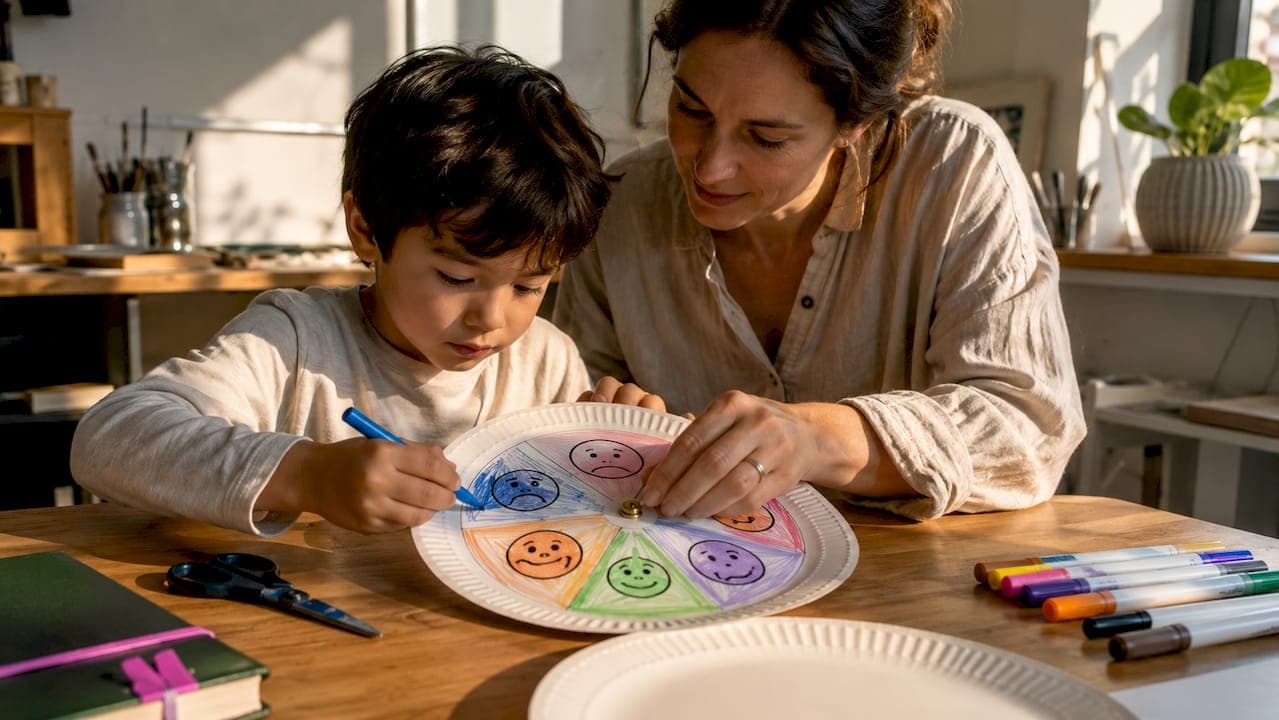
1. Build a DIY paper-plate wheel
Materials: two paper plates, markers, scissors, a brad fastener. Time: 20 to 30 minutes. Ages: 4 and up. Cut one plate into a pie shape with a wedge removed so the bottom layer shows through. Write broad core emotions (happy, sad, angry, scared) on the bottom plate, then specific synonyms on the top layer, spaced so each core word lines up with three or four related words. Punch the centers and join them with the brad so the top layer spins freely. The assembly itself is part of the lesson. Kids who cut and color their own wheel remember the words on it far better than kids handed a printed one.
2. Run a 90-second group morning check-in
Time: 90 seconds to 3 minutes. Ages: 5 and up. Pass the wheel around a circle. Each child spins, names the word the arrow lands near, and says one sentence: "I feel this because..." No follow-up questions, no correction. The goal is repetition, not perfection.
3. Try emotion-matching and role-play scenarios
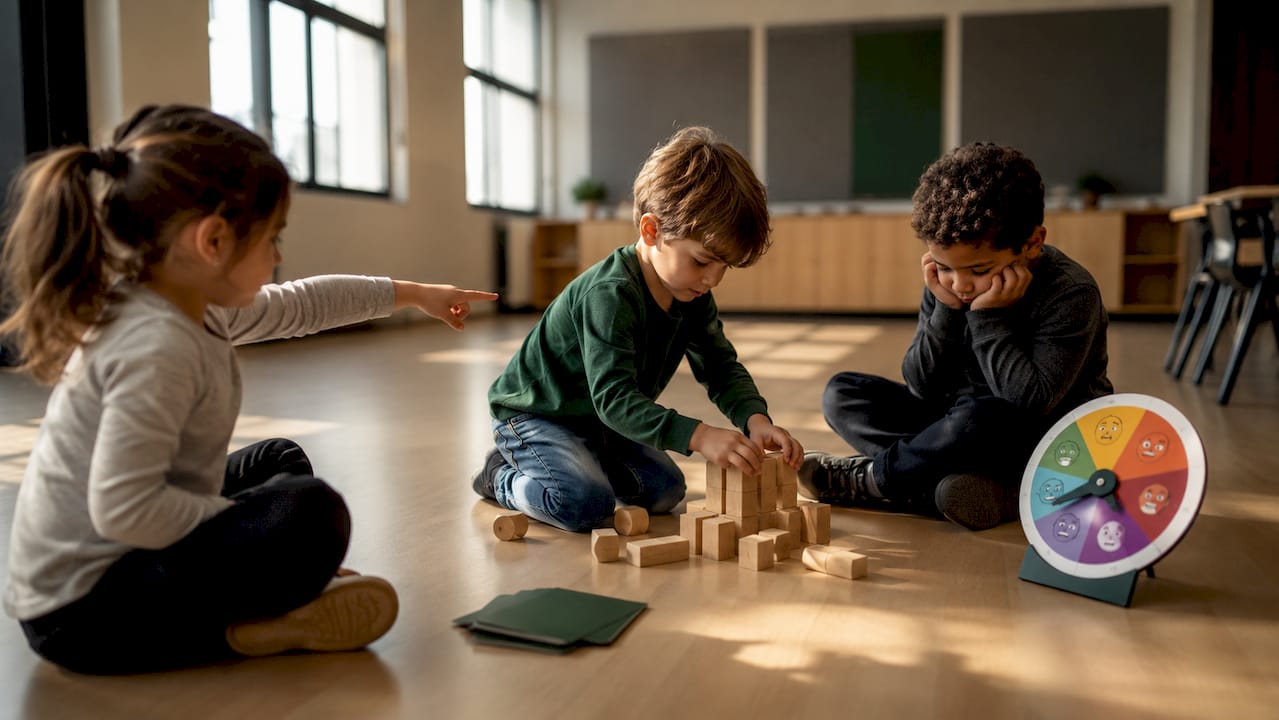
Write five short scenarios on index cards ("your block tower fell down," "you got picked last for a game"). Kids pick a card, find the matching wheel word, then act out a response. This works especially well with siblings or small groups of three to four.
4. Add a storytime reflection wheel
After a picture book, pause on a page where a character reacts strongly. Ask, "Where on the wheel is this character?" Follow with a quick journal or drawing prompt: "Draw a time you felt this way too."
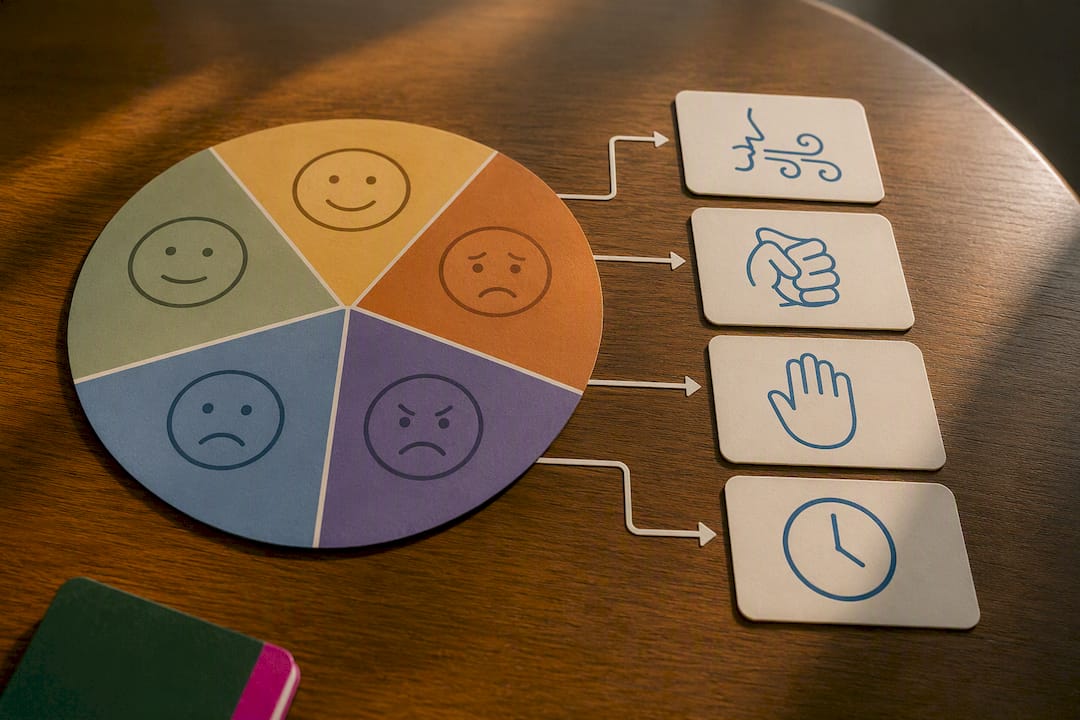
5. Set up a calm-down wheel
Pair each outer-ring word with one coping strategy on a laminated card taped nearby (deep breaths for "overwhelmed," a squeeze ball for "frustrated"). The wheel names the feeling; the card supplies the next step.
6. Use wheel journaling and art prompts
For kids who write, a simple daily line works: "Today I felt ___ because ___." For younger children, swap words for crayons and color-matching.
Pro Tip: Keep a second, blank wheel in the room labeled "add your own word." Kids who outgrow the standard vocabulary will start contributing new synonyms, and that ownership sticks longer than any printed list.
Adapting Feelings Wheel Activities by Age and Ability
The same wheel needs different entry points depending on who's using it.
- Preschool (ages 3 to 5): Skip words entirely at first. Use a face-based wheel with colors and single-word labels, and stick to soft, sensory-safe materials like felt or foam.
- Elementary (ages 6 to 10): Add scenario cards, partner-sharing, and a hunt for emotion synonyms ("what's another word for mad?").
- Tweens and teens (11 and up): Push into nuance. Ask them to write a private journal entry linking a wheel word to a regulation plan they choose themselves.
- Neurodivergent kids: Offer nonverbal options like pointing or matching colors instead of speaking, build in movement (spin the wheel, then take five jumping jacks), and reduce the language load by starting with three words instead of thirty.
Building Feelings Wheel Check-Ins Into Daily SEL Routines
A two-minute morning check-in and a two-minute end-of-day reflection cover most of what a classroom or family needs. Morning: spin, name, one sentence. Evening: "What was the biggest feeling today, and what did you do about it?"
These small routines map directly onto the CASEL competencies of self-awareness and self-management, since naming a feeling accurately is the first skill and choosing a response is the second. Research aligned with the CASEL framework links this kind of consistent naming-and-managing practice to stronger academic and social outcomes over time.
To move from labeling into regulation, add a two-question script right after the name:
- "Where do you feel that in your body?"
- "What do you think you need right now?"
A five-minute mini-lesson using this script, three times a week, is enough to build the habit without turning it into a chore.
Where to Find Feelings Wheel Templates and How to Make Your Own
A good printable template keeps the classic three-ring structure: a core emotion in the center, with more specific synonyms fanning out toward the edge, using color coding to group related feelings visually. Free downloadable versions, like the one from MyFrameworks, follow this layout closely.
- Look for high-contrast printed color blocks so kids with visual differences can still track categories.
- For DIY assembly: two circles, a pair of scissors, a marker, and a brad fastener are all you need.
- For classroom durability, laminate both layers or mount the bottom circle on cardstock, then add a Velcro dot under the spinner arrow so it holds its position.
- For remote or hybrid learning, a simple slide-based digital wheel with clickable wedges covers the same ground without the craft supplies.
What Experts Want You to Know Before You Start
A feelings wheel works because of its structure, not its size. The Cleveland Clinic describes it as concentric rings moving from broad core emotions at the center out to specific, nuanced synonyms, which builds what researchers call emotional granularity, the ability to tell "annoyed" apart from "furious" instead of calling both "mad."
The wheel works best as a compass, not a dictionary. Don't rush a child to find the "exact" word. Let the vocabulary sharpen gradually over weeks, not in one sitting.
Naming is only step one. Practitioner guidance recommends immediately asking what the feeling signals, since treating an emotion as information rather than a problem to suppress helps kids move toward solving it. Pairing that question with a body check, such as focusing exercises that ask where a feeling sits physically, bridges the gap between naming a word and actually calming down.
Pro Tip: If a child insists a feeling is "everything at once," don't push for one word. Let them circle three. Emotions rarely arrive alone, and the wheel should flex to that reality.
Why Icon Literary Builds Activity Kits Around the Feelings Wheel
A spinning wheel teaches vocabulary. A story makes that vocabulary matter. Icon Literary designs activity kits that pair original characters with tactile tools, so a child isn't just naming "jealous" in the abstract, they're naming it because a character they already care about just felt it too. That emotional hook is what turns a worksheet into something kids actually ask to do again.
For deeper implementation, the how to use an emotion wheel guide walks through moving from core emotion to specific feeling, and the feelings corner piece covers where to physically put these tools so kids reach for them without being told to.
— Derek Amarillas
Ready-Made Feelings Wheel Kits From Icon Literary
Icon Literary is the shortcut for anyone who wants these activities without spending a weekend cutting paper plates. Each kit pairs a printable, color-coded feelings wheel with lesson prompts, story hooks tied to original characters, and journaling pages built for ages 3 to 8.

Busy teachers running a morning check-in, parents building a calm-down corner, and counselors who want curated, well-designed materials instead of a generic worksheet all land on the same problem: time. A ready-to-use kit solves that without sacrificing the craft and story elements that make kids actually want to use it. For more ways to extend the practice, emotional intelligence worksheets and tools from partners like Therapy Canvas round out a full toolkit for daily check-ins.
Visit the Icon Literary storefront to browse the current lineup of feelings-wheel kits and downloadable templates, and pick the one that matches your classroom, counseling room, or kitchen table routine.
Sources
- What Is the Feelings Wheel? How It Works — Cleveland Clinic
- CASEL framework — Harvard (Exploresel)
- The Emotion Compass exercises — Emotion Compass
- Positivepsychology