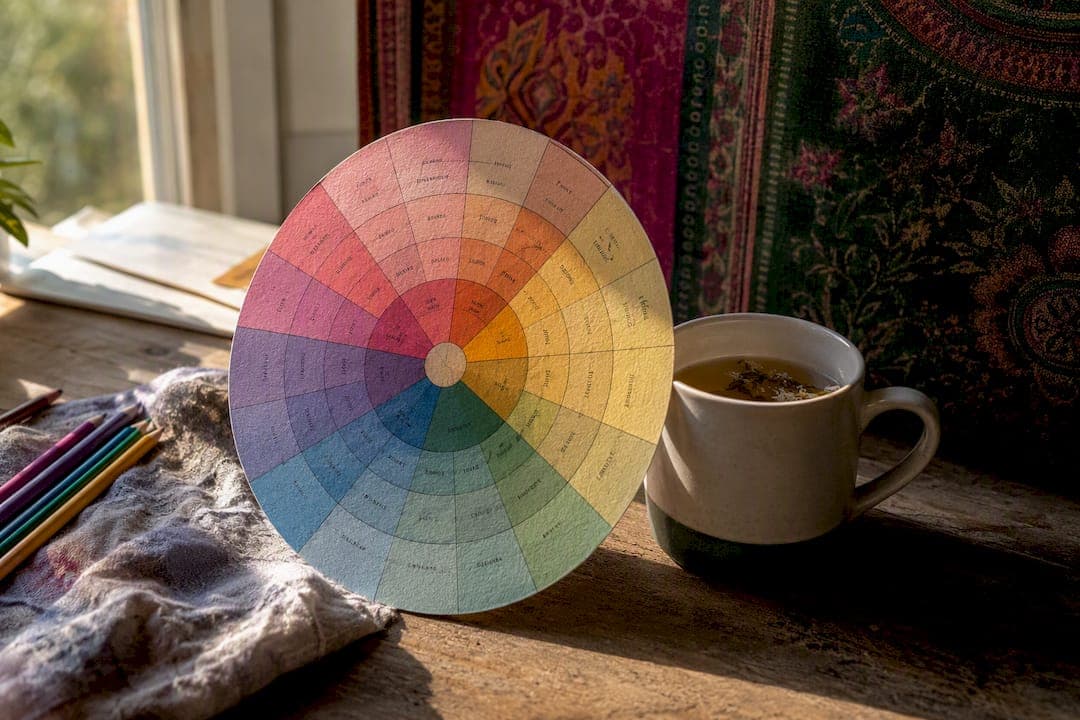
An emotion wheel helps you name what you feel so you can respond instead of react. The fastest way to use it: notice your body, pick a core emotion, move outward to a specific word, then choose one constructive action.
Here's how that looks in practice:
- Pause and notice what's happening in your body (tight chest, clenched jaw, restless legs).
- Pick the core emotion closest to the center of the wheel: mad, sad, glad, scared, or similar.
- Specify by moving outward to a more precise word, like "resentful" instead of just "mad."
- Act on it, whether that's a breath, a journal entry, or a short conversation.
You can use a wheel this way during a solo check-in, before a hard conversation, or as a journaling prompt at the end of the day.
Key Takeaways
Naming a specific emotion, rather than a vague one, is the single action that makes an emotion wheel useful for self-awareness and regulation.
| Point | Details |
|---|---|
| Start at the center | Pick the broadest emotion first, then move outward to a specific word on the wheel. |
| Match the wheel to your goal | Use kid-friendly or Willcox-style wheels for vocabulary building, Plutchik's for intensity and mixed feelings. |
| Pair labeling with one action | Choose a single response, like breathing, journaling, or a short conversation, after naming the feeling. |
| Expect mixed emotions | Landing between two spokes is normal and often more informative than forcing one word. |
| Extend the practice with stories | Icon Literary's read-aloud books and card decks give kids extra entry points into naming feelings. |
Table of Contents
- Understanding the Emotion Wheel and Its Main Versions
- How the Wheel Is Structured: Rings, Spokes, and Intensity
- Steps to Use an Emotion Wheel, Start to Finish
- Using an Emotion Wheel for Kids, Therapy, and Daily Check-Ins
- Common Mistakes and How to Get Better Results
- How Icon Literary Builds Emotion-Mapping Into Children's Materials
- What the Research Actually Supports About Using This Tool
- Where to Find Emotion-Mapping Books and Card Decks
- Sources
Understanding the Emotion Wheel and Its Main Versions
The emotion wheel started as a way to solve a real problem: most people default to "fine," "mad," or "stressed" because they never learned more precise words for what they feel. Dr. Gloria Willcox built her feelings wheel in the 1980s specifically for therapy, arranging broad emotions at the center with increasingly specific words radiating outward. Psychologist Robert Plutchik took a different approach with his "wheel of emotions," organizing eight core emotions into four opposing pairs (joy versus sadness, trust versus disgust) with color intensity showing how strongly each one hits.
Both wheels solve the same problem in different ways, and Healthline's guide to using an emotion wheel notes that Plutchik's version is better suited to mapping intensity and blended emotions, while Willcox-style wheels tend to help adults build vocabulary for everyday communication.
Choosing between them comes down to your goal:
- Kid-friendly or emoji wheels work best for young children or anyone building emotional vocabulary from scratch.
- Willcox-style wheels suit adults who want richer words for everyday check-ins or conversations.
- Plutchik's wheel fits people working through intense or mixed feelings, often in a therapeutic setting.
How the Wheel Is Structured: Rings, Spokes, and Intensity
Every wheel reads from the center outward. The middle holds broad, easy-to-recognize emotions like "happy," "sad," "angry," or "scared." Each ring beyond that gets more specific, so "sad" might lead to "lonely," which leads to "abandoned" or "isolated." Spokes divide the wheel into wedges, and the colors typically group related feelings together so you can scan quickly instead of reading every word.
Here's a simple way to move through it:
- Start at the center and pick whichever broad emotion feels closest to true.
- Follow that spoke outward one ring at a time.
- Stop when a word feels uncomfortably accurate, not just technically correct.
Intensity conventions vary by wheel. On Plutchik's version, the most intense feeling sits at the center (rage, for example, sits closer to the middle than mild annoyance), which reverses the pattern used by most feelings wheels for kids and Willcox-style adult wheels, where the center holds the broadest category and intensity increases as you move outward. Healthline explains that Plutchik's structure uses this intensity gradient specifically to show how a mild feeling can escalate into something much stronger.
Mixed emotions don't always land on a single spoke. It's normal to feel caught between two adjacent words, and some practitioners treat that in-between space as useful information rather than a problem to fix.
Pro Tip: If you can't decide between two words, write down both. The tension between them is often more informative than picking just one.
Steps to Use an Emotion Wheel, Start to Finish
This is the core routine, and it works whether you're checking in with yourself, prepping for a hard conversation, or journaling before bed.
- Ground first. Notice body cues before you reach for a word: a tight jaw, shallow breathing, a knot in your stomach. Take one slow breath before you look at the wheel.
- Pick the core emotion. Scan the center ring or spokes and choose whichever broad category feels closest, even if it's not perfect yet.
- Move outward to something specific. Follow that spoke to a middle or outer-ring word. "Frustrated" might actually be "overwhelmed" or "underappreciated" once you look closer.
- Check the trigger. Ask what happened right before this feeling showed up, and whether it connects to a pattern you've noticed before. PsychCentral's method for using an emotion wheel follows this same sequence: identify the closest core emotion, trace the trigger, then look at how it connects to past experiences before deciding what to do next.
- Choose one constructive action. Not five. One. That might be a breathing exercise, a journal prompt, setting a small boundary, or asking someone for help.
A short script helps when you're saying the emotion out loud for the first time: "I'm noticing I feel [specific word], probably because [trigger]. I think I need [one action]." That's it. No need to explain or justify it further.
This process works because naming a feeling does something measurable in your brain. Psychology Today points out that labeling emotions engages language centers and the prefrontal cortex, which helps shift you out of a reactive state and into one where you can actually think through your next move.
Using an Emotion Wheel for Kids, Therapy, and Daily Check-Ins
The same wheel adapts to very different settings depending on who's using it and why.
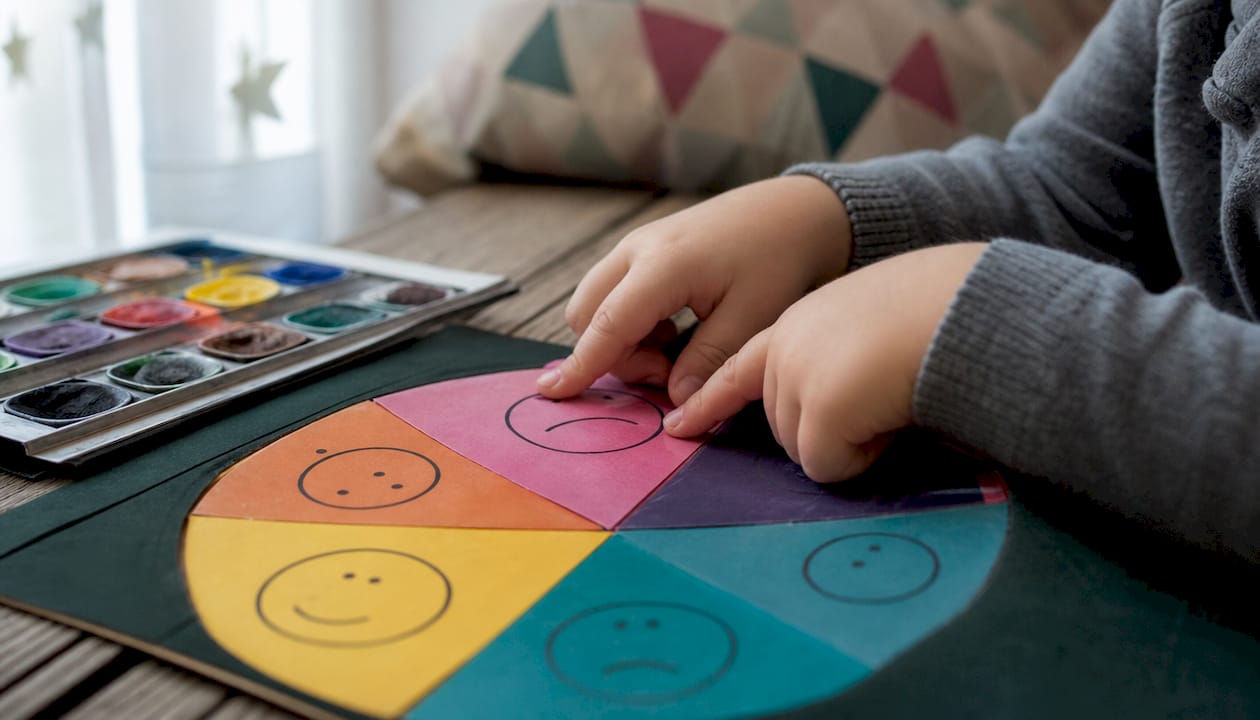
- Introducing the wheel to kids works best in calm moments, not mid-meltdown. Start with a simplified, emoji-based version and let a child point rather than demanding a verbal label, since Understood notes this approach fits children with limited emotional vocabulary far better than open-ended questions.
- Therapists and coaches often use the wheel as shared language between sessions, assigning it as homework so clients can track patterns over the week. SimplePractice's resource on feelings wheels for kids describes how this shared object also lowers shame, since a child pointing at a printed word feels less exposed than having to explain a feeling from scratch.
- A daily journaling template can be as simple as three columns: time of day, core emotion, specific label, and one action taken. Five entries a week starts revealing patterns you'd otherwise miss.
- In conversation, a wheel label makes a great opener: "I've been feeling more resentful than annoyed lately, and I think it's about how we've been splitting things at home." That's a much easier conversation to have than starting from "I'm just stressed."
Pairing a printable wheel with a read-aloud feelings book gives kids a story context for the words they're pointing to, which tends to stick better than the wheel alone.
Common Mistakes and How to Get Better Results
The biggest mistake is treating the wheel like a diagnostic tool that needs a single correct answer. Practitioners describe it instead as a compass, not a map, and PositivePsychology's guide to the emotion wheel notes that people commonly land on more than one word, and that's not a failure of the process.
A few things to watch for:
- Don't use the wheel to force a positive spin on a hard feeling. It's for labeling, not talking yourself out of what's real.
- Expect to land between two spokes sometimes. That's normal, not a sign you're doing it wrong.
- Pair every label with one small action rather than stopping at the word itself.
- Keep a copy visible (fridge, desk, notes app) so checking in takes seconds, not a search.
If intensity keeps escalating over days or weeks instead of settling, or if a feeling feels stuck no matter what action you pair with it, that's a signal worth bringing to a therapist rather than working through alone.
How Icon Literary Builds Emotion-Mapping Into Children's Materials
Icon Literary designs its picture books and activity kits around the same principle behind every good emotion wheel: kids regulate better once they have a specific word for what they're feeling, not a vague one.
A simple activity you can try today:
- Read a story together and pause at an emotional turning point for the main character.
- Hand your child a printed wheel and ask them to point, not explain.
- Pull a matching prompt card from an Icon Literary card deck to extend the conversation into a small drawing or writing exercise.
That combination (story, wheel, prompt) gives children three different entry points into the same feeling, which matters since not every child processes emotion verbally on the first try.
What the Research Actually Supports About Using This Tool
Most advice on emotion wheels treats them like a quiz with a right answer, and that's where it goes wrong. The research points somewhere more useful: labeling itself, not precision, is what shifts you out of reactivity. A word that's close enough still engages the prefrontal cortex. Waiting for the "perfect" spoke just delays the benefit.
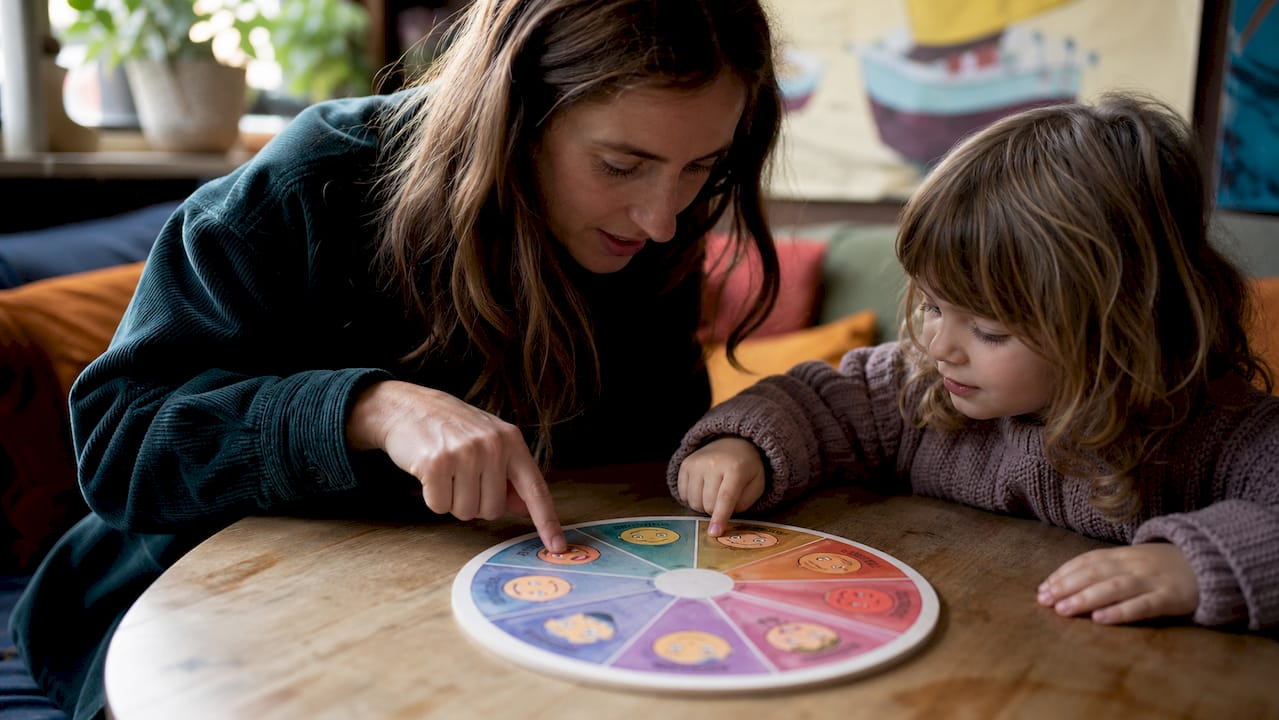
Caregivers get this backward with kids most often. They ask open-ended questions ("How do you feel?") when pointing at a wheel works far better for a child who doesn't have the vocabulary yet. The wheel should lower the bar to naming a feeling, not turn it into another test.
If you take one thing from this guide, prioritize the pairing step over the wheel itself: name the feeling, then do exactly one small thing about it. A wheel without an action attached is just a vocabulary list. With one, it becomes a genuine regulation habit, and that's the part conventional advice tends to skip.
— Derek Amarillas
Where to Find Emotion-Mapping Books and Card Decks
If you're building this habit with a child, a printable wheel goes further paired with a story that shows a character working through the same feelings. Icon Literary designs picture books, card decks, and activity kits specifically for ages 3 to 8, built around the same labeling-plus-action approach covered above, rather than generic "feelings" content with no follow-through.

What sets these materials apart is the pairing: each story introduces a specific emotional vocabulary word in context, and each card deck gives kids a concrete prompt to act on it, whether that's drawing, talking, or a small physical action. That's the same structure researchers point to as effective (label, then act) built directly into the product instead of left for a caregiver to improvise. If you're ready to add a book or card deck to your emotion-wheel routine, browse the full collection at Icon Literary and start with whichever title matches your child's current reading level.
Sources
- Emotion Wheel: What It Is and How to Use It
- The Emotion Wheel | Psychology Today
- Emotion Wheel: How to Use It for Emotional Literacy