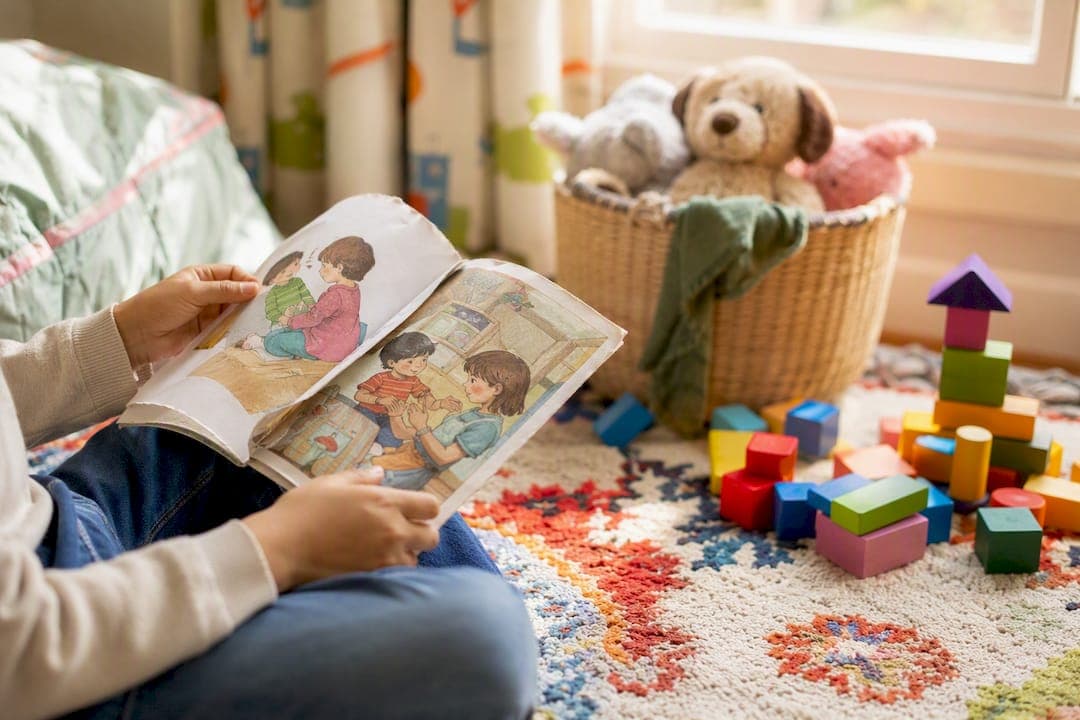
Children's books help siblings name their feelings, practice seeing a fight from the other kid's side, and pick up concrete repair skills, which makes them one of the most useful tools a caregiver has for reducing sibling bickering. A Stanford library guide groups picture books by age specifically for exploring jealousy and rivalry in kids roughly 3 to 8. Parenting expert Dr. Laura Markham argues that connection and emotional literacy, not punishment, are what actually calm sibling conflict.
Three mechanisms do the heavy lifting:
- Naming feelings so jealousy, anger, and hurt stop feeling scary and start feeling manageable.
- Perspective-taking, where a child watches a character misstep and self-correct without being lectured.
- Concrete skills, like specific words for asking to share or apologizing, that a child can copy the next time a fight starts.
Key Takeaways
Books reduce sibling conflict when they name feelings specifically, model a repair, and hand children a concrete script they can use in real fights.
| Point | Details |
|---|---|
| Distance builds regulation | A story gives kids enough emotional distance to examine anger or jealousy without feeling attacked. |
| Look for repair scenes | Choose books that show a fix, not just a fight that fades, so kids see conflict resolved. |
| Match books to age | Ages 3–5 need short, concrete scenes; ages 5–8 can handle longer, perspective-shifting narratives. |
| Follow up within minutes | A short drawing, role-play, or script practice right after reading moves the lesson into real behavior. |
| Icon Literary rounds it out | Icon Literary pairs picture books with activity kits and card decks so the story, the practice, and the repair script all come from one aligned set. |
Table of Contents
- Why picture books and short stories work on sibling conflict
- Storytelling techniques that actually teach kids something
- How to choose books that help with sibling fights
- Read-aloud prompts and activities that make the lesson stick
- Fitting books into a bigger plan for sibling bickering
- Where to find books that actually address sibling rivalry
- What Icon Literary offers for sibling conflict at home
- Frequently Asked Questions
- Sources
Why picture books and short stories work on sibling conflict
A book gives a child enough distance to look at a feeling without being inside it. That's the core reason stories work better than in-the-moment scolding: a kid mid-meltdown can't process advice, but a kid listening to a character named Fox lose his temper over a shared toy can watch, judge, and learn without defending himself.
There's a real cognitive piece here too. When a child is flooded with anger, the amygdala runs the show and language shuts down. A calm story, paired with a short follow-up conversation, gives the brain room to shift toward the prefrontal cortex, the part that handles reasoning and self-control. That's not a reason to skip the conversation after the story. It's the reason the conversation works at all.
Connection comes first. Markham's guidance in Peaceful Parent, Happy Siblings centers on teaching kids to manage their own big feelings and resolve conflict directly, rather than relying on a parent to referee every dispute.
Books also let you narrate feelings out loud without singling out your own child. Reading "she felt so furious she wanted to scream" lands differently than "why are you screaming at your brother again."
- Books externalize the emotion onto a character, which lowers a child's defensiveness.
- Repeated read-alouds build a shared vocabulary your kids can use mid-fight.
- A story read on a calm afternoon primes a script kids can reach for later, during an actual fight.
Storytelling techniques that actually teach kids something
Certain narrative devices are the actual engine behind a book's ability to shift behavior. Spotting them helps you tell a genuinely useful book from one that's just cute.
- Naming feelings directly. The best books use exact words: jealous, left out, embarrassed, instead of vague ones like "upset."
- Perspective-shift scenes, where the story pauses to show what the other sibling is thinking or feeling.
- Creative outlets as regulation. In Terrible Horses from Candlewick Press, a child channels rage into drawing and writing, and that creative act becomes the bridge to actually understanding her sister.
- Problem to repair sequences, where the fight isn't the end of the story. Something breaks, and then something gets fixed.
- Humor that reframes conflict, turning a tense moment into something a child can laugh at instead of relive with shame.
- Explicit kid-facing strategies. Some books hand children literal scripts or short steps to try, rather than just modeling good behavior for an adult to point out.
A practitioner-focused resource like The Sibling Survival Guide makes the case that books offering direct, kid-facing tactics build a stronger sense of agency than stories that only show adults solving the problem.
That last point matters more than most parents assume. A child who's handed an actual script is far more likely to try it than one who just absorbed a vague moral.
How to choose books that help with sibling fights
The fastest test in a bookstore or library: does this book name a feeling out loud, show a repair, and hand the child something doable? If it hits all three, it's worth reading twice.
- Scan for emotion words in the first few pages. If nothing gets named specifically, keep looking.
- Check for a repair scene, not just a resolution. A sibling apologizing or sharing matters more than a fight that simply fades out.
- Look at the illustrations for cues, exaggerated expressions and body language often teach as much as the text.
- Confirm the family looks recognizable to your own, or at least to some of the kids who'll read it.
- Match length and complexity to age, since a 4-year-old and a 7-year-old need very different pacing.
For ages 3 to 5, look for short, concrete scenes: one clear feeling, one clear behavior, big expressive art. For ages 5 to 8, kids can handle longer narratives with two viewpoints, subtler emotional shifts, and problem-solving that takes a few pages to unfold.
- Diverse family structures (blended families, adoptive families, multigenerational households) help kids across the age range see a version of themselves.
- Books with siblings of varying ages mirror real dynamics better than books where kids are the same age and size.
- A University of Illinois roundup of sibling-rivalry titles shows how wide this theme runs across children's literature, so there's rarely a shortage of options for a specific family shape.
Read-aloud prompts and activities that make the lesson stick
A story alone rarely changes behavior. What moves a lesson from the page into an actual fight later is a short, structured follow-up right after you close the book.
- Call-and-response labeling. Ask "how did she feel when her brother grabbed the toy?" and wait for an actual word, not a shrug.
- "What would you do?" role-play. Pause at the conflict point and ask your child to predict, then act out, a different ending.
- Draw the worry monster. BookTrust's guidance suggests drawing out a character's anxiety, which gives shy kids a way to talk without talking.
- Build a repair script together, three or four words your child can actually say mid-fight, like "I'm sorry, want to trade?"
- Swap-roles dramatization, where the sibling who usually feels wronged plays the other role for a scene.
- Retell the ending, letting your child rewrite how the story's fight gets fixed.
Reproducible five-minute template: Read the book. Ask one feeling question. Ask one "what would you do differently" question. Draw or act out the new ending together. Done.
Pro Tip: Skip the lecture during these activities. If you jump in to correct or moralize, kids shut down and start performing the "right" answer instead of actually practicing one. Let the story do the teaching; your job is just to ask the question and wait.
Fitting books into a bigger plan for sibling bickering
Books work best as one piece of an ongoing approach, not a one-time fix for a single fight. Pair regular story time with predictable routines and direct modeling of the language you want your kids to use, and the effect compounds.
- Read sibling-themed books on a regular, low-stakes schedule, not just right after a blowup.
- Build "fair" routines (turn-taking systems, individual one-on-one time) that lower the daily competition for attention.
- Brazelton and Sparrow's Touchpoints framework recommends age-specific check-ins that adjust as kids grow, since what defuses rivalry at 4 looks different at 7.
After a recurring fight, try this sequence: read a relevant book that evening, run a five-minute follow-up activity, practice the repair line together, then catch your child using it in real life and name it specifically ("you used your trading words, that worked").
- Read the book.
- Run the short activity.
- Practice the exact repair phrase.
- Reinforce with specific, not generic, praise.
Where to find books that actually address sibling rivalry
Start with a librarian and a specific request. Ask for "PreK to Grade 2 books about jealousy and sibling rivalry," which mirrors the exact categorization Stanford's library guide uses, and you'll get a far better list than a generic search for "sibling books."
- Search using age-based terms (PreK to Grade 2, early elementary) rather than vague ones like "kids books."
- Ask teachers or school librarians for their go-to titles; they see which books actually get requested a second time.
- Check publisher and SEL-focused catalogs for titles built specifically around emotional literacy rather than general storytelling.
Icon Literary's picture books, activity kits, and card decks are built around this exact set of criteria: naming feelings clearly, showing repair, and handing kids something concrete to try. If you want a broader list first, best book gift ideas for new siblings is a solid next stop.
An author's take on why the follow-up matters more than the story
Stories only go as far as what happens after you close the book. A weekly family story time, capped with one small repair activity, does more for sibling peace than any single perfect title. Icon Literary builds that follow-up directly into its activity kits, because a book without a next step is just a nice ten minutes, as the studio's own look at how SEL books reduce peer conflict lays out in more depth.
What Icon Literary offers for sibling conflict at home
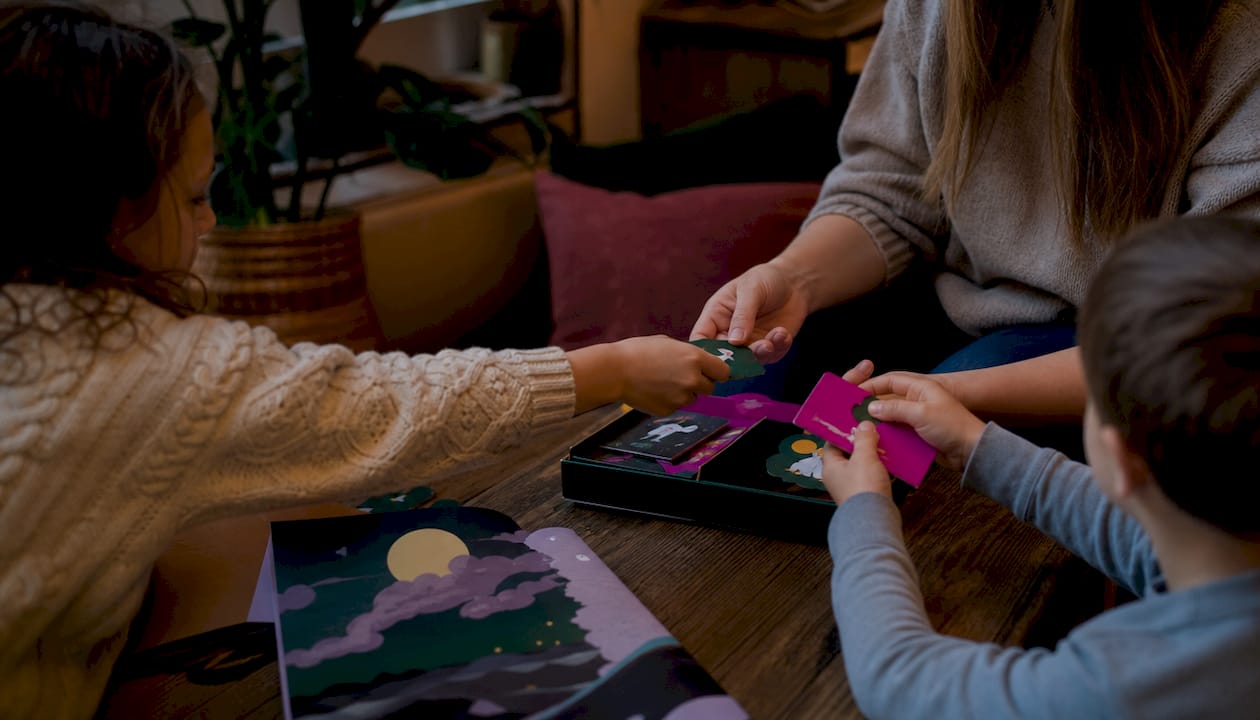
Icon Literary builds its picture books, activity kits, and card decks around the same three things this guide points to: naming feelings clearly, showing a repair, and giving kids something concrete to try next time a fight starts.
Each format serves a different moment in the process:
- Picture books for the read-aloud that first puts a name to jealousy, anger, or feeling left out.
- Activity kits for the five-minute follow-up, drawing, role-play, or a worry monster, that turns the story into practice.
- Card decks for the fast repair scripts kids can pull out mid-fight, once the bigger lesson has already landed.
If your family is dealing with a recurring flashpoint, whether that's a new baby, shared toys, or two kids who just process conflict differently, browse the full collection at Icon Literary's storefront and start with whichever format fits your next story time.
Frequently Asked Questions
What age should I start reading sibling conflict books? Kids as young as 3 can benefit from short, simple books with clear feelings and big expressive illustrations. Around age 5, they're ready for longer stories with perspective shifts and multi-step problem-solving.
How often should we read these books to see a difference? A regular, low-stakes rhythm, weekly or even a few times a week, works better than pulling out a book only after a fight, since kids absorb the vocabulary and scripts before they need them.
Do books work for kids with a big age gap? Yes, though you'll want different titles for each child and a shared conversation afterward that lets the older sibling model the language for the younger one.
What if my child refuses to talk after the story? Try a drawing activity instead of a direct question. Externalizing feelings onto paper, like sketching a "worry monster," often opens conversation for kids who clam up when asked directly.
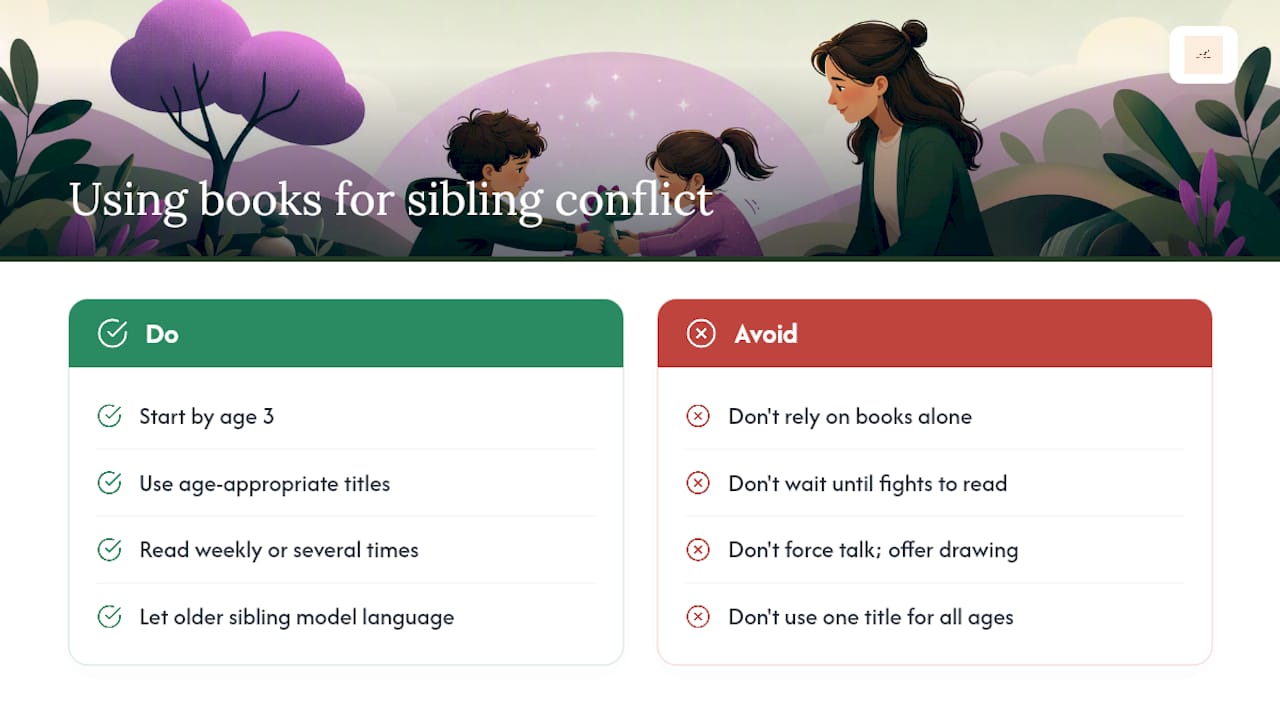
Can books replace other conflict-resolution strategies? No. Books work best paired with predictable routines, individual attention for each child, and real-time coaching during actual fights, not as a standalone fix.
Sources
- Jealousy/sibling rivalry - Children's books exploring emotions (Stanford University Libraries)
- Terrible Horses - Candlewick Press
- Peaceful Parent, Happy Siblings by Dr. Laura Markham (Penguin Random House)
- Publish
- Understanding sibling rivalry – The Brazelton way (Hachette Book Group)