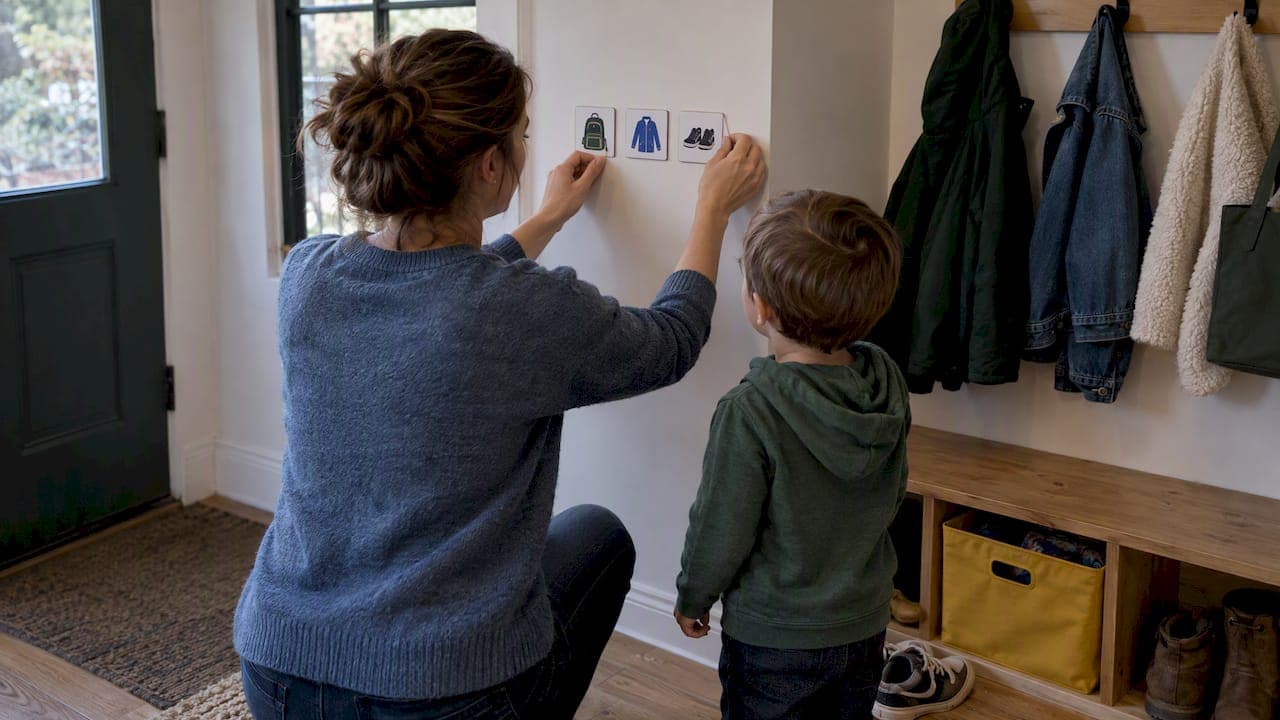
Set up a visible, child-level routine-card sequence and teach your child to move a marker or card into a "finished" pocket after each step: this simple system increases predictability, supports independent transitions, and cuts down on repeated verbal reminders. Choose one routine, make three to six cards for it, and post the sequence where your child can reach and see it without help.
TL;DR:
- Visual schedules are most effective when referenced consistently, paired with praise or rewards, and used throughout the day to support independence.
- Start with routines that cause the most friction, such as morning departure, bedtime, or classroom transitions, and focus on one routine for one to two weeks.
- Use simple, durable materials like laminated photos or icons and place the sequence at the child's eye level, involving modeling and prompting for best results.
- Break down complex steps into smaller visuals, especially for children with special needs or tough transitions, and avoid exceeding six steps in a routine.
- Flexibility and pairing routines with a character or story help maintain engagement without making the system feel like a strict rule.
Table of Contents
- What research says about routine and visual cards
- Which routines to tackle first
- How to build and set up a routine-card system
- Adjusting routine cards by age and setting
- Fixing common problems before you give up on the system
- Why this guidance holds up
- Keeping routines steady without making them rigid
- Pair routine cards with a story your child wants to follow
- FAQ
- Sources
What research says about routine and visual cards
Visual schedules are considered an evidence-based practice for supporting young children, and the research behind them is fairly consistent. A 2024 literature review looking at academic-related on-task behavior found that visual schedules improved outcomes for students, with the strongest results appearing when the cards were paired with prompting and reinforcement rather than used alone.
Guidance from the National Center for Pyramid Model Innovations points to the same conclusion: predictability is the real mechanism at work. When a child can see what is happening now and what comes next, a lot of the anxiety that drives meltdowns and stalling simply has less to grab onto.
A few practical takeaways stand out across this evidence:
- Visual schedules work best when referenced consistently throughout the day, not just introduced once.
- Pairing cards with praise or a small reward builds the habit faster than cards alone.
- Portable and digital options exist, but printed, static cards often perform just as well for younger children.
A 2024 review of 10 studies found that most reported improved independent transitions and reduced challenging behavior when visual schedules were combined with prompting and reinforcement, which is a useful reminder that the cards are a support tool, not a replacement for your presence.
Which routines to tackle first
You do not need a full system on day one. Start with the moment that causes the most friction, since that is where a routine card will show the fastest results.
- Morning departures and bedtime wind-downs tend to involve the most steps and the most rushing, which makes them prime candidates.
- Classroom transitions, like moving from circle time to centers, are worth targeting if you notice frequent prompting or long delays.
- Cleanup routines are a good starting point because they are short, repeatable, and easy to measure for progress.
Pick one routine and commit to it for one to two weeks before adding another. Watch for where you find yourself repeating the same instruction three or four times, since that repetition is usually the clearest sign of where a card sequence will help most.
How to build and set up a routine-card system
You do not need special equipment to get started, and a basic version can be ready in an afternoon.
Materials: printable cards or photos of your child's actual environment, a laminator or clear contact paper for durability, Velcro dots, magnets, or a small pocket chart, and binder rings if you want a portable version.
Layout: arrange cards left to right or top to bottom in the order steps happen, post the sequence at your child's eye level, and include a "finished" pocket or a moveable marker so your child can show each step is done. The National Center for Pyramid Model Innovations recommends this exact structure, including identifying the hardest moments of the day first, then building the sequence around them.
Here is a simple setup sequence to follow:
- Pick one routine and list its steps in order.
- Take photos of the real objects or spaces involved, or choose simple icons if photos are not practical.
- Laminate or cover the cards so they hold up to daily handling.
- Mount the sequence at your child's eye level, not yours.
- Model the routine once yourself, narrating each step as you go.
- Practice together, prompting only as much as needed.
- Let your child move the marker or flip the card to "finished" and respond with specific praise.
For classroom and home display options, a small binder works well for portability while a wall-mounted pocket chart holds up better for shared or high-traffic spaces.
Pro Tip: Use photos of your child's own home or classroom objects rather than generic clip art, and label cards in your family's home language when that differs from the language used at school.
Adjusting routine cards by age and setting
A toddler and a second grader need very different versions of the same idea, and home and classroom setups call for their own adjustments too.
- Toddlers: keep sequences to one or two items, use photo-based cards, and expect to guide the process yourself rather than handing over independence right away.
- Preschool and early elementary: three to six steps works well, and assigning a rotating "helper" job to move the cards builds both ownership and peer modeling.
- Special education settings: break steps down further than you think you need to, use high-contrast or photo-based visuals, and consider a first/then board for especially tough transitions. Check with your child's IEP team to make sure the system lines up with existing goals.
- Home versus classroom: laminated cards survive daily handling better at home, while a classroom often benefits from a larger wall chart plus a smaller portable version for field trips or transitions between rooms.
Older children in particular may prefer a more discreet, binder-style version over a large wall display, since visibility to peers can feel embarrassing even when the system itself still helps.
Fixing common problems before you give up on the system
Most routine-card struggles trace back to a handful of fixable issues rather than the method itself.
If your child ignores the cards, check visibility first: cards placed above eye level or tucked behind furniture simply will not get used. Model the routine again, and pair it with immediate praise the first several times.
If your child stalls on a specific step, that step is usually too broad. Break it into smaller visuals and swap vague verbs like "get ready" for a specific action like "put on shoes."
If progress stalls overall, track how often the behavior happens, adjust your prompting level, and if difficult behaviors continue despite consistent use, a school team or Functional Behavioral Assessment can help identify what is really driving the resistance.
Pro Tip: Avoid stacking more than six steps on a beginner sequence. A routine that takes longer to review than to complete defeats its own purpose.

Why this guidance holds up
This guide draws on practice resources from the IRIS Center, which has long served as a reference point for educators on visual supports, alongside national practice guidance and peer-reviewed research cited throughout. Derek Amarillas has written extensively on parent and educator guides covering social-emotional learning activities, with a focus on tools families and classrooms can put to use the same day they read about them. We create themed card decks and activity kits designed to make routines and emotional check-ins feel like part of a story rather than a chore, which shapes how this guide frames practical setup and troubleshooting.

Keeping routines steady without making them rigid
Routine cards work best as a tool you adjust, not a rulebook you enforce. A missed step or a skipped day will not undo the predictability you have built, and a little flexibility keeps the system from feeling like a demand.
Pairing a routine with a favorite character, where a character "does" the step first and your child copies it, often keeps younger kids more engaged than the cards alone ever could.
— Derek Amarillas
Pair routine cards with a story your child wants to follow
A routine card tells your child what to do next. A character they already love gives them a reason to want to do it. Our Duckwave Decks turn everyday steps into story beats, where a character models the action and your child follows along, which works well alongside the sequence you have already built.

- Use a themed deck to turn a routine step into a mini story moment your child looks forward to.
- Browse the full Icon Literary catalog for decks and activity kits that pair naturally with daily routines.
- For therapists or hybrid sessions building interactive visual routines, Therapy Canvas offers shareable tools worth exploring alongside a printed card system.
FAQ
What are routine cards used for?
Routine cards are visual sequences, usually photos or icons, that show a child the steps of a task in order. They reduce the need for repeated verbal instructions and help a child complete a routine with more independence.
How many cards should a routine sequence have?
Most beginner sequences work best with three to six cards, since longer sequences take more time to review than to complete. Toddlers typically do better with just one or two steps at a time.
Do routine cards actually work, or is this just a trend?
A 2024 literature review found that visual schedules improved on-task behavior and transitions when paired with prompting and reinforcement. National practice guidance from the National Center for Pyramid Model Innovations also treats visual schedules as an established, evidence-based practice.
What if my child ignores the routine cards?
Check that the cards are posted at your child's eye level and are actually visible during the routine. Model the sequence again yourself and add immediate praise when your child completes a step, since inconsistent referencing is the most common reason cards get ignored.
Can routine cards be used alongside a themed card deck?
Yes, a themed deck can turn a routine step into a short story moment, which often increases engagement for younger children. Our Duckwave Decks are built around this idea, letting a character model a step before your child imitates it.
Sources
- Using Visuals to Support Children in the Early Learning Environment — National Center for Pyramid Model Innovations
- The use of visual schedules to increase academic-related on-task behaviors of individuals with autism: a literature review