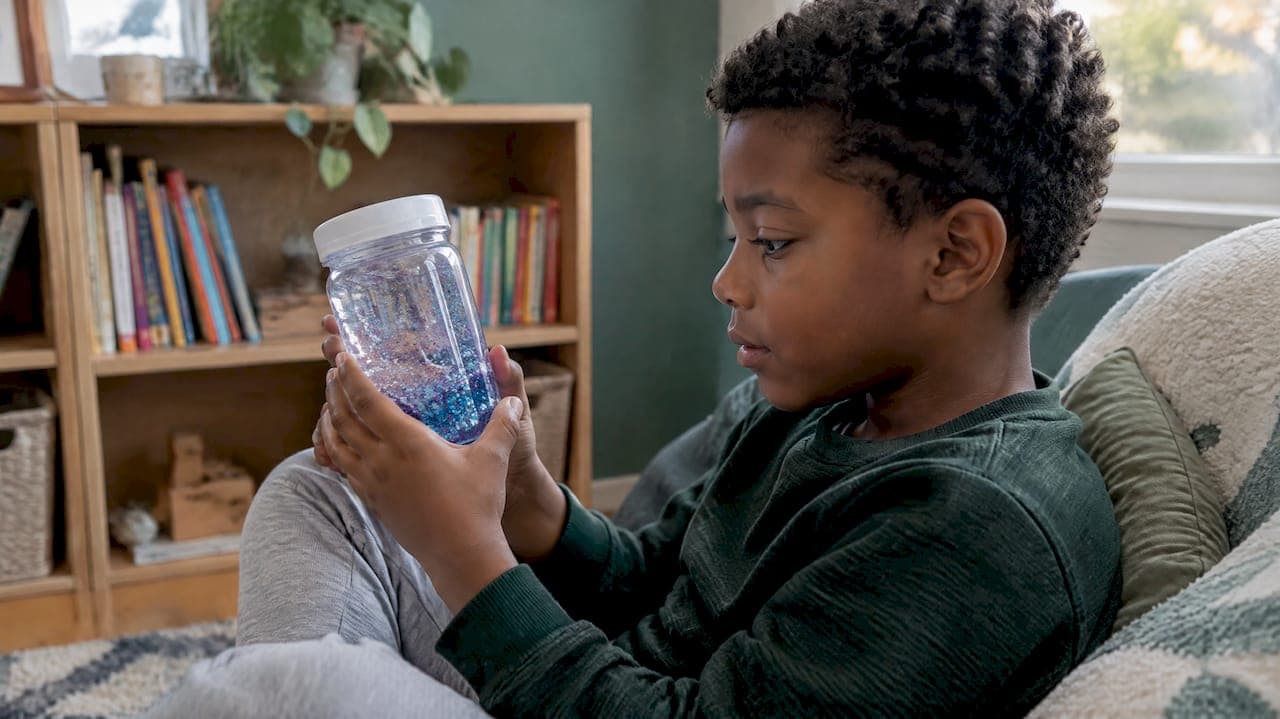
A calm down jar is a sealed clear bottle of water, clear glue and glitter. A child shakes it, watches the glitter swirl and settle, and slows down along with it. The basic recipe takes about ten minutes. The ideas below change the look, the settling speed and the way you use the jar, so it fits your child or your classroom.
This guide covers the base recipe, twelve variations, safety steps for ages 3 to 8, and how to introduce the jar so a child reaches for it on a hard day.
TL;DR
- The base recipe is a plastic bottle, hot water, clear gel glue and glitter, sealed with super glue.
- More glue slows the glitter. More water speeds it up. Mixing glitter sizes gives you fast and slow fall in one jar.
- Adults handle the hot water and super glue. Children choose colors, fillers and a name for the jar.
- Practice with the jar when your child is calm, then offer it during big feelings, along with slow breaths.
- A positive jar is a different tool: it collects good moments rather than slowing a upset body.
Table of Contents
- What a calm down jar does
- The base recipe
- Control the settling speed
- 12 calm down jar ideas
- Safety for ages 3 to 8
- How to use the jar
- What about a positive jar?
- Our perspective
- A card deck to pair with your jar
- Troubleshooting
- FAQ
- Sources
What a calm down jar does
When a child is upset, words are often the hardest thing to find. A jar gives them something to do with their hands and eyes. Michigan State University Extension notes that calming jars can help young children who struggle to express emotions verbally learn self-regulation.
The mechanism is simple. A pediatric psychologist quoted by Connecticut Children's describes these bottles as coping skill tools for kids dealing with sensory overload or anxiety. Children's Healthcare of Atlanta describes it as a sensory experience: the child shakes the jar to release tension, then refocuses as the glitter settles.
The jar is not a punishment, and it does not fix a feeling. It gives a child a few quiet moments to settle so that they can talk, cuddle or move on.
The base recipe
Start here. Every idea after this one is a change to these steps.
You need:
- A clear plastic bottle or jar with a tight lid. An empty water bottle works.
- Hot water
- Clear gel glue (not white school glue)
- Glitter
- Optional: a drop of food coloring
- Super glue for the cap (adult only)
Steps:
- Fill the container about three quarters full with hot water.
- Add the clear glue and stir or shake to dissolve it.
- Add glitter, screw the lid on and shake.
- Adjust. Add more glue or water until the glitter falls at a speed you like.
- Put super glue around the cap, close it and let it dry fully before a child touches it.
Those steps follow PBS Kids for Parents. Plan for a mess. The Children's Healthcare of Atlanta tip sheet suggests covering the workspace and leaving time for cleanup.
Control the settling speed
Settling speed is the most useful thing you can change, and it decides who the jar suits.
According to PBS, more clear glue makes glitter settle more slowly, while more water makes it settle faster. Different glitter sizes also fall at different speeds. Use that as a dial:
| Goal | Change | Good for |
|---|---|---|
| Slow, dreamy fall | More clear glue, fine glitter | Bedtime, anxious or sensory-seeking kids |
| Quick fall | More water, chunkier glitter | Short attention spans, ages 3 to 4 |
| Layered fall | Mix fine and chunky glitter | Kids who like to watch changes |
Test the jar before you seal it. Shake it, count out loud while it settles, and ask the child whether that feels too fast or too slow. A jar that settles in under a minute is a good start for a three-year-old. A jar that takes a few minutes may suit a seven-year-old who is practicing breathing.
12 calm down jar ideas
1. The classic single-color glitter jar
One color of glitter, a drop of matching food coloring. Simple jars are often the best ones for younger kids, because there is one thing to watch.
2. Two-size glitter jar
Use normal glitter and micro glitter together. Some falls fast and some falls slowly, so the jar keeps changing as the child watches. A classroom SEL tutorial that ranks for this topic uses the same trick.
3. Jellyfish bottle
Connecticut Children's lists a jellyfish bottle among its ideas. Kids like the story: the jellyfish drifts and floats as it settles. Ask your child what the jellyfish is feeling.
4. Glow-in-the-dark jar
Glow-in-the-dark pieces can turn the jar into a night light and add a sensory surprise, according to the same Connecticut Children's page. This works well for kids who feel worry at bedtime.
5. LEGO brick jar
Drop a few small LEGO bricks in with the glitter. Kids who love building often enjoy a jar with a favorite toy inside. Check that the bricks fit through the neck only if you plan to open the jar. Once sealed, nothing comes out.
6. Sequins, beads and mini erasers
PBS lists sequins, beads, googly eyes and mini erasers as fillers. Heavier items fall faster than glitter, so test them in the jar before you seal it.
7. Theme jars
Pick a theme from your child's current obsession: ocean (blue glitter, tiny shells), space (dark blue, silver stars), garden (green and yellow). A theme gives the child a reason to feel ownership of the jar.
8. A jar for each feeling
Make a red jar for anger and a blue jar for sadness. Children often find it easier to say "I need the red jar" than "I am angry." For a deeper look at helping kids name feelings, see our 6 to 8 week plan to teach emotions to kids.
9. A jar with a word on the lid
One calming jar guide from Transitions LifeCare is built around short messages. Write a phrase on a label, such as "I am OK" or "You can do this." Let the child pick the words.
10. The timer jar
A jar can work as a gentle timer. PBS suggests it as a calming timeout timer, and it also suggests turning chores into a race against the settling glitter. Tidy-up becomes a game: "Can we pick up the blocks before the glitter lands?"
11. Oil and water bottle
Some sensory bottles use baby oil and water instead of glue, which gives slow, bubbly movement and distinct layers. The settling is different, and some children find it more soothing than glitter. Use the same sealed-cap rules.
12. A mini travel jar
A small bottle fits in a backpack or a car seat pocket. Keep one for the school drop-off line or the doctor's waiting room.
Safety for ages 3 to 8
A jar is a calm tool only if it is safe. These steps come from PBS and the Children's Healthcare of Atlanta tip sheet:
- Use a plastic container, never glass.
- An adult handles the hot water. Let it cool a little if the child will help pour.
- An adult handles the super glue, and the cap is sealed with it.
- Let the glue dry before the child holds the jar.
- Check the cap now and then. If it loosens or the jar leaks, replace it.
For children who still put things in their mouths, skip small loose fillers and stay close. If your child has a sensory or medical need that affects how they handle objects, ask their pediatrician or occupational therapist whether a jar is a good fit.
If you want more ideas for handling craft materials, jars and supervision at home, these easy mason jar crafts show other ways to prepare and use jars with kids. For a calm down jar, stay with plastic.
How to use the jar
Making the jar is half the job. The other half is the routine around it.
Practice when everyone is calm
Transitions LifeCare notes that practicing with the jar during calm periods can help a child use it better during worry or stress. Try it at story time. Shake it, watch it, and talk about how your body feels as the glitter settles.
Add slow breathing
Transitions LifeCare also suggests deep breathing alongside watching the jar. Try this: breathe in as you shake, breathe out slowly until the glitter lands. Keep it light. If the child is not interested, watching is enough.
Offer it, don't order it
Say "Would the jar help right now?" rather than "Go sit with your jar." PBS says a parent or educator can invite the child to shake it and focus on the glitter. Invitations keep the jar a tool the child owns.
Give it a home
Keep the jar where the child can reach it. In a classroom, that is often a feelings corner. Our guide to designing a feelings corner explains how to set one up, and our ten minute rehearsal for calm down boxes shows how to teach kids to use these tools in a short lesson.
Pair it with other tools
A jar works best as one of several choices. Add grounding techniques for kids, or other emotion regulation activities, so a child has something to try when the jar is not nearby.
What about a positive jar?
A positive jar is a different idea. Instead of slowing a child's body, it collects good things. The usual version is a gratitude jar, where kids add small notes about things they appreciate. One family gratitude jar guide suggests prompts and a regular routine, such as a daily or weekly note.
For kids ages 3 to 8, who cannot write yet, you can adapt it:
- Drop in a pom-pom or a bead for each kind thing someone did.
- Let the child draw a quick picture and fold it in.
- Write down what they tell you and read the notes together on a Friday.
The two jars work as a pair. The calm down jar is for the hard moment. The positive jar is for remembering that hard moments pass.
Our perspective
We make picture books, card decks and activities for children ages 3 to 8, and we think about emotional literacy a lot. What we see again and again is that children take up a tool when it feels like theirs, not when it feels like a lesson.

That is why we like the jar. It is quiet and visual, and it does not tell a child what to feel. We would rather a child learn "I can slow down" through playing and watching than through a lecture. So make the jar with your child, let them pick the colors, and name it something silly.
We also suggest pairing the jar with a story. Reading about a character who has a big feeling gives a child words for it before the hard moment arrives. Our post on the benefits of reading emotional books to kids explains why.
— Derek Amarillas
A card deck to pair with your jar
If you want a playful activity to use once the glitter has settled, look at our Duckwave Decks, $7 one-off. For longer stories and characters, visit Socko's Universe. Looking for a gift? See our 8 best gifts supporting child emotional growth.
Troubleshooting
- Glitter clumps at the bottom. Add a little more hot water, or use a finer glitter. Shake well.
- Glitter falls too fast. Add more clear glue and shake.
- Glitter will not fall at all. There is too much glue. Pour some out before sealing and add water.
- The water looks cloudy. Cloudiness can come from too much glue or from some glitters. Start again with less glue.
- Child shakes it hard and keeps shaking. That is fine for a moment, since shaking releases tension. Then invite them to hold it still and watch.
FAQ
What should you put in a calm down jar?
Hot water and clear gel glue make the base. Glitter is the classic filler, and you can add sequins, beads, googly eyes or mini erasers, according to PBS. Food coloring is optional.
How do you make a glitter calm down jar?
Fill a plastic container about three quarters full with hot water, add clear gel glue and glitter, then shake. Adjust the mix until it settles at a good speed. An adult then seals the cap with super glue and lets it dry.
How long should glitter take to settle?
There is no single right time. More glue slows it and more water speeds it up, so adjust until it suits your child. Many parents start with a jar that settles in a minute or two for younger children.
Is a calm down jar safe for a 3-year-old?
Yes, if it is made of plastic and the cap is sealed with super glue and fully dry. An adult should handle hot water and glue, and stay nearby when a young child uses the jar. Replace it if it leaks.
Sources
- PBS Kids for Parents: How to make a glitter jar
- Children's Healthcare of Atlanta: Glitter Jars tip sheet
- Transitions LifeCare: Calming Jar family activity
- Michigan State University Extension: Calming Jar
- Connecticut Children's: DIY calming bottle
- Gratitude jar ideas for kids