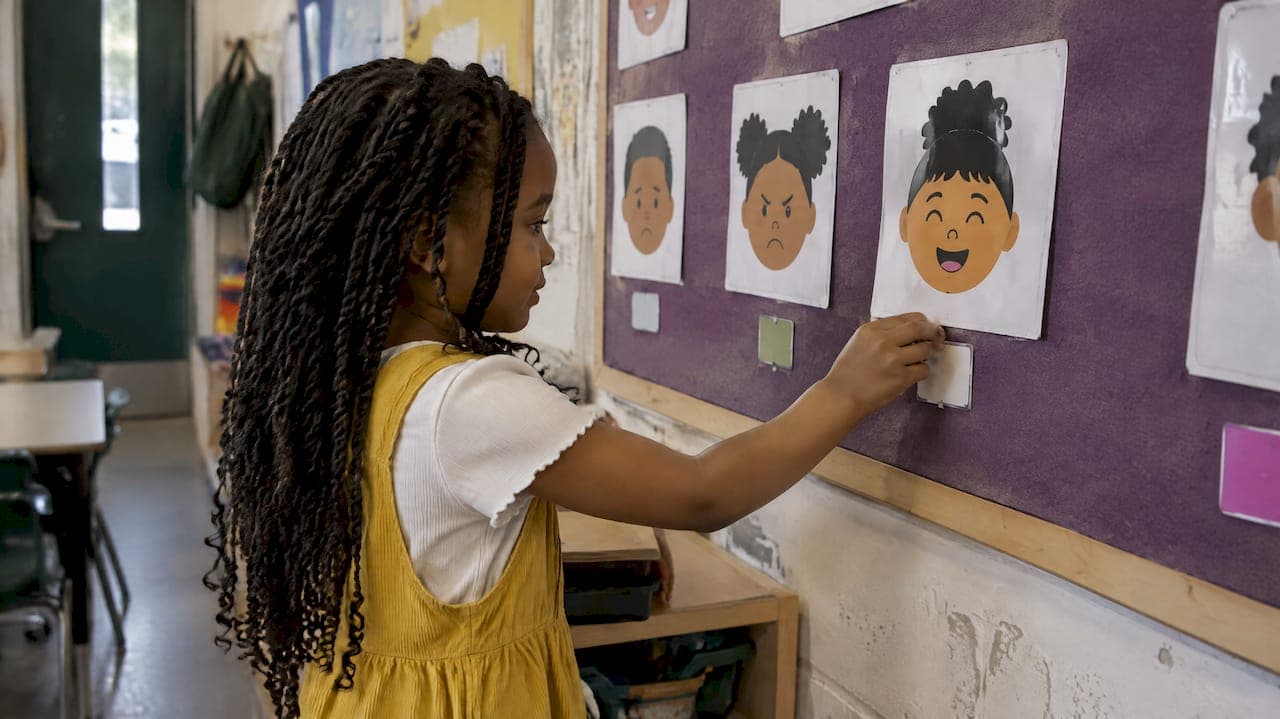
A classroom emotion bulletin board gives children a place to see feeling words, match them to how they feel, and talk about them with you. The best ones are simple, sit at child height, and get used every day. This guide covers what to put on the board, three layouts that work for ages 3 to 8, how to make it fit children with different communication needs, and how to use it without pressuring anyone to share.
TL;DR
- Start small: 4 to 6 feeling words with pictures, then add more as children learn them.
- Pick one format and use it daily: name-card check-in, mood meter, or feelings wheel.
- Hang the board where every child can reach it, and protect the cards so they last.
- Offer more than one way to respond: pointing, moving a card, or using words.
- Model the board yourself by naming your own feelings. Never require a child to share.
Table of Contents
- What an emotion bulletin board does
- Choose the feeling words
- Three formats that work
- Make it work for every communicator
- Setup and materials
- Use it without pressuring anyone
- Ideas by theme and time of year
- Our perspective
- A ready-made option for your board
- FAQ
- Sources
What an emotion bulletin board does
A feelings board is a visual reference. Children see an emotion word next to a face or picture, and they connect the two. That sounds small, but emotional vocabulary is a skill children have to learn. The Pyramid Model guide from the National Center for Pyramid Model Innovations notes that children are not born able to understand emotions and learn these skills at different rates. It also says that building emotional vocabulary is essential for emotional literacy.
The same guide says visual supports give children a reference for classroom expectations. A feelings board works the same way. It is always there, and it does not depend on a child finding the right word in the moment.
A useful frame comes from the RULER approach, described by NAEYC. It names five skills: recognizing, understanding, labeling, expressing, and regulating emotions. Your board mainly supports the first and third. It helps children recognize a feeling and put a label on it. The other three skills come from the conversations, stories, and calm-down routines you build around the board.

Choose the feeling words
Do not post 20 emotions on day one. Younger children do better with a few clear words they see every day.
A North Carolina state resource lists emotion words appropriate for young children by age. For children 24 to 36 months, it includes angry, proud, jealous, brave, lonely, kind, and hurt, building on words from earlier ranges. Children in your classroom are older, so you can start with the basics and grow from there.
NAEYC suggests that for ages 3 to 8, a simple mood meter with colors is developmentally appropriate before you bring in more nuanced vocabulary. The colors are red for angry, blue for sad, green for calm, and yellow for happy.
Here is one way to phase the words in over a school year. It is our suggestion, not a research standard.
| Stage | Words on the board | Good for |
|---|---|---|
| Weeks 1 to 3 | happy, sad, angry, calm | Pre-K and kindergarten, or any class new to the board |
| Weeks 4 to 8 | scared, excited, proud, tired | Adding body clues and everyday situations |
| Later | nervous, frustrated, lonely, jealous, brave, disappointed | Grades 1 to 3, paired with read-alouds |
When children are ready for richer words, a feelings bank helps. One feelings word bank from a UK family program includes words such as fed-up, disgusted, and interested. Those are good examples of feelings children have but rarely name.
For age-banded word lists and scripts to say aloud, see our guide to emotion vocabulary for kids.
Three formats that work
Pick one format first. You can add a second once the first is routine.
1. The name-card check-in
Each child has a name card with sticky-tack on the back. When they arrive, or during morning meeting, they move their card to the emotion that fits best. We Are Teachers describes this sticky-tack name card setup in its free emotions bulletin board kit.
This format is fast. It gives you a quick read of the room, and children see that classmates feel different things on the same morning. That alone normalizes feelings.
If you want more layout ideas for boards with movable student cards, these classroom bulletin board setup ideas show how to arrange pieces so children can reach and change them.
2. The mood meter
A mood meter is a four-color grid or a vertical strip. Children place a clothespin, a clip, or a card on the color that matches. Keep it simple with the four colors above. Add a word and a face to each color so the color is not the only clue.
This format suits the youngest children, because colors are easier to read than words. It also works well for children who are still learning English.
3. The feelings wheel
A feelings wheel has a spinner or pointer on a circle of faces and words. Children point it to the feeling they have. The Pyramid Model Preschool Classroom Kit includes an Emotional Literacy Kit with a feelings wheel, 24 feelings cards, four bingo cards, and a relaxation thermometer. That gives you a sense of what a full toolkit contains.
A wheel is more of a conversation piece than a daily tracker. It works well at a small table, in a calm-down area, or in a one-on-one chat. For quick routines, see our 90-second feelings wheel activities.
Which one should you pick?
| If your class is... | Start with |
|---|---|
| Pre-K, or mixed language levels | Mood meter |
| Kindergarten to grade 2, with a morning routine | Name-card check-in |
| A small group, counseling room, or calm-down area | Feelings wheel |
Make it work for every communicator
A board that only works for children who speak up is not much of a board. The research here is clear and practical.
The Vanderbilt Kennedy Center explains that a communication board can use objects, photographs, line drawings, and words. Symbols should be chosen for individual needs and preferences, and should include both everyday core vocabulary and context-specific words. For your board, that means pairing each emotion word with a picture, and swapping in a photo or object when a child needs it.
Here is how to apply that:
- Use real options. Offer a photo, a line drawing, and a word for each emotion. Children can pick whichever helps.
- Match what a child already uses. ASHA says using the same symbols as a student's AAC system can help the student understand, anticipate, and communicate about routines. If a child has an AAC system, ask the speech-language pathologist which symbols it uses and use the same ones.
- Accept all responses. Texas SPED Support advises teachers to identify each student's response mode, such as verbal, physical, visual, subtle movement, vocalization, or AAC. Build those into your activities instead of assuming speech or writing is the only valid response.
- Treat every attempt as meaningful. The University of Minnesota's Institute on Community Integration recommends that educators acknowledge every potential communicative effort, even when the message is unclear. AAC should always be available, but a student should not be required to use it.
- Wait. Give children time to respond, and model the board yourself.
Visual supports work best when they are individual. ASHA's guidance points out that visual prompts can improve independent task initiation and participation. A generic poster hung for decoration does not do that.
If you teach in a public school, there is also a legal side. The U.S. Departments of Education and Justice state that districts must ensure communication with students with hearing, vision, or speech disabilities is as effective as communication with other students. It also says the student's requested aid gets primary consideration. For a specific student, talk to your special education team and speech-language pathologist about what the board should include.
Setup and materials
Good setup decides whether children use the board or ignore it.
- Height. Hang it where every child can reach it, including children who use wheelchairs or mobility devices. The Vanderbilt guide advises placing boards where all students can easily access them.
- Protection. The same guide suggests adding a protective layer such as laminate. Young children handle cards constantly, and laminated pieces survive.
- Size. Make faces and words large. Leave space between choices so a child can point without hitting two at once.
- Location. Put it near the door for arrival check-ins, or near the calm-down area. The Pyramid Model guide notes that emotion posters are hung around classrooms and in calm-down areas. If you are building a quiet space, our guide to a feelings corner kids actually use covers layout.
- Consistency. Keep the same words, pictures, and positions week to week. Change one thing at a time.
A quick shopping list: cardstock, a laminator or clear contact paper, sticky-tack or hook-and-loop dots, clothespins, a marker, and a printed set of faces. Many teachers build the whole thing in under an hour.
Use it without pressuring anyone
The board should invite, never demand. Some children, especially shy or sensitive ones, will not want to announce a feeling in front of the class.
Vanderbilt's Rapid Check-In board shows one approach. It lets students share how they feel without approaching the teacher personally, including anonymously with numbered popsicle sticks. Teachers can then follow up discreetly with students who signal they are struggling or need someone to talk to. In an early grade, you can give every child a numbered clip so only you know whose is whose.
Then model it. NAEYC suggests that educators label their own feelings and help children connect physical cues, such as a frown or crossed arms, with words like frustrated or annoyed. Try this:
- "I put my card on tired today. My eyes feel heavy."
- "Your arms are crossed. I wonder if you feel frustrated."
- "I'm nervous about the assembly. I'm going to take three slow breaths."
Also respect that coping looks different. The Autism Research Institute says regulation strategies must be individualized, and that stepping away from people in a bad mood can be a good strategy for some. So if a child moves a card to angry and then goes to a quiet spot, that is the board working.
A few ground rules help:
- All feelings are okay. Not every action is okay.
- Moving a card is a choice. Skipping it is also fine.
- Never use the board for behavior charts or consequences. Once it feels like a grade, children stop being honest.
- Check in privately with a child who is on red or blue for several days in a row, and loop in your school counselor if needed.
Ideas by theme and time of year
Once the basic board is working, you can dress it up. Keep the core words constant and change the frame around them.
- Back to school. "How are we feeling about a new year?" Add nervous, excited, and curious.
- Fall. A tree with leaves, each leaf holding a feeling word. Children move their name to a leaf.
- Winter. Snowflakes or mittens as cards, with words like cozy, lonely, and cold-and-grumpy.
- Spring. A garden where each flower is a feeling. Good for talking about growth and patience.
- Book of the week. Rotate in the feelings from your read-aloud. NAEYC notes that reading books with emotions lets educators introduce new feeling words and tie them to classroom themes, such as using nervous or brave to talk about a doctor's visit. Our read-aloud guide for feelings books shows how to do this for ages 3 to 8.
You can also pair the board with hands-on practice. Emotion sorting activities and feelings charades give children a chance to act out the words they see on the wall. If you want a longer arc, our 6 to 8 week plan to teach emotions fits neatly around a new board.
Our perspective
At Icon Literary, we make emotional-literacy picture books, card decks, and activity kits for ages 3 to 8. Here is what we have learned from building tools for children.
Children read tone fast. If a board feels like a lesson, they treat it like one. We design our stories and decks to teach emotional literacy without lecturing, using characters children want to spend time with. The same idea applies to a bulletin board. Make it a place children visit because it is interesting, not because they are told to.
We also believe in individuality. Two children can feel the same way and show it very differently, so a good board leaves room for that. Offer more than one way to respond, avoid right and wrong answers, and let children add their own words over time.
Finally, keep it small and consistent. A short, familiar routine beats an elaborate display that nobody touches after October.
— Derek Amarillas
A ready-made option for your board
If you would rather not draw every card yourself, our Duckwave Decks are themed card decks for $7 (one-off). Teachers and parents can use character cards as part of a feelings display or as a conversation starter at a calm-down table. You can find them on our Duckwave Decks page.
We also publish picture books and story worlds you can read aloud alongside your board. Browse Socko's Universe to see what is available.
FAQ
How many emotions should a classroom feelings board have?
Start with four to six. Happy, sad, angry, and calm are enough for the first few weeks, and you can add scared, excited, proud, and tired next. Add more nuanced words like frustrated or disappointed once children use the first set confidently.
Where should I put the board in my classroom?
Place it near the entrance for arrival check-ins, or beside a calm-down area for quieter conversations. Whichever you pick, hang it at child height so every student can reach it. Keep it away from busy traffic spots so children are not on display while they choose.
Should children's names be visible on the board?
It depends on your class. Name cards work well for a morning meeting where sharing is comfortable. If some children feel exposed, use numbered clips or sticks so only you know whose is whose, then follow up privately with children who seem to be struggling.
What if a child will not use the board?
That is fine. Keep modeling it with your own feelings, and let the child watch. Some children need weeks before they try. You can also offer another way to respond, such as pointing to a card or using a picture, and check in one-on-one instead.
Can I use a feelings board at home?
Yes. A small board on the fridge or a bedroom wall works the same way. Use the same words each day, name your own feelings, and keep it low pressure.
Sources
- The Pyramid Model Preschool Classroom Kit
- Teaching Emotional Intelligence in Early Childhood, NAEYC
- Emotion Words Appropriate for Young Children
- Shaping Us feelings bank
- Free Emotions Bulletin Board Kit, We Are Teachers
- Basic Functional Communication Board, Vanderbilt Kennedy Center
- Augmentative and Alternative Communication, ASHA
- Texas SPED Support monthly instructional guide
- TIES Tips: Communicative Competence, University of Minnesota
- Effective Communication FAQs, U.S. Department of Education and Department of Justice
- Rapid Check-In Board, Vanderbilt
- Emotional Regulation Strategies, Autism Research Institute
- Classroom bulletin board setup ideas