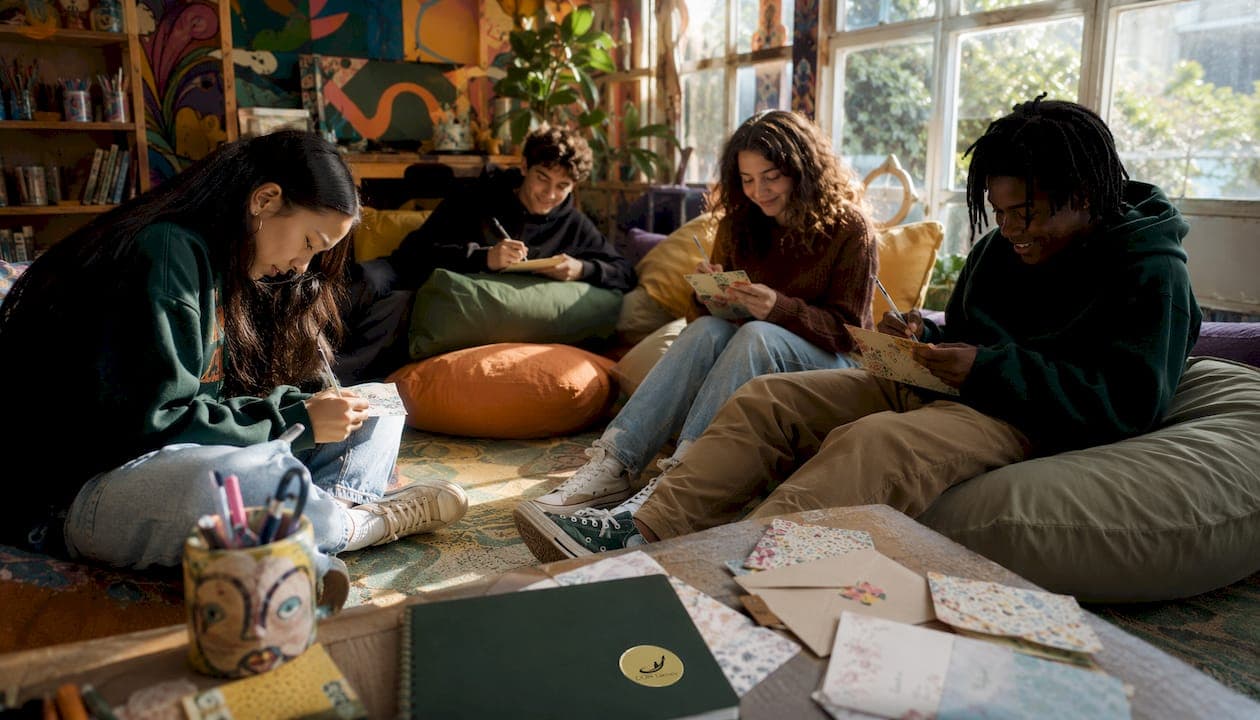
Safe, reputable pen pal programs for teenagers do exist in the U.S., and the core concept adapts well for younger children with the right structure. Two practical routes cover most situations:
- (A) Supervised teen exchanges: Moderated programs that require parental or guardian consent before any minor participates. Reputable services explicitly avoid pairing minors with adults and operate with staff or platform oversight.
- (B) Teacher-led alternatives for ages 3–8: Postcard swaps, picture exchanges, and class scrapbook projects that deliver the same connection and SEL benefits without the risks of direct correspondence.
Read on for safety rules and consent checklists, a step-by-step setup guide, age-adapted activities, ready-to-use prompts, and a cost breakdown.
Table of Contents
- What pen pal programs for teenagers actually look like
- Where to find reputable teen pen pal programs in the U.S.
- Safety rules and the parental consent checklist every family needs
- How to run a supervised pen pal exchange for a class or youth group
- How to adapt pen pal ideas for children ages 3–8
- Ready-to-use prompts and letter templates
- What pen pal exchanges typically cost and how to schedule them
- Recommended first steps for parents and educators
- Privacy laws and data protection for minors beyond the U.S.
- Key Takeaways
- Why this guide was written this way
- Icon Literary activity kits pair naturally with pen pal exchanges
- Useful sources and further reading
What pen pal programs for teenagers actually look like
Pen pal programs come in four main formats. Postal exchanges are the classic model: participants write physical letters and mail them, often through a school or organization that manages address distribution. Moderated digital exchanges use email or a platform's internal messaging system, with staff reviewing content before delivery. Classroom-to-classroom partnerships pair two school groups, with teachers acting as the go-between. Nonprofit and youth-organization programs (such as those run by 4-H or community centers) add a structured curriculum layer, including prompts, project ideas, and staff oversight.
Typical organizers include schools, public libraries, 4-H chapters, and community-based youth nonprofits. Common features across reputable programs: defined age ranges, interest-based or language-based matching, a clear moderation level, and explicit consent requirements. Some services offer optional starter kits with reproducible templates and postage guides, which reduce teacher prep time considerably.
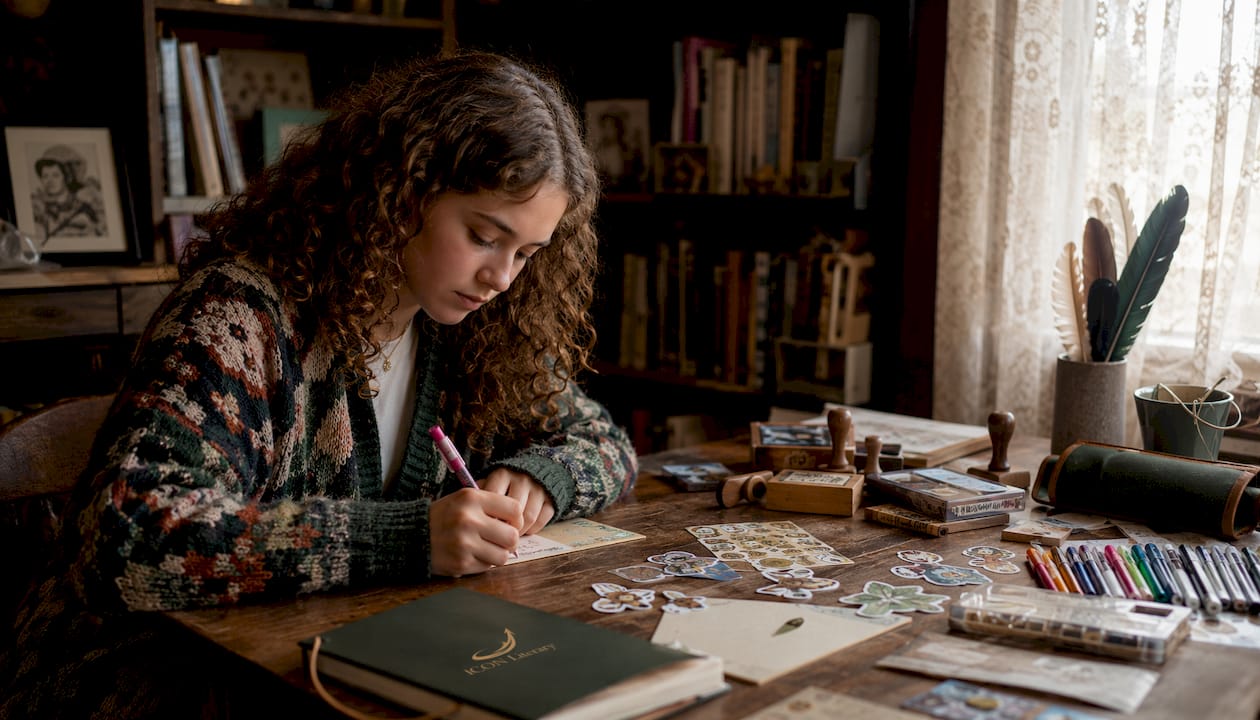
That framing matters. A pen pal program can build empathy, writing confidence, and global awareness. It works best when adults treat it as a structured learning activity, not a drop-in social network.
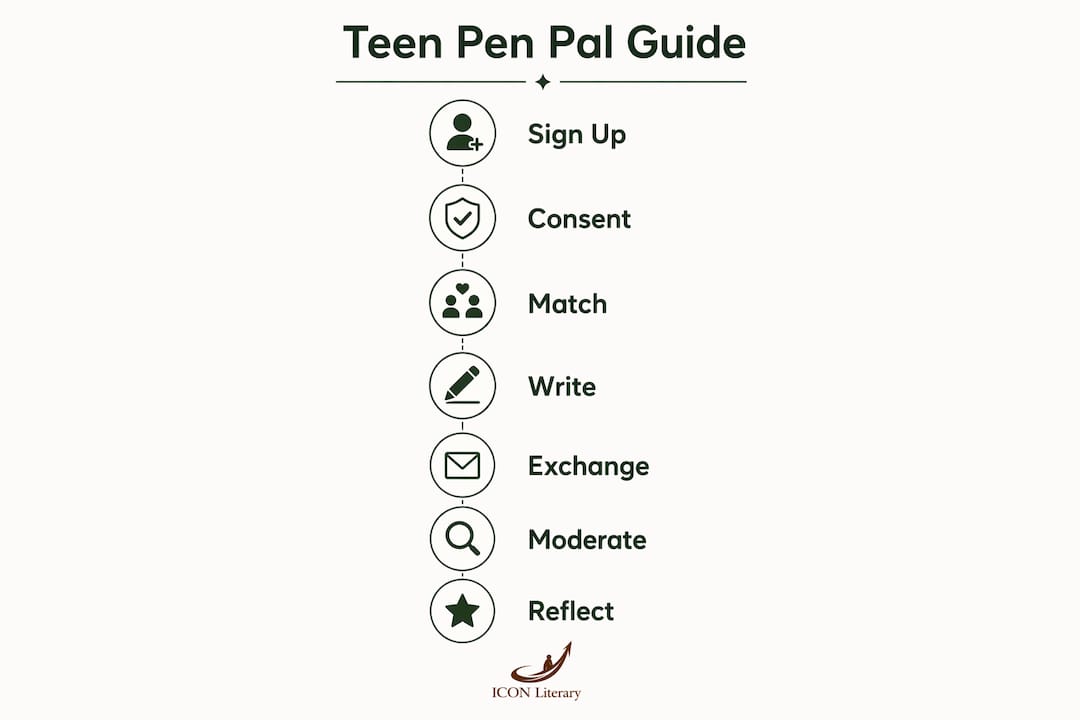
Where to find reputable teen pen pal programs in the U.S.
The most reliable channels are the ones with built-in adult oversight. School exchange programs coordinated by teachers are the gold standard because every letter passes through a known adult. Public libraries sometimes run seasonal exchanges or can connect you with regional programs. National youth organizations like 4-H run pen pal programs with structured prompts and staff moderation. Moderated online services and community centers round out the options for families who want something outside a school setting.
When vetting any program, look for these signals:
- Explicit parental or guardian consent requirement for participants under 14
- A stated moderation or escrow process (staff reviews letters before delivery)
- A privacy policy that covers minors specifically
- Hard age-range limits with no minor-to-adult pairing
- Published safety rules, not just a generic terms-of-service page
Some community-driven services match within a two-year age range and explicitly prohibit pairing minors with adults. That kind of policy, stated publicly, is a meaningful vetting signal.
Pro Tip: Before signing up for any service, search the organization's name alongside "safety policy" or "moderation." If nothing comes up, that's your answer.
Open community forums where users post personal profiles seeking pen pals can work, but they require extra vetting. Informal matching boards show what real teen preferences look like, but they lack the oversight structure that makes a program safe for minors.
Safety rules and the parental consent checklist every family needs
Parental or guardian consent is required for participants under 14 on reputable pen pal exchange databases. Consent isn't a formality; it's the mechanism that keeps adults informed and gives them an opt-out path.
Core safety checklist:
- No sharing of home addresses, school names, phone numbers, or Social Security numbers in initial communications
- All exchanges run through a moderated channel (school mailbox, teacher email, or platform escrow)
- Age-appropriate pairing only; no minor-to-adult matches under any circumstances
- A clear escalation path: who a student contacts if a letter feels uncomfortable or inappropriate
- First two or three exchanges reviewed by a teacher or staff member before direct swaps begin
Sample consent points for a permission form:
- Permission to exchange postal addresses under teacher or staff supervision
- Agreement on content rules (no personal identifiers, no inappropriate topics)
- Acknowledgment of the opt-out procedure and timeline
- Emergency contact information on file with the program organizer
Pro Tip: Store signed consent forms digitally in a shared staff folder, not just in a physical binder. If a concern arises mid-program, you want those records accessible in under a minute.
How to run a supervised pen pal exchange for a class or youth group
Start by defining your goals. Are you building writing skills, cultural awareness, or SEL competencies? The answer shapes everything from match criteria to prompt selection. Set a clear duration (six to eight weeks works well for a first run) and decide whether you want postal or digital delivery.
Matching criteria table:
| Criteria | Options | Notes |
|---|---|---|
| Age range | Same grade, within 1–2 years | Avoids developmental mismatch |
| Shared interests | Hobbies, sports, reading, art | Use a short intake form |
| Language level | English only, bilingual | Clarify upfront for international pairings |
| Anonymity level | First name only, full name | First name only for initial exchanges |
| Geographic pairing | Same state, cross-country, international | International adds cultural richness |
Operationally, successful school exchanges log consent forms, keep a central moderation queue for the first letters, and schedule the first three exchanges for staff review before allowing direct swaps. After that, spot checks every few weeks are usually sufficient.
Registration collects name, age, and basic interests. Standard registration forms flag under-14 participants as requiring parental consent before any match is made. Build that flag into your own intake process.
How to adapt pen pal ideas for children ages 3–8
The traditional teen pen pal model isn't developmentally appropriate for ages 3–8 without heavy adult mediation. That's not a limitation; it's a design prompt. The goal is the same (connection, empathy, communication) but the format shifts entirely.
Practical alternatives by age:
- Ages 3–5: Postcard swaps where the teacher transcribes what the child dictates. The child draws a picture; the teacher writes the message. Simple, safe, and genuinely exciting for small kids.
- Ages 6–8: Short guided sentences ("My favorite animal is ___ because ___."), pen pal buddies within the same school building, or a shared class scrapbook that travels between two classrooms.
Picture-exchange projects and sticker reply stations work especially well for preschoolers. The physical act of receiving something in the mail is powerful at that age, even if the "letter" is a decorated index card.
Pro Tip: Never publish home addresses for children in this age group. Keep all exchanges inside school mailboxes or use teacher-controlled distribution. A child's home address should never appear on any outgoing material.
For a deeper look at running these activities, the pen pal guide for ages 3–8 from Icon Literary walks through practical setup steps for parents and educators.
Ready-to-use prompts and letter templates
Structured prompts reduce the blank-page problem and improve long-term participation. Programs that provide weekly themes or suggested topics see better sustained engagement than open-ended exchanges. That's the single most practical thing an organizer can do.
Teen prompts by category:
- Culture: "What's one tradition your family celebrates that you think I'd find surprising?"
- Hobbies: "What are you currently obsessed with, and how did you get into it?"
- School life: "What's the most interesting thing you've learned this year?"
- Empathy: "Tell me about a time you changed your mind about something."
Young children prompts (teacher reads aloud, child responds):
- "What is your favorite color and what does it remind you of?"
- "Draw your favorite animal and tell me one thing it does."
- "What makes you laugh?"
Three short templates:
-
Teen letter template: "Hi [Name], my name is [Name] and I'm [age] from [city/state]. I'm writing because [program name] matched us. One thing I love is [hobby]. I'd love to know [question from prompt list]. Looking forward to hearing from you, [Name]."
-
Child postcard (teacher transcribes): "[Child's first name] says: 'My favorite thing is [item]. I drew a picture of it for you. What is YOUR favorite thing?'"
-
Preschool transcription format: Teacher writes at the top: "This message is from [First Name], age [X], dictated on [date]." Child's words follow verbatim.
Cultural awareness note: Avoid asking directly about religious holidays or family structure in a first letter. Stick to universals (food, animals, weather, games) until the relationship is established.
What pen pal exchanges typically cost and how to schedule them
Exchanges can cost as little as the price of a postcard stamp or involve small fees for moderated platform matching and starter kits. Free registration is available on some services, but faster or more specific matching often involves a nominal fee. Paid starter kits are a common model and a practical way to get structured prompts, postage guides, and reproducible templates without building them from scratch.
Sample schedule and cost table:
| Frequency | Typical engagement | Teacher time/week | Estimated cost |
|---|---|---|---|
| Weekly | High; builds momentum fast | — | Higher (postage adds up) |
| Biweekly | Moderate; sustainable for most classes | — | Moderate |
| Monthly | Lower; works for long-distance or international | — | Low |
| One-time postcard swap | Single-session; great for ages 3–8 | 1 class period | Minimal |
Typical cost items: postage for domestic letters, cardstock or stationery, optional starter kit fees, and classroom admin time. Free options exist but often come with longer wait times for matches.
Recommended first steps for parents and educators
Moderated programs are the right call for teens; teacher-led alternatives are the right call for ages 3–8. Both approaches work when adults stay in the loop from day one.
Three things you can do this week:
- Download or draft a consent form using the sample points in the safety section above. Have it signed before any match is made.
- Pilot a four-week exchange with one class. Start with biweekly letters, moderate the first two rounds, then assess whether direct swaps are appropriate.
- Choose your channel: a school-internal postcard swap for younger children, or a vetted moderated service for teens. Pair either with an SEL learning goal from your existing curriculum.
One last reminder: pen pal exchanges work best as a structured activity with clear goals, not as a free-form social experiment. Pair them with an SEL book club or a related literacy unit, and the learning value multiplies.
Privacy laws and data protection for minors beyond the U.S.
U.S. programs must comply with COPPA (Children's Online Privacy Protection Act), which restricts data collection from children under 13 without verifiable parental consent. Any platform collecting names, ages, or contact details from minors must meet this standard.
Internationally, the picture is more complex. The EU's GDPR sets the age of digital consent at 16 in most member states (though individual countries can lower it to 13). The UK's Children's Code (Age Appropriate Design Code) requires platforms likely to be accessed by under-18s to apply high privacy settings by default. Canada's PIPEDA applies similar principles to personal data collected from minors.
For classroom exchanges involving international pen pals, the practical implication is straightforward: never transmit a minor's personal data through a platform that lacks a clear privacy policy covering minors in both countries. Use teacher-controlled distribution for addresses, and confirm that any third-party service your school uses has documented compliance with the relevant laws for each participant's country.
Key Takeaways
Safe, moderated pen pal programs exist for U.S. teens, and the concept adapts well for younger children when adults control the format and distribution.
| Point | Details |
|---|---|
| Consent is non-negotiable | Parental or guardian consent is required for participants under 14 on reputable programs. |
| Moderation protects everyone | First two to three exchanges should be reviewed by a teacher or staff member before direct swaps begin. |
| Adapt the format for ages 3–8 | Use postcard swaps, picture exchanges, and teacher transcription instead of direct correspondence. |
| Prompts sustain engagement | Programs with weekly themes or suggested topics see better long-term participation than open-ended exchanges. |
| Icon Literary for classroom use | Icon Literary's SEL activity kits and story packs pair directly with postcard swaps and teacher-led exchanges for ages 3–8. |
Why this guide was written this way
Most articles about pen pals for teenagers treat safety as a footnote. A paragraph near the bottom, a bullet or two about not sharing your address, and then a list of platforms. That approach gets the priority order exactly backwards.
The more interesting question isn't "which platform has the most users?" It's "what does a developmentally appropriate, emotionally safe exchange actually look like for a nine-year-old versus a fourteen-year-old?" Those are different answers, and collapsing them into one generic guide does a disservice to both groups.
What I find genuinely underestimated here is the SEL dimension. A well-run pen pal exchange, paired with structured prompts and a brief classroom debrief, teaches perspective-taking in a way that a worksheet simply cannot. The child is writing to a real person who will actually read it. That stakes-raising changes how carefully they choose their words. That's not a small thing.
Icon Literary activity kits pair naturally with pen pal exchanges
If you're running a postcard swap or a teacher-led exchange for children ages 3–8, the hardest part is usually the first session: getting kids to say something meaningful on a small card. Icon Literary's SEL picture books and activity kits solve exactly that problem. The books give children a shared emotional vocabulary; the activity kits provide structured prompts, drawing templates, and guided questions that translate directly into postcard content.
Teachers have used Icon Literary's classroom bundles as the anchor for a four-week exchange unit, pairing one book per week with a corresponding postcard prompt. Parents can use the take-home kits the same way for a home-based exchange with a cousin or family friend. Every kit is designed for ages 3–8, which means the prompts are age-calibrated and the activities require no additional prep.
Browse the full Icon Literary catalog to find activity kits, card decks, and story packs ready for classroom or home use.
Useful sources and further reading
- 4-H Pen Pal Program — Guidance on running structured, moderated exchanges with prompts and project ideas; a strong model for school and youth-group organizers.
- Student Letter Exchange — One of the longer-running U.S. pen pal matching services; useful for understanding registration practices, consent norms, and fee structures.
- USPenpalS — Community-driven service that enforces age-range matching and no-minor/adult pairing; good reference for vetting signals.
- QuaranTEEN Pen Pal Project — Youth-run email exchange with prompts; illustrates what a teen-led, community-based model looks like.
- Global Penfriends — Long-running international service covering snail mail and online correspondence; useful for international pairing options and family-friendly safety standards.