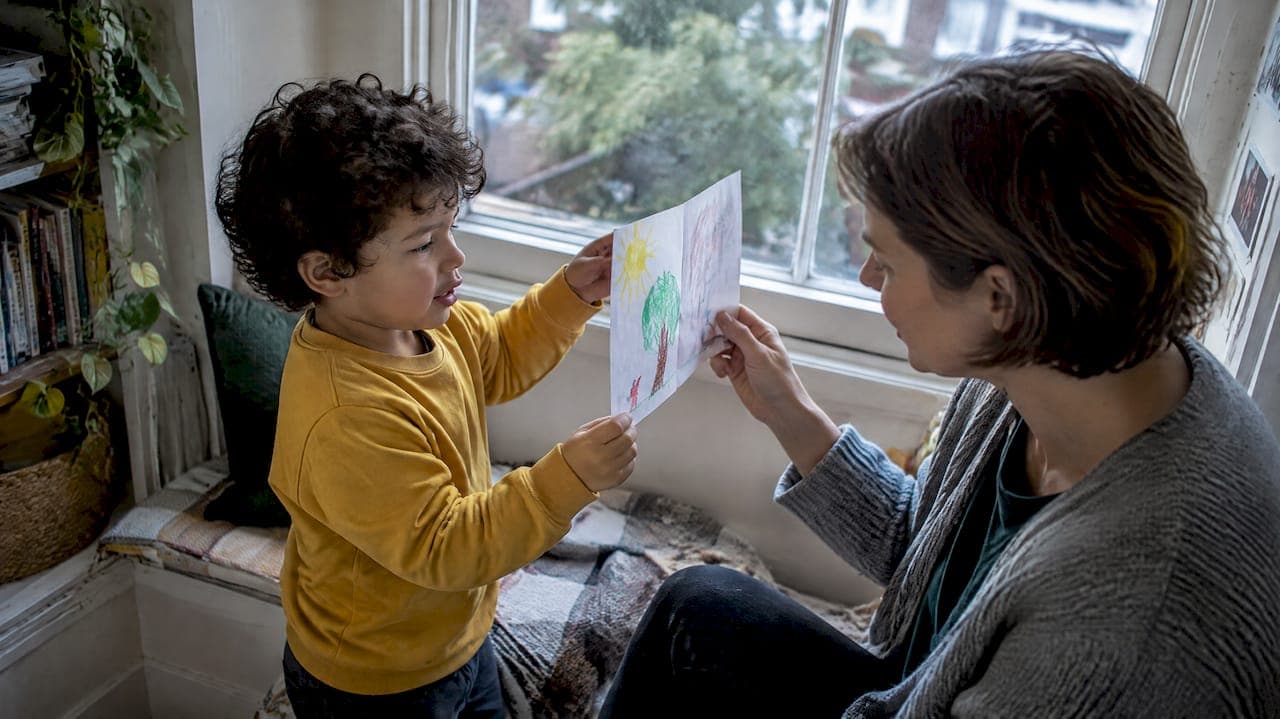
Perspective taking means understanding that another person may think, feel, know or want something different from you. Young children learn it through repeated, concrete practice: stories, drawing, pretend play and short conversations. Below are ten activities for ages 3 to 8 that you can run at home or in a classroom, plus a simple way to teach the skill without turning it into a lecture.
TL;DR
- Perspective taking is a skill that grows over time. Treat a child's answer as a first guess, not a right or wrong result.
- Short, repeated activities work better than one big lesson. One preschool study used nine 45-minute small-group sessions.
- Use "might" and "could" language, and ask "What else?" so children learn to separate clues from guesses.
- Shy or sensitive children do best with drawing, puppets and partner talk instead of public performance.
- Books are one of the easiest tools. Pause during the story and ask what each character knows, feels and wants.
Table of Contents
- What perspective taking is, and what it is not
- How to teach it: a simple frame
- Ten perspective taking activities for ages 3 to 8
- A sample week for a small group
- Perspective
- Adapting activities for different children
- Common mistakes to avoid
- Activities and tools from Icon Literary
- FAQ
- Sources
What perspective taking is, and what it is not
Perspective taking is the ability to consider that someone else may have different thoughts, feelings, knowledge, experiences or goals. University of Nevada, Reno Extension lists practical ways to build it in young children: model empathy, talk about feelings, ask open-ended questions, read stories, practice sharing and turn-taking, and use pretend play.
It is not mind reading. Harvard's Project Zero describes it as an ongoing process: you form a tentative idea about what another person might feel or know, notice what information is missing, and revise your idea when you learn more. That framing matters for young children. It gives them permission to be wrong, and it keeps them from deciding they know exactly what someone else is thinking.
Researchers also split the skill into three parts. In a preschool study, children practiced three kinds of perspective taking:
- Visual: what someone can see from where they stand.
- Cognitive: what someone knows or believes.
- Affective: what someone feels.
This split is useful when you plan. A child who easily says "you can't see the picture from there" may still find "she didn't know the party was a surprise" hard. Practice each part on its own.
How to teach it: a simple frame
Before the activities, a few habits make every one of them work better.
- Say your own feelings out loud. University of Nevada, Reno guidance says everyday modeling is the strongest teacher. Name your feeling, then wonder aloud about someone else's: "I felt rushed this morning. I wonder if Grandpa felt rushed too."
- Use tentative words. "Maybe," "might" and "could" keep the answer open.
- Separate clues from guesses. Ask, "What do you see that makes you think that?" Then ask, "What else could it mean?"
- Ask what is missing. "What would we need to find out to understand better?"
- Praise the behavior, not the label. Say "You noticed he was standing alone and asked him to join," not "You're so empathetic."
- Keep it short. Ten to fifteen minutes is plenty for ages 3 to 8.
Harvard's Step In, Step Out, Step Back routine puts this into three questions:
- Step In: What might this person feel, believe, know or experience?
- Step Out: What would you need to learn to understand them better?
- Step Back: What do you notice about your own point of view?
For young children, shorten the language: "What might she be feeling?" "What don't we know yet?" "What did you think first?"
Ten perspective taking activities for ages 3 to 8
1. Emotion detective (ages 3 to 6)
Show a picture of a person or character in a situation. Ask the child to be a detective and find clues: the face, the body, what just happened. Then ask, "What might they be feeling?" and "What else could they be feeling?" Accept more than one answer if the child can name a clue for it.
For more sorting practice, see our low-prep emotion sorting activities.
2. What can you see from here? (ages 3 to 5)
This one targets the visual part. Place a toy duck, a cup or a picture book between you and the child, with one side showing a different view (a drawing on one side, blank on the other). Ask, "What do I see from my side?" Then let the child walk around and check. Move to harder versions: hold a picture facing yourself and ask what the child sees.
3. Point-of-view swap (ages 4 to 8)
Pick a small event, such as one child getting the last turn on the slide. Ask two questions: "How might the child who got the turn feel?" and "How might the child who waited feel?" Draw two faces on paper, one for each, and let the child add words or marks. The point is that the same event can feel different to two people.
4. Pause-and-ask read-alouds (ages 3 to 8)
Pick a picture book and stop at three or four moments. Ask what each character knows, feels, wants, notices and may do next. University guidance recommends discussing characters' feelings, choices and predictions during ordinary story reading, so you do not need a special lesson.
Try this question set:
- What does she know right now? What does she not know?
- How can you tell she feels that way?
- What does he want most in this scene?
- Could the two characters feel differently about the same event?
Avoid asking only for the moral at the end. The questions during the story do more of the work. Our guide to storytelling for emotional learning has more on how to structure those pauses.
5. Draw what they might feel (ages 4 to 8)
Ask the child to draw a character at a key moment, then draw the same moment from another character's side. Label each drawing with "might" statements. Drawing is especially helpful for children who are slow to speak up. The feelings collage activity works the same way with process art.
6. Feelings and Options (ages 6 to 8)
This is a ready-made 15-minute routine from Harvard Project Zero. Feelings and Options walks through four steps:
- Identify the people involved and the challenge.
- Infer how each person feels and why the situation is hard for them.
- Come up with several possible responses.
- Decide what people could say to get a more caring outcome.
It works alone, in pairs, in small groups or with a whole class. Use a short scenario from your own day: two children want the same book, or a friend was not invited to a game.
7. Step In, Step Out, Step Back with a picture (ages 5 to 8)
Choose a picture, a story page or a classroom moment. Harvard recommends small groups and written responses on separate notes before discussion, so children do not simply copy the first answer they hear. For younger children, a teacher can write what each child says. After sharing, ask, "What do we still need to find out?"
8. Puppet problems (ages 3 to 6)
Give two puppets a small conflict: one wants to play outside, the other wants to stay in. Let the child pick a puppet, say what it wants, then switch. Puppets are a low-pressure way to speak from another point of view, especially for children who feel exposed in role-play. For tips on this kind of play, see our guide to classroom storytelling centers.

9. Feelings charades with a twist (ages 4 to 8)
In normal charades, children guess a feeling. Add one step: after the guess, ask, "What might have happened to make someone feel that way?" Then ask for a second possible reason. Our feelings charades scripts give you 10 to 20 minute versions with no prep.
10. Same event, different feelings (ages 6 to 8)
Describe an event such as rain on the day of a picnic. Ask children to name one person who would be happy about it and one who would be upset (a farmer, a child with new boots, a family with a cake). The aim is to show that one event can lead to many valid feelings.
A sample week for a small group

A research-based preschool format used a small-group sequence of story reading, reflection and discussion, dramatization, drawing and exercises that shifted children among visual, affective and cognitive perspectives. The training ran nine sessions, three times a week, 45 minutes per session, with about four to five children per group. The trained group showed more affective perspective taking and more prosocial, less aggressive peer behavior. That is evidence from one specific intervention, not a promise for every child.
You can borrow the shape of it with shorter sessions:
| Day | Focus | Activity | Time |
|---|---|---|---|
| Monday | Visual | What can you see from here? | 10 min |
| Tuesday | Cognitive | Pause-and-ask read-aloud: what does each character know? | 15 min |
| Wednesday | Affective | Emotion detective with pictures | 10 min |
| Thursday | All three | Puppet problems | 15 min |
| Friday | Reflection | Draw what they might feel | 15 min |
Repeat for several weeks and swap in new books and scenarios. Children need many rounds of practice, not one.
Perspective
We make picture books, card decks and activity kits for children ages 3 to 8, so we see the same pattern again and again. Adults often rush to the moral. The child nods, says "be kind," and nothing changes.
We would rather start from a character. When a child meets a duck with a strong opinion, a quirk or a bad day, they can look at that character's point of view from a safe distance. They can say "he might be embarrassed" long before they can say "I was embarrassed." That distance is what makes the practice possible for shy and sensitive children.
Our view is that emotional literacy should feel playful, not preachy. Good stories leave room for more than one reading of a scene. That is exactly what perspective taking asks of a child: hold your first idea lightly, notice what you do not know, and listen when someone shows you something new. A story that hands over the lesson in the last line leaves no room for that.
— Derek Amarillas
Adapting activities for different children
Shy and sensitive children
Avoid forced public performance. Start with drawing, puppets, partner talk or a character's point of view instead of the child's own. A systematic review of school mentalization-based interventions found that programs targeting emotion understanding, empathy, perspective taking and theory of mind can improve social-cognitive skills and emotion regulation, though program design and measurement vary a lot. In practice, that means you should pick formats a child can handle, then stay consistent.
Allow more than one valid interpretation, as long as the child can point to a clue. Never ask one child to speak for a whole identity group. Ask about individual experience and context instead.
Children from different backgrounds
NAEYC describes perspective taking as developing over time through chances to identify and discuss your own and others' thoughts, feelings and actions. In classrooms, language protocols, concrete objects, collaborative play and new peer groupings can make differences something children can talk about, not an abstract idea. Pair children who do not usually work together, and give them an object or picture to talk about.
Children with ADHD
Parents often ask whether children with ADHD struggle with perspective taking. Research suggests that, on average, they show some difficulties. A 2024 meta-analysis of 142 studies, with 8,300 participants with ADHD and 7,983 typically developing participants, reported average differences in theory of mind, facial emotion recognition and everyday social skills. That is a group average, though. It is not a universal inability, and results vary by task, age, language, attention and executive functioning. Executive-function difficulties may play a role, so short activities, visual supports, movement and quick feedback often help. If you have concerns about a particular child, talk with their pediatrician, school psychologist or counselor.
Common mistakes to avoid
- Treating a guess as a fact. A child who says "he's mad" has made a guess. Ask for the clue and for another possibility.
- Asking for one right answer. Perspective taking has no single correct response in most scenarios.
- Doing it only when there is a conflict. Practice during calm moments, with stories and pictures. Hot moments are poor times to teach.
- Labeling the child. Praise a specific action, not a trait.
- Making it too long. Stop while the child still wants more.
For children who need words for feelings first, our emotion vocabulary guide breaks the work into three age bands. If you want a longer plan, try our 6 to 8 week plan to teach emotions or the family empathy activities for use at home.
Activities and tools from Icon Literary
If you want ready-made material that fits the activities above, we publish original characters and story worlds for ages 3 to 8. Our Duckwave Decks are collectible card decks, priced at 7 $ one-off, and they work well for emotion detective, point-of-view swap and charades-style games. For story-led practice, explore Socko's Universe in our catalog.
FAQ
What are examples of perspective taking for kids?
A child notices that a friend is sitting alone and asks if they want to play. A child says, "She might be sad because her toy broke." A child realizes that you cannot see a picture they are holding to their chest. These are visual, affective and cognitive examples.
At what age can children start learning perspective taking?
Children can begin with simple visual and feelings activities in the preschool years, and the skill keeps developing through later childhood. NAEYC describes it as growing over time with chances to talk about thoughts, feelings and actions. Start with concrete tasks such as "what can you see from here?" and move toward harder questions about what someone knows or believes.
Do people with ADHD struggle with perspective taking?
On average, research finds some differences in social cognition for children with ADHD, but not every child is affected, and results depend on the task and on attention and executive functioning. Use short, visual and active activities, and ask a school psychologist or pediatrician if you have specific concerns.
What is a good game about perspectives?
Try Feelings Charades with a follow-up question: after a child guesses the feeling, ask for two reasons someone might feel that way. Another good option is the visual game "What can you see from here?" with a picture or toy placed between you and the child.
Sources
- Building Perspective-Taking Skills in Young Children, University of Nevada, Reno Extension
- Step In, Step Out, Step Back, Project Zero
- Feelings and Options, Project Zero
- Perspective Taking Ability in Psychologically Maltreated Children, PMC
- Embracing Different Perspectives, NAEYC
- Mentalization-based interventions in schools: a systematic review, PMC
- Social cognition and everyday social skills in children and adolescents with ADHD: a meta-analysis, PubMed