
Discussion-based learning delivers six core benefits that no lecture alone can replicate: sharper critical thinking, deeper retention, stronger communication skills, genuine perspective-taking, social-emotional growth, and a classroom community where students actually want to engage. The mechanism is straightforward. When students explain ideas to peers, argue positions, and encounter viewpoints that challenge their own, they construct knowledge rather than receive it. That active construction is what makes the difference between information that sticks and information that evaporates after the exam.
Here is the quick-scan version of those benefits:
- Critical thinking and higher-order cognition (analysis, evaluation, synthesis)
- Deeper retention through peer explanation and active knowledge construction
- Communication skills built through real-time argumentation and listening
- Perspective-taking via exposure to diverse viewpoints
- Engagement and motivation from student-centered dialogue
- Social-emotional learning (SEL) and community-building
Key Takeaways
Discussion-based learning produces its strongest outcomes when instructors align it to higher-order goals, scaffold preparation, and facilitate actively rather than passively.
| Point | Details |
|---|---|
| Match method to goal | Use discussion for analysis, synthesis, and evaluation; use retrieval practice for factual recall. |
| Require written prep | Pre-class written responses raise participation quality and give you a formative artifact before the session starts. |
| Facilitate actively | Assign roles, use wait time, and redistribute airtime; passive facilitation produces unequal participation. |
| Assess quality, not quantity | Build rubrics around evidence use, reasoning, and synthesis, not how often a student speaks. |
| Combine methods | Pair discussion with low-stakes quizzes to cover the full cognitive range of most learning objectives. |
Table of Contents
- What are the core benefits of discussion-based learning?
- What does the research actually show, and where are the limits?
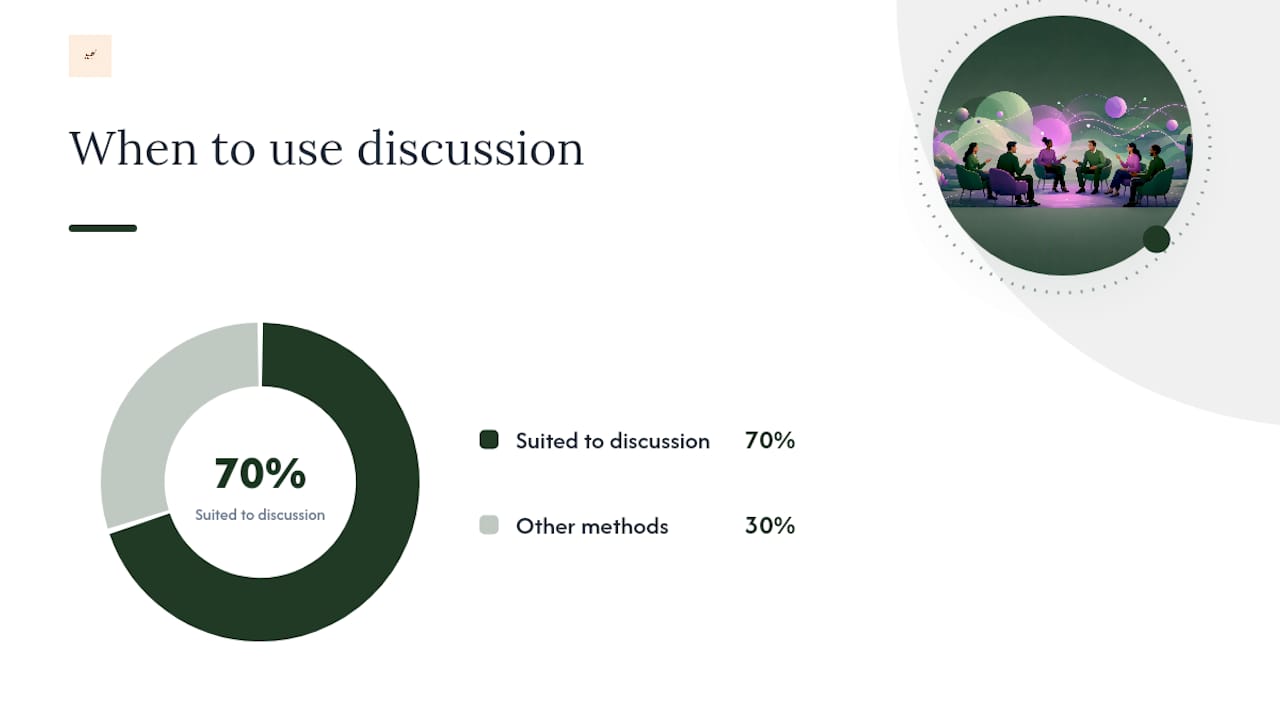
- When should you use discussion, and when should you choose something else?
- How do you plan and facilitate a discussion that actually works?
- Which discussion formats work best, and how do you run them?
- How do you assess discussion quality and measure learning outcomes?
- What challenges should you prepare for, and how do you address them?
- Practitioner insights: what teaching centers and research say about implementation
- What I learned from running discussions badly first
- Sources
What are the core benefits of discussion-based learning?
Learning Through Discussion at Columbia's Center for Teaching and Learning frames it well: discussion shifts students from passive listeners to active knowledge builders, and that shift is what drives improvements in higher-order thinking, conceptual understanding, and long-term retention. Each benefit below has a distinct cognitive mechanism behind it.
Critical thinking and higher-order cognition. When a student has to defend a claim in front of peers, they cannot rely on vague recall. They have to analyze evidence, evaluate counterarguments, and synthesize a coherent position. Bloom's taxonomy places analysis, evaluation, and synthesis at the top of the cognitive ladder. Discussion is one of the few classroom formats that routinely exercises all three at once.
Deeper retention through peer explanation. Research published in Instructional Science found that explaining concepts to peers produces greater long-term retention than passive listening, with gains still measurable a month after the session. The act of explaining forces students to identify gaps in their own understanding before those gaps become permanent.
Communication skills. Students who discuss regularly get practice with something most assessments never test: real-time, high-stakes articulation of a half-formed idea. That is a professional skill. Listening carefully enough to respond substantively is equally rare and equally valuable.

Perspective-taking. Hearing a classmate interpret the same text or data set differently is not just interesting. It is cognitively destabilizing in a productive way. Students revise their mental models when they encounter a well-reasoned alternative view, and that revision is a form of learning that a solo reading assignment cannot produce.
Engagement and motivation. University of Washington teaching resources report that discussion increases engagement and exposes learners to diverse perspectives, and that high levels of peer-to-peer interaction correlate with improved course grades and student motivation. Students who feel heard in a classroom tend to show up prepared.
SEL and community-building. Discussion is a rehearsal space for democratic discourse. When instructors model civil disagreement and treat every contribution as worth examining, they build the kind of belonging that makes students take intellectual risks. That community effect compounds over a semester in ways that are hard to manufacture through other means. For early childhood educators, community storytime SEL benefits offer a parallel model worth examining.
Integration and transfer. Discussion asks students to connect new material to what they already know, to other disciplines, and to real-world contexts. That integration is what produces transfer: the ability to apply knowledge in situations the instructor never explicitly taught.
Statistic callout: Columbia CTL reports that studies consistently link high levels of student participation and peer-to-peer interaction to improved course grades and higher student motivation.
Pro Tip: Use scaffolded prompts to convert participation into analysis. Instead of "What do you think about X?" ask "What evidence from the text supports that claim, and what would someone who disagrees say?" That single reframe pushes students from opinion-sharing to argumentation.
What does the research actually show, and where are the limits?
The evidence for discussion-based learning is strong for higher-order goals and more complicated for everything else. Here is an honest summary.
Where the research is solid. University teaching centers at Columbia, Washington, Delaware, and Calgary all converge on the same conclusion: discussion reliably improves analysis, synthesis, moral reasoning, and perspective-taking. The Taylor Institute's discussion-based learning guide lists critical thinking, problem solving, communication, and group competencies as well-supported outcomes, while also noting that poor facilitation can limit coverage and learning gains. A 2024 peer-reviewed study found that group discussions combined with lectures and clear frameworks produced meaningful learning by integrating theory with students' practical knowledge, but the results depended heavily on task design and a psychologically safe climate.
Where the evidence gets complicated. A between-groups study (N=98) published in PMC found that test-enhanced learning outperformed group discussions for retention of factual material. Discussion benefits were also uneven: students high in need-for-cognition gained more than those who preferred structured, low-ambiguity tasks. That finding matters for instructors who teach mixed-ability or mixed-motivation groups.
Practical caveats instructors should know. Poor facilitation is the single biggest risk factor. A discussion without a clear purpose, adequate preparation, or active facilitation can reinforce misconceptions rather than correct them. Unequal participation is a structural problem, not a student character flaw. And some learners, particularly those with high anxiety or multilingual backgrounds, need explicit scaffolding before they can contribute meaningfully.
| Source | Main finding | Practical implication |
|---|---|---|
| Columbia CTL | Discussion improves higher-order thinking and retention | Prioritize discussion for analysis and synthesis goals |
| PMC comparative study (N=98) | Test-enhanced learning beats discussion for factual recall | Use quizzes for memorization; reserve discussion for complex reasoning |
| Taylor & Francis, 2024 | Discussion + lecture + clear framework produces meaningful learning | Pair discussion with structured content delivery |
| Springer (peer explanation) | Explaining to peers improves retention more than passive listening | Build in peer-explanation tasks within discussion formats |
| Taylor Institute guide | Poor facilitation limits coverage and gains | Invest in facilitation planning, not just question design |
When should you use discussion, and when should you choose something else?
Discussion is not the right tool for every learning goal. Choosing it well means knowing exactly when it earns its time.
Learning goals that suit discussion:
- Analyzing competing interpretations of a text, data set, or historical event
- Synthesizing ideas across multiple sources or disciplines
- Evaluating ethical dilemmas or policy trade-offs
- Developing moral reasoning and civic argumentation
- Building perspective-taking and empathy
- Solving complex, open-ended problems with no single correct answer
- Integrating lecture theory with students' practical experience
Learning goals better served by alternatives:
- Memorizing vocabulary, formulas, or factual sequences (retrieval practice and low-stakes quizzing are more efficient)
- Building basic procedural fluency in math or writing mechanics (direct instruction with immediate feedback works faster)
- Introducing entirely new content students have no prior knowledge of (lecture or structured reading first, then discussion)
The CTAL teaching guide recommends aligning discussion purpose to student learning outcomes before designing a single question. That alignment step takes five minutes and prevents an hour of unfocused conversation.
Quick decision criteria. Ask yourself three questions: Does the goal require students to reason, not just recall? Is there genuine interpretive space where multiple defensible answers exist? Will hearing a peer's reasoning change how a student thinks? If yes to all three, discussion is the right call.
Pro Tip: Combine discussion with a low-stakes quiz on the same material. The quiz handles factual recall; the discussion handles interpretation and application. Together they cover the full cognitive range of most learning objectives without sacrificing efficiency for either goal.
How do you plan and facilitate a discussion that actually works?
Planning is where most discussions succeed or fail, and it happens before students walk in the room. The Edge Foundation's DBL toolkit emphasizes the teacher-as-facilitator role and democratic classroom climate as prerequisites for productive student-led dialogue.
Aligning purpose to learning outcomes
Start by writing down the specific student learning outcome (SLO) the discussion is meant to advance. Share that purpose with students explicitly. "Today's discussion will help you evaluate competing arguments about X" is more useful than "Let's talk about X." When students know why they are discussing, they prepare differently.
Pre-class preparation
Unprepared students produce shallow discussions. Set a minimum standard: a short reading guide, three guiding questions students must answer in writing before class, or a brief response task submitted the night before. That written pre-work does two things: it raises the floor of contributions and gives you a formative check before the session starts.
Question design mapped to Bloom's taxonomy
- Knowledge/comprehension (warm-up): "What is the central claim of the reading?"
- Analysis: "What assumptions does the author rely on, and are they justified?"
- Synthesis: "How does this argument connect to the case study from last week?"
- Evaluation: "Which of the two policy options is better supported by the evidence, and why?"
Questions at the analysis, synthesis, and evaluation levels are where discussion earns its time. Save knowledge-level questions for the warm-up or a pre-class quiz.
Norms and equity protocols
Establish discussion norms on day one and revisit them before high-stakes conversations. Useful norms include: speak from evidence, not just opinion; build on what a peer said before shifting direction; one voice at a time. Talking tokens (each student gets two chips and spends one per contribution) are a blunt but effective tool for redistributing airtime in groups with dominant speakers.
Wait time matters more than most instructors expect. Extending silence after a question from three seconds to seven seconds measurably increases the number of students who respond and the complexity of their answers.
Modality choices
- Face-to-face: highest energy, fastest feedback loop, hardest to manage equity
- Synchronous online (Zoom, Teams): breakout rooms help equity; chat function gives quieter students a lower-stakes entry point
- Asynchronous forums (Canvas, Blackboard): University of Washington research notes these increase participation and deeper reflection for students who need processing time; the trade-off is reduced spontaneity
Facilitation checklist
- State the discussion purpose and connect it to the SLO.
- Confirm students completed pre-class preparation.
- Open with a warm-up question at the knowledge/comprehension level.
- Transition to an analysis or synthesis question within five minutes.
- Monitor airtime: redirect dominant speakers, invite quieter students by name or role.
- Summarize emerging themes at the midpoint.
- Close with a synthesis question or exit ticket.
- Debrief briefly: what did students learn that surprised them?
Pro Tip: Assign discussion roles (questioner, devil's advocate, synthesizer, note-taker) for the first few sessions. Roles reduce anxiety for students who do not know how to enter a conversation and give everyone a clear job. Rotate roles across sessions so no student is permanently typecast.
Which discussion formats work best, and how do you run them?
Each format below suits a different class size, goal, and comfort level. Pick one, run it cleanly, and iterate.
Socratic seminar / Harkness discussion
Best for: Text-based analysis, ethical reasoning, literary interpretation. Works well with 10–25 students.
How to run it:
- Assign a shared text and require written annotations before class.
- Arrange seating in a circle so every student can see every other student.
- Pose one open, interpretive question to open.
- Step back. Your job is to track participation, note misconceptions, and intervene only when the conversation stalls or goes factually wrong.
- Close by asking students to name one idea they changed their mind about.
Sample prompt: "The author argues that individual freedom and collective responsibility are incompatible. Do the texts we read this week support or challenge that claim?"
Equity note: For English learners or introverted students, provide the opening question 24 hours in advance so they can prepare a written response to draw from.
Think-pair-share
Best for: Large classes, introducing a new discussion habit, warming up before a full-group conversation. Works at any class size.
How to run it:
- Pose a question. Give students 60–90 seconds to write a response individually.
- Pair students (pre-assigned pairs avoid the awkward shuffle).
- Each pair shares their synthesis with the full group.
Sample prompt: "Write one reason the policy in the case study might fail. Share it with your partner, then together identify the strongest objection."
Equity note: The individual writing step is the equity mechanism. It gives every student something to say before the social pressure of speaking kicks in.
Fishbowl
Best for: Modeling discussion quality, exploring multiple perspectives on a controversial topic. Works well with 20–40 students.
How to run it:
- Place four to six students in an inner circle; the rest observe.
- Inner circle discusses the question for 10–15 minutes.
- Outer circle takes notes on reasoning quality, evidence use, and listening behaviors.
- Debrief with the full group: what did observers notice?
Sample prompt: "Inner circle: argue whether the school's policy is ethically defensible. Outer circle: track which arguments used evidence and which relied on assertion."
Equity note: Rotate inner-circle membership so the same students do not always perform. For inclusive discussion with diverse learners, pre-assign roles that match student strengths.
Jigsaw
Best for: Covering multiple texts or perspectives efficiently, building interdependence. Works well with 20–40 students.
How to run it:
- Divide the class into expert groups, each assigned a different reading or perspective.
- Expert groups discuss and master their material.
- Regroup into mixed teams where each member teaches their expert content.
- Full group synthesizes across all perspectives.
Equity note: Assign expert groups deliberately so that students with different language backgrounds or learning needs are distributed across groups, not clustered.
Asynchronous forums
Best for: Courses with large enrollment, online or hybrid formats, topics requiring careful reflection. Use when live discussion would disadvantage students who need processing time.
When to choose async over live: When students are in different time zones, when the topic is emotionally sensitive and benefits from reflection, or when you want a written record for assessment. Audio-based participation options can also support differentiated instruction for diverse learners who process information more effectively through listening than reading.
Sample prompt: "Post a 150-word response to the following question by Thursday. Reply substantively to at least two peers by Sunday. Substantive means you add evidence or a counterargument, not just 'I agree.'"
How do you assess discussion quality and measure learning outcomes?
Assessing discussion well means measuring what students actually learned, not just who talked. The distinction between quantity and quality is the most important design decision you will make.
Quality over quantity. A student who speaks once with a well-reasoned, evidence-backed argument contributes more than one who speaks six times with unsupported opinions. Build your rubric around reasoning, not frequency.
Sample discussion rubric
| Criterion | 3 (Proficient) | 2 (Developing) | 1 (Beginning) |
|---|---|---|---|
| Evidence use | Cites specific evidence from texts or data | References material generally | Makes claims without evidence |
| Reasoning | Explains the logical connection between evidence and claim | Partial explanation | Assertion only |
| Listening and response | Directly builds on or challenges a peer's point | Acknowledges peers loosely | Does not reference peers |
| Synthesis | Connects ideas across sources or perspectives | Connects within one source | Stays within a single point |
Cornell's Center for Teaching Innovation recommends assessing for contribution quality and providing reflection opportunities after discussion, which the rubric above supports directly.
Formative assessment options:
- Exit ticket: One sentence on the most persuasive argument they heard and why. Takes two minutes, reveals whether students were listening or just waiting to talk.
- Post-discussion quiz: Three to five factual or analytical questions on the content discussed. Pairs well with the PMC finding that retrieval practice strengthens retention of factual material.
- Reflection prompt: "What did you believe before the discussion that you now question?" Surfaces genuine perspective change.
- Pre/post comparison: Collect students' written pre-class responses and their post-discussion reflections. The gap between the two is your evidence of learning.
Carnegie Mellon's guidance on group projects notes that peer feedback and authentic tasks are among the strongest benefits of group-based learning, and that assessment design is where those benefits are either captured or lost.
What challenges should you prepare for, and how do you address them?
Every experienced discussion facilitator has a mental list of things that go wrong. Here are the most common, with concrete fixes.
Dominant speakers. Two or three students fill the air and the rest disengage. Fix: talking tokens, structured turn-taking (go-around the circle), or a norm that no one speaks twice until everyone has spoken once. Fishbowl format also redistributes airtime structurally.
Silence and non-participation. Some students genuinely do not know how to enter a conversation; others are anxious; others are underprepared. Fix: the written pre-class response is the single highest-leverage intervention. When every student arrives with something written, the barrier to speaking drops significantly. Small-group discussion before full-group sharing also lowers the social stakes.
Off-topic drift. Discussions wander when the question is too broad or the purpose is unclear. Fix: post the guiding question visibly throughout the session. When the conversation drifts, redirect with "How does what you just said connect to our central question?"
Misinformation spreading. A student states something factually wrong, peers accept it, and the misconception embeds. Fix: instructors must intervene directly and immediately when factual errors circulate. Framing it as "Let's check that against the text" rather than "That's wrong" preserves the student's dignity while correcting the record.
Low preparation. Students who did not do the reading cannot contribute meaningfully and drag the conversation toward the lowest common denominator. Fix: make preparation a graded component. A short written response submitted before class (even ungraded) changes preparation rates dramatically.
Equity for neurodiverse and multilingual learners. Students with ADHD may struggle with the unstructured turn-taking of open discussion; multilingual students may need more processing time. Fix: provide the discussion question in advance, offer a written-response option as an alternative to speaking, and use small groups before full-group formats. Audio-based learning tools can also support engagement measurement for students who participate through non-traditional means.
Pro Tip: Require a short written response (100–150 words) submitted before every discussion session. Students who write first speak better. The written record also gives you a formative assessment artifact without adding a separate assignment.
Practitioner insights: what teaching centers and research say about implementation
Three findings from the research and teaching-center literature stand out as genuinely underused by most instructors.
Facilitation quality matters more than format. The IDEA Paper on classroom discussion approaches is direct: structured facilitation mediates improvements in critical thinking and satisfaction more than the specific format chosen. Instructors who invest in facilitation planning, not just question design, get better outcomes regardless of whether they use Socratic seminar or think-pair-share.
Pair discussion with retrieval practice. The PMC comparative study makes a strong case for combining methods. Use a low-stakes quiz to handle factual recall, then use discussion to handle interpretation and application. The two methods are complementary, not competing. Neither alone covers the full range of learning goals most instructors are working toward.
Writing before and after discussion raises the quality of both. Research published in the Journal of Excellence in Teaching and Education found that short written responses before or after discussion help students organize their thinking, raise the level of contributions, and produce a record for assessment. This is not an extra assignment. It is a facilitation move that pays off in the discussion itself.
A one-week scaffolded sequence
- Monday: Assign reading with three guiding questions. Students submit written responses before Wednesday.
- Wednesday: Open with a think-pair-share on the guiding questions. Transition to a full-group Socratic discussion on the synthesis question. Close with an exit ticket.
- Friday: Low-stakes quiz on factual content from the reading. Return written responses with one comment each. Students revise their pre-discussion response in light of what they heard.
That sequence covers retrieval practice, peer explanation, higher-order discussion, and formative assessment in three class sessions without adding a single extra assignment.
Pro Tip: After running a discussion, ask students to rate it on two dimensions: how prepared they felt and how much they learned. Collect responses anonymously. That two-question check takes 90 seconds and gives you the data to iterate on your design before the next session.
What I learned from running discussions badly first
The first time I ran a Socratic seminar, I asked a genuinely open question, stepped back, and waited. What followed was 40 minutes of the same four students talking past each other while the rest of the class watched. The discussion looked active. Almost no learning happened.
The change that fixed it was structural, not motivational. I started requiring written pre-class responses, assigned roles for the first three sessions, and built in a midpoint pause where I asked the group to name the strongest argument made so far. Participation spread. The quality of reasoning went up. Students who had never spoken in a full-group setting started contributing because they had something prepared and a role that gave them permission to use it.
The lesson is not that discussion is hard. It is that discussion without scaffolding is just organized waiting. The research backs this up, and so does every teaching center that has written seriously about it. Instructors who treat discussion as a break from teaching are the ones who get disappointing results. Instructors who treat it as a method that requires as much design as a lecture get the outcomes the research promises.
For instructors working with younger learners, the same principles apply at a smaller scale. SEL book clubs for kids ages 3–8 use the same scaffolding logic: a shared text, a guiding question, roles, and a closing reflection. The format scales down; the mechanism stays the same.
Sources
The sources below are the primary references behind the claims in this article. Each one is worth reading in full for the depth it adds beyond what a single article can cover.
- Learning Through Discussion | Columbia Center for Teaching and Learning
- Explaining to others enhances learning: A classroom intervention study (Springer)
- Group Discussions and Test-Enhanced Learning: A comparative study (PMC)
- Engaging students in discussions | University of Washington
- Teaching Through Discussion | Center for Teaching and Assessment of Learning (CTAL)
- Discussion based learning guide | Taylor Institute (University of Calgary)
- Group discussions: an active learning resource for school and kindergarten leaders? (Taylor & Francis, 2024)