
A curated reading list is a purposefully assembled collection of books or written materials, carefully chosen and organized around a specific goal, theme, or audience. Merriam-Webster defines "curated" as carefully chosen and thoughtfully organized, which is exactly what separates a curated list from a random pile of recommendations. A librarian building a list of picture books on managing big emotions for kindergartners is curating. A friend texting you five titles they liked is not.
Readers can recognize a curated list by four consistent features:
- A stated purpose (learning goal, theme, age group, or occasion)
- A selection rationale (why each title was included)
- A manageable length, typically 10–20 titles
- Short annotations explaining who each book is for
As Collins Dictionary notes, reading lists are organized compilations of written materials tailored to learning or personal interest, usually arranged by theme or purpose. That structure is what makes them useful rather than overwhelming.
Key Takeaways
A curated reading list is a carefully chosen, purposefully organized collection of titles built around a specific goal, and its value lies entirely in the quality of the selection criteria behind it.
| Point | Details |
|---|---|
| Definition | A curated list is purposefully assembled, not random, with a stated goal and selection rationale. |
| Typical length | Most curated lists run a modest number of titles; shorter lists with annotations outperform long lists without them. |
| Who creates them | Librarians, educators, critics, and services like NoveList build the most reliable human-curated lists. |
| How to start | Set a one-sentence goal, define your criteria, then select and annotate several titles to begin. |
| Where to find them | U.S. public libraries, NoveList (free with a library card), and The New York Times books section are the strongest starting points. |
Table of Contents
- Why do curated reading lists matter?
- Who creates curated reading lists?
- How are curated reading lists built?
- What types of curated reading lists exist?
- Where can you find curated reading lists in the U.S.?
- How Icon Literary curates a children's SEL picture-book list
- A curator's honest note on staying flexible
- Sources
Why do curated reading lists matter?
The practical value of a curated list comes down to time and trust. A reader who wants to understand grief, or a teacher building a unit on empathy, does not need every book ever written on the subject. They need someone with judgment to narrow the field.
For readers, a curated list provides direction. Instead of scrolling through hundreds of titles, you start with a short, vetted set built around your actual goal. For teachers and educators, curated lists function as curriculum scaffolding, pairing books to learning objectives so students build knowledge in sequence. A third-grade teacher might use a themed list to anchor a social-emotional learning unit across several weeks.
Librarians use curated lists as a readers' advisory tool, matching patrons to books based on mood, interest, or reading level. Public libraries routinely publish staff-curated lists that include links to catalog records so patrons can place holds immediately. Parents looking for age-appropriate books on specific topics, from starting school to handling conflict, rely on curated lists to skip the guesswork.
The benefits of curated SEL picture book displays in classrooms and libraries extend beyond convenience. A well-built list signals to a child that the books on it belong together, which builds reading confidence and thematic understanding at the same time.
Who creates curated reading lists?
Curated lists come from a wide range of sources, and the creator matters as much as the content.
Human curators include librarians, educators, literary critics, publishers, community reading groups, and specialist organizations. They bring context, lived experience, and professional judgment. A children's librarian choosing books about grief for ages 4–7 will weigh emotional vocabulary, illustration style, and cultural representation in ways an algorithm cannot.
Algorithmic curation operates at scale. Recommendation engines on retail and streaming platforms analyze reading history and purchase behavior to surface titles. The tradeoff is real: algorithms excel at pattern-matching but miss nuance. They cannot tell whether a book's portrayal of a difficult topic is handled with care or carelessly.
| Source | Strengths | Limitations |
|---|---|---|
| Librarians and educators | Context, nuance, representation awareness | Time-intensive; limited scale |
| Literary critics and publishers | Deep genre knowledge, discovery of new titles | May reflect commercial bias |
| NoveList | Professionally compiled, library-integrated, genre-spanning | Requires library access |
| The New York Times books section | High editorial standards, wide cultural reach | Skews adult literary fiction |
| Algorithmic services | Speed, personalization at scale | Lacks contextual judgment |
When you need a list for a specific, sensitive, or developmental purpose, human curation wins. For broad discovery or genre browsing, algorithmic tools are a reasonable starting point.
How are curated reading lists built?
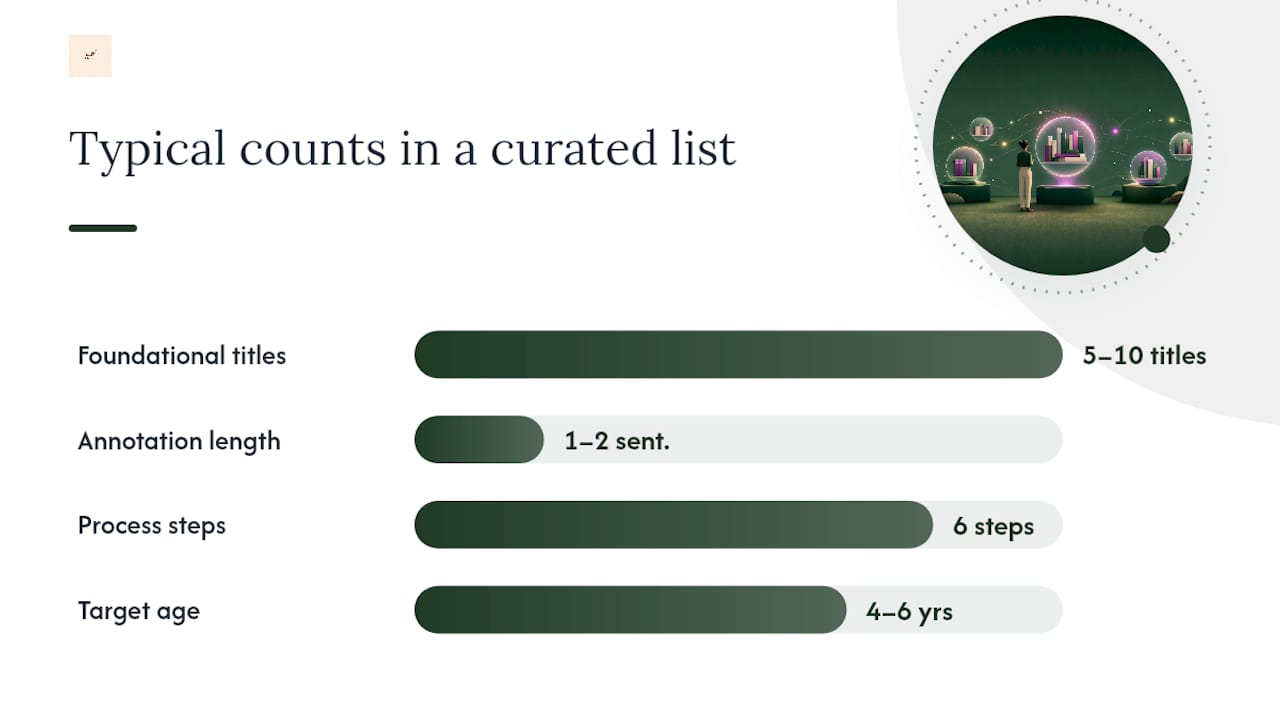
The process starts with intention, not with books. A practical guide from 1000libraries Magazine describes this as the T-Shape method: go deep on one core topic (5–10 foundational titles) and then add breadth with related, contextual reads that expand the picture.
Here is a repeatable process:
- Set a clear goal. Name the purpose in one sentence: "Help parents of 4–6-year-olds find picture books about managing anger."
- Define your selection criteria. Decide upfront what a title must have to qualify.
- Search and gather candidates. Pull more titles than you need, then cut.
- Sequence the list. Order titles from accessible to complex, or thematically so each book builds on the last.
- Write short annotations. One to two sentences per title: who it is for and why it made the list.
- Share and iterate. Publish the list, collect feedback, and update it as better titles emerge.
Selection rubric (adapt freely):
- Relevance to the stated goal
- Accuracy and credibility of content
- Age or reading-level appropriateness
- Representation and cultural inclusion
- Readability and engagement
- Novelty or value beyond what is already on the list
Sample annotation template: "[Title] by [Author] is ideal for [audience] because [specific reason]. It works especially well for [context or pairing]."
Pro Tip: When curating for children, check that your list reflects a range of family structures, cultural backgrounds, and character identities. A list that looks like it was built from a single publisher's catalog is a signal to revisit your sources. For a detailed inclusion checklist, see how to select inclusive books for library shelves.
Cambridge Dictionary's definition of curation emphasizes selection and care as the core acts, which is a useful frame: every title you add is a choice, and every choice reflects your judgment about what the reader actually needs.
What types of curated reading lists exist?
Lists take different shapes depending on their purpose. Knowing the type helps you find the right one or build the right one.
| List type | Best use | Typical size |
|---|---|---|
| Thematic | Exploring one topic in depth (grief, courage, identity) | 10–20 titles |
| Curriculum-linked | Supporting a specific course or unit | 6–8 titles |
| Age-appropriate | Matching developmental stage to content | 10–20 titles |
| Display or seasonal | Library or classroom feature (summer, holidays) | 6–8 titles |
| Goal-based or challenge | Reading challenges, personal growth goals | 10–20 titles |
NoveList offers professionally compiled lists across all of these types, organized by genre and reading level, accessible through most U.S. public library accounts. The New York Times books section publishes thematic and seasonal lists with strong editorial curation, though these skew toward adult readers. For children's SEL titles organized by age, Icon Literary's age-range guidance offers a practical starting point.
Sequencing matters more than most curators expect. A list that opens with the most challenging title loses readers early. Starting with an accessible, engaging entry point and building toward complexity keeps readers moving through the list rather than stopping after the first book.
Where can you find curated reading lists in the U.S.?
- Your public library: Most U.S. public libraries publish staff-curated lists on their websites and through their catalog portals. Library networks like MNLink connect patrons to curated resources across multiple library systems.
- NoveList (via library card): This database, accessible through most public library accounts at no cost, offers ready-made curated lists built by librarians and reading specialists across genres and age groups.
- The New York Times books section: Strong for adult literary fiction, nonfiction, and seasonal gift lists.
- Library subject guides: Many libraries publish LibGuides or topic pages with curated lists on subjects from local history to children's mental health.
- Specialist publishers and educational sites: Organizations focused on SEL, literacy, or specific communities often maintain their own curated lists. For science-focused young readers, Brainie Comics offers age-targeted educational comics that complement traditional picture-book lists.
Pro Tip: Ask a librarian directly. Most public libraries offer readers' advisory services, meaning a librarian will build a short, personalized curated list for you based on your specific interests or a child's needs. This is one of the most underused free services in the U.S.
How Icon Literary curates a children's SEL picture-book list
At Icon Literary, curating a short SEL picture-book list for ages 3–8 starts with a single, specific goal: for example, "help children ages 4–6 name and regulate feelings of frustration." That goal drives every decision that follows.

The evaluation criteria used in practice include clarity of emotional theme, age-appropriate vocabulary, quality of illustration in supporting the text's emotional content, representation across character backgrounds, and whether the book pairs naturally with a simple activity. A book that handles anger well but uses vocabulary beyond a five-year-old's grasp does not make the list, regardless of its reviews.
A finished list typically runs 6–8 picture books. Each title comes with a one-paragraph note explaining the emotional theme it addresses and a suggested discussion prompt or activity pairing, such as a feelings check-in card or a drawing exercise. This pairing approach is grounded in the idea that a book works best when it opens a conversation rather than closing one. Booklists that support childhood mental wellness consistently show stronger outcomes when paired with structured reflection activities.
The SEL book selection criteria guide for educators from Icon Literary walks through this rubric in detail, including how to evaluate books for emotional accuracy and cultural authenticity.
A curator's honest note on staying flexible
Start smaller than you think you need to. Six books with clear annotations beat twenty titles with no context every time. Give yourself permission to remove a title that is not landing with your audience, even if it looked perfect on paper. A curated list is not a monument; it is a working tool.
One practical tip: sequence your list so the first title is the easiest entry point, not the most impressive one. Readers who feel capable after the first book come back for the second.
Sources
- Merriam-Webster — curated
- Cambridge Dictionary — curation
- NoveList – Curated Lists
- Collins Dictionary — reading list