
Use this five-part quick screen to decide whether a children's title belongs in an inclusive collection before you spend a minute on deeper review.
A title clears the baseline when it passes all five checks below. If it fails two or more, reject it outright. One failure warrants a closer look before purchase.
- Author/illustrator connection: Does the creator share lived experience with the community depicted, or is there documented collaboration with community members and sensitivity readers?
- Cultural authenticity signal: Does the backmatter (author's note, acknowledgments, bibliography) show research, community consultation, or firsthand knowledge?
- Harmful tropes absent: Is the text free of pity-based disability arcs, single-story framing, white-savior plots, or exoticizing language?
- Character agency and literary quality: Do characters from marginalized groups drive the plot, make decisions, and exist beyond their identity label?
- Accessible formats available: Is the title available in formats that serve your community (large print, audiobook, bilingual edition, or digital download)?
"Books are sometimes windows, offering views of worlds that may be real or imagined, familiar or strange. These windows are also sliding glass doors, and readers have only to walk through in imagination to become part of whatever world has been created or recreated by the author." — Rudine Sims Bishop
The Joan Ganz Cooney Center's checklist for diverse children's media confirms that pairing a short screen like this with deeper review produces more consistent, defensible acquisitions decisions than impressionistic judgment alone.
Table of Contents
- How do librarians evaluate inclusive children's books in detail?
- How can you verify a creator's credentials and authenticity quickly?
- Why does collection balance matter, and how do you audit for it?
- What red flags should disqualify or limit a title?
- What is a repeatable six-step workflow for evaluating a title?
- What does the research say about evaluating diverse children's books?
- Key Takeaways
- The checklist is a tool, not a verdict
- Icon Literary titles built for inclusive, SEL-focused collections
- Curated resources librarians should consult when evaluating titles
How do librarians evaluate inclusive children's books in detail?
The quick screen gets you to a first decision. This full checklist is what you use when a title passes the screen but still needs a thorough review before cataloging.
Cultural authenticity
Look for specificity over generality. A book that portrays a Lakota family's daily life should name specific practices, foods, and relationships accurately, not default to pan-Indigenous imagery. Ask: Does the text reflect the beliefs, values, and daily rhythms of a specific community, or does it flatten multiple distinct cultures into one? Check illustrations for the same problem. Generic "ethnic" clothing or food props with no cultural grounding are a red flag even when the text is clean.

Insider authorship carries weight, but it is not the only path to authenticity. An outsider author who has done sustained community research, worked with sensitivity readers, and documented that process in the backmatter can produce a more accurate portrayal than an insider author writing outside their own subgroup. Weigh the evidence, not just the bio.
Literary quality and character depth
A practical evaluation framework identifies five core literary criteria: character complexity, plot coherence, narrative voice, point of view, and age-appropriateness. Apply all five.
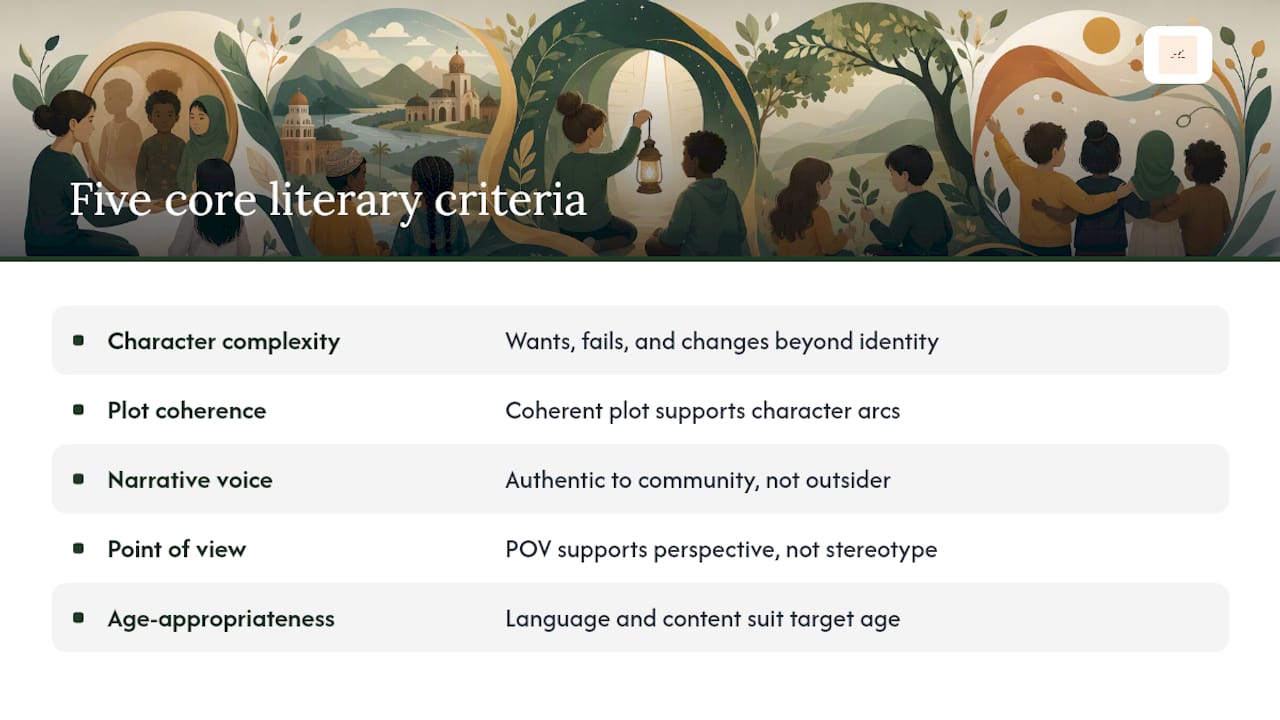
A character who exists only to teach the majority-culture protagonist a lesson about diversity is tokenism, not representation. Look for characters who want things, fail at things, and change over the course of the story independent of their identity. Voice matters too: does the prose sound like it belongs to this community, or does it read like an outsider's approximation?
Pro Tip: Read the first and last page of the book before the middle. If the character's identity is the entire arc (problem at the start, identity-based resolution at the end), that structure often signals tokenism. Strong inclusive books use identity as context, not plot engine.
Illustration analysis
| Illustration criterion | What to look for | Common red flag |
|---|---|---|
| Visual diversity | Range of skin tones, body types, family structures | All background characters are white; diversity only in one "token" figure |
| Character agency | Characters depicted as active, expressive, capable | Characters of color shown as passive, fearful, or in service roles |
| Cultural accuracy | Clothing, settings, objects match the specific culture | Generic "ethnic" props with no cultural grounding |
| Disability representation | Disabled characters shown in full, agentic contexts | Disabled characters depicted only in medical or pitied settings |
| Exoticizing imagery | Ordinary domestic scenes for all groups | One group always shown in "exotic" or ceremonial contexts only |
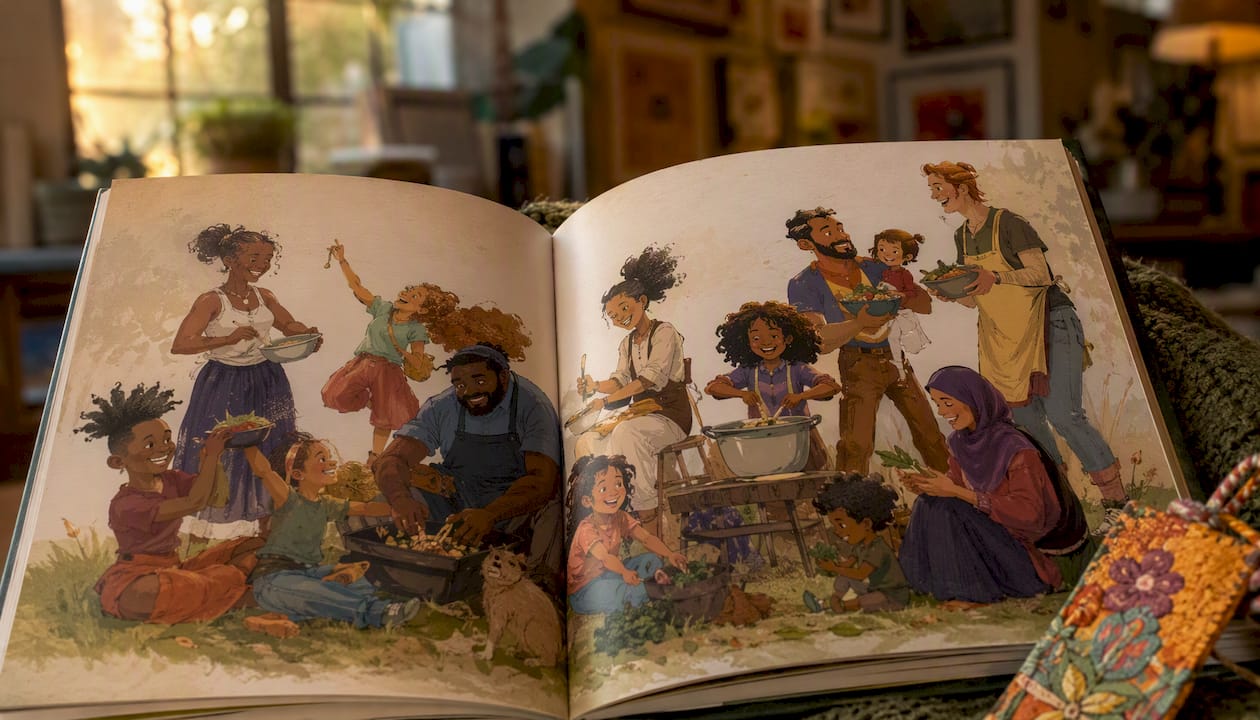
For deeper guidance on how visual storytelling shapes early literacy, the illustration analysis framework at Icon Literary's blog breaks down how to read pictures as a second text layer.
Stereotypes and tropes to flag
Teaching for Change's anti-bias selection guide identifies invisibility and tokenism as two of the most persistent problems in children's collections. Invisibility means a group simply does not appear; tokenism means they appear but only as background decoration or as a foil for the main (usually white, usually non-disabled) protagonist.
Flag these tropes specifically: the "magical cure" disability narrative, the pity-based arc where a disabled child's suffering is the emotional engine, the single-story framing that treats one character as representative of an entire culture, and the folk-tale stereotype that places non-Western cultures permanently in the past.
Documenting findings
Write a brief selection note in your acquisitions record: note which criteria the title met, which it failed, and what sources you consulted. This protects your decision if a title is challenged and builds institutional knowledge for future selectors.
How can you verify a creator's credentials and authenticity quickly?
Verification does not have to take long. A focused five-minute check covers most of what you need.
- Search WNDB and ALA/ALSC lists. We Need Diverse Books maintains curated lists of titles by and about underrepresented communities. ALA/ALSC award lists (Pura Belpré, Coretta Scott King, Schneider Family Book Award) signal community recognition, though awards alone do not guarantee authenticity.
Pro Tip: Search the author's name alongside the community name (e.g., "author name + Deaf community" or "author name + Navajo Nation") to find interviews, essays, or community responses that do not appear in publisher materials.
Why does collection balance matter, and how do you audit for it?
Rudine Sims Bishop's windows and mirrors framework, now foundational to inclusive collection development, describes three types of reading experiences. A mirror reflects a child's own life and identity back to them, validating their existence. A window offers a view into a life or world different from their own, building empathy. A sliding glass door goes further: the reader can imaginatively enter that world and experience it from the inside.
A collection heavy on mirrors for one demographic and windows for everyone else is not balanced. Children who never see themselves in books receive a quiet message that their lives are not worth narrating. Children who only ever see their own experience miss the empathy-building that windows provide.
"When children cannot find themselves reflected in the books they read, or when the images they see are distorted, negative, or laughable, they learn a powerful lesson about how they are devalued in the society of which they are a part." — Rudine Sims Bishop
A simple collection audit template
Run this audit by age band (picture books, early readers, middle grade) separately. A collection can look balanced overall while being severely imbalanced at the picture-book level, which is where identity formation is most active.
Community demographics should inform your acquisition priorities, but they should not limit them. A school that serves a predominantly Latino community still needs windows into other experiences. The goal is a collection where every child finds multiple mirrors and multiple windows, not a collection that only reflects the majority.
For practical guidance on pairing insider narratives with contextualizing nonfiction or window titles, the classroom belonging guide at Icon Literary's blog offers pairing strategies organized by theme and age range.
What red flags should disqualify or limit a title?
Some problems are disqualifying. Others warrant a restricted display note rather than outright rejection, particularly when a title has historical significance or redeeming literary qualities alongside its problems.
Disqualifying issues:
- Pervasive stereotyping that defines every character of a group by a single trait
- A white-savior plot where a character from the majority culture rescues or educates a community that could not help itself
- Pity-based disability narratives where the disabled character exists to make non-disabled characters feel grateful or inspired, with no agency of their own
- Miracle-cure arcs where disability is resolved rather than lived with, implying disability is a problem to be fixed
- Outsider voice that distorts a culture's beliefs, practices, or language through consistent factual error
Subtle harms worth flagging:
- Power imbalances in plot where characters of color consistently defer to white characters
- Invisibility: a book set in a diverse community where all named, speaking characters are white
- Over-reliance on folk-tale framing that places non-Western cultures permanently in a pre-modern past, with no contemporary counterpart
"The single story creates stereotypes, and the problem with stereotypes is not that they are untrue, but that they are incomplete." — Chimamanda Ngozi Adichie
Cataloging note suggestion for borderline titles: "This title contains [specific issue]. Recommended for use with educator guidance. Pair with [title] for a more complete representation of [community/topic]."
What is a repeatable six-step workflow for evaluating a title?
A multi-pass review, rather than a single read-through, produces more consistent and defensible decisions. ALSC's EDI guidance specifically recommends separating literary and representation passes to prevent conflating diversity with quality.
- Verify authenticity — Run the five-step verification check: backmatter, bios, WNDB/ALSC lists, one-star reviews, sensitivity-reader statements.
Pro Tip: Schedule a monthly "review stack" day where you and a colleague read aloud from shortlisted titles together. Reading aloud surfaces pacing problems, linguistic stumbling blocks, and subtle stereotyping that silent reading misses. ALSC practitioners report this as one of the most effective pre-display checks available.
What does the research say about evaluating diverse children's books?
The evidence base for inclusive selection is well-developed, and it points in a consistent direction: literary quality and authentic representation are not competing priorities.
| Research source | Core finding | Practical implication |
|---|---|---|
| LibreTexts practical framework | Systematic criteria produce more defensible decisions than impressionistic judgment | Use a structured checklist, not gut feel alone |
| Teaching for Change anti-bias guide | Invisibility and tokenism are the most common representation failures | Audit for absence, not just for harmful presence |
| ALSC disability guidance | Pity and miracle-cure narratives are the dominant harmful tropes in disability representation | Apply disability-specific criteria as a separate checklist item |
| Beyond Checklists (peer-reviewed) | Rigid checklists miss context; a multi-pass, critically grounded approach works better | Use the checklist as a scaffold, not a scorecard |
| ALSC EDI in Action | Collaborative read-alouds catch subtle biases that solo review misses | Build colleague review into your workflow |
The peer-reviewed "Beyond Checklists" research makes an important caution: a checklist used mechanically, without professional judgment, can produce false confidence. A book can pass every line item and still present a community in a way that feels off to community members. That is why verification steps and community reviews are not optional add-ons but core parts of the process.
Award lists and curated databases are useful starting points, not finish lines. A Pura Belpré honor signals community recognition; it does not replace your own textual evaluation.
The inclusive books benefits research summarized at Icon Literary's blog reinforces why this work matters: collection balance affects children's sense of self and their attitudes toward peers who are different from them, with effects that show up in classroom behavior and social development.
Key Takeaways
Librarians who apply a structured, multi-pass evaluation process, grounded in windows and mirrors theory and verified against community sources, build collections that serve every child's identity development and empathy growth.
| Point | Details |
|---|---|
| Run the five-part quick screen first | Check author connection, cultural authenticity, harmful tropes, character agency, and accessible formats before deeper review. |
| Separate literary and representation passes | Reading for quality first, then for bias, prevents you from excusing representation failures because the writing is strong. |
| Verify beyond the bio | Use backmatter, WNDB lists, ALSC awards, and community one-star reviews together; no single source is sufficient on its own. |
| Audit your collection by identity category | Use the windows and mirrors template to find gaps by age band, not just across the whole collection. |
| Icon Literary titles | Icon Literary's SEL-focused picture books for ages 3–8 prioritize diverse characters, art-forward illustration, and accessible formats, making them straightforward additions to an inclusive collection. |
The checklist is a tool, not a verdict
The most common mistake I see in inclusive selection practice is treating the checklist as a pass/fail test rather than a diagnostic instrument. A book that scores well on every criterion can still present a community in a way that feels hollow or performative to readers from that community. A book with one notable flaw can still be the only title in your collection that shows a child a mirror they have never seen before.
That tension does not mean the checklist is useless. It means the checklist is the beginning of professional judgment, not a substitute for it. The criteria exist to make your thinking visible and your decisions defensible, not to automate them.
The other thing worth saying plainly: this work takes time, and most library budgets and staffing levels do not account for it. The six-step workflow above is designed to be efficient, but "efficient" is relative when you are managing hundreds of acquisitions a year. Prioritize the multi-pass review for titles in categories where your collection is weakest, where community need is highest, or where you have received patron feedback about gaps. You cannot do everything at full depth every time. Knowing where to concentrate your effort is itself a professional skill.
Small public libraries with one or two staff members can adapt the workflow by batching: evaluate five to ten titles in a single session rather than one at a time, and use the quick screen to triage before committing to full review. School librarians working with classroom teachers can share the verification load, with teachers handling community-review checks while the librarian runs the literary-quality pass.
The goal is not a perfect collection. It is a collection that keeps getting better, one documented decision at a time.
Icon Literary titles built for inclusive, SEL-focused collections
Librarians who have worked through this checklist know what a strong inclusive title looks like: original characters with genuine agency, art-forward illustration that reflects visual diversity without exoticizing, and story worlds designed for ages 3–8 that center emotional literacy alongside narrative.
Icon Literary's children's picture books and activity kits are built around exactly those criteria. Each title features diverse characters embedded in emotionally resonant stories, SEL themes woven into the plot rather than bolted on as lessons, and illustration designed to show children as capable and expressive. Formats include physical books, digital downloads, and activity kits, covering the accessibility range your catalog note will need.
For cataloging purposes, a suggested selection note reads: "SEL-focused picture book featuring diverse characters and art-forward illustration. Suitable for storytime programming and independent reading, ages 3–8. Available in print and digital formats."
Browse the full Icon Literary catalog to review titles, formats, and order options, or visit iconliterary.com to request review copies for institutional purchase consideration.
Curated resources librarians should consult when evaluating titles
These organizations and databases are the most reliable external verification sources available for U.S. library selectors.
- Evaluating Books About Youth with Disabilities
- 3.6: Evaluating Books in Context- A Practical Framework — Humanities LibreTexts
- A Checklist for Evaluating Diverse Children's Media
- A Family Guide to Selecting Diverse Books
- How to Find Diverse Books | Colorín Colorado
- Beyond Checklists: Applying an “I Spy” Approach to Evaluating Children's Literature in Urban Classrooms
- Evaluating Diverse Literature — Children & Young Adult ...
- Guide for Selecting Anti-Bias Children’s Books — Teaching for Change
- EDI in Action: Intentionally inclusive book selection
| Resource | Best used for | Limitation |
|---|---|---|
| WNDB booklists | Discovery and corroboration | Does not replace in-text evaluation |
| ALSC award lists | Community recognition signal | Awards do not guarantee authenticity |
| Teaching for Change guide | Anti-bias criteria and trope examples | Focused on bias; less on literary quality |
| Social Justice Books database | Thematic programming and pairing | Searchability varies by category |
| Colorín Colorado | Bilingual and ELL-focused titles | Narrower scope than general diversity lists |
Use these lists in combination with the textual checklist rather than instead of it. A title on a WNDB list that fails your authenticity verification still fails. The lists narrow your search; your professional judgment closes it.
For a practical guide to finding inclusive picture books across these databases, Icon Literary's blog offers a search-strategy walkthrough organized by age range and identity category.