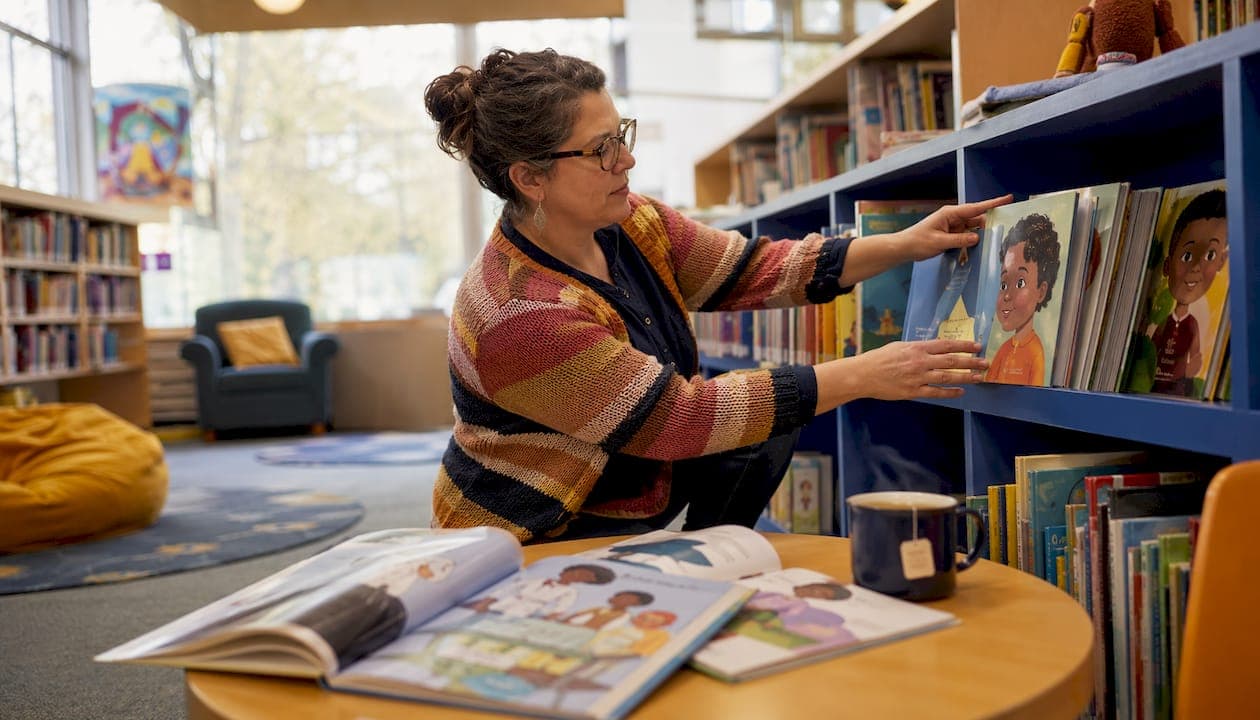
What a curated SEL picture book collection actually is — and why it matters
A curated SEL picture book collection is a deliberately assembled set of books chosen to support children's social and emotional development, not just a shelf of feel-good stories. The difference between a curated collection and a random assortment is intentionality: every title earns its place by addressing specific emotional competencies, reflecting the children who will read it, and meeting them at the right developmental stage.
Social emotional learning, as defined by the CASEL framework, covers five core competencies: self-awareness, self-management, social awareness, relationship skills, and responsible decision-making. Picture books are one of the most natural entry points for all five. A child who sees a character navigate jealousy, grief, or exclusion in a story gains emotional vocabulary before those feelings arrive in real life.
The benefits go beyond vocabulary. Picture books that reflect a child's own identity affirm belonging. Books that show unfamiliar lives build empathy. And when a collection balances stories of joy, humor, and pride alongside stories of struggle, it avoids the trap of teaching children that their culture or identity is defined only by hardship. 2026 guidance specifically calls out this balance: collections should mirror student identities without overemphasizing struggle narratives that can quietly reinforce stereotypes.
An effective SEL picture book collection includes:
- Books spanning the full range of emotions, not just sadness and anger
- Titles that reflect diverse cultures, family structures, abilities, and neurodiversity
- Age-appropriate language and themes matched to developmental stages
- Stories where characters of color, disabled characters, and LGBTQ+ families appear in joyful, ordinary contexts, not only in adversity
- A rotation plan so the collection stays current and relevant to the specific children in the room
How to choose SEL picture books that actually work for your collection
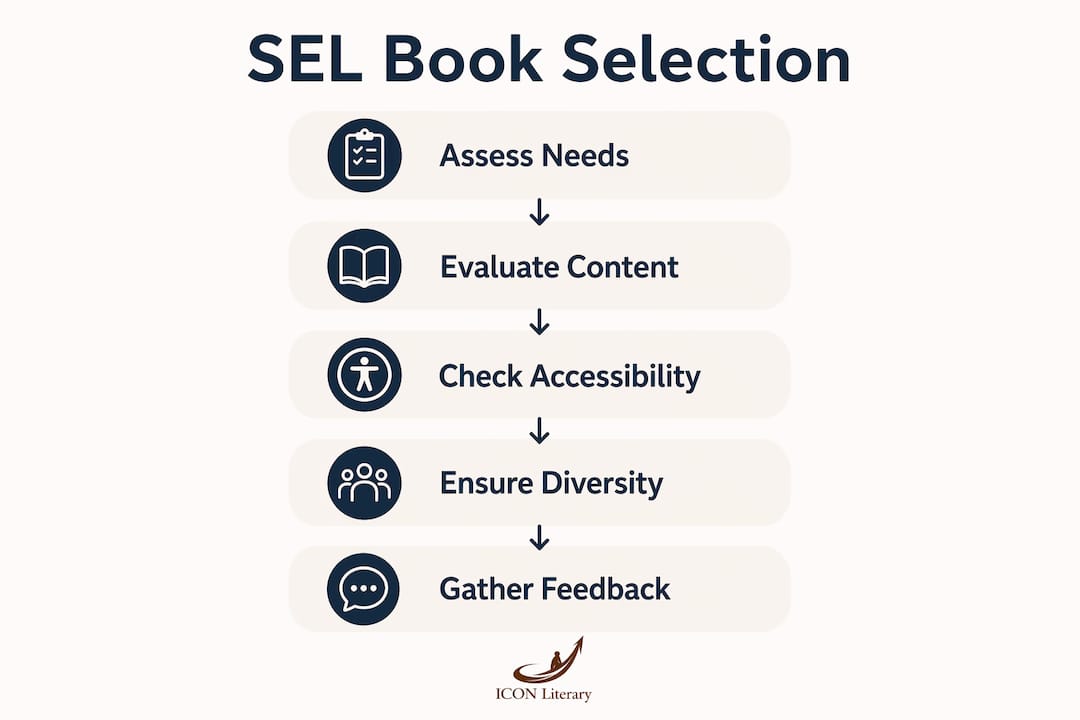
Choosing well means applying a consistent lens before a book reaches the shelf. Engaging narrative and emotional realism come first. A book that lectures children about kindness rarely lands the way a story does, where a character makes a real mistake, feels the weight of it, and finds a way forward. That arc is what makes the SEL lesson stick.
Starting as early as preschool age with books focused on basic emotional vocabulary makes sense developmentally. At that age, expressive illustrations carry most of the meaning, and simple stories that clearly show what happy, sad, or surprised looks like build the foundation. For children ages 8–12, the collection can expand into complex social themes: fairness, belonging across difference, navigating peer pressure, and managing disappointment.
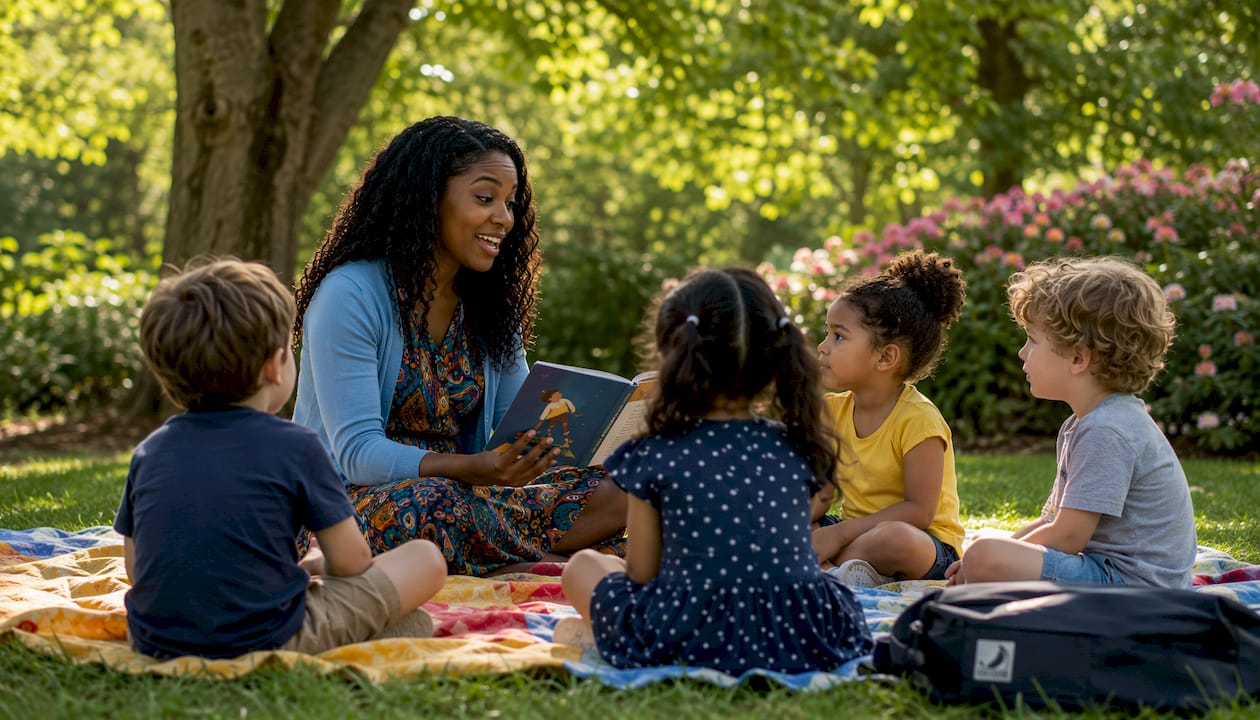
Cultural responsiveness is not optional. A book that depicts a culture through surface details (food, clothing, holidays) without authentic emotional depth can do more harm than good. Look for books with diverse characters where the cultural context shapes the story's emotional logic, not just its backdrop. Authors and illustrators who share the lived experience they depict tend to get this right in ways that outside perspectives often miss.
The Five-Finger Rule is a practical accessibility check: ask a child to read one page aloud and hold up a finger for each unknown word. Five or more unknown words on a single page means the child will spend cognitive energy decoding rather than connecting emotionally with the story. For SEL purposes, accessibility matters as much as content quality.
Pro Tip: Build an "aware reading" checklist before adding any book to your collection. Ask: Does this story honor the emotional context of the characters? Does it avoid shame-based repair? Could any child in your group feel unseen or harmed by this narrative? If a book raises a red flag on any of these, pair it with a "mirror" book that affirms the same community's strength and joy.
A practical selection checklist:
- Does the story show emotional realism rather than tidy, instant resolution?
- Are characters from marginalized groups shown in full, complex lives?
- Does the language match the developmental stage of your readers?
- Does the book pass the Five-Finger Rule for your group's reading level?
- Is the cultural representation authentic rather than decorative?
- Does the collection as a whole balance challenge stories with joy and pride stories?
- Have you consulted SEL book selection criteria from practitioners familiar with your student population?
Recommended SEL picture books that reflect diverse experiences and strong emotional themes
The titles below represent a cross-section of what a well-rounded SEL collection looks like in practice. They span age ranges, cultural backgrounds, and emotional competencies. No single list is definitive, and your specific community's demographics should always shape final choices.
| Title | Author | Age Range | SEL Themes | Cultural Representation |
|---|---|---|---|---|
| The Name Jar | Yangsook Choi | — | Identity, belonging, courage | Korean American |
| Each Kindness | Jacqueline Woodson | — | Regret, empathy, kindness | Black American |
| Last Stop on Market Street | Matt de la Peña | — | Gratitude, community, perspective | Latino American |
| The Proudest Blue | Ibtihaj Muhammad | — | Identity, pride, resilience | Muslim American |
| Enemy Pie | Derek Munson | — | Friendship, conflict resolution | General American |
| Sulwe | Lupita Nyong'o | — | Self-acceptance, colorism, beauty | Black African |
| A Chair for My Mother | Vera B. Williams | — | Resilience, family, community | Working-class American |
| Wonder (picture book adaptation) | R.J. Palacio | — | Empathy, inclusion, kindness | Disability representation |
| The Invisible String | Patrice Karst | — | Grief, connection, love | Universal |
| Jabari Jumps | Gaia Cornwall | — | Courage, perseverance, parental support | Black American |
| Koko's Kitten | Dr. Francine Patterson | — | Perseverance, empathy, loss | Animal/cross-species empathy |
CASEL practitioners specifically highlight books featuring respectful treatment of animals and diverse human characters as particularly effective for building genuine empathy, because children connect emotionally with non-human characters in ways that bypass defensiveness. Koko's Kitten is a strong example of that principle in action.
A few standout picks worth highlighting:
- The Name Jar opens a direct conversation about identity and the pressure to assimilate, making it especially powerful for classrooms with immigrant or multilingual students.
- Each Kindness is one of the rare SEL books that does not offer a tidy resolution. The regret Chloe feels at the end is real, and that emotional honesty is exactly what makes it memorable.
- Sulwe addresses colorism with a gentleness that does not minimize the pain, pairing it with a creation myth that reframes darkness as beautiful.
- Jabari Jumps shows a Black father and son navigating fear together, a combination of identity affirmation and emotional modeling that is genuinely hard to find.
- The Invisible String handles grief and separation without euphemism, which makes it useful for classrooms dealing with loss, deployment, or family change.
Rotating and labeling your collection by theme or SEL competency encourages children to self-select books that match what they are feeling, which deepens the emotional connection beyond what a teacher-assigned read-aloud can achieve on its own. Thematic baskets (one for "big feelings," one for "friendship troubles," one for "being brave") work especially well in classroom libraries.
Pro Tip: When building your inclusive picture book collection, aim for at least one title per major SEL competency that features a protagonist from a culture or background represented in your classroom. Children notice when they are absent from the shelf.
How to use SEL picture books effectively in classrooms, libraries, and homes
The setting and timing of a read-aloud shape how children receive the story. One-on-one reading supports sensitive emotional processing, giving a child space to ask questions or sit with a feeling without an audience. Whole-class read-alouds build shared vocabulary around social norms, creating a common reference point ("Remember how Jabari felt before he jumped?") that teachers can return to throughout the week.
Natural transition times work particularly well for SEL story sessions. After lunch is a low-pressure moment when children are physically settled but not yet focused on academic tasks. Reading a short picture book then, rather than during formal instruction time, signals that emotional learning is part of the day's rhythm, not a special event.
Engagement goes deeper when the story becomes a conversation rather than a performance. Reflective questions work better than comprehension checks: "What do you think she was feeling before she said that?" lands differently than "What happened next?" Role-play and thematic projects extend the learning beyond the book itself. A class that reads Enemy Pie and then writes their own "enemy pie" recipes for turning a rival into a friend is doing SEL work, not just listening to a story.
Aware reading is the practice of anticipating which students might feel unseen or harmed by a particular narrative before you read it aloud. A book about a child whose parent is incarcerated, for example, might be exactly what one student needs and deeply exposing for another. Pairing struggle stories with mirror books that affirm the same community's joy and strength prevents the collection from inadvertently teaching children that their identity is primarily a source of difficulty.
Practical usage tips:
- Read the book yourself before sharing it with children, noting any moments that might require a pause or a follow-up question
- Use emotional read-alouds as anchors for the week's SEL theme rather than standalone events
- Let students help select books for the class library, especially English language learners, new students, and students with disabilities
- After a struggle story, follow it within the same week with a joy or pride story from the same cultural community
- Track which books children return to on their own. Repeated self-selection is the clearest signal that a book is doing real emotional work
Expert insights on building an SEL collection that holds up over time
The most durable SEL collections share one quality: they were built with the specific community in mind, not assembled from a generic "best of" list. Culturally responsive curation means asking whose emotional norms are centered in each book, whose conflict resolution strategies are treated as universal, and whose family structures are shown as ordinary rather than exceptional.
Trauma-informed selection adds another layer. A book that depicts a child experiencing neglect or violence may be clinically accurate and even well-intentioned, but reading it aloud in a group setting without preparation can retraumatize children who have lived that experience. The selection checklist matters here: does the book honor emotional context, avoid shame-based repair, and leave the child with a sense of agency rather than helplessness?
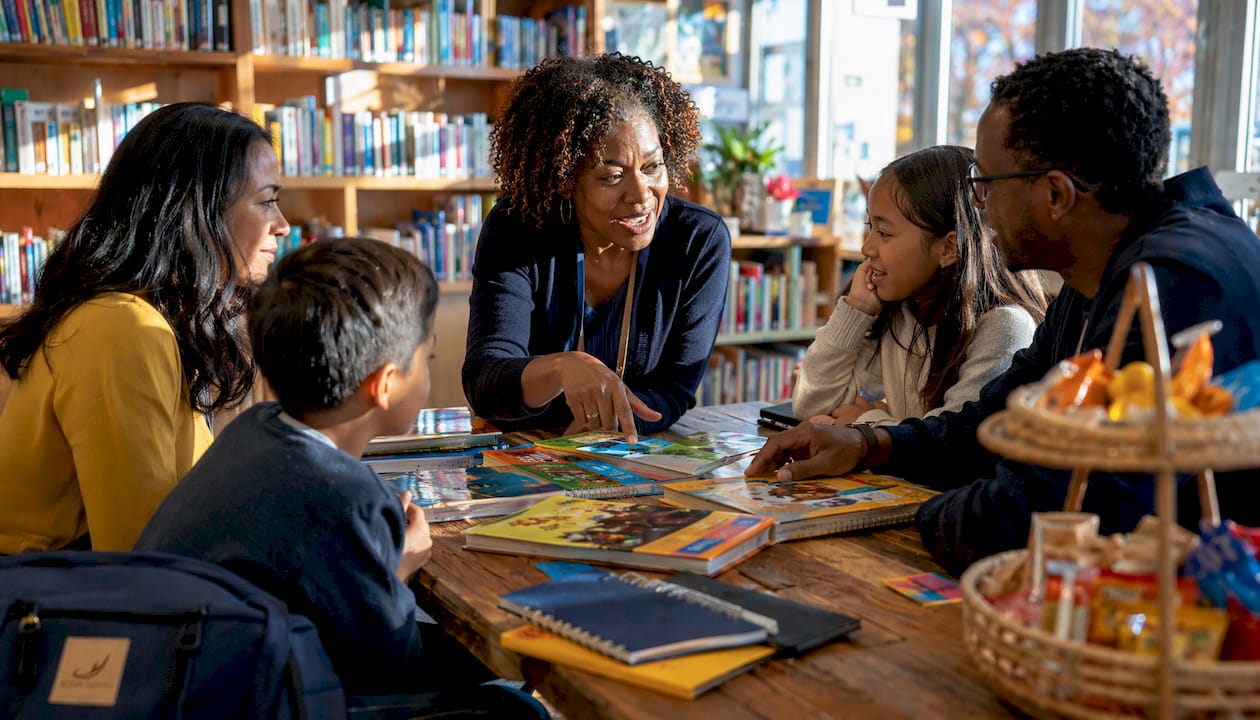
Community involvement strengthens any collection. When students and families contribute titles, the shelf reflects actual lives rather than a curator's best guess. Some of the most effective classroom libraries have a "community picks" basket where families can add books from home, which also signals that the school values knowledge that comes from outside its walls.
Regular auditing keeps a collection from going stale. A book that was groundbreaking five years ago may now feel dated in its representation or its emotional framing. Reviewing the collection once per semester, ideally with student input, catches titles that no longer reflect the room and surfaces gaps in coverage.
Expert curation best practices:
- Apply a culturally responsive lens to every title, not just books explicitly labeled as "diverse"
- Use the Five-Finger Rule to confirm accessibility before adding a book to the active rotation
- Pair every struggle narrative with at least one mirror book affirming the same community's strength
- Involve students and families in selection to ensure the collection reflects actual community demographics
- Audit the collection each semester and retire titles that no longer serve the room
- Consult curated lists from practitioners and researchers, including SEL research guides from university library systems, to discover titles outside your existing awareness
- Track which books children choose independently. Self-selection data is the most honest measure of a collection's impact
Icon Literary's Socko the Flamingo character was built around exactly these principles: a story that teaches emotional literacy and belonging through humor and imagination, designed to spark conversations about big feelings and identity without centering struggle. That approach, joy-forward, identity-affirming, and genuinely funny, is a model worth applying across any SEL collection you build.
Key Takeaways
A well-curated SEL picture book collection balances cultural responsiveness, developmental appropriateness, and emotional honesty to support children's social and emotional growth across every stage.
| Point | Details |
|---|---|
| Balance joy and struggle | Pair challenge stories with mirror books that affirm the same community's strength and pride. |
| Match books to developmental stages | Start with basic emotional vocabulary at preschool age and expand to complex social themes for ages 8–12. |
| Use the Five-Finger Rule | Check reading accessibility so children focus on the SEL message, not on decoding unfamiliar words. |
| Rotate and audit regularly | Review the collection each semester with student input to keep titles relevant and representative. |
| Apply aware reading before every read-aloud | Anticipate which narratives might harm or exclude specific children, and plan accordingly. |