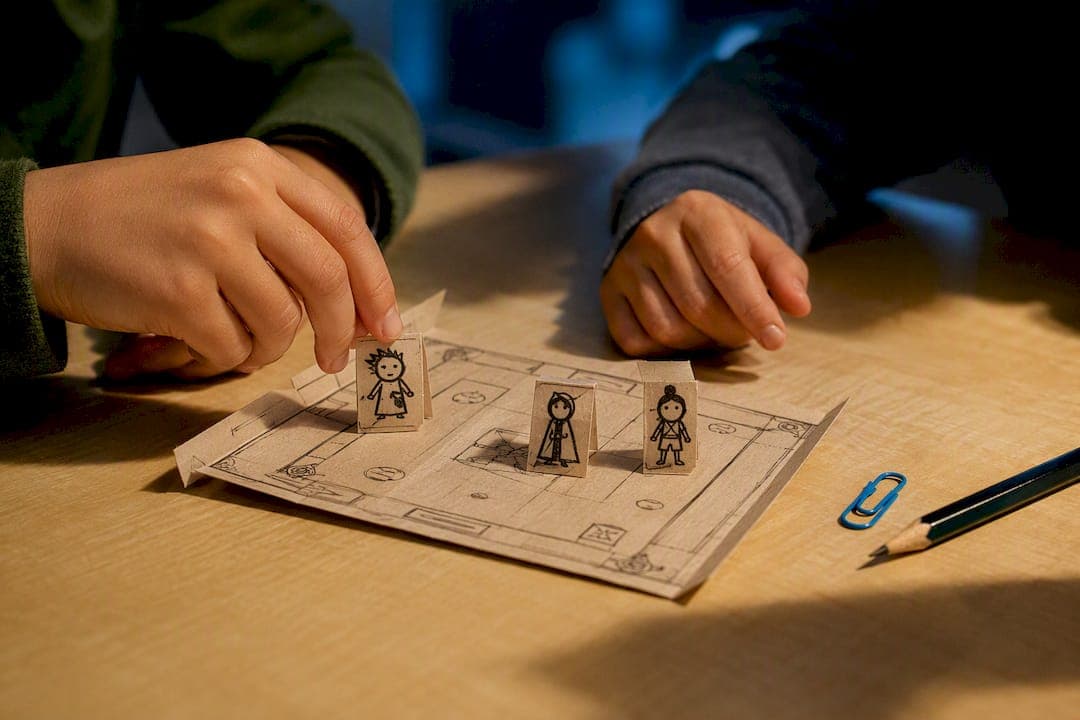
Map-making, character creation, story-cube prompts, and small-world play deliver the most learning per minute for school-age kids, and every one of them scales from a single 30-minute session to a multi-week class project. They work for ages 6 through 14 with small adjustments to complexity, cost almost nothing beyond paper and craft supplies, and fit equally well in a classroom, a homeschool block, or a rainy Saturday at the kitchen table. Activity kits and printables give you a ready-made starting point if you'd rather skip the prep.
TL;DR:
- Kids develop more engaging worlds using simple activities like mapping, character creation, and conflict design, which are scalable from one session to mult-week projects.
- Activities tailored to age groups improve focus, with younger children benefiting from self-contained sessions and older kids handling systems with multiple interconnected storylines.
- Using low-cost household items like paper, crayons, loose parts, and printable templates makes worldbuilding accessible without extra shopping or preparation.
- Embedding spatial language and social-role play in map-making and negotiation activities supports language, spatial reasoning, and social-emotional skills.
- Ready-made kits and prompts enhance efficiency and consistency, particularly for teachers or parents with limited prep time, while reinforcing core standards.
Table of Contents
- Worldbuilding Activities for Kids: 8 Ready-to-Run Picks
- Age-by-Age Progression: 6–8, 9–11, and 12–14
- How to Run a Worldbuilding Session Step by Step
- Materials, Kits, and Low-Cost Household Swaps
- What the Research Says About Worldbuilding and Learning
- Reusable Prompts, Templates, and Printables
- Why Icon Literary Builds Worldbuilding into Everything We Make
- Ready-Made Worldbuilding Kits from Icon Literary
- Sources
- FAQ
Worldbuilding Activities for Kids: 8 Ready-to-Run Picks
You don't need a curriculum to start. You need a table, some paper, and about twenty minutes. Here are eight worldbuilding activities for kids that work with almost no setup, organized by what they teach and how long they take.
- Landmark Mapping (ages 6–9, 20 minutes): Kids sketch four to six key places on a fictional island using crayons and butcher paper. Low-cost swap: the back of a cereal box works fine. For mixed-ability groups, let non-writers label with drawn symbols instead of words.
- Compass Rose Cartography (ages 9–12, 30 minutes): Add scale, legend, and travel routes to an existing map. Swap in a paper plate for a compass rose if you're out of printables.
- Character Trait Cards (ages 6–14, 15 minutes): Each child picks three trait cards (brave, stubborn, curious) and builds a character around them. Index cards and a marker are all you need; for younger kids, cut the traits down to a picture deck.
- Story Cube Roll (ages 6–11, 10 minutes): Roll six icon dice and weave the images into a thirty-second oral story. No dice? Write icons on sticky notes and pull them from a jar.
- Settlement Founding (ages 9–12, 30 minutes): Groups decide why a town exists (mining, trade, refuge) and sketch its layout. Great for mixed-ability groups because roles split naturally: mapper, namer, historian.
- Conflict Spark (ages 11–14, 25 minutes): Introduce one problem (drought, rival clan, missing heir) and have kids write how their world responds. Swap paper for a shared notebook if the group wants to keep building week to week.
- Small-World Terrain Build (ages 6–10, 45 minutes): Use blocks, fabric scraps, and figurines to construct a physical mini-world. Loose parts like bottle caps and cardboard tubes work as well as bought pieces.
- Puppet Diplomacy (ages 8–13, 30 minutes): Two characters from different settlements negotiate a trade deal using sock or paper-bag puppets. For younger or shyer kids, let them narrate instead of performing dialogue live.
Age-by-Age Progression: 6–8, 9–11, and 12–14
The same worldbuilding activities for kids stretch or compress depending on attention span, fine motor skill, and how much narrative complexity a child can hold in mind at once. Sequencing the right way keeps kids challenged without overwhelming them.
- Ages 6–8: sensory and single-session. Attention span runs 15 to 25 minutes, so keep projects self-contained. Kids at this age produce simple maps with named landmarks, one or two-trait characters, and short oral stories rather than written ones. Fine motor skills favor big crayons and chunky blocks over intricate cutting. A single session with a clear start and finish (draw a map, name three places, done) works better than an open-ended multi-week arc.
- Ages 9–11: structure and scale. This band can sustain a 30 to 45 minute session and start connecting ideas across sessions. Introduce map scales, legends, and compass roses, following the sequencing recommended by Diy, which suggests four to six key locations before adding symbols and travel paths. Kids in this range can also link settlements to simple economics (a fishing village trades with a mining town) and write a paragraph of backstory for a character rather than just naming traits. A two- to three-session arc, one for geography, one for settlements, one for characters, matches their growing capacity to hold multiple story threads.
- Ages 12–14: systems and conflict. Preteens and young teens can manage multi-week projects with real narrative stakes. The Kennedy Center's sci-fi and fantasy worldbuilding lesson outlines a ten-step classroom sequence that moves from geological features through settlements to character motivation and plot conflict, and it holds up well for this age group specifically because it treats worldbuilding as a system with cause and effect rather than a list of fun facts. At this stage, kids should produce a written conflict scenario tied to the world's rules (why this drought matters to this economy) and can present findings to peers, which aligns naturally with Common Core ELA speaking and listening standards and National Core Arts Standards for theatre and visual presentation, detailed in the Theatre at a Glance overview.
Sequencing single sessions for younger kids and multi-week arcs for older ones isn't just about patience. It mirrors how narrative complexity actually develops, and pushing a 7-year-old into a five-session epic usually backfires into frustration rather than deeper engagement.
How to Run a Worldbuilding Session Step by Step
A repeatable structure removes the guesswork, whether you're a teacher covering a 30-minute block or a parent filling a Tuesday evening. This five-step flow works at home and in a classroom with almost no prep.
- Engage (5 minutes). Pose one question: "What's the biggest problem in your world right now?" Skip long instructions.
- Build (10 to 20 minutes). Kids draw, write, or construct based on the day's focus, whether that's a map, a character, or a conflict.
- Apply (5 to 10 minutes). Have them use what they built. Tell a thirty-second story about the map. Introduce their character to a partner's.
- Reflect (5 minutes). Ask one specific question: "What surprised you about your settlement's problem?" This is where language and emotional processing happen.
- Store or share (5 minutes). Photograph the work, pin it to a wall, or add it to a running class binder. Teachers who turn session outputs into visible class artifacts, like a map mural or a rotating zine, tend to see stronger engagement and more revision on later visits, according to the Kennedy Center's classroom notes.
For a 30-minute class, compress steps two and three into 15 minutes total. For a 60-minute block or a home session with no bell to watch, let the build phase run long and add a second reflect round at the midpoint. Simple assessment doesn't require a rubric spreadsheet: track participation (did they contribute one idea?), narrative detail (did the map or character have at least three specific features?), and collaboration (did they build on someone else's idea?).
Pro Tip: Limit each character to exactly three traits or each map to one room before expanding. Practitioners who use tight constraints like this see higher participation and less stalling than groups given a blank page, because a limited prompt gives kids somewhere to start instead of an infinite menu to freeze over, a pattern noted by ReadBrightly's creative storytelling guide.
Materials, Kits, and Low-Cost Household Swaps
You can run every activity in this guide with a shoebox of supplies. The core kit: plain paper, crayons or markers, index cards, a set of six blank dice or wooden cubes, and some loose parts for small-world building.
- Loose parts like fabric scraps, bottle caps, cardboard tubes, and buttons work as terrain and props, a rotation strategy Mommy Poppins recommends for keeping imaginative play fresh across sessions.
- No story cubes? Write six icons (mountain, river, stranger, storm, treasure, ruin) on sticky notes and draw from a jar instead.
- No map templates? A paper plate makes a serviceable compass rose; a pizza box lid works as a map board.
- Sensory-friendly swaps: offer quiet, tactile options like felt boards or clay instead of loud dice or timers for kids who find noise or time pressure overwhelming, and let nonverbal kids point to icon cards rather than speaking aloud during reflect time.
None of this requires a shopping trip. If you'd rather skip assembling supplies, printable character sheets and story-cube icon sets are available as ready-made downloads.
What the Research Says About Worldbuilding and Learning
Mapping isn't just an art project. Embedding spatial-language prompts, words like "above," "adjacent," and "boundary," into map-making sessions gives kids repeated practice with vocabulary that predicts later skill in geometry and measurement, according to TinyStepper's research on imaginary map-making. A ten-minute mini-lesson where kids describe where the river sits relative to the mountain does double duty as language practice and spatial reasoning.
Pretend play builds planning, role allocation, and negotiation skills that show up directly in executive function gains, according to Bright Horizons' overview of pretend play. Kids assigning themselves roles in a settlement-founding activity are rehearsing the same skills they'll need for group projects years later.
Worldbuilding also gives kids a low-stakes way to rehearse real social situations. Hands On As We Grow's research on pretend play notes that children draw heavily on real-world observation when they build imaginary scenarios, which makes puppet diplomacy or settlement negotiation genuine social-emotional learning rather than just fun. Teachers can lean on that overlap directly: worldbuilding sessions map cleanly onto SEL competencies like social awareness and relationship skills, and the narrative and presentation work satisfies ELA and arts standards without extra paperwork.
Reusable Prompts, Templates, and Printables
A prompt bank saves you from staring at a blank session plan every week. Sort starters into three buckets and rotate through them:
- Map prompts: "What's on the other side of the mountain?" "Why did this town get built here and not somewhere else?" "Where does the river cause conflict between two settlements?"
- Character prompts: "Pick three traits and one fear." "What does your character want that they can't have?" "Who does your character trust least?"
- Conflict prompts: "A drought hits the largest farm. Who suffers first?" "Two settlements both claim the same bridge. What happens?"
A basic character sheet needs four fields: name, three traits, one goal, one fear. A map legend needs symbols for water, settlements, danger zones, and travel routes, following the same sequencing DIY.org recommends. For story cubes, a six-icon set (mountain, river, stranger, storm, treasure, ruin) covers most story needs, and Icon Literary's story-cube prompt collection offers thirty ready-made starters if you want to skip designing your own. Archive finished work as a class zine, a map mural taped to the wall, or a short puppet-show video, all cheap ways to turn a single session into something kids revisit.
Why Icon Literary Builds Worldbuilding into Everything We Make
Studio work on story worlds taught us the same lesson classrooms keep proving: kids invest more in a world they helped build than one handed to them finished. That's why low-stakes constraints, three traits, one room, one conflict, show up in our own card decks and activity kits, not just in this guide. Worldbuilding done this way isn't separate from social-emotional learning; it's one of the more direct routes into it.
— Derek Amarillas
Ready-Made Worldbuilding Kits from Icon Literary
If you've read this far and want to skip the printer-and-scissors setup, There are activity kits, story cubes, and printable templates all built around the same map, character, and conflict structure covered above.

The advantage over assembling your own materials is simple: everything arrives pre-designed and SEL-aligned, so a teacher prepping five sections a day or a parent with twenty minutes before dinner doesn't have to build a character sheet from scratch. Each kit pairs with the session flow in this guide, meaning the engage, build, apply, reflect, and share steps already have prompts attached. For a broader prompt bank once you've exhausted the starter set, The story-cube collection and the SEL activity library both extend the same framework into new sessions. If you want a structured prompt progression to pair with your own materials, Book-a-holic's writing prompt guide is a solid companion resource.
Visit the Icon Literary storefront to browse current kits and printable sets and pick the one that matches your next session.
Sources
- Diy
- Kennedy Center — Sci‑Fi & Fantasy worldbuilding (lesson plan)
- TinyStepper — Imaginary map making
FAQ
What Are Good Character-Building Activities for Kids?
Trait cards (picking three traits and building a character around them), puppet diplomacy, and short "what does your character fear?" writing prompts all build character depth quickly. Starting with a limited trait set, rather than an open-ended blank sheet, tends to produce richer characters because it removes the pressure of unlimited choice.
What Are Some Fun Word-Building Activities for Kids?
Story cube rolls, where kids weave six random icons into a spoken story, double as vocabulary builders because they force quick word choices under a time limit. Map-making with spatial-language prompts like "above," "beyond," and "adjacent" also strengthens vocabulary while teaching geography concepts.
What Is the Golden Rule of Worldbuilding?
Consistency matters more than scale: a small world with rules that hold together beats a sprawling one that contradicts itself. For kids specifically, starting with tight constraints, one room, three traits, one conflict, keeps the world consistent because there's simply less to keep track of.
What Are Good Building Activities for Kids Overall?
Landmark mapping, settlement founding, and small-world terrain building using blocks or loose parts are strong entry points because they're tactile and produce a visible result fast. Printable templates and activity kits offer a ready-made starting point if you want the structure built in already.