
A good emotional-literacy storytime pairs one book with one feeling skill and gives kids a chance to practice it out loud, not just hear about it. You don't need a curriculum or a certification to start. You need a theme, a book with a clear emotional arc, and a simple structure that repeats every time.
Here's a mini template you can run today:
- Opening ritual (3–5 minutes): A greeting song or breathing cue that signals "we're about to talk about feelings."
- Read-aloud with two scaffolded prompts (10–12 minutes): Pause at the emotional turning point and ask a feeling-label question, then a "why" question.
- Activity plus closing (12–20 minutes): A hands-on practice (Feelings Tree, role-play) followed by a short ritual closing.
Success looks like kids using a new feelings word unprompted, or naming one coping strategy they'd try next time they feel that way.
Key Takeaways
Hosting an emotional-literacy storytime works best when one SEL goal drives the book choice, the prompts, and the closing activity in a single, repeatable structure.
| Point | Details |
|---|---|
| Pick one SEL goal | Match a single skill, like naming worry or perspective-taking, to your theme instead of covering several. |
| Follow the 30 to 40 minute blueprint | Use a ritual opening, a read-aloud with two prompts, a hands-on activity, and a ritual closing. |
| Choose books with clear emotional arcs | Prioritize relatable motives, diverse characters, and a visible coping moment worth pausing on. |
| Layer prompts for mixed ages | Give younger kids a label question, older kids a why question, and everyone a nonverbal option. |
| Track vocabulary and carryover | Log new feeling words and caregiver reports of at-home coping use to gauge progress. |
| Use Icon Literary kits to cut prep | Icon Literary's books and printable Feelings Tree guides map to this structure and shave prep time down. |
Table of Contents
- How Do You Pick a Theme and Goal for an Emotional Literacy Storytime?
- What's the Best Session Structure and Timing for Storytime?
- How Do You Choose Books That Build Emotional Literacy?
- What Questions Should You Ask During the Read-Aloud?
- What Activities Reinforce Emotional Learning After the Story?
- What Does the Research Say About Storytelling and SEL?
- Do You Need Training to Host an Emotional Literacy Storytime?
- How Do You Adjust Storytime for Different Ages and Settings?
- How Do You Know If Emotional Literacy Storytime Is Working?
- How Do You Handle Big Feelings or Disruptive Behavior During Storytime?
- Sources
How Do You Pick a Theme and Goal for an Emotional Literacy Storytime?
Choose one social-emotional skill per session instead of trying to cover everything. The five standard categories are self-awareness, self-management, social awareness, relationship skills, and responsible decision-making, and a session built around a single one of these produces better transfer than a session that touches three or four. Research on repeated, focused practice cycles backs this up: short, targeted sessions repeated over weeks show measurable gains, while scattershot sessions tend to blur together for young children.
Match your theme to the goal directly:
- Worry or anxiety pairs with self-management. Focus on naming the feeling and picking one coping strategy (belly breathing, a comfort object, telling a grown-up).
- Friendship conflict pairs with social awareness. Focus on perspective-taking: what did the other character want or feel?
- Making a mistake pairs with responsible decision-making. Focus on repair, not punishment.
- New siblings or big changes pairs with self-awareness. Focus on naming mixed feelings.
A librarian planning a season of themes can use a cataloging system for emotional themes to avoid repeating the same skill four sessions in a row. Send one follow-up idea home per session so the skill gets practiced outside the room, not just inside it.
What's the Best Session Structure and Timing for Storytime?
A 30 to 40 minute session is the sweet spot most emotional-literacy programs land on, and it maps neatly onto a book, a coping-skill lesson, an interactive activity, and a take-home resource, according to standard program structures. Here's how to break it down and adjust for shorter or longer slots:
- Opening ritual (3–5 min): Same song or breathing cue every time, so kids know what's coming.
- Read-aloud with prompts (10–15 min): Pause twice, not five times. Over-pausing kills momentum.
- Hands-on activity (10–15 min): Feelings Tree, role-play, or a movement break tied to the theme.
- Closing ritual (3–5 min): A goodbye song, a one-word "feelings check," or a quiet moment.
For a tighter 25 to 30 minute slot, cut the activity to one round instead of two. For 40 to 45 minutes, add a caregiver debrief at the end.
One adult can run a group of 15 to 20 kids solo if the activity is simple; above that, recruit a helper to manage materials while you hold the group's attention. Build in nonverbal response options, like thumbs-up or colored cards, for kids who aren't ready to speak, and plan a sensory break station for anyone who needs to step away without leaving the room.
Pro Tip: Keep a designated "quiet chair" near the group, not outside it, so a child who needs a sensory break can still see and hear the session without feeling excluded.
How Do You Choose Books That Build Emotional Literacy?
Look for a clear emotional arc: a character feels something specific, that feeling changes because of an event, and the resolution shows (rather than states) how they coped. Vague feelings language ("she felt bad") gives you less to work with than specific language ("her stomach felt tight and she wanted to hide").
Prioritize these traits when picking a book:
- A relatable motive. Kids need to understand why the character feels what they feel, not just that they feel it.
- Diverse representation. Characters from different backgrounds, family structures, and abilities widen whose experience feels "normal."
- A visible coping moment, even a small one, that you can pause on and discuss.
- Age-appropriate length. Toddlers need shorter arcs with repetitive language; early elementary kids can track a longer emotional journey across a full plot.
Instead of reading the whole book cover to cover in one pass, flag two or three short passages ahead of time where the character's feeling shifts. Those are the moments worth slowing down on. A guide to reading feelings books together breaks down age-paired excerpts if you want a head start on which passages actually generate discussion.
What Questions Should You Ask During the Read-Aloud?
Four prompt types do most of the work in a dialogic read-aloud: a feeling label plus evidence ("What is she feeling? How do you know?"), an inferential why or how question, a coping-plan prompt, and a perspective-taking prompt. Scaffolded prompts like these help kids move past naming a feeling and into reasoning about it, which is where the real transfer happens.
Adjust the phrasing by age:
- Toddlers: "Is he happy or sad? Point to his face."
- Preschoolers: "Why do you think she's crying? What happened right before?"
- Early elementary: "If you were her friend standing there, what would you do?"
When a child answers, expand rather than correct. If a four-year-old says "mad," you might say, "Mad, yeah, or maybe frustrated, because his tower kept falling." That single follow-up sentence hands them a new word without turning it into a vocabulary quiz.
Pro Tip: For mixed-age groups, ask the simple label question first and let the youngest kids answer, then follow immediately with the "why" question for older kids. Nobody feels left out, and nobody feels bored.
What Activities Reinforce Emotional Learning After the Story?
A Feelings Tree turns abstract emotion talk into something kids can touch. Consistently labeling emotions with a visual anchor like this measurably expands how well children can name and communicate what they feel.
- Draw or print a bare tree on poster board.
- Hand out paper leaves in a few colors, each tied to a feeling family (yellow for happy, blue for sad, red for mad).
- Ask each child to write or draw one moment from the story on a leaf and tape it to the tree.
- For a group version, build one shared tree over the whole season. For an individual version, send a mini paper tree home as a take-home tracker.
For older kids or a rotating-station format, an Emotion Detective activity works well, having kids identify feelings from body language, word choice, and situation clues at separate stations. A role-play station modeled on a stuffed animal clinic activity builds empathy and caregiving language by having kids "treat" a stuffed patient's feelings, not just its body.
Materials for either activity cost under $10: poster board, construction paper, tape, and whatever stuffed animals families already own.
Songs and Movement That Support Emotional Regulation
A short song works as both a transition tool and a regulation tool. Try a call-and-response where kids stretch "big" for strong feelings and shrink "small" for quiet ones, matching body movement to emotional intensity.
- Use the same melody every session for the opening and closing so it becomes a predictable cue.
- Offer a hum-along or clapping option for nonverbal kids so nobody has to sing to participate.
- A slow, low song works better for a reset after an activity than a fast one, which tends to rev kids up further.
How Do You Bring In Guest Readers Without Extra Prep?
Give any guest reader exactly one job, reading the book aloud, and run the prompts and activity yourself. That keeps prep light and keeps the session's structure consistent.
- Send guests the book and your two planned prompts a day ahead, nothing more.
- Confirm accessibility needs (large print, seating) and get consent for photos before the session, not during.
- Keep families connected between sessions with a simple postcard or email listing the next theme and one at-home conversation starter.
What Does the Research Say About Storytelling and SEL?
Narrative-based programs that combine a ritual opening, a preparatory activity, the story itself, creative processing, guided reflection, and a ritual closing produced measurable gains in emotion comprehension among early elementary kids, according to a 2026 study on narrative participation. Separately, a 15-week program of daily 25-minute SEL read-alouds improved children's emotion vocabulary and problem-solving.
Ritual openings and closings aren't just nice touches. They give kids emotional containment, a signal that it's safe to go into a feelings conversation and safe to come back out of it.
Icon Literary's practitioner adaptations, drawn from running sessions with this structure repeatedly: keep the ritual identical every time even if the theme changes, cap scaffolded prompts at two per read-aloud, and always send home one tiny action instead of a worksheet. More background on the emotional payoff of shared reading lives on the Icon Literary blog.
Do You Need Training to Host an Emotional Literacy Storytime?
No formal certification exists for this, and you don't need a counseling degree to run one well. What actually matters is preparation, not credentials.
Read the book once, alone, before you ever read it to a group. Mark the two moments where the character's feeling shifts, and write your two prompts in the margin so you're not improvising mid-session. If you're new to this, a K to 2 read-aloud example set shows how experienced facilitators phrase prompts for that age band, which saves you from writing every script from scratch.
Practice the coping strategy yourself before teaching it. If the session goal is belly breathing, do three rounds of it on your own first so you can model it smoothly instead of fumbling through instructions live.
Know your group's needs ahead of time. If a child in the group has a diagnosed anxiety condition, a sensory processing difference, or a recent loss in the family, a quick check-in with a caregiver or teacher beforehand helps you avoid stepping on a raw spot without meaning to. You are not providing therapy, and you should say so if a parent asks, but you are creating a structured space for kids to practice naming and managing everyday feelings.
Build a simple binder or folder with your go-to books sorted by SEL goal, your standard opening and closing scripts, and a short list of two or three backup activities. Once that's built, prep time for each new session drops to fifteen or twenty minutes.
How Do You Adjust Storytime for Different Ages and Settings?
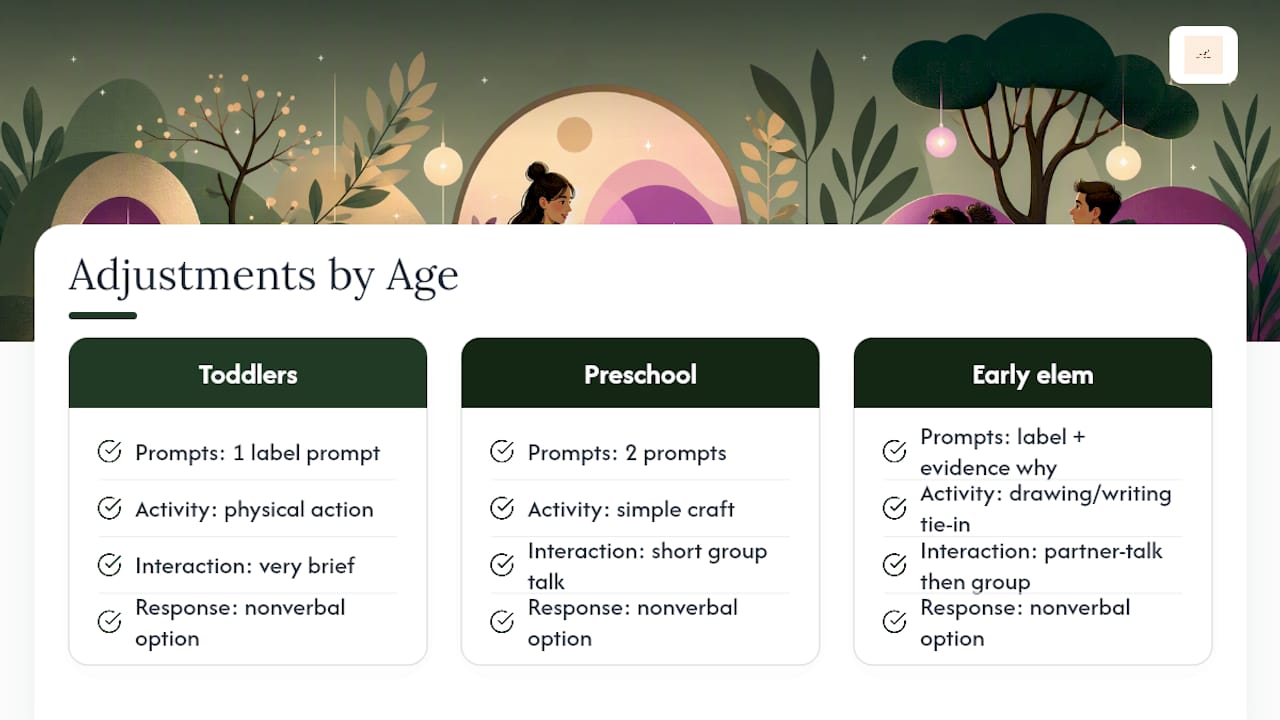
The same book and theme can serve a mixed-age room if you build in layers rather than trying to find one script that fits everyone. Prepare a simple label prompt for the youngest kids, an evidence-based "why" prompt for older kids, and a nonverbal response option like a thumbs-up or colored card for kids who respond faster with their hands than their voices, an approach supported by SEL storytelling research on layered prompting for mixed groups.
For toddlers, shrink everything: shorter book, one prompt instead of two, and a physical activity (patting a stuffed animal, pointing to a face) instead of a drawing or writing task. For preschoolers, two prompts and a simple craft work well. For early elementary kids, you can add a partner-talk step, having them turn to a neighbor and share their answer before the group discusses it, which increases participation from kids who are shy about speaking up first.
Setting matters as much as age. A classroom storytime benefits from a follow-up writing or drawing activity that ties into other lessons. A public library storytime, where families come and go and siblings of different ages sit together, benefits from an activity simple enough that an older sibling can help a younger one without adult intervention. A home or small-group setting gives you room to slow down and let one child's response lead the conversation longer than you could in a room of thirty.
Watch for kids who need the material presented differently: a child who processes language slowly benefits from you repeating the question rather than rephrasing it immediately, and a child with limited verbal language can point to a feelings chart instead of speaking. Neither adjustment requires special training, just attention.
How Do You Know If Emotional Literacy Storytime Is Working?
You don't need a formal assessment tool to track progress, though a few informal methods work well over a season of sessions. The most direct signal is vocabulary growth: keep a running list of feeling words a child uses unprompted across sessions, and watch it expand from broad terms ("sad," "mad") to specific ones ("disappointed," "frustrated," "jealous").
A second signal is whether kids can name evidence for a feeling, not just the feeling itself. A child who says "he's sad" is at one stage; a child who says "he's sad because his voice got quiet and he looked down" is demonstrating the kind of inferential reasoning that scaffolded prompts are meant to build.
Behavioral carryover outside the session is the strongest, if slowest, signal. If a caregiver reports that their child used a coping strategy from storytime, like naming a feeling before a meltdown or asking for a "big breath," at home during an unrelated moment, that's a sign the skill transferred beyond the room.
For a lightweight tracking system, keep a simple session log: theme, SEL goal, one quote or observation from a child's response, and any caregiver feedback you receive. Reviewing that log every four to six sessions shows you patterns, like whether a particular age group struggles with perspective-taking prompts more than label-and-evidence prompts, that you can adjust for going forward. This is observational, not clinical, and it's meant to inform your planning rather than diagnose anything about a child.
How Do You Handle Big Feelings or Disruptive Behavior During Storytime?
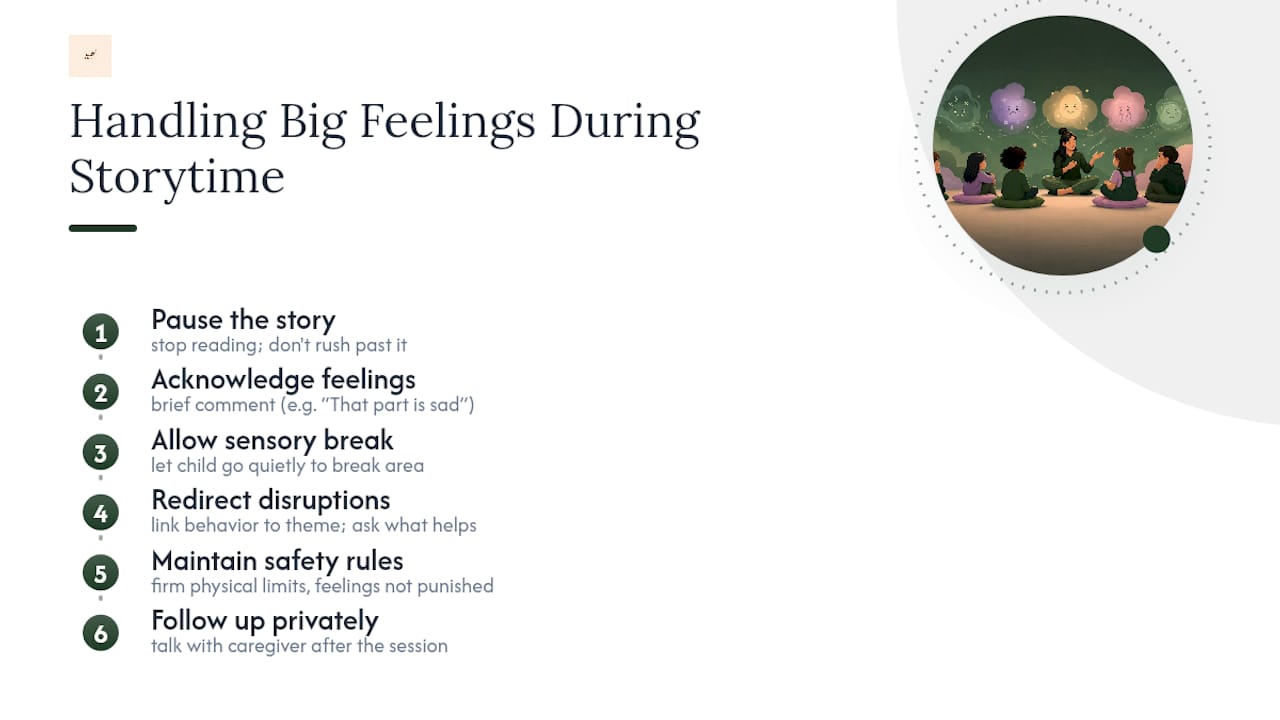
A child who cries, shuts down, or acts out during an emotional-literacy storytime isn't derailing the session; that reaction is often the session working exactly as intended, since you're asking kids to sit with feelings they don't always get space to name elsewhere.
When a child gets upset during the read-aloud, pause the story rather than pushing through it. A brief acknowledgment, "That part is sad, huh," followed by a beat of silence, does more than rushing to the next page. If the child needs to step to the sensory break area you set up ahead of time, let them go without making it a big production in front of the group.
For a child who becomes disruptive rather than withdrawn, redirect toward the theme instead of away from it. If a session about frustration triggers a frustrated outburst, that's an opening, not a problem: "It looks like you're feeling frustrated right now, just like the character. What do you think would help?" This only works if you've built emotional safety into the room from the start, through your ritual opening and consistent structure, so kids trust that big feelings won't get them in trouble here.
Set a clear boundary before you need one: physical safety rules (no hitting, no biting) stay firm regardless of the feeling behind them, but the feeling itself is never treated as the problem. If a session consistently triggers strong reactions in one child, a private word with a caregiver afterward, not during, keeps the group moving while making sure that child gets support outside the room too.
A Practitioner's Note on Keeping It Manageable
Sessions rarely go exactly to script, and that's fine. One habit that saves real time: pre-writing your two prompts on a sticky note inside the book's front cover, so you're never improvising the hardest part live. Author credentials and full bio to come.
How Icon Literary's Kits Cut Prep Time for Storytime Hosts
Icon Literary builds its emotional-literacy books, printable feelings cards, and activity guides around the exact structure above, so the prep binder is basically done for you. A themed book pairs directly with a printable Feelings Tree template and a one-page activity guide sized to the 30 to 40 minute blueprint, cutting your planning time from an evening to about fifteen minutes.

You can absolutely build this from a library book and a homemade poster board tree, that DIY route works fine and plenty of hosts run it that way. But if you're planning a season of sessions and want the theme, book, and craft already matched to a specific SEL goal, browse the current lineup at Icon Literary and pick a title that fits your first theme.
Sources
- Narrative participation as a context for meaning-making in early school years (Frontiers, 2026)
- Schultz & Baczek (study)
- Head Start: Fostering emotional literacy
- The explicit teaching of social-emotional skills through storytelling (Hamline capstone)