
Emotion coaching is the evidence-based, five-step method parents use to help children name what they feel, calm down faster, and solve problems on their own. Developed by researcher Dr. John Gottman, it works by treating a child's big feelings as a teaching moment instead of a problem to shut down. Parents who practice it regularly tend to see benefits such as fewer meltdowns, stronger social skills, and calmer conversations at home.
TL;DR:
- Parents should coach emotions during low to moderate intensity moments, avoiding full meltdowns to ensure children are receptive and learning effectively.
- Using short, repeatable phrases like "You seem upset" or "That sounds hard" helps children process feelings without overwhelming them.
- For toddlers, keep labels simple and offer choices; preschoolers benefit from expanded vocabulary and guided problem-solving, while school-age kids can articulate their perspective and negotiate solutions.
- Revisit coaching after children have settled, and avoid forcing participation during high-stress outbursts to prevent backfire.
- Building feeling vocabulary through daily activities, story reading, and tools like feelings cards fosters emotional literacy and strengthens coaching success.
Table of Contents
- What Is Emotion Coaching, and Where Did It Come From?
- The Five Emotion Coaching Steps, With Scripts You Can Use Today
- When to Coach, When to Pause, and What to Avoid
- Preparing Yourself Before You Coach
- Age-by-Age Scripts: Toddlers, Preschoolers, and School-Age Kids
- When Emotion Coaching Doesn't Seem to Work
- Quick Activities to Build Feelings Vocabulary Fast
- Why Icon Literary Builds Around This Approach
- Practice Emotion Coaching at Home With the Right Tools
- Sources
What Is Emotion Coaching, and Where Did It Come From?
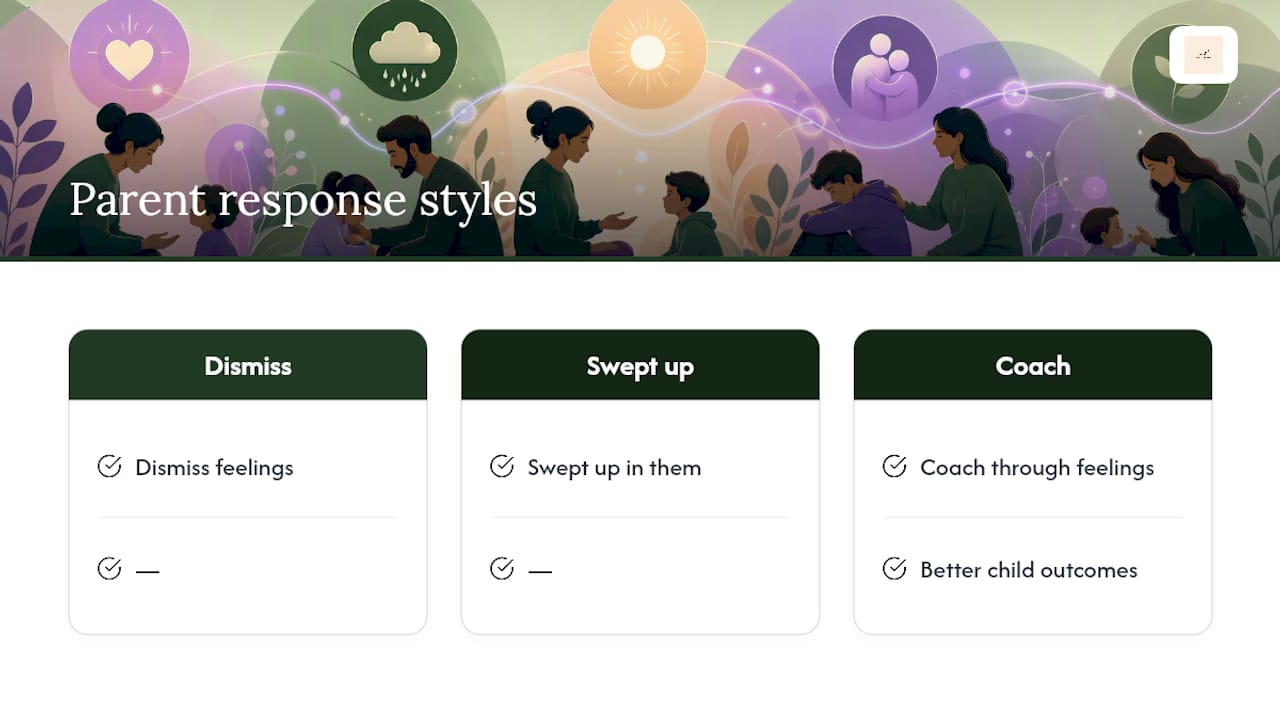
Emotion coaching comes from the research of psychologist Dr. John Gottman, who spent years studying how parents respond to children's emotional outbursts. He found that parents fall into rough categories: some dismiss feelings, some get swept up in them, and some coach through them. The coaching group raised kids with better outcomes across the board.
That fifth style breaks into five concrete steps you can learn in an afternoon. The payoff shows up in research linking parental emotion coaching to stronger peer relationships, better academic performance, and fewer behavior problems. Part of the reason it works so well comes down to basic biology: saying a feeling out loud, "you're frustrated," "you're scared," has a measurable calming effect on a child's nervous system. Naming turns an overwhelming wave into something a child can actually handle.
The Five Emotion Coaching Steps, With Scripts You Can Use Today
Gottman's framework breaks into five moves, and each one has a short phrase attached that you can say almost word for word.
- Notice the emotion before it escalates. Watch for a clenched jaw, a stomping foot, or sudden silence.
- Treat it as a teachable moment, not an interruption to your day. Your inner script: "This is worth stopping for."
- Listen with empathy. Get on their level and say, "That sounds really hard."
- Help them label the feeling. Try: "It looks like you're feeling jealous" or "Sounds like you're disappointed."
- Problem-solve and set limits together. "You're mad you have to leave the park. It's still time to go. What's one thing we could do on the walk to the car?"
Coach at low to moderate intensity. Trying to reason with a child mid tantrum rarely lands, but catching frustration early works well. Gottman's own materials note that short, repeatable phrases work better than long explanations because they reduce how much a stressed parent has to think on the spot.
Pro Tip: Practice your labeling phrases out loud during calm moments, like during a car ride or while making dinner. Rehearsed language comes out faster when you actually need it.
When to Coach, When to Pause, and What to Avoid
Timing decides whether emotion coaching helps or backfires. During a full meltdown, a child's brain is not ready to learn vocabulary or negotiate solutions. Comfort first, teach later. Once things settle, you can revisit the moment: "Earlier you were really upset about sharing the toy. What could we try next time?"
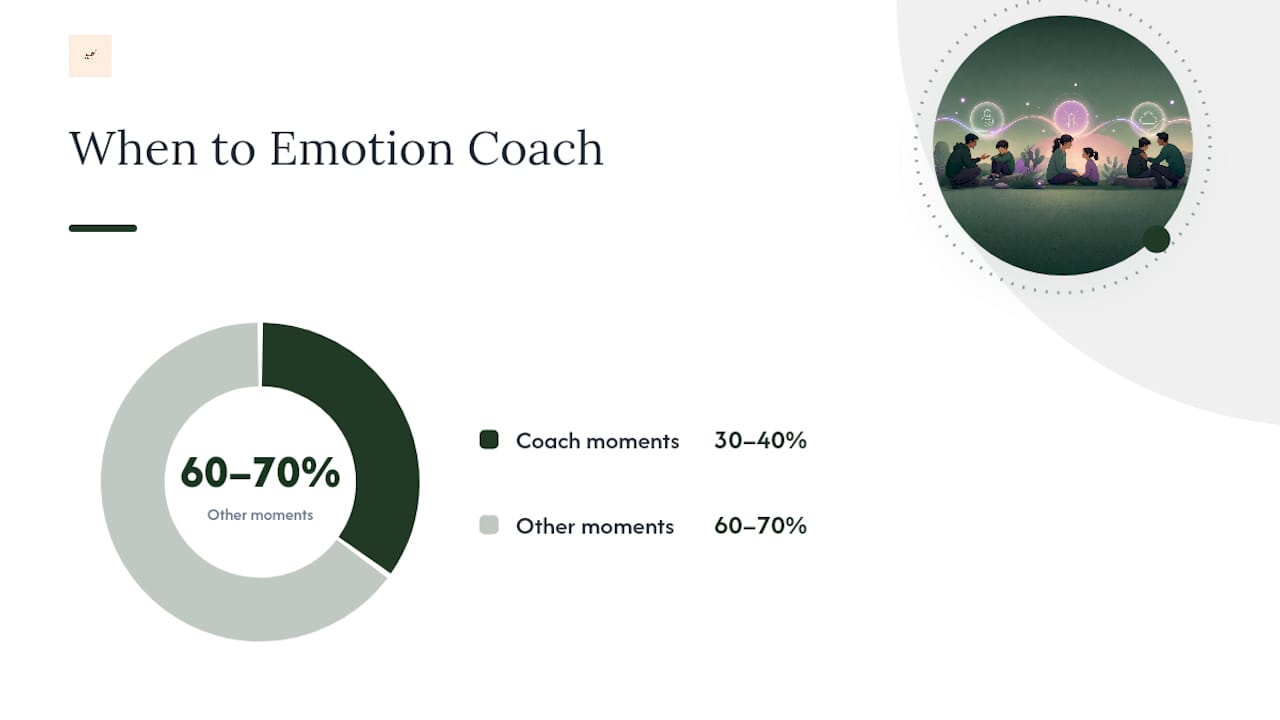
You don't need to coach every single moment. Parenting researchers at the University of Wisconsin Extension suggest aiming for roughly 30 to 40 percent of opportunities. That leaves room for ordinary redirection the rest of the time, which is realistic for busy households.
Do:
- Stay calm and validate the feeling before addressing the behavior.
- Use short, specific labels instead of vague reassurance.
Don't:
- Argue with how your child feels ("you're not really scared").
- Shut the conversation down with "stop crying" or "you're fine."
Preparing Yourself Before You Coach
A child's nervous system takes cues from yours. If you're raising your voice while asking them to calm down, the mismatch confuses the lesson. Co-regulation, staying steady so your child can borrow your calm, only works if you get there first.
A few resets that take seconds:
- Take four slow box breaths (four counts in, four counts hold, four counts out).
- Count to three silently before responding to a provocation.
- Step away for 30 seconds with a simple script: "I need a second, then I'll come help you."
If you're too frayed to coach in the moment, that's fine. Plan to revisit the conversation once you've both settled, and briefly recap what happened before offering two simple options to solve it together, a habit child development specialists at VCU's Hope Lab recommend for keeping kids engaged in the follow-up talk.
Pro Tip: Keep your reset phrase the same every time. Kids learn to predict "I need a second" faster than they learn a new line each time.
Age-by-Age Scripts: Toddlers, Preschoolers, and School-Age Kids
Emotion coaching looks different depending on your child's age, mostly because vocabulary and reasoning skills grow so much between ages two and eight.
- Toddlers (roughly ages 1 to 3): Keep labels to one or two words. "Mad." "Tired." Offer two simple choices to calm down: "Do you want to sit on my lap or get your blanket?" Toddlers can't problem-solve yet, but they can start connecting a word to a feeling.
- Preschoolers (roughly ages 3 to 5): Expand the vocabulary. "You're feeling jealous that your sister got a turn first." Add a short, guided problem-solving step: "What could we do so you both get a turn?"
- School-age kids (roughly ages 6 to 8): Invite them to explain their own perspective before you label anything. "What happened? How did that feel?" Then move toward negotiated solutions they help design, since kids this age want more say in the outcome.
When Emotion Coaching Doesn't Seem to Work
If your child won't engage, don't force a conversation. A calm, quiet presence next to them, sometimes without words, often does more than pushing for a label they're not ready to give. Try again in small steps, or revisit the moment once they've had time to settle.
Repeated behavior problems need a different lens: separate the feeling from the action, as explained in practical strategies for supporting children through grief. You can validate the emotion behind hitting, "you were really angry," while still holding a firm limit on hitting itself. One without the other tends to backfire. It also helps to look for the emotion hiding under the behavior, since jealousy, fear, and shame often show up disguised as defiance.
If outbursts are frequent, intense, or paired with signs like sleep changes or withdrawal, loop in your pediatrician or a child therapist. Emotion coaching is a parenting skill, not a substitute for professional support when a child needs more than daily practice can offer.
Quick Activities to Build Feelings Vocabulary Fast
You don't need a curriculum to practice this skill. A few minutes a day, tied to something you're already doing, builds the habit.
- Do a 30 second feelings check-in at dinner: "What was one thing that made you feel happy, mad, or worried today?"
- Read a story together and pause to ask, "How do you think she feels right now?"
- Try a short feelings wheel activity to expand vocabulary beyond "mad" and "sad."
- Set up a calm down corner your child can retreat to and revisit feelings with you later, using ideas from designing a feelings corner.
- Role play a tricky moment from earlier in the week, swapping who plays which part.
Why Icon Literary Builds Around This Approach
Stories give kids a low-pressure way to practice naming feelings before they need the skill in real life. That's the thinking behind picture books and card decks feature characters that model labeling language useful for teaching emotions. Reading together, then pausing to ask "how does that feel?", turns storytime into rehearsal.
— Derek Amarillas
Practice Emotion Coaching at Home With the Right Tools
Books and card decks won't replace the five steps, but they make practicing them a lot easier on nights when you're too tired to invent a script from scratch. Emotional-literacy picture books can include labeling language within stories, helping children pause to consider feelings naturally instead of perceiving it as a lesson.

The card decks work well for the problem-solving step. Picture a bedtime wind-down where your child is still annoyed about a sibling squabble. Pulling a card with a feelings prompt gives you both a low-stakes way to name it and talk through two options, without you having to come up with the conversation cold. Browse the full collection of books and activity kits at Icon Literary and pick a title that matches the feeling your child struggles with most right now.
Sources
- An Introduction to Emotion Coaching — The Gottman Institute
- Noticing and naming emotions — CDC Essentials for Parenting Toddlers
- Emotion Coaching — Parenting and Family Relationships (UW Extension)
- Peer-reviewed research summary (PubMed) on parental emotion socialization and child outcomes