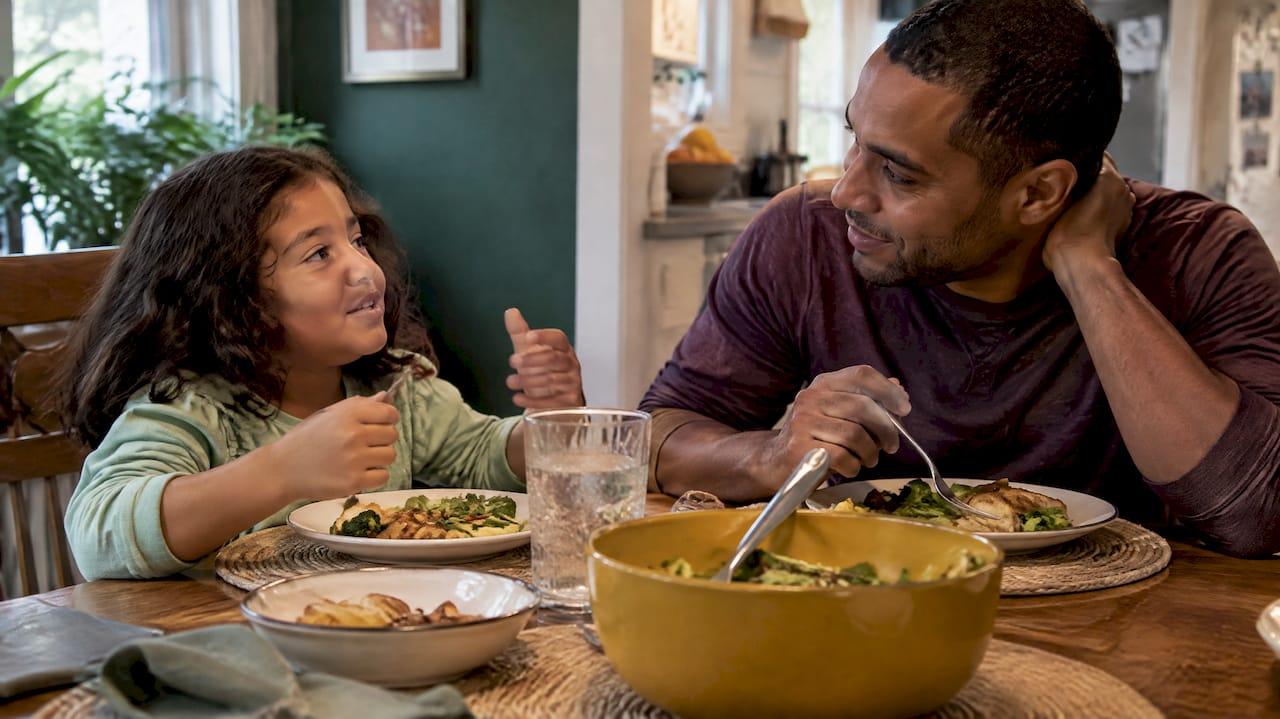
The best family dinner questions for young kids are short, concrete and open-ended, and you ask only one or two. Skip "How was school?" and try "What was the funniest thing that happened today?" or "If you could be any animal for a day, which one would you pick?" Below you will find questions sorted by what they do, ways to adapt them for shy or sensitive kids, and a few habits that keep dinner relaxed. If your child likes characters and stories, our Duckwave Decks give the conversation a playful starting point.
TL;DR
- Ask open-ended questions, not ones with a yes, no or one-word answer.
- Pick one or two questions per meal and listen more than you talk.
- Wait a few seconds after you ask. Young kids need time to think.
- For shy or sensitive kids, use silly, imaginative or "pretend" questions first. Feelings questions come easier after that.
- Keep discipline and arguments away from the table.
Table of Contents
- Why "How was your day?" gets "Fine"
- How to ask so kids actually answer
- Questions about the day, school and friends
- Questions about feelings and kindness
- Silly and imaginative questions
- Adapting questions for shy or sensitive kids
- What to leave off the table
- Make it a routine: the question jar
- Ages 3 to 8 at a glance
- Turn dinner answers into stories with Duckwave Decks
- Our perspective
- FAQ
- Sources
Why "How was your day?" gets "Fine"
Big, vague questions ask a 4-year-old to search a whole day, pick a memory and put it into words. That is hard work at the end of the day. A one-word answer is a reasonable reply.
The National Association for the Education of Young Children (NAEYC), the main professional group for early childhood educators in the US, advises open-ended questions that invite a child to think and share ideas. It suggests avoiding questions with one-word or right-or-wrong answers. It also notes that a child who answers in one or two words can still be asked how and why questions. You can then expand on the short answer to model more words.
So the fix is rarely a better list. It is a smaller, more specific question, asked in a calm way.
How to ask so kids actually answer
These habits matter more than any single question.
Ask one or two, not ten
A handout from the Community Education Association of Wisconsin recommends picking one or two prompts and listening more than talking, so dinner does not feel like an interrogation. Children's Health makes the same point: specific, engaging questions work better than rapid-fire ones, which can shut communication down.
Go first
Children's Health also suggests asking your child to share one good thing and one not-so-great thing from the day, with you modeling first. If you say "My best part was finding a parking spot, and my hardest part was a long meeting," your child sees what a good answer sounds like. It also tells them that hard moments are fine to mention.
Wait, then follow up
NAEYC's 2024 guidance recommends waiting at least a few seconds after a question and matching it to the child's vocabulary and pace. Count to five in your head. Then restate what your child said, such as "So the sandbox was the funniest part?", and let them add to it. If you wonder whether a child is taking longer than expected to answer or find words, this guide on recognizing speech delays covers what to look for. Your pediatrician is the right person to ask about any specific concern.
Let them answer their way
NAEYC encourages letting children answer in whatever way they prefer. That can be a word, a drawing, an action or a story. A child who acts out the "funniest thing" with a silly voice has answered the question.
Set the scene
The Academy of Nutrition and Dietetics recommends a relaxed mealtime with minimal distractions, including turning off the television and handheld devices. It also advises against pressuring or forcing children to eat. A child who feels watched over a plate of broccoli will not feel like chatting.
Questions about the day, school and friends
These work well for ages 5 to 8, and the simpler ones suit 3- and 4-year-olds. They are concrete, so a child can pick one real moment.
- What was the best part of your day? (the Human Performance Resources program of the U.S. Army, HPRC, suggests this one)
- What made you smile today?
- What was the hardest thing you did today?
- Who did you play with today?
- What was the funniest thing you saw or heard?
- What is something new you learned?
Children's Health suggests the second, third and fourth questions above. NAEYC offers a handy format for preschoolers: ask for the best, hardest, funniest and saddest thing about the day. Turn it into a game by having each person give one of each.
The Wisconsin handout adds early-elementary prompts about a favorite moment at school, a happy or exciting moment, and who your child played or talked with. A good follow-up is "What did you two play?" It gives the child something easy to describe.
A worked example. You ask a 6-year-old, "What was the hardest thing you did today?" She shrugs. You say, "Mine was getting up this morning. It was so dark!" She laughs and says, "Mine was when I couldn't tie my shoe." Now you have something real: "Did anyone help you, or did you keep trying?" You started with one question, shared your own answer, and followed her lead.
Questions about feelings and kindness
Feelings questions are the heart of emotional literacy, which simply means knowing and naming what you feel. Young children do better with simple feeling words and a concrete situation than with "How do you feel about things?" The Wisconsin handout recommends concrete, playful questions with simple feeling words for kindergarten through grade 2.
Try these:
- What makes you feel loved? (suggested by HPRC)
- What are you most thankful for? (also HPRC)
- How did someone show kindness to you today?
- Did you help someone today? How did that feel?
- What do you think makes a great friend?
- What is something you wonder about?
The last three are in the same spirit as the prompts in The Everymom's 2026 list, which covers helping someone, what makes a great friend and what a child wonders about.
If your child names a hard feeling, thank them and keep it simple: "Thanks for telling me. That sounds like it felt sad." You do not need to fix it at the table.
Silly and imaginative questions
Play is the easiest door into conversation. Hypothetical questions have no wrong answer, so no child feels tested.
- If you could be an animal for one day, which animal would you be? (a classic that appears in several family lists, including one from Utah State University Extension, which adds "and why?")
- If you could start a new family tradition, what would it be? (also from the Utah State cards)
- What are your three favorite foods? (an age 2 to 7 prompt from HPRC)
- What sport or activity would you like to try? (also HPRC)
- How would you describe the way this food smells, tastes or sounds when you chew it? (a sensory prompt from NAEYC)
The food-description question suits picky eaters well. It turns attention from "Will you eat it?" to "What is it like?", which keeps pressure off.
For more imaginative prompts, our storytelling prompts for kids, sorted by age, work at the table too. Try "What would the animal you picked do at school?" and let the story grow.
Adapting questions for shy or sensitive kids
A shy child often has plenty to say. They need a lower-stakes way in. Here are approaches that fit what the NAEYC and Wisconsin guidance recommends.
- Start with pretend. "If you could be an animal for one day..." asks nothing personal. Once a child is talking, a personal question feels less exposed.
- Offer choices. "Was today more of a silly day or a calm day?" is easier than an open prompt. It is a bridge, and you can follow with an open question once they warm up.
- Let a character speak. "What would a duck do if it felt nervous on the first day of school?" gives your child distance from the feeling while they work through it.
- Accept short answers. Respond with warmth and add one detail yourself. Do not push for more.
- Use other ways to answer. A drawing, a thumbs-up or a pointing game counts. NAEYC encourages letting children answer however they prefer.
- Wait longer. Some kids need more than a few seconds. Look at them kindly, keep your body relaxed and give them room.
- Skip the spotlight. Ask the whole table the same question and let your child answer when ready, not first.
Some children do better away from the table. Car rides, bath time and bedtime are all good for quiet questions. Dinner is just one option.
Sensitive kids also tend to notice tone. If a question sounds like a test, they may freeze. Ask the way you would ask a friend, with real curiosity.
Our guide to narrative therapy activities for kids goes deeper on using stories to help children talk about big feelings. It is a good next step for parents, counselors and therapists.
What to leave off the table
KERA's Growing Healthy Families guidance suggests avoiding negative conversations that lead to arguments and handling discipline away from the table. It also recommends making sure everyone gets a turn to talk without criticism, and keeping mealtime a chance to share and laugh.
In practice:
- Save report-card talks, missed chores and "we need to discuss your behavior" for another time.
- Do not correct answers. If your child says the funniest thing was "a purple dog," just ask what the dog did.
- Do not comment on how much anyone eats.
- Keep screens away, for you as well as for your child.
If something upsetting did happen at school, say "Let's talk about that after dinner, just us." That keeps the meal safe and shows your child the issue will be heard.
Make it a routine: the question jar

Routines take the work out of coming up with questions. A question jar is the simplest one. Write questions on strips of paper, drop them in a jar and take turns drawing one at dinner. Letting your child help write and decorate the strips gives them ownership. Pick a few from each section above, plus some of your own.
Ideas for the jar:
- One silly question, one kindness question and one about the day in every handful.
- A "pass" card that lets anyone skip without explaining.
- A blank strip where your child makes up the question.
A weekly version works too. Pick one night as story night and let the questions grow out of a book or a character. Our guide to planning a family story night shows how, at home or at school.
Teachers, librarians and early educators can use the same approach at snack time or circle time, with one question per group and a quiet "pass" always allowed. For books that make good conversation starters, see our list of ways books spark family conversations. If you are buying for someone else, gift books that spark conversation is a good place to start.
Ages 3 to 8 at a glance
| Age | What works | Sample question |
|---|---|---|
| 3 to 4 | Very concrete, one idea, choices | What makes you laugh? |
| 5 to 6 | Best/hardest/funniest format, simple feeling words | What was the hardest thing you did today? |
| 7 to 8 | Why questions, wonder questions, small hypotheticals | What is something you wonder about? |
These are rough guides, not rules. NAEYC's point is to match the question to your child's own vocabulary and pace, so a chatty 4-year-old may enjoy the questions in the last row and a quiet 8-year-old may prefer the first.
Turn dinner answers into stories with Duckwave Decks
Once a child is chatting, characters can carry the conversation further. Our Duckwave Decks are themed card decks, priced at $7 one-off, that give your family original characters to draw from, talk about and play with. You can pull a card, ask what that character might feel or do, and let your child take the lead. Explore Duckwave Decks to see the line.

Icon Literary also creates picture books and graphic narratives, including Socko's Universe, with emotional literacy built into the story world. If you want more screen-free ideas to go with your dinner routine, see our screen-free SEL activities.
Our perspective
We make stories, characters and card decks for children ages 3 to 8. We have built our work around one belief: kids learn about feelings best when nobody is teaching them a lesson.
A dinner question that sounds like a quiz tends to get a quiz answer. A question about a character who is nervous, grumpy or proud of a messy drawing lets a child say true things from a safe distance. That is why our stories and decks lean on original characters and playful humor rather than instructions.
Our approach to emotional literacy is subtle and indirect by design. We want children to feel seen in their individuality and to enjoy the process of talking, not to feel they are being worked on.
For parents, this means the best dinner question is often a small, silly one that you ask with real interest. Add a story or a card, give your child time, and the harder feelings tend to come up when they are ready.
Derek Amarillas
FAQ
What are good dinner questions for a 4-year-old?
Keep them concrete and cheerful. Try "What makes you laugh?", "What is your favorite food?" or "If you could be an animal for a day, which would you be?" All three are short and have no wrong answer. Expect brief replies and add a detail of your own to keep going.
What if my child won't answer?
Wait a few seconds, then try a choice question or a pretend one. NAEYC recommends giving children time to process and letting them answer in their own way, including by drawing or acting. If dinner is hard, try the same question in the car or at bedtime.
How many questions should I ask at one meal?
One or two is enough. The Wisconsin handout advises choosing one or two prompts and listening more than you talk. Rapid-fire questions can feel like an interrogation, according to Children's Health, and a shorter conversation that feels good will lead to more talking next time.
What should we not talk about at dinner?
Avoid arguments, criticism and discipline. KERA's family mealtime guidance recommends handling those away from the table and keeping the meal positive, with a turn for everyone. If something needs to be discussed, tell your child you will talk about it after dinner.
How can I use a book or card deck at dinner?
Pick a character or a scene and ask what that character felt or might do next. Children often say more about a character than about themselves, and over time the answers get more personal. Take turns so everyone, including the adults, answers.
Sources
- NAEYC: Ideas to Spark Rich Conversations with Your Children
- NAEYC: Message in a Backpack, Asking Questions to Stretch Your Child's Thinking
- HPRC: Mealtime conversation starters
- Community Education Association of Wisconsin: Questions to Ask at Dinner Tonight
- Children's Health: How To Get Kids to Talk About Their Day
- Academy of Nutrition and Dietetics: End Mealtime Battles
- KERA: Creating Family Mealtimes
- Utah State University Extension: Family Mealtime Conversation Cards
- The Everymom: Family Dinner Questions