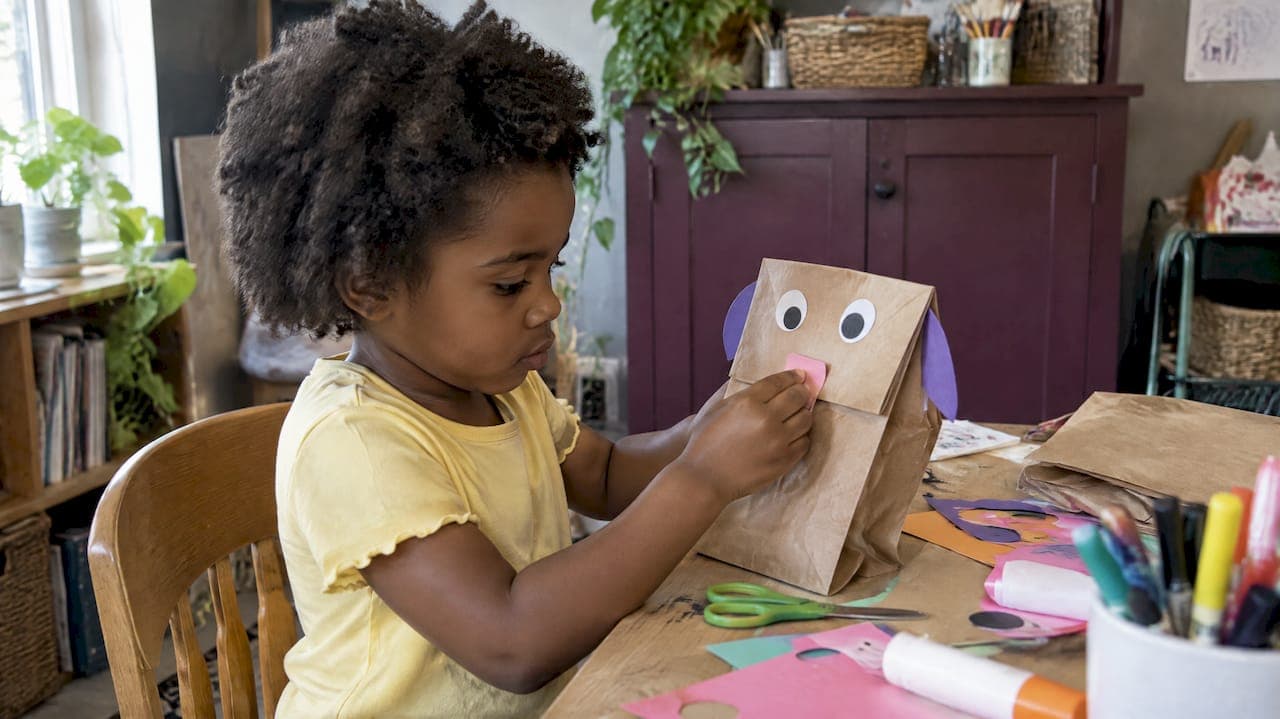
The best storytelling art projects ask a child to make something and then tell what happens in it. Puppets, comic strips, collages, story stones and story quilts all do this. They need only paper, markers and household scraps, and they work at home, in a classroom or in a library corner. Below you will find projects sorted by age, the steps and materials for each, and ways to adjust them for a short attention span or a first-time storyteller.
TL;DR
- Ages 3 to 5 do best with puppets, simple crafts and a one-action story, such as a character who does one thing and gets one reaction.
- Ages 6 to 8 can plan a beginning, a problem and a solution, so comic strips, story stones, collage and story quilts fit well.
- Let the child make the art first, then tell the story out loud. Write down their words exactly.
- Keep the sequence short for younger children. Add panels or scenes as they gain confidence.
- Pair any project with a picture book to link art, reading and talking.
Table of Contents
- Why art and story work well together
- Storytelling art projects for ages 3 to 5
- Storytelling art projects for ages 6 to 8
- Which project fits which child
- Adapting projects for different ages and attention spans
- Turning a corner of the room into a theater
- Connecting art projects to picture books
- Making stories that include more people
- Bring a story world into your art time
- FAQ
- Sources
Why art and story work well together
Young children often think in pictures before they think in sentences. Making a character with their hands gives them something to talk about. Hands-on projects such as puppet-making, comic strips and dioramas help children organize ideas, plan story sequences and explore character development, and they build fine motor skills along the way.
There is an emotional side too. Writing in NAEYC's Young Children, Flynn, Hoy, Avello-Vega and Williams describe storytelling, art and play as connected processes that let children share worries, work through stress and regain a sense of control. That is why a drawing of a scary storm, or a puppet who is nervous about school, can matter more than it looks.
You do not need to be an artist to lead any of this. You need a calm place, a few supplies and patience for a story that wanders.
Storytelling art projects for ages 3 to 5
Children this age tell stories in short bursts. They may name a character, say one thing it does and move on. That is a complete story for them. Build projects around making one character and letting it speak.
Paper bag, egg carton and shape characters
One university early-childhood guide lists paper bag puppets, egg carton critters and shape monsters among its crafts for ages 3 to 5. Each one gives a child a character to hold.
Materials: paper lunch bags, an empty egg carton, construction paper, safety scissors, glue stick, markers.
Steps:
- Let the child choose a character: an animal, a monster, a silly cook.
- Help them glue on eyes, a mouth and any extras.
- Ask three questions: What is its name? What does it like? What happened to it today?
- Write down the answers and read them back.
Cardboard tube puppets
Toilet-paper and paper-towel rolls make sturdy puppets. The Pennsylvania College of Art & Design instructions cut a hinge in the tube and attach string, which gives the puppet a moving part. An adult should handle the cutting. Young children can decorate the tube with paper, paint or markers.
Popsicle stick puppets
These need sticks, pipe cleaners and cut-out or drawn images. An arts-education writing guide suggests children name their puppets, think about their personality traits and imagine their stories. That naming step is where the story begins. A child who decides the puppet is "scared of thunder" has already written a problem.
If you want a puppet project built around feelings, our emotion puppets craft takes about 20 minutes.
One Two Books
Princeton's "Pop Goes the Page" describes One Two Books as a simple sequential form. The child makes a two-page card that shows an action on one side and the reaction on the other. A ball is thrown, then a splash. A door opens, then a surprise. It is an easy first step toward a story with a before and an after.
Storytelling art projects for ages 6 to 8
At this age, children can hold a plot in their heads. They can plan a beginning, a problem and an ending, and they enjoy detail. Give them more structure and more materials.
Comic strips with a Story Mountain
The National Air and Space Museum's Draw Your Own Comic Strip activity uses a "Story Mountain" to plan. The beginning introduces the character and setting. The middle brings a problem or challenge. The end shows how it was solved.
Materials: paper, plus crayons, markers or colored pencils.
Steps:
- Fold the paper and mark three panels.
- Talk through the Story Mountain: who, where, what goes wrong, how it gets fixed.
- Sketch the plan in pencil, one panel at a time.
- Draw the final comic and add speech bubbles if the child wants them.
For classrooms, a blank comic template saves the folding and ruling time. If your group needs help with the structure itself, see how to teach story structure by grade.
Story stones and sock puppets
The same early-childhood guide suggests sock puppets and story stones for independent makers ages 6 to 8. Paint or draw a character, object or place on each stone. Then the child draws three or four from a bag and tells a story using them. The random mix prompts surprising plots.

Story quilts
The Kimball Art Center's lesson on artist Faith Ringgold has children make story quilts. They collage paper, use patterns and draw stories from memories, then add imagination. Give each child a sheet divided into squares. Each square holds one moment. Together the squares make a story.
Collage adventures
Inspired by artists like Christian Robinson, a collage adventure story layers materials such as tissue paper and foam to show a personal experience or an imaginary trip. Tear shapes instead of cutting them. Children who say "I can't draw" often relax with torn paper.
Wax resist scenes
The Getty's lesson What's the Story? uses a wax resist technique. Children draw characters in action with wax-based crayons, then paint the setting over them with watercolor. The characters stay visible. The same lesson suggests illustrating a story as one continuous scene in a landscape or building, or as a sequence in four frames.
Silhouette vase stories
The Getty's A Story on a Vase lesson has students imitate black-figure vase painting. They use positive and negative space to set their main characters against a background. Older children in this range enjoy the bold look, and it keeps detail simple.
Cave art stories
The Smithsonian National Museum of Natural History suggests building a cave from household furniture and making cave art inside. The art can tell stories or record memories to share with family. It works well on a rainy afternoon with blankets, chairs and a flashlight.
Which project fits which child
| Project | Best age | Main supplies | Time | Story skill it builds |
|---|---|---|---|---|
| Paper bag or tube puppet | 3 to 5 | Bags or rolls, markers, glue | 20 to 30 min | Character and voice |
| One Two Book | 3 to 8 | Card, markers | 10 to 15 min | Action and reaction |
| Popsicle stick puppets | 4 to 7 | Sticks, pipe cleaners, paper | 20 to 30 min | Personality and problem |
| Comic strip | 6 to 8 | Paper, markers | 30 to 45 min | Beginning, middle, end |
| Story stones | 6 to 8 | Stones, paint or markers | 30 min plus play | Invention and retelling |
| Story quilt | 6 to 8 | Paper, glue, patterns | 45 to 60 min | Memory and sequence |
| Collage adventure | 5 to 8 | Tissue paper, foam, glue | 30 to 45 min | Setting and mood |
The times are our rough estimates from running activities like these. Yours will vary with the group.
Adapting projects for different ages and attention spans
Princeton's guidance is simple: the younger the artist, the simpler the sequence should be, with one action and one reaction. Here is how to apply that.
- Short attention span: split the project into two sittings. Make the character on day one. Tell its story on day two.
- Not ready to draw detail: use shapes. A Occidental College lesson on shadow puppets suggests clear, distinct outlines such as a head, torso and legs rather than intricate detail.
- Reluctant talkers: let the puppet speak. Many shy children will say through a puppet what they will not say themselves.
- Fast finishers: add a panel, a second character or a new problem.
- Fine motor challenges: swap scissors for tearing, and markers for chunky crayons or dabbers.
When a child has no idea what to say, offer a prompt rather than a plot. Our storytelling prompts for kids are sorted by age. For ordering events, try story sequencing activities.
Turning a corner of the room into a theater
A finished puppet needs a stage. In pre-K, Edutopia describes how dramatic-play areas can become theaters where children build houses from different materials and act out familiar stories. This supports social-emotional skills and story sequencing. The same piece notes that masks and puppets help children get familiar with story structure in a joyful, pressure-free way.
A simple setup:
- Drape a sheet over a table for a puppet stage.
- Add a few painted backdrops on cardboard.
- Keep a basket of puppets and story stones nearby.
- Invite two children at a time to perform for the group.
This kind of play is rooted in early development. If you want background on pretend play in toddlers, it shows where these skills begin. For more routines, see our classroom storytelling centers guide.
NAEYC authors Umezawa and Arakaki also point out that child-created texts enacted through puppetry let children explore the world and show adults something of their own surroundings. Watch the performance closely. It tells you what matters to the child.
Connecting art projects to picture books
Art projects are a natural follow-up to a read-aloud. Choose a book, read it once for fun, then ask the child to make something about it: the main character, the setting, a different ending.
The Getty suggests teachers connect art and literacy by having children look at works of art that tell stories, create continuous or sequential narrative drawings, and write the stories they show. North Shore Country Day School describes a similar blend in its lower school, where students added written narrative essays to abstract collages. The school notes that mixing writing and art helps students see how words inspire pictures.
For children who cannot write yet, an adult can act as scribe. Write what they say under each picture. Reading it back shows them that their spoken story is a real text.
If you work with children on feelings, try the ideas in CASEL-aligned storytelling for emotional learning or therapeutic storytelling for ages 3 to 8. For acting out situations, the 5-minute role play routines are short and printable. And to invent a hero together, see kids' character design.

Making stories that include more people
Children's stories grow richer when they include more kinds of people, families and places. A few projects make this natural.
- Story cloths. In one program, students drew personal story cloths about their ancestries, inspired by Hmong story cloths, which are embroidered pictures of daily life and legends. Invite each child to draw a cloth about their family, a tradition or a place that matters to them.
- Mirrors and windows. Dr. Tracey Flores and Dr. Sandra Osorio explain that diverse books work as mirrors and windows: they reflect a child's own identity and culture, and they offer a look into lives different from theirs. After reading, ask: Who is in this story? Who could we add?
- Open conversations. Researchers writing in the Urban Education Journal argue that art and storytelling that represent diverse perspectives can help educators build acceptance and begin hard but needed conversations. With young children, keep these gentle and curious.
Let children decide how their characters look. Do not correct their choices of skin color, hair or family shape. Ask what the character likes to do.
Our perspective
We build stories for children ages 3 to 8, and we keep seeing the same thing: feelings come out sideways. A child who will not say "I was embarrassed" will happily tell you that a small duck felt hot in the face at the pond.
That is why our work leans on original characters and story worlds rather than lectures. We design our stories, decks and activities to teach emotional literacy without being didactic, and we aim to make them visually rich enough that a child wants to return to them.
An art project does the same job from the other side. When a child makes the character, the child owns the story. Our advice: make the art, tell the tale, then ask one gentle question about how the character felt. Stop there.
Derek Amarillas
Bring a story world into your art time
Some children get started faster when they have characters to play with. Our Duckwave Decks are $7, a one-off price, and are designed to give children original characters to look at, sort, retell and draw from. Use them as story starters: draw three cards, then make a puppet or comic for the character you drew. You can see the Duckwave Decks here.

If you want to browse more, our full catalog lists the Socko's Universe line.
FAQ
What is the easiest storytelling art project for a 3-year-old?
A paper bag or cardboard tube puppet is a good start. The child decorates it, and you ask what its name is and what it did today. Write down the answers. Keep the story to one action, since very young children tell short tales.
How do I help a child who says they cannot draw?
Switch to materials that do not require drawing skill. Tear tissue paper for a collage, use ready-made shapes, or paint story stones with simple symbols. You can also let a puppet do the talking. The goal is a story, not a picture-perfect result.
How long should a storytelling art project take?
For ages 3 to 5, plan 10 to 30 minutes, and split longer projects across two days. Ages 6 to 8 can often work 30 to 45 minutes. Stop while the child is still interested, then pick it up again later.
How can teachers use these projects with a whole class?
Set them up as a center or a short block after a read-aloud. Give each child the same structure, such as three comic panels with a Story Mountain, but let characters and settings vary. End with a sharing circle where children show their work and tell the story.
Should I correct the story if it does not make sense?
No. Ask questions instead: What happens next? How does the puppet feel? Children build logic through telling, and gentle questions help more than corrections.
Sources
- Art Projects for Elementary Kids That Encourage Storytelling
- Using Story Circles, Art, and Play to Support Children's Healing (NAEYC)
- Arts and Crafts for Age 0-8
- Cardboard Puppets (Pennsylvania College of Art & Design)
- Creative Writing Through Art
- Pop Goes the Page (Princeton)
- Draw Your Own Comic Strip (National Air and Space Museum)
- Faith Ringgold story quilts (Kimball Art Center)
- Read + Create: Collage Adventure Story
- What's the Story? (Getty Education)
- A Story on a Vase (Getty Education)
- Make Your Own Cave and Cave Art (Smithsonian National Museum of Natural History)
- Exquisite Corpse Shadow Puppets Lesson Plan (Occidental College)
- Using Talk for Writing in Pre-K With Classic Stories (Edutopia)
- The Power of Child-Created Texts and Puppetry (NAEYC)
- Seeing the World Differently (North Shore Country Day School)
- Sharing Stories, Shaping Multicultural Literacy (Fund for Teachers)
- Why Diverse Books Matter: Mirrors and Windows (Colorín Colorado)
- Beyond Words: Reimagining Education through Art and Activism (Urban Education Journal)