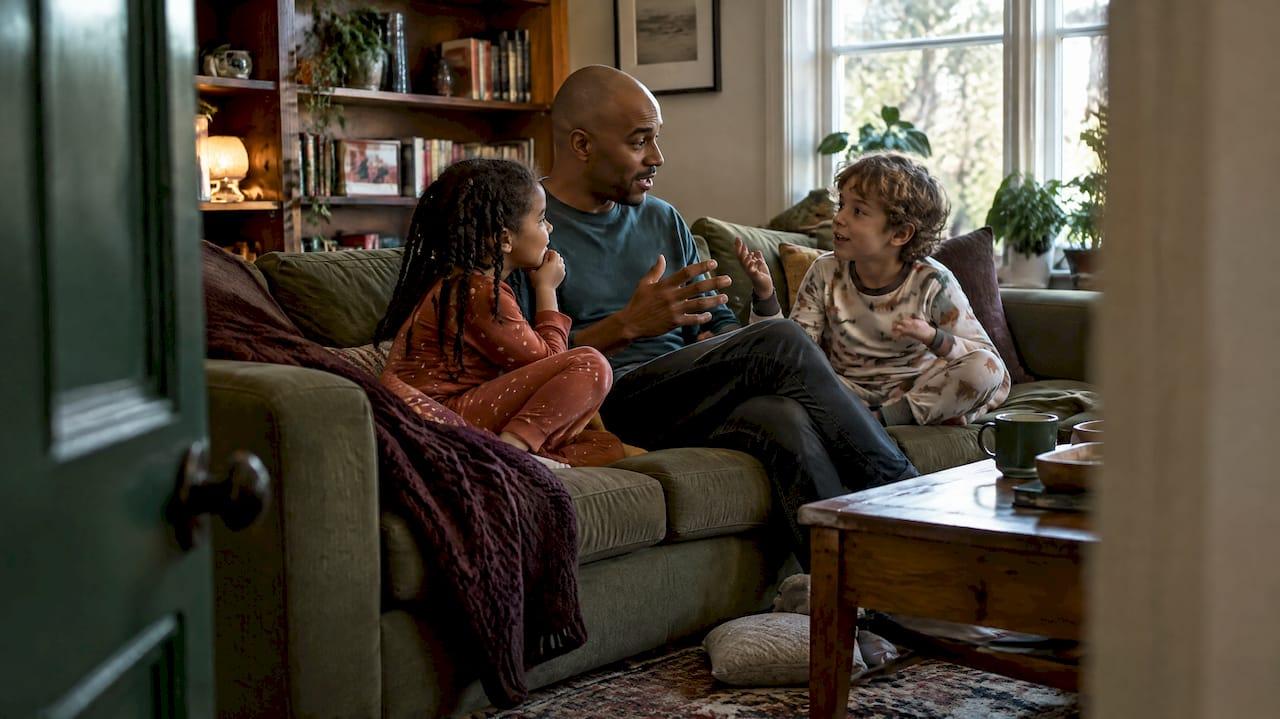
A family story night is an evening set aside for sharing stories together. You can host it in your living room, a classroom, or a library. For children ages 3 to 8, the best ones are short and cozy. They have a simple order of events and room for every child to take part in their own way. This guide shows you how to plan one, which games to play, how to include shy or sensitive kids, and how to keep the habit going after the night is over.
TL;DR
- Pick one theme, keep the evening to about an hour, and write a simple running order so everyone knows what comes next.
- Mix a shared read-aloud with hands-on moments: story games, props, drawing, or a sock puppet.
- Let shy or sensitive children join at their own pace, with a quiet corner and a visual schedule.
- Send something home, such as a book, a printable, or a card deck, so the night becomes a routine.
- At home, a regular time and a few favorite books are enough.
Table of Contents
- What a family story night is
- Why shared stories help young children
- Choose a theme and a simple format
- Story games that get everyone talking
- Make room for shy and sensitive children
- Our perspective
- Find a story event near you
- Turn one night into a home routine
- Bring the story home with Duckwave Decks
- FAQ
- Sources
What a family story night is
The idea is flexible. Some schools run it as a parent and community event built around early literacy. One program describes a Family Storytelling Night as an interactive event that celebrates early literacy and family and cultural heritage through shared true stories. Libraries often call similar events family storytime. Many families simply do it on their own: pajamas, a stack of books, and one person telling a story that gets passed around the room.
What these versions share is that the adults take part too. Children are not an audience here. They listen, add to the story, act it out, and sometimes lead.
Why shared stories help young children
Storytelling does real work for children this age. PBS KIDS for Parents notes that telling stories lets children improve listening and communication skills, imagination, and memory. The same page says storytelling teaches, entertains, shares perspectives, and connects people.
Raising Children Network adds that you do not need a book for this. Storytelling can model language and prompt talk about pictures, and children pick up words and literacy skills from shared songs, stories, and conversations.
There is an emotional side as well. When a family sits down to the same story, children get a safe way to talk about feelings like nervousness, jealousy, or excitement without being asked directly. If you want to go deeper on that, our guide to ways books spark family conversations has nine methods you can try at the table, and our piece on shared reading and its emotional benefits explains why the sharing matters as much as the reading.
Choose a theme and a simple format
A theme keeps planning easy. It gives you a reason to pick certain books, props, and snacks. Good themes for ages 3 to 8 include animals, bedtime, brave moments, a favorite character, or "stories from our family."
One school-focused framework suggests choosing a date, time, and theme, recruiting volunteers, planning 5 to 8 rotating stations, adding a shared moment such as a story walk or group read-aloud, and sending books home. That is built for a big school event. At home, you can shrink it to two or three "stations" around the house.

A running order that works
A library early literacy toolkit recommends planning with a running sheet and displaying it for parents and carers. Its sample routine moves through a welcome song, storytime, music time, a second storytime, activity time, and a goodbye song, as described in the Let's Read! early literacy toolkit. You can borrow that rhythm for a family night:
- Welcome (5 minutes). A short song or a simple greeting. Show the order of the evening.
- Read-aloud (10 minutes). One picture book, read slowly, with pauses for questions.
- Movement or music (5 minutes). Stretch, sing, or act out one scene from the story.
- Story game (10 to 15 minutes). Choose one of the games below.
- Making time (15 minutes). Draw a favorite scene, build a character from paper, or sort picture cards into story order.
- Goodbye (5 minutes). A closing song or one sentence from each person about their favorite part.
That adds up to about an hour, which suits the attention span of most 3 to 8 year olds. If your group includes mostly 3 and 4 year olds, trim the game and the making time.
Materials you probably own
You do not need a budget. Scarves, a sock, paper, crayons, a laundry basket, and a flashlight cover most of what you need. For a classroom, our classroom storytelling center routines show how to set up a repeatable corner with minimal supplies, and our story sequencing activities give you ready ideas for the making time.
Story games that get everyone talking
Interactive games turn a read-aloud into something the whole room owns. These all work with mixed ages, because older children can add detail and younger ones can add a single word.
Turn-taking stories
PBS KIDS for Parents recommends family turn-taking, where one person says a sentence and the others add on. It needs no prep. Start with a spark such as "One morning, a duck found a tiny door in the garden," and go around the circle.
A variation is the Story Pass game. One site describes it as starting a story, having the child continue it, and going back and forth, and notes it can be played anywhere. That makes it a good car ride or waiting-room version of your story night.
Folded Story and Story Stick
Brightly describes two games that work well at a table. In Folded Story, each person adds to a story on paper, folding it so only the last line shows. In Story Stick, the holder of the stick tells the story and others add to it on their turn. The folded version ends with a funny, surprising story that you can read aloud together. Younger children can draw their turn instead of writing it.
Props, puppets, and movement
The Kennedy Center's home resource describes using movement, a simple song, waving scarves, and a sock puppet to narrate dramatic moments during story time in its Start with the Arts at Home guide. You can do the same with a book you already own. Let the scarves be wind during the storm scene. Let the sock puppet say what a character is afraid to say.
Art that tells a story
Drawing is a gentle way for children who do not want to speak in front of a group to still tell a story. Ask each child to draw the moment they remember best, then place the drawings in order on the floor. Our guide to storytelling art projects for kids ages 3 to 8 has more ideas, and our narrative therapy activities show how children can retell and reshape their own stories in a calm, playful way.

Make room for shy and sensitive children
A good story night is one where a quiet child feels as welcome as the loudest one. Library accessibility resources give practical steps you can copy.
An information sheet on sensitive story time suggests you reduce noise, define the seating area, provide a separate break space, use a visual schedule, and keep sessions short and simple. It also says props such as bubbles, scarves, or puppets can help hold attention, and that a less busy time or a separate room can lower the noise.
Here is how that looks in practice:
- Show the plan. American Libraries Magazine recommends a visual schedule board so participants know what is happening next, which reduces anxiety and provides comfort. Pictures and words on a poster are enough.
- Do not insist everyone sits. The same article says inclusion can mean not requiring everyone to sit during reading or stand during dancing, and letting people take in the event in different ways.
- Offer a quiet corner. A blanket, a cushion, and a book basket give an overwhelmed child a place to reset and still hear the story.
- Offer many ways to join. The ALA's children's library journal notes that inclusive programs provide multiple ways for children to engage, so children of any physical ability or developmental level can participate and feel successful. A child can point, nod, hold the puppet, or turn the page instead of speaking.
- Let shy kids pass. In a turn-taking game, "pass" is a full turn. Come back to that child at the end and offer a choice between a word, a drawing, or a gesture.
For a deeper look at why indirect, gentle storytelling suits tender feelings, see our piece on therapeutic storytelling for ages 3 to 8. If a child's anxiety or sensory needs seem to go beyond shyness, a school counselor, pediatrician, or child therapist is the right person to talk to about support.
Our perspective
We build Icon Literary stories around one belief: children learn about feelings best when the lesson is not announced. A story night works the same way. The goal is not a talk about emotions. The goal is a shared, playful moment in which a child sees a character feel something big, and decides on their own what it means.
That is why we design our stories, decks, and activities to blend premium design with a little playful chaos. Odd, funny characters give children permission to laugh first and reflect second. We aim for emotional literacy without didactic lessons, which suits sensitive and shy children who do not want to be put on the spot.
For a family story night, we suggest you choose one character your children love and build the evening around that character. Read a story, ask "what would the character do next?", and let the answers get silly. Recurring characters and worlds give children something to return to, and returning is what turns a one-time event into a ritual.
Derek Amarillas
Find a story event near you
If you would rather join an event than host one, local libraries, gardens, and community centers often run family storytimes. A site like local family storytime events lets you search for gatherings near you, and attending one first is a good way to see how a group format feels before you plan your own. If you are a teacher or librarian, our write-up on community storytime and its SEL benefits can help you explain the value to families and administrators.
Turn one night into a home routine
The event is the spark. The routine is what lasts. NAEYC's family guide to falling in love with reading suggests setting a regular time for cozy storytime, letting children choose books, rereading favorites, encouraging children to tell or retell stories, and acting stories out with voices, gestures, or props. PBS KIDS for Parents also frames hosting storytime at home as a social, family activity.
A realistic weekly version:
- Pick a night. Friday or Sunday works for many families. Protect it.
- Let the child choose. Two books, one chosen by the child and one by an adult.
- Keep one game. Rotate between turn-taking, Story Pass, and drawing the best scene.
- Retell on the third reading. After a book has been read a few times, ask your child to tell it back to you in their own words. Do not correct them. Enjoy the changes.
- Save the stories. Write down one line from each night and keep them in a jar. By the end of a season you have a family story collection.
If you are looking for fresh story material that supports this kind of conversation, our article on mythic picture books for SEL storytime is a good place to start, and our guide to CASEL-aligned storytelling for emotional learning is written for preschool teachers who want a framework.
Bring the story home with Duckwave Decks
A story night is easier to repeat when you have something on hand that starts the conversation. Our Duckwave Decks are themed card decks set in the Duckwave Universe, a world of original characters and playful design. They are priced at $7 as a one-off purchase. Pull a card, make up a story about it, and pass it to the next person. You can also browse our wider catalog of picture books and activity kits for ages 3 to 8.

Explore the Duckwave Decks or visit the Icon Literary home page to see what is available for your next story night.
FAQ
How long should a family story night last?
About an hour is a good target for children ages 3 to 8. Sensitive story time guidance suggests keeping sessions short and simple. If the children are restless, end the game early and finish with a song or a favorite page.
What do we need to host one at home?
A few books, paper, crayons, and a couple of props such as scarves or a sock puppet are plenty. Add a blanket for a cozy reading spot and a printed schedule so everyone knows the plan. A story card deck can stand in for a prompt if you run out of ideas.
How do I include a child who will not talk in front of others?
Give them other ways to take part. They can draw their turn, hold a puppet, turn pages, or pass. Libraries that run inclusive programs suggest letting people take in the event in different ways rather than requiring everyone to do the same thing at the same time. A quiet corner helps too.
Can a teacher or librarian run a story night for a whole class or school?
Yes. Choose a theme, recruit a few volunteers, set up several short stations, include one shared group read-aloud, and send books or materials home with each family. Post a running sheet so parents know what happens and when. Keep stations simple, with one clear activity at each.
How often should we do it?
Weekly is ideal for a home routine, since a regular time of day makes story time feel like a cozy habit, as NAEYC advises. A school or library event can run once a season. Either way, send something home so the stories continue between events.
Sources
- Parent Engagement and Early Literacy Workshop for Families
- Reading and Sharing Stories, PBS KIDS for Parents
- Reading and storytelling with babies and children, Raising Children Network
- Family Reading Night Ideas: 40 Fun Activities for Schools
- Let's Read! Early literacy toolkit
- The "Story Pass" Game
- 6 Creative Storytelling Games for Kids, Brightly
- Start with the Arts at Home, Kennedy Center
- Sensitive Story Time information sheet, Amaze
- Making Room for Inclusion, American Libraries Magazine
- No Finish Line: Creating Inclusiveness in Children's Programs, ALA
- Fall in Love with Reading, NAEYC
- Host Storytime at Home, PBS KIDS for Parents