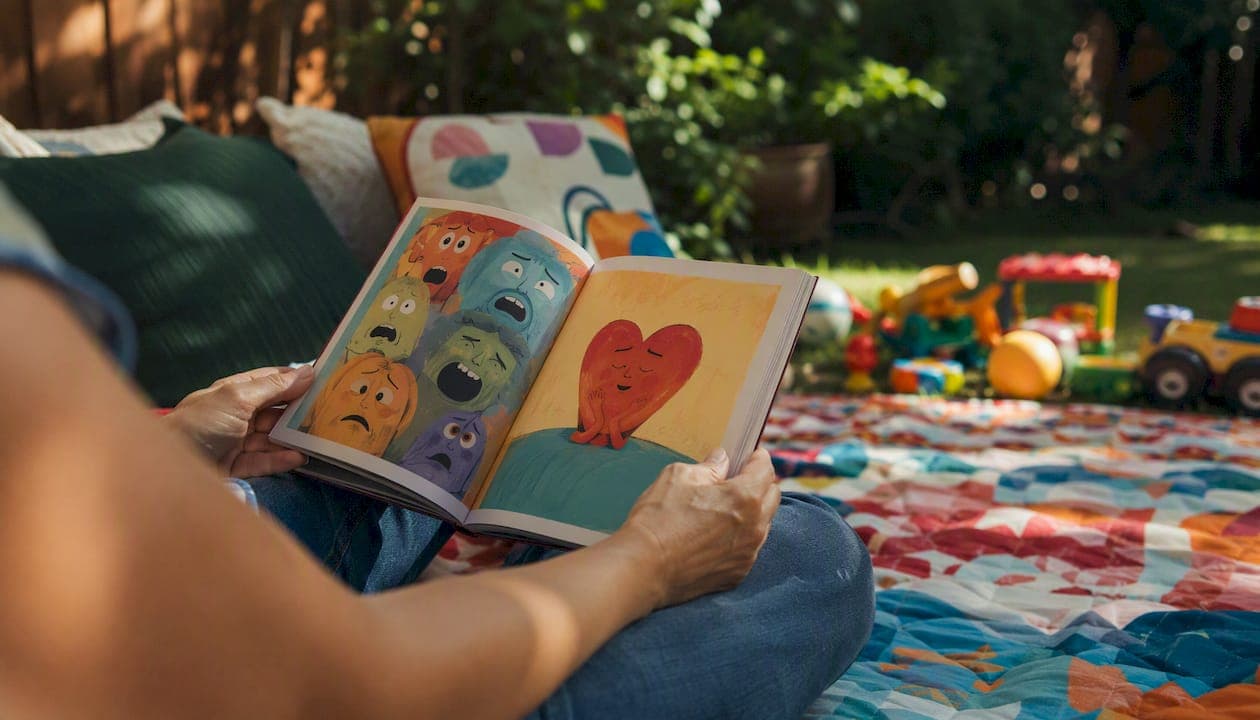
Shared reading strengthens secure attachment, builds emotional regulation and empathy in children, and supports adult wellbeing in ways that extend well beyond literacy. That claim isn't just practitioner intuition. An observational study published in Pediatrics found that lower caregiver-reported shared reading frequency is associated with a higher risk of social-emotional problems in young children presenting for primary care. A 2025 narrative review synthesizing multiple study types concluded that shared book reading supports emotional engagement, perspective-taking, and social connection across educational settings. Community-level programs add another layer: facilitated reading-for-pleasure initiatives have shown improvements in wellbeing, reduced loneliness, and stronger empathy among adult participants.
The emotional benefits of reading together aren't a side effect of literacy instruction. They're the mechanism. Here's what the evidence says, how it works, and what you can do with it today.
The core benefits at a glance:
- Secure attachment and caregiver-child relational warmth
- Emotion regulation and co-regulation skills
- Empathy and theory of mind development
- Attention and early executive function gains
- Reduced social isolation and improved wellbeing for adults
Pro Tip: Start with five minutes tonight. Pick a book your child already knows, sit close, and instead of rushing through the text, pause once to ask: "How do you think this character feels right now?" That single question activates more emotional processing than reading the whole book straight through.
Key Takeaways
Shared reading's emotional benefits are real, cumulative, and accessible to any caregiver or educator willing to read interactively for five minutes a day.
| Point | Details |
|---|---|
| Attachment and regulation | Shared reading builds secure caregiver-child patterns and teaches emotion regulation through co-regulation and vocabulary. |
| Empathy via narrative | Stories let children safely simulate social worlds, building perspective-taking and theory of mind over repeated sessions. |
| Discussion amplifies benefits | Reading plus reflective conversation produces stronger emotional outcomes than reading alone, per PLOS ONE analysis. |
| Re-reading is a strategy | Familiar texts free attention for feeling and nuance; re-reading the same book across days deepens emotional engagement. |
| Icon Literary's design | Icon Literary picture books and activity kits are built around named emotions, inclusive characters, and re-readable arcs that support every stage of a shared reading session. |
Table of Contents
- What is shared reading, and how does it work across ages?
- What emotional and social benefits does shared reading give children?
- How does shared reading benefit caregivers, educators, and communities?
- Why does shared reading produce these emotional benefits?
- What does the research actually show, and where are the limits?
- How to do shared reading well: age-adapted tips and prompts
- Why emotional-literacy design changes what shared reading can do
- Icon Literary's picture books and kits for shared reading
- Sources
What is shared reading, and how does it work across ages?
Shared reading is an interactive, scaffolded reading routine in which an adult reads aloud with one or more children, actively inviting participation, discussion, and emotional response rather than simply delivering text. The adult models fluency and comprehension, but the emotional work happens in the back-and-forth: pointing, questioning, naming feelings, and building shared meaning. It differs from independent reading precisely because the relationship is the container.
Most practitioners and researchers describe the practice in four recognizable stages:
- Introduction and preview. The adult introduces the book, activates prior knowledge, and sets emotional context. ("This story is about a bear who feels left out. Have you ever felt that way?")
- Reading aloud and modeling. The adult reads with expression, pausing to think aloud, label emotions, and track character reactions.
- Joint participation. The child joins in: predicting, pointing, repeating refrains, or answering questions about characters' feelings and motivations.
- Wrap-up and reflection. The pair or group revisits the story's emotional arc, connects it to real experience, and consolidates meaning.
Age adaptations matter. For infants (0–18 months), stages three and four are compressed into brief pointing games and rhythmic repetition; the emotional benefit comes mostly from physical closeness, vocal tone, and sustained joint attention. Toddlers (18–36 months) can handle simple emotion-labeling prompts during stage two and short "what happened?" reflections at the end. Preschoolers (3–5 years) can engage all four stages fully, including perspective-taking questions and brief discussions about why a character made a choice.
For materials, picture books with repetitive text, big-format books for group settings, and books that explicitly name feelings work best across all ages. The ERIC research on shared book reading in preschool classrooms specifically highlights feelings-focused picture books as tools for intentional SEL instruction, not just story time.
What emotional and social benefits does shared reading give children?
Attachment and relational security
Shared reading creates a reliable, low-stakes context for caregiver-child closeness. The physical proximity, synchronized attention, and responsive back-and-forth during a reading session mirror the same patterns that build secure attachment in other caregiving interactions. Over time, children come to associate books with felt safety, which makes the emotional content of stories easier to engage with rather than avoid.
The Pediatrics observational data is worth taking seriously here. Children whose caregivers reported reading together less frequently showed a measurably higher risk of social-emotional problems at primary care visits. That's a population-level association, not proof that reading causes security, but it's consistent with what attachment theory would predict.
Emotion regulation and co-regulation
When a caregiver reads with a child, the adult's voice, pacing, and calm presence function as an external regulator. A child who is dysregulated can settle into the rhythm of a familiar story the same way they settle into a familiar song. Over repeated sessions, that external scaffolding gets internalized. Research on shared reading beginning in infancy links the practice to improvements in emotional regulation, sustained attention, and early executive function.

Naming emotions during reading is a specific mechanism here. When a caregiver says, "Look, the rabbit is scared. His ears are flat," the child gains a word for a physical state they already know. That labeling process, repeated across hundreds of sessions, builds the emotion vocabulary that underlies self-regulation.
Empathy and theory of mind
Stories let children practice perspective-taking in a psychologically safe environment. A child who watches a character navigate jealousy or grief can rehearse understanding that experience without the stakes of real conflict. Research syntheses describe narrative simulation as a mechanism by which readers practice inhabiting other minds, which supports both empathy and theory of mind development.
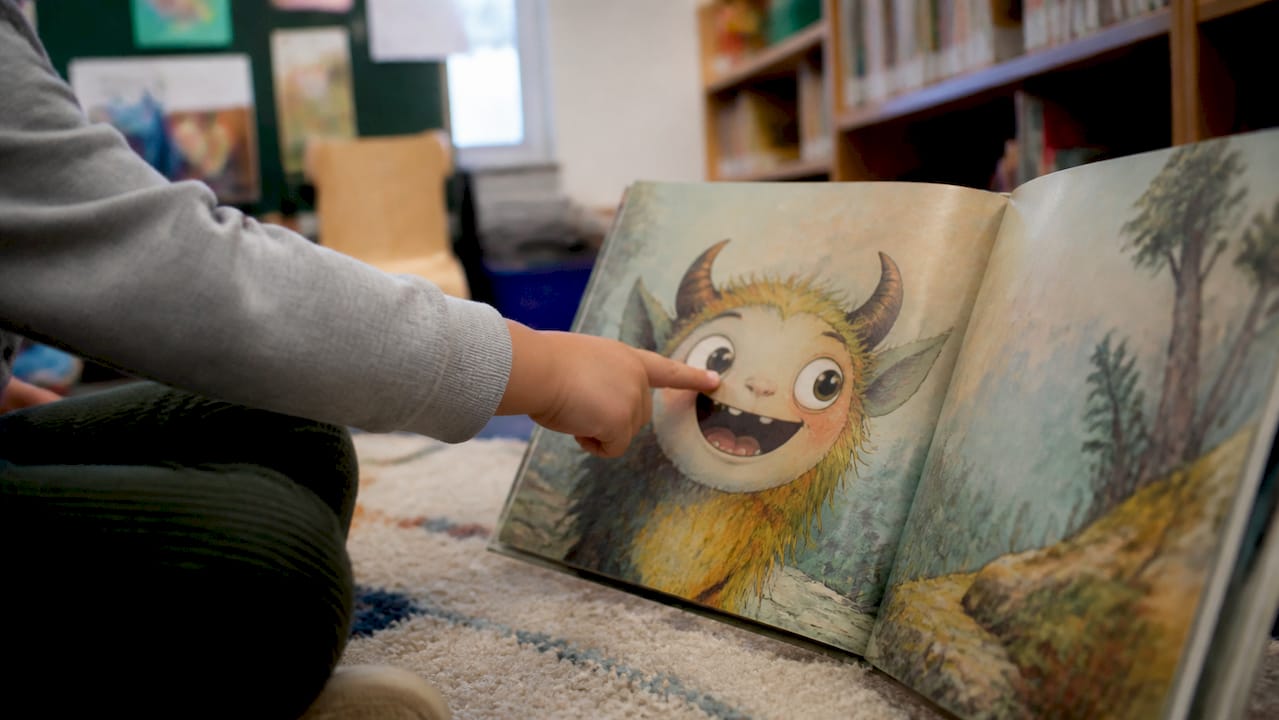
A recent narrative review found that shared book reading appears to support emotional engagement and perspective-taking across educational settings, with the interactive element amplifying gains beyond what silent reading alone produces. For children ages 3–8, books designed to teach empathy give this mechanism a concrete vehicle.
Attention and executive function
Joint attention during shared reading, where both adult and child focus on the same object and track each other's gaze and pointing, is one of the earliest building blocks of executive function. Sustained, interactive reading sessions train children to hold information across a narrative arc, inhibit impulsive responses, and shift attention between text, pictures, and conversation. These are the same cognitive skills measured by executive function assessments in early childhood.
The ERIC preschool study documents emotion vocabulary improvements following shared reading interventions, and the broader evidence base links those vocabulary gains to better emotional understanding and self-regulation. Where the evidence is strongest: attachment, emotion vocabulary, and co-regulation. Where causality is still tentative: long-term executive function gains and empathy as a stable trait, both of which require longer follow-up studies than most current research provides.
How does shared reading benefit caregivers, educators, and communities?
The emotional benefits of reading together don't flow in only one direction.
For caregivers, regular shared reading sessions tend to increase parental self-efficacy, the sense that you know how to support your child's development. That confidence matters independently of what the child gains. Caregivers who read with their children daily report feeling more connected and less stressed during those interactions, even when the rest of the day has been hard. Programs like Reach Out and Read, which trains pediatric providers to prescribe books and model shared reading at well-child visits, are built partly on this insight: when parents see a pediatrician demonstrate interactive reading, they feel equipped to do it themselves.
For educators, shared reading in classroom settings creates a shared emotional reference point for the whole group. A class that has read the same book about feeling left out has a common vocabulary for discussing those feelings when they arise on the playground. The narrative review evidence supports this: shared reading in educational settings strengthens adult-child rapport and creates structured opportunities for SEL scaffolding that are difficult to replicate through direct instruction alone. Libraries have recognized this too, which is why emotional literacy books are increasingly prioritized in collection development and programming.
For community groups and adults, the evidence is smaller but consistent. A 12-week shared reading intervention reported measurable increases in participants' sense of purpose and collective identity, though the sample was small (n=16) and results should be interpreted cautiously. The Reading for Wellbeing pilot found improvements in positivity, self-understanding, and social connection among group participants. The Reader organization's program evaluations across health and social care settings document improved mood, reduced social isolation, and quality-of-life gains for people with dementia and chronic conditions.
One consistent finding across adult programs: facilitation matters. Reading-for-pleasure programs led by trained facilitators produce stronger wellbeing outcomes than unstructured reading groups, because the facilitator creates psychological safety and guides the discussion that turns narrative engagement into social meaning-making.
Why does shared reading produce these emotional benefits?
Four mechanisms do most of the work.
Narrative simulation. When a child or adult follows a character through an emotional experience, the brain processes that experience in ways that overlap with real social cognition. Cognitive-literature research describes this as narrative simulation: stories provide a safe psychological distance that lets readers process complex emotions and rehearse responses without real-world consequences. For a four-year-old watching a character lose a friend, that simulation is practice for a situation they haven't faced yet.
Co-regulation. The adult's voice, rhythm, and calm presence during reading function as an external regulatory scaffold. A caregiver who slows down at a tense moment in the story, lowers their voice, and says "It's okay, let's see what happens" is modeling emotional regulation in real time. Children absorb that pacing. Over hundreds of sessions, the external scaffold becomes internal.
Language scaffolding and emotion vocabulary. Shared reading exposes children to emotion words in context, not as a vocabulary drill but as live description of characters they care about. "She's embarrassed" lands differently when a child is watching a beloved character turn red on the page. The ERIC preschool research documents this specifically: emotion vocabulary grows through shared reading routines, and that vocabulary is the raw material of emotional understanding.
Discussion and reflective conversation. Reading alone produces some benefit. Reading plus discussion produces more. A PLOS ONE analysis found that reflective discussion after reading is the step most likely to convert narrative engagement into wellbeing and social connection. The discussion externalizes the internal response, makes it social, and consolidates it. For children, that means a caregiver asking "Why do you think she cried?" For adults in a reading group, it means the conversation that starts when someone says "That part hit me differently."
Re-reading as restorative practice. Familiarity with a text frees attention from plot-tracking and redirects it toward feeling, language, and nuance. Research on re-reading shows it increases comfort, reduces social pain, and deepens group resonance more effectively than always consuming new material. Children who ask for the same book ten nights in a row are not being repetitive for its own sake. They're using the story as a ritual.
What does the research actually show, and where are the limits?
The evidence base for shared reading's emotional benefits is real, growing, and genuinely heterogeneous. Here's an honest map of it.
Strongest evidence:
- The Pediatrics observational study (Martin et al.) links lower shared reading frequency to higher risk of social-emotional problems in young children at primary care. Large sample, population-level, but observational: it cannot rule out that families with more social-emotional challenges read together less for reasons unrelated to reading itself.
- The 2025 Schapira and Grazzani narrative review synthesizes multiple study types and finds consistent support for emotional engagement, perspective-taking, and social connection as outcomes of shared book reading in educational settings.
- Preschool intervention studies (including the ERIC paper) show measurable emotion vocabulary gains following structured shared reading programs.
Moderate evidence:
- Community program evaluations (The Reader, Reading for Wellbeing) show wellbeing improvements and reduced isolation, but most rely on self-report, small samples, and short follow-up periods.
- A 12-week shared reading intervention reported increases in purpose and collective identity, though the small sample size limits generalizability.
Where causality is still tentative:
- Long-term executive function gains from shared reading alone, separate from broader language and literacy development, have not been isolated in large randomized trials.
- Whether empathy gains from shared reading persist as stable traits, rather than state-level responses during reading, remains an open question.
Practical interpretation: The evidence is strong enough to recommend shared reading as a daily practice for children ages 0–8 with confidence. Parents and educators should not expect a single book or a single session to produce measurable change. The benefits accumulate through consistent, interactive practice over months and years. Correlation in observational studies and effect sizes in small interventions both point in the same direction, and the practice carries no known downside.
How to do shared reading well: age-adapted tips and prompts
A high-impact session in five steps
- Choose the right book. For ages 3–8, prioritize books with clear emotional arcs, named feelings, and characters whose inner states are visible in illustrations. Repetitive text helps younger children join in. What makes an SEL book effective comes down to vocabulary, emotional specificity, and re-readability.
- Set up for closeness. Sit side by side or with the child in your lap. Physical proximity isn't incidental; it's part of the co-regulation mechanism.
- Read with expression, pause with purpose. Slow down at emotionally charged moments. Let the silence sit for a second before you name what's happening. "Look at his face. What do you think he's feeling?"
- Ask open questions, not quizzes. "Why do you think she did that?" beats "What color is her hat?" The goal is perspective-taking, not comprehension testing.
- Wrap up with a connection. One sentence linking the story to real life: "Has anything like that ever happened to you?" That bridge is where the emotional processing consolidates.
Prompts by age
Infants (0–18 months): Point to faces in illustrations and name the expression. "Happy! She's happy." Track the child's gaze and follow their pointing. The session can be two minutes.
Toddlers (18–36 months): "Show me the sad one." "What sound does he make when he's scared?" Keep questions concrete and tied to what's visible on the page.
Preschoolers (3–5 years): "If you were the rabbit, what would you do?" "Why do you think the bear didn't say anything?" These questions activate theory of mind directly. For practical scripts tailored to this age group, the read-aloud feelings books guide offers structured prompts.
Dosage and duration
Daily sessions of 5–15 minutes outperform longer, less frequent ones. Repetition across days matters more than session length. Re-reading the same book three or four times over a week produces deeper emotional engagement than reading three different books once each, because familiarity frees the child to focus on feeling rather than plot.
Pro Tip: When a child is upset or dysregulated, reaching for a familiar book rather than a new one tends to work better. The known story provides predictability, and the re-reading itself functions as a calming ritual rather than a new cognitive demand.
Pro Tip: After reading, resist the urge to debrief immediately. Give the child 30 seconds of quiet. Some of the most meaningful responses come after a pause, not during the structured question time.
For children who struggle with social anxiety, books that address those specific fears can make the shared reading session feel directly relevant rather than abstract.
Why emotional-literacy design changes what shared reading can do
The research on shared reading's emotional benefits assumes the book itself is doing some of the work. A story with a flat emotional arc, undifferentiated characters, or no named feelings gives the adult very little to work with. The prompts fall flat because there's nothing in the text to prompt from.
At Icon Literary, the design of every picture book and activity kit starts from this constraint. Emotional vocabulary has to be in the text, not just implied. Characters need inner lives that are visible and specific enough for a four-year-old to recognize. The story arc has to be re-readable, because the tenth read is when the deepest conversations happen. Inclusive characters matter too: a child who sees themselves in a story engages the perspective-taking mechanism more readily than one who is always reading about someone else's world. That's not a values statement; it's a design requirement grounded in how the emotional benefits of reading actually work.
The evidence in this article points toward a specific kind of book. Icon Literary's catalog is built around exactly that specification.
Icon Literary's picture books and kits for shared reading
The practices in this guide work best when the book in your hands was designed for them. Icon Literary's children's picture books, read-together activity kits, and downloadable prompt cards are built around the same mechanisms this article covers: named emotions, inclusive characters, re-readable story arcs, and built-in conversation starters that make the wrap-up stage natural rather than forced.

The activity kits pair physical books with printable prompts and feeling-word cards, so the emotion vocabulary work happens during and after the session, not just in the moment. For parents who want a ready-made shared reading experience to give as a gift, the read-together gift bundles combine a picture book with guided prompts and a feelings card deck. If you're looking for supplemental digital resources, emotional intelligence ebooks offer downloadable options that extend the conversation beyond a single title.
Browse the full collection at Icon Literary and find the book or kit that fits your child's age, your classroom's needs, or your next read-together moment.
Sources
- Shared Reading and Risk of Social‑Emotional Problems (Pediatrics / AAP)
- Shared book reading and promoting social and emotional competences in educational settings: a narrative review
- ARC-NENC: How can reading for pleasure improve mental health and wellbeing?
- BMJ Mental Health article (shared reading study)
- The Effects of Shared Book Reading on the Emotional Development of Preschool Children (ERIC)
- What is Shared Reading? — The Reader
- Can reading help heal us and process our emotions? — The Conversation
- PLOS ONE: On how discussion amplifies reading's social and emotional effects
- PubMed: Re-reading restorative effects (study)
This article is general information, not a substitute for advice from a qualified doctor. Consult a qualified healthcare professional about your own circumstances before acting on anything here.