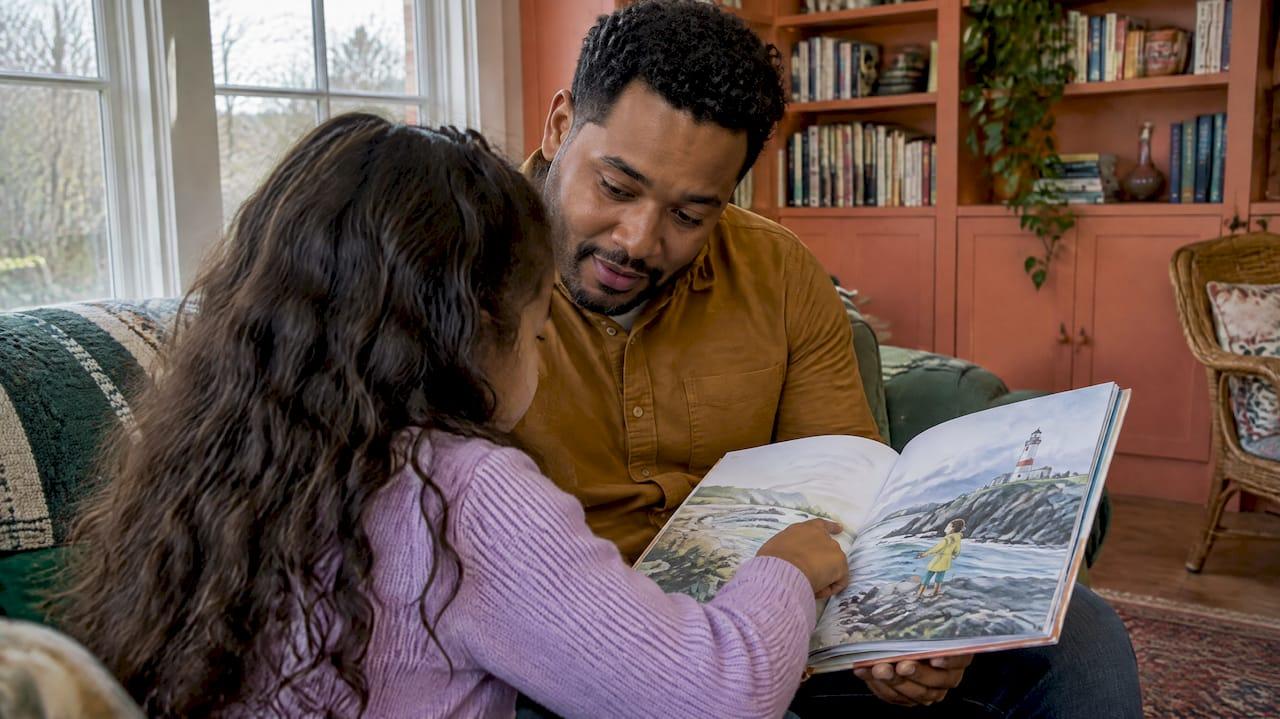
To read a wordless book, look at the pictures together and tell the story out loud. Start with the cover. Take a slow walk through the pages. Ask open questions. Then let the child tell what happens. There is no wrong version, so you can't get it wrong.
This guide shows you how, step by step. It covers the questions to ask, how to adjust for shy or sensitive children, and how to use wordless books in a classroom, library or therapy room.
TL;DR
- A wordless picture book tells its story through art alone, so the reader's job is to notice, guess and narrate.
- Begin with the cover and title, take a picture walk, then model the story with voices and sound effects before you hand the telling to the child.
- Ask open-ended questions that can't be answered yes or no, such as "What do you think will happen next?"
- For shy or sensitive kids, ask what a character might be thinking and leave room for their own answer.
- Sharing these books builds listening, vocabulary, comprehension and a sense of how stories are built.
Table of Contents
- What a wordless book is and why it feels different
- Before you start: set the scene
- How to read a wordless book, step by step
- Questions that get children talking
- What if the child is shy or sensitive?
- What children gain from wordless books
- Adapting for different ages and settings
- Common mistakes and easy fixes
- Perspective: why we care about stories without a script
- Keep the conversation going
- Try our Duckwave Decks
- FAQ
- Sources
What a wordless book is and why it feels different
A wordless picture book tells its story only through illustration. According to the Eric Carle Museum, facial expressions, body language, context, image size, lighting and color all show what the characters are like and how they feel. They also set the mood.
That changes your role as the adult. In a regular picture book, the text sets the story and you read it. In a wordless book, you read the pictures. The same museum notes that because the images are open to interpretation, readers decode them and build the story together, and each child reads in a unique way.
So two children can look at the same page and tell two different stories. Both can be right.

Why adults feel stuck at first
Many parents and teachers worry they will "do it wrong." They flip the pages quickly and say nothing. Or they narrate every detail and leave no room for the child.
Neither is a mistake you need to fear. Both are easy to fix with a simple routine, and the steps below give you one.
Before you start: set the scene
A few small choices make the first read easier.
- Pick a calm time. Ten minutes at bedtime or after lunch works well. You can't rush a picture walk.
- Sit side by side. The child needs to see the same details you see. Sitting next to each other beats sitting across a table.
- Choose a book with a clear arc. For a first wordless book, pick one where a character does something, meets a problem and reaches some kind of ending.
- Let go of the "right" story. Decide ahead of time that you will follow the child's ideas, not a script in your head.
If you are choosing titles for a classroom or a home shelf, our guide to wordless picture books that build empathy lists nine and pairs each with questions.
How to read a wordless book, step by step
The steps below follow the approach described by Reading Rockets and the PTA family resource on reading these books.
Step 1: Explore the cover and title
Hold the book where the child can see the front. Read the title if there is one. Ask what they notice. Who is on the cover? Where might they be? What might this book be about?
Invite predictions. Write none of them down and correct none of them. You are warming up the child's imagination.
Step 2: Take a picture walk
Flip through the pages slowly, one at a time. Look closely at the details and context clues. Point to small things: a character's eyebrows, a shadow, a change in color, an object that appears again later.
You don't need to tell the story yet. Just look. A picture walk gives the child a map before the real telling begins.
Step 3: Model the storytelling
Now go back to page one and tell the story. Use character voices and sound effects. Describe what the characters do and how they seem to feel. Keep your sentences short and your pace slow.
This step shows the child what "reading" a picture looks like. Reading Rockets describes it as modeling before inviting the child to take over.
Step 4: Invite the child to tell it
On a second read, or halfway through the first, hand over the story. Say something like, "Now you tell me what happens." Then be a good audience.
Listen to the child's version. Expand on their ideas with a comment or a question. This tells the child their interpretation matters. If they skip a page or change the plot, let them.
Step 5: Talk about it afterward
When the book ends, ask which page was their favorite and why. Ask how the character felt at the beginning and at the end. Short, relaxed talk after the book often brings out the most.
Questions that get children talking
The best questions are open ended. The PTA resource advises asking questions that are not yes-or-no and that don't lead the child to a set answer. Examples it gives include "What do you think the character is thinking?" and "What do you think will happen next?"
Here is a set you can keep on a sticky note.
| Goal | Question to try |
|---|---|
| Notice details | What do you see on this page? What else? |
| Describe the action | What is happening here? |
| Predict | What do you think will happen next? |
| Infer feelings | How do you think the character feels? What shows you? |
| Infer thoughts | What do you think the character is thinking? |
| Explain reasons | Why do you think the character did that? |
| Retell | Can you tell me the story from the start? |
Wh-questions like what, where and why work well. Research on dialogic reading with wordless books, published by researchers in Germany, found that open-ended prompts and wh-questions can target both literal and inferential parts of a story and support narrative comprehension. The same study found that starting with low-demand questions and following with high-demand ones had a stronger effect on children's vocabulary than low-demand questions alone.
In plain terms: start easy, then go a little deeper.
- Easy: "What do you see?"
- Deeper: "Why do you think she looks worried?"
Using clues in the art
Encourage the child to use the artwork as proof. When they say a character is sad, follow up with, "What in the picture makes you think that?" They might point to a drooping posture, dark colors or a small figure in a big space.

This is the same skill a reader uses to infer meaning from text. It also helps with describing images in words, a skill that matters for readers who can't see the art. If you are curious how that works, this piece on accessible image descriptions shows how visual details become words.
What if the child is shy or sensitive?
Some children freeze when asked "What happens next?" They worry about giving the wrong answer. A wordless book can feel safer than a regular one, because the story belongs to no one yet. You can help that along.
- Talk about the character, not the child. Ask what the character might be thinking. The PTA resource suggests inviting the child to consider a character's thoughts and leaving room for their interpretation. That puts a little distance between the child and the feeling.
- Point to clues together. Notice the character's face or posture and say, "Look at his shoulders." Let the child finish the thought.
- Accept short answers. A single word is a contribution. Repeat it back and add a small piece: "Yes, nervous. He is holding on tight."
- Offer a choice. "Do you think she is excited or nervous?" is a gentle way in, as long as you also welcome other answers.
- Take turns. You say one sentence, the child says one. This is easy to keep light. If you like the idea of taking turns and building on a child's ideas, the same habit starts early, as this piece on reading aloud to babies explains.
- Skip pressure. If the child doesn't want to talk today, narrate for them and try again tomorrow.
For more ways to open feelings talk at home, see our guide to reading feelings books together.
What children gain from wordless books
Sharing wordless books can build listening skills, vocabulary, comprehension and an understanding of how stories are structured, according to Reading Rockets. That happens because of the conversation around the book.
A 2024 study protocol from Italy on dialogic book-sharing makes a related point. It notes that extended talk with literal and inferential questions can strengthen the effects of shared reading, and that children learn more words during such conversations. It also describes the interaction between adult and child, not the book's own text, as what stimulates discussion of emotions, thoughts and relationships.
That is good news for wordless books. There is no text to compete with your conversation. The talk is the main event.
Adapting for different ages and settings
At home with ages 3 to 5
Keep it short and playful. Use sound effects, point a lot, and let the child lead the page turns. Choose one or two questions per page at most. If attention fades, stop and come back later.
At home with ages 6 to 8
Older children can retell the whole story, add dialogue for each character, or invent a different ending. You can ask them to explain their reasoning: "What made you think that?" They might also like to draw the next page.
In the classroom
Teachers can use wordless picture books to support learners' emotional and social growth. A 2022 journal study from Slovakia describes using them in primary English lessons along with emotion charts, a mood meter, character charts and the ruler approach.
A simple whole-class routine:
- Show the cover and gather predictions.
- Do a picture walk on the projector or with a big copy.
- Pair students to tell the story to each other.
- Bring the class back to compare versions.
- Ask how the main character felt and what showed it.
We lay out full lessons in our session plans for wordless picture books for teachers and therapists. If you are weaving feelings books into lessons more broadly, our guide to getting SEL books working in lessons can help.
In a library or therapy setting
Librarians can run a wordless story hour where children narrate in turn. Counselors and therapists can use the same pictures to talk about feelings through a character, which lets a child speak without having to talk about themselves. For library programs, see our practical SEL playbook for public libraries.
Common mistakes and easy fixes
| What happens | Try this instead |
|---|---|
| You narrate every page without pausing | Stop after each page and ask one open question |
| You correct the child's story | Add a question: "What makes you think that?" |
| You ask yes-or-no questions | Switch to "what," "where" or "why" |
| The child says "I don't know" | Point to a detail and wonder aloud together |
| You race through the book | Spend two minutes on a single page with a lot going on |
| You expect the same story every time | Enjoy the new version each read |
Perspective: why we care about stories without a script
At Icon Literary, we build stories, card decks and activities for children ages 3 to 8. We aim to help children grow in emotional literacy without lecturing them. Wordless reading fits that goal well.
When a book gives no instructions, a child has to look, wonder and decide. We think that is where emotional understanding starts. A child who says "he looks nervous because he is holding his bag tight" is naming a feeling and giving evidence for it. Nobody told them what to feel.
That is also how we approach our own characters and worlds. We design them to be visually rich, a little playful and open to interpretation, so that children and the adults reading with them have plenty to notice and talk about. Our view is that the adult's best tools are curiosity and patience, and that a good picture invites both.
If you take one thing from this guide, let it be this: your questions matter more than your narration.
Derek Amarillas
Keep the conversation going
Once the book is closed, the talk can continue. Here are a few easy ways.
- Draw a new page. Ask the child to draw what happens after the last picture.
- Act it out. Take turns being the character and showing the feeling.
- Make a feelings list. Name each feeling you spotted in the book and where you saw it.
- Use a card deck. Themed cards can give the child a prompt to tell a short story or describe a character.
For more habits that turn books into family talk, see our list of ways books spark family conversations. If you want a longer plan for naming feelings, our 6 to 8 week plan to teach emotions to kids breaks it into weekly steps.
Try our Duckwave Decks
If your child likes inventing stories from pictures, our Duckwave Decks are a playful next step. They are themed card decks from the Duckwave Universe, one of the story worlds we create at Icon Literary. They are $7, one-off.
Look at the cards together, pick one, and let the child tell you who the character is and what is happening. It is the same skill you practiced with the wordless book.
You can find the decks on our site. Members can also visit the member site home.
FAQ
Do I have to tell the story the "right" way?
No. There is no single correct version of a wordless book. The PTA resource advises leaving room for the child's own interpretation. Your job is to look closely, ask open questions and listen.
What age is best for wordless books?
Children of many ages can enjoy them. Younger children like pointing and sound effects, while older children can retell the whole story, add dialogue or change the ending. Pick a book whose pictures match the child's attention and interest.
What should I say when the child gives only one word?
Treat it as a real answer. Repeat it, add a small detail, and ask one more open question, such as "What do you see that tells you that?" Short answers grow with practice and a relaxed pace.
Can I use wordless books for emotional learning?
Yes. Ask what characters are thinking and feeling, and what in the pictures shows it. In classrooms, teachers have paired wordless books with emotion charts and mood meters, as described in a 2022 study from Slovakia. Our session plans give ready-to-use steps.
How long should a session last?
For young children, five to ten minutes is plenty. Stop while they are still interested. You can go back to the book another day and find new details each time.
Sources
- Louder than Words: A History of Wordless Storytelling, Eric Carle Museum
- Sharing Wordless Picture Books, Reading Rockets
- How to Read a Picture Book That Has No Words, PTA
- Dialogic reading with wordless books, postprint (2020)
- Early parent-child intervention with Dialogic Book-Sharing (2024)
- Social-emotional development of learners through wordless picture books (2022)