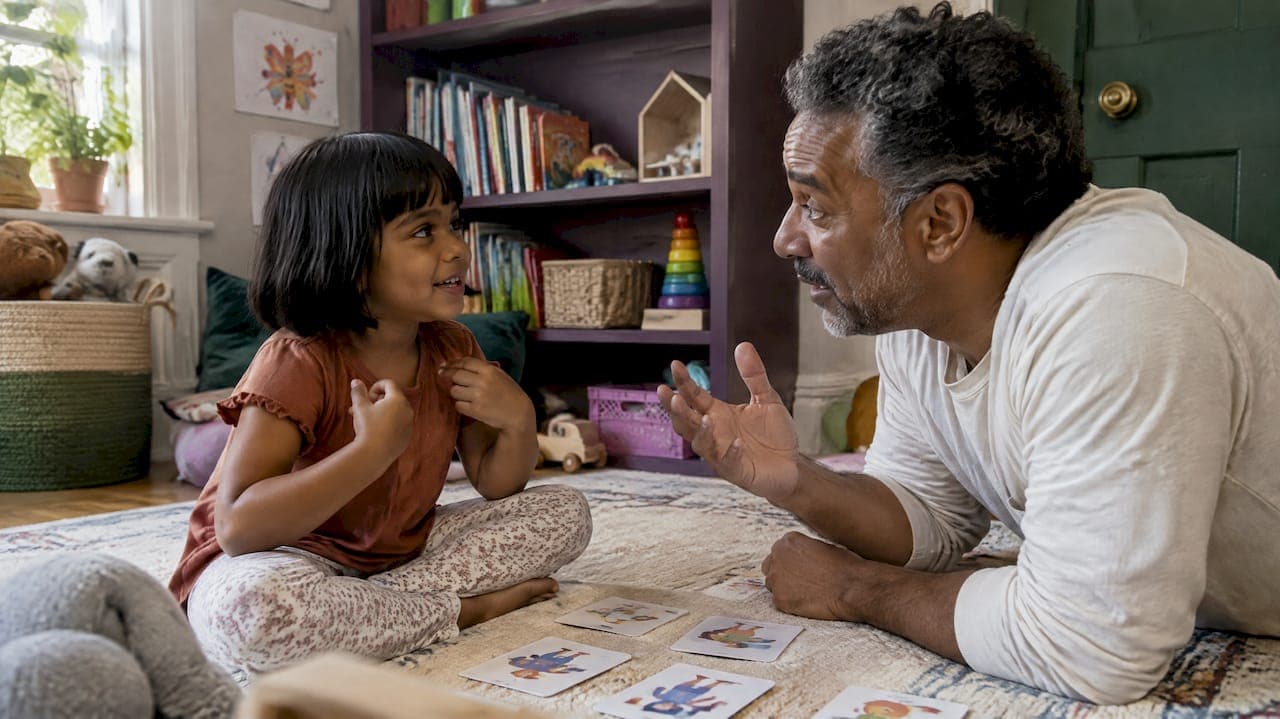
Role play cards for kids are small prompts, each one describing a real-life moment, that a child acts out with a grown-up or a friend. They work best when the scenes are short, the language is simple, and the adult models the skill first. This guide shows what the cards cover, how to run a session, and how to pick a set that fits a child aged 3 to 8.
TL;DR
- Role play cards turn everyday moments, like saying hello or sharing a toy, into a short scene a child can rehearse.
- Research-backed practice follows a pattern: explain the skill, break it into steps, model it, rehearse it, give feedback.
- For shy or sensitive kids, start with simple scripts and let the child watch first.
- Pick cards that are age-appropriate, flexible, and inclusive of different families and backgrounds.
- Five minutes a day is enough. Keep it playful.
Table of Contents
- What role play cards are
- What kids can practice with them
- Situations worth covering
- How to run a role play session
- Adapting cards for shy, sensitive, or differently abled kids
- How to choose a set for ages 3 to 8
- Using cards at home, in class, and in the library
- Our perspective on role play with cards
- Try our Duckwave Decks
- FAQ
- Sources
What role play cards are
A role play card names a situation. Some show a picture. Some give a line to say. Others ask a question, such as what you would do if a friend takes your turn.
The child plays one part and the adult or a friend plays the other. Then you swap. That swap matters. When a child plays the "other person," they see how their own words land.
The format is close to what children already do. PBS KIDS for Parents notes that role-playing emotions or conflict resolution can build empathy, and that dramatic play can sharpen problem-solving and critical thinking. The cards simply give that play a clear topic.
Cards are useful because they remove the blank page. A parent who is tired at 6 p.m. does not have to invent a scene. They pull a card and start.
What kids can practice with them
The cards are not only about manners. They give children practice in three areas.

Language. Pretend play lets children try new words and retell what they know. The National Association for the Education of Young Children explains that dramatic play gives children a chance to practice vocabulary and narrative structure. A card about ordering a snack, for example, gives a child a short script with a beginning, middle and end.
Feelings. Many cards ask a child to name what a character feels and what they could do next. This is the base of emotional literacy: noticing a feeling, naming it, choosing a response.
Social moves. These include greeting someone, asking to join a game, taking turns, saying sorry, saying no politely, and saying goodbye.
Younger children, around 3 and 4, do best with one move per card. By 7 or 8, children can handle a scene with two steps, such as noticing a friend looks sad and then deciding what to say.
If your child is still in the toddler stage of pretend play, this overview of pretend play development in toddlers explains how the skill grows before cards come in.
Situations worth covering
The best cards match moments your child will actually meet. Here are common ones.
Parties and playdates
Understood, a nonprofit for families of kids who learn and think differently, suggests role-playing birthday party moments, such as greeting a host who is busy, reacting when another child brings the same gift, and saying goodbye.
The same article points out that playing at a friend's home involves its own skills: making conversation, talking with adults you do not know, sharing, taking turns, asking where things are, and following rules that differ from your own house.
Those are excellent card topics. They are small, specific, and a little stressful for many kids.
Friendship and conflict
Try cards like these:
- A friend wants the toy you are using.
- You want to join a game that has already started.
- Someone says you cannot play.
- You bumped into someone by accident.
Each one has more than one good answer. That is a feature. Ask, "What else could you say?" and act out a second version.
Big feelings
These cards cover disappointment, frustration, nervousness, and excitement. A child might act out taking three slow breaths, asking for a hug, or saying, "I need a minute." If you want more feelings-focused games without cards, our guide to feelings charades scripts works well alongside them.
School and community
Raising a hand, asking a librarian for help, lining up, ordering food, and asking a teacher for a pencil all make good cards. They suit classrooms and library story hours.
How to run a role play session
The University of Minnesota's social-skills training guidance describes a sequence that holds up well for kids: give a reason, break the skill into steps, model it, rehearse it, give feedback, and encourage real-life practice. Here is how that looks with cards.
- Pick one card. Do not use a stack. One scene is enough.
- Say why. "Sometimes it is hard to join a game. Let's practice."
- Break it into steps. For joining a game: walk over, wait for a pause, ask, "Can I play too?"
- Model it. You play the child. Your child plays the friend. Exaggerate a little. Silly is fine.
- Swap. Now your child tries the skill while you play the friend.
- Give feedback. Start with what worked. "I liked how you waited and smiled." Then offer one small tweak.
- Try a twist. Change the answer: "Now the friend says not right now." What could you do?
- Practice for real. Mention it before the next playdate. Afterward, ask how it went.
Keep each session to about five minutes for ages 3 to 5, and ten minutes for ages 6 to 8. Stop while your child still wants more.
We have also put together 12 printable five-minute role play routines for parents who want ready scripts, and a six-to-eight-week plan for teaching emotions if you want a longer arc.
Let some things go wrong
Child Mind Institute advises parents to allow natural consequences during play-based social practice, as long as the activity is safe, so children learn from real interactions. In a role play, that means you do not always play a perfectly kind friend. Sometimes the friend says no. Your child gets to practice handling that, in a setting where nothing is at stake.
Adapting cards for shy, sensitive, or differently abled kids
Not every child warms up to acting. Here is what helps.
Let them watch first. Use a stuffed animal or puppet for both parts. The child observes, then joins when ready.

Offer a script. Child Mind Institute notes that for shy or autistic children, families can use social role-play and simple scripts to practice skills such as eye contact and responding to another person's mood. A card with a line printed on it does this job well. The child does not have to invent words under pressure.
Lower the volume. Whisper the scene. Draw it instead of acting. Use finger puppets.
Offer choices. "Do you want to be the friend or the host?" Control makes the task feel safer.
Use more than one way in. The National Association of Elementary School Principals says inclusive social-emotional learning should make content accessible in multiple ways and tailor supports to individual needs. For cards, that can mean pictures plus words, acting plus drawing, or a quiet corner for a child who needs it.
Skip eye contact as a rule. Some children find it hard or uncomfortable. Treat it as one option, not a requirement, and talk with your child's therapist or teacher if you are unsure what to practice first.
For more low-pressure ideas, see our screen-free SEL activities for ages 3 to 8.
How to choose a set for ages 3 to 8
A good set is easy to use on a bad day. Check these things before you buy or print.
Age fit. For ages 3 to 5, look for big pictures, one-step scenes, and very short text. For ages 6 to 8, look for scenes with a choice or a feeling to name.
Open-ended prompts. Cards that have only one right answer teach quickly and then get boring. Cards that ask "What could you do?" last longer.
Inclusive scenes. NAESP says adults should look for social-emotional resources that are age-appropriate, accessible in different ways, and affirming of students' identities and backgrounds. Check that the characters and family settings reflect many kinds of children and homes.
Tone. Kids tune out lectures. Cards that are funny, warm and visual get picked up again.
Format. Printables are low-cost and easy to reuse in a classroom. Physical cards survive car rides and sticky hands. Many families want both.
Fit with your setting. A teacher running a small group needs cards that work for a circle. A parent needs cards that work in a five-minute pause before dinner. A counselor needs cards that can lead into a longer conversation.
A quick way to test a set
Pull three cards at random. Ask yourself:
- Can I explain this scene to a 4-year-old in one sentence?
- Is there more than one good response?
- Would a shy child feel safe trying it?
If the answer is yes three times, the set is likely a fit.
If you want to compare formats, our guide to social-emotional games mapped to six SEL skills shows what each type of game is best for.
Using cards at home, in class, and in the library
At home. Pick a time that is already part of your day: after dinner, in the car, before bed. Keep the cards in a small bag by the table.
In the classroom. Use one card at morning meeting. Let two volunteers act it out while others watch for what went well. Teachers often say time is tight, and a study of special education teachers found that time constraints and trouble tracking SEL progress were common barriers. A single five-minute card is easier to fit into a schedule than a full lesson.
In the library. Pair a card with a picture book. Read a story about a character who feels left out, then act out one way the character could ask to join. Our list of books for teaching kids empathy is a good place to start.
In counseling. Cards give a structure to rehearse a skill, then practice it between sessions. Adults who work with children should choose scenes with the child's own therapist or counselor in mind.
Our perspective on role play with cards
We make stories, decks and activity kits for children ages 3 to 8, and we have seen the same thing again and again: children learn feelings best when they do not feel taught.
A card that lectures gets put away. A card with a funny character, a real problem and room for a child's own answer gets pulled out again. That is why we build our worlds around original characters and let emotional themes show up through the story rather than through a moral at the end.
We also think design matters. A beautiful card feels like a treat, not homework. Children treat it with care, and adults enjoy handing it over.
Our approach is to keep emotional lessons subtle and indirect, celebrate individuality, and let kids shape the scene. If your child wants to be the grumpy duck instead of the helpful one, let them. Playing the hard part is often where the learning happens.
Derek Amarillas
Try our Duckwave Decks
If you want cards your child will want to keep, look at our Duckwave Decks. They are themed card decks set in the Duckwave Universe, a world of original characters, and each deck costs $7 one-off. We designed them to start conversations about feelings and everyday moments in a playful way.
Members also get access to printables and ongoing fresh content through our member site. You can also browse our full catalog of routines and scripts for more ways to play.
FAQ
What age are role play cards best for?
Children as young as 3 can use simple, one-step cards with a grown-up. Ages 6 to 8 can handle scenes with a choice or a feeling to name. Always match the card to the child, not the number on the box.
How often should we practice?
A few minutes, a few times a week, is enough. Short sessions keep it playful. Practice right before a real event, like a party or the first day of a new class, is especially useful.
What if my child refuses to act?
Let them watch you and a puppet play both parts. Offer a choice of role or let them draw the scene instead. Pressure usually backfires. If a child is very anxious about social situations, talk with your pediatrician or a child therapist.
Can role play cards help with emotional literacy, not just manners?
Yes. Many scenes ask a child to notice and name a feeling and choose a response. Research on dramatic play suggests that acting out emotions can build empathy, according to PBS KIDS for Parents. Pair cards with games like our emotion charades cards for extra practice.
Can I use cards with a group of kids?
Yes. Pick two volunteers to act, and let the rest watch and suggest another way to respond. Rotate the actors each time so every child gets a turn, and let quiet kids join as an observer first.
Sources
- Act It Out: Dramatic Play for Kids, PBS KIDS for Parents
- 4 social situations to role-play with your grade-schooler, Understood
- Inclusive SEL Helps Students Thrive, NAESP
- Cómo ayudar a mi hijo a hacer amigos, Child Mind Institute
- Social Skills Training, University of Minnesota
- Creating Dramatic Play Areas That Support Literacy, NAEYC
- An Examination of Special Education Teachers' Perspectives on SEL, OhioLINK