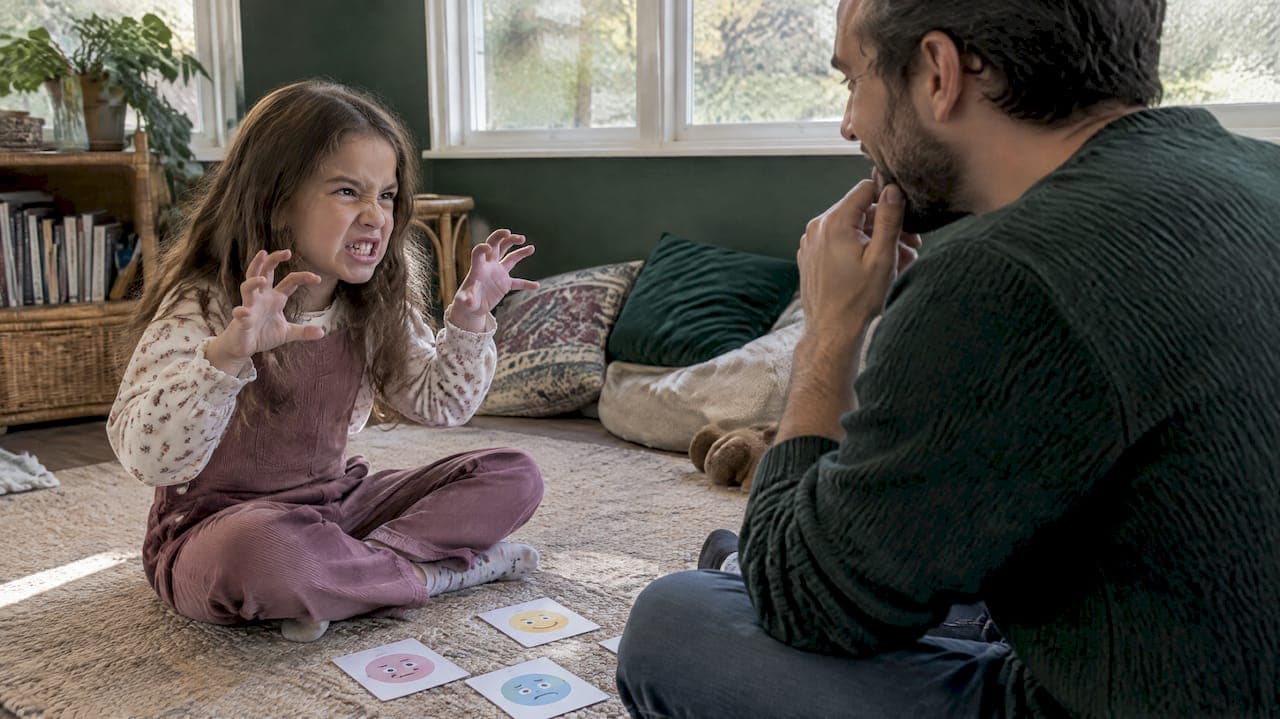
Emotion charades cards are a set of cards, each naming or showing a feeling, that a child draws and acts out while others guess. You can print a set in about ten minutes, cut it out, and play the same day. This guide shows you which feelings to include, how to run the game for children ages 3 to 8, and how to adjust it for shy or sensitive kids.
TL;DR
- Emotion charades cards ask a child to act out a feeling, or a situation that causes it, while others guess the emotion.
- Start with four to six basic feelings for ages 3 to 5. Add trickier ones like nervous, jealous, and confused for ages 6 to 8.
- You can print cards, glue them to index cards, or make your own from magazine pictures and family photos.
- Shy children can play in pairs, act with a partner, or guess before they act.
- Finish each round with a short chat about which feelings were easy or hard to read.
Table of Contents
- What emotion charades cards are
- Which feelings to put on the cards
- How to make printable emotion charades cards
- How to play: step by step
- Adapting the game for shy and sensitive children
- Talk about it afterward
- Our perspective: why emotional learning works best when it feels like play
- Pair the game with a deck of your own
- More ways to build on the game
- Common mistakes to avoid
- FAQ
- Sources
What emotion charades cards are
The game works like classic charades, with one change. Instead of a movie title, the card holds an emotion. The child acts it out with their face, body, and voice, or acts out a moment that could cause the feeling. Everyone else guesses.
That small change matters. According to LeapFrog's emotion charades activity, children act out emotional states and think about events that might prompt them. The game gives them practice with how to respond to a scenario and how to spot a feeling in someone else.
PBS Parents describes the same idea from the body-language side. Linking body language to feelings through play can help children build empathy and feel more in control of their emotions. A child who has practiced what "frustrated" looks like on a face is better placed to notice it on a friend.
You may also see these called feelings charades cards or emotions charades printables. They are the same game. The only real difference between sets is how many cards they hold and whether they use words, pictures, or both.

Which feelings to put on the cards
Start with what your child already knows. A card that names a feeling the child has never talked about will only produce a blank look. A good first set is small and familiar.
Ages 3 to 5: start with the basics
Young children do best with feelings they have visibly had that week. Use pictures or simple drawings of faces, because many of them cannot read yet.
- Happy
- Sad
- Mad
- Scared
- Surprised
- Sleepy
Six cards is plenty. Add a seventh card that is blank, so the child can pick any feeling they like. That gives them a say in the game from the start.
Ages 6 to 8: add shades and mixed feelings
Children in this range can handle words on the card and more precise feelings. LeapFrog suggests adding cards for emotions a child needs practice with, such as confused, jealous, or nervous. Other good additions:
- Proud
- Embarrassed
- Disappointed
- Excited
- Frustrated
- Lonely
- Left out
- Calm
For a wider word list sorted by age, see our guide to emotion vocabulary for kids. It gives you three age bands and short scripts to use as you go.
Include comfortable feelings too
It is tempting to fill a deck with big, hard feelings. Mix in calm, cozy, proud, and silly. Children need a way to practice the pleasant ones, and the game feels lighter when not every card is a struggle.
How to make printable emotion charades cards
A printed set costs almost nothing, and a homemade set can be tailored to your child. Here is a simple method.
- Pick your feelings. Choose six to twelve from the lists above.
- Choose a card style. Words only suits readers. Faces or drawings suit pre-readers. Words plus a face works for mixed groups.
- Print and cut. LeapFrog's suggestion is to print and cut out the cards, then glue them to 3x5 index cards. The thicker card stock lasts longer and is easier for small hands.
- Add your own. Include emotions your child needs practice naming. If a child often struggles with disappointment, make two cards for it.
- Gather pictures. The PTA's feelings charades guide suggests that before playing, families find emotions in magazines or family photos or make emotion cards for the game. Photos of your own family make the cards much more personal.
- Put them in a bowl or bag. Drawing blind adds a little suspense and keeps turns fair.
If you like to color as you prepare, our emotions coloring pages can double as card faces. Children can color the face first, then use it in the game.
How to play: step by step
The basic game takes five to ten minutes. You can stretch it to 20 with extra rounds. If you want a ready-made script with timing, our no-prep feelings charades guide covers 10 to 20 minute sessions for teachers and parents.
- Set the rules. Say that nobody laughs at anyone's acting. Everyone gets a turn, and there are no wrong faces.
- Model a turn first. Draw a card yourself and act it out. Over-do it a little. Children relax when the adult goes first.
- Child draws a card. They look at it quietly and keep it hidden.
- Child acts. They show the feeling with their face and body. They can also act out a situation that might cause it, which is the format LeapFrog describes: the child acts out a situation that could cause the emotion while the audience tries to name it.
- Everyone guesses. Let guessers call out. Accept close answers, such as "grumpy" for "mad", and use them to talk about how feelings overlap.
- Reveal the card. The child shows it. Then pass the bowl to the next player.
No sound, then sound
For a first round, play silent. Face and body only. In a second round, allow sounds but no words, such as a sigh, a gasp, or a groan. Tone of voice carries a lot of feeling, and children often notice it for the first time here.
The exaggeration round
The PTA guide includes an exaggeration round, in which players make each emotion look as big and intense as possible. This is a good one for energetic kids. Big acting is easier to guess, and it is funny, which keeps the mood light. After that, try a "tiny" round, where the feeling is shown as quietly as possible. That is closer to how feelings often look in real life.
Is it right for ages 3 to 8?
LeapFrog lists Kindergarten and Grade 1 as the learning stages for the game, which is roughly ages 5 to 7. In our experience with this age group, the game stretches both ways with small changes. Younger children need picture cards and a helper. Older children can take on harder words and scenario-style acting.
| Age | Card style | Number of cards | Suggested twist |
|---|---|---|---|
| 3 to 4 | Faces only | 4 to 6 | Adult acts with the child |
| 5 to 6 | Faces plus words | 6 to 10 | Silent round, then sound round |
| 7 to 8 | Words and scenarios | 10 to 16 | Act out a situation, not just the face |
Adapting the game for shy and sensitive children
Some children freeze when everyone is watching. That does not mean the game is wrong for them. It means the entry point should be gentler.
- Let them guess first. Watching an adult act is a full way to take part. Guessing builds the same skill of reading feelings.
- Act in pairs. Two children, or a child and an adult, draw a card and act it together. Attention is shared.
- Pair younger children with an older helper. The PTA guide suggests younger children can pair with an older family member who helps them think of emotions to act out.
- Use a prop or puppet. A stuffed animal can "feel" the emotion while the child moves it. Many shy children find it easier to act through a toy.
- Offer a pass. Let the child swap a card or skip a turn without comment. Pressure kills the game.
- Start with just you and the child. A private round at the kitchen table works better than a group on day one.
For children who find faces hard to read, use cards with a clear picture and a short word, and keep the number of cards low. Slow the pace and repeat a card as often as needed. If a child's difficulty with emotions worries you, a school counselor, pediatrician, or child therapist is the right person to talk to. A game is a practice tool, not an assessment.
Talk about it afterward
The acting is the fun part. The talking is where children connect it to their own lives. The PTA guide notes that children practice social awareness, empathy, relationship skills, listening to verbal and nonverbal cues, and turn-taking, and that adults can reflect with children on which emotions were easy or hard to identify and what skills they used.
Keep the questions short:
- Which feeling was easiest to guess? Why?
- Which one was tricky? What did you look at to figure it out?
- When did you last feel that way?
- What helps you when you feel that way?
Do not push. If the child answers with a shrug, that is fine. Try again another day. For a low-pressure follow-up at home, our 1 to 10 feelings rating is a small daily habit that builds on the same vocabulary.
Our perspective: why emotional learning works best when it feels like play
We make picture books, card decks, and activity kits for children ages 3 to 8, so we think a lot about how a child meets a feeling for the first time. Our view is simple: a lesson that sounds like a lesson makes children pull away. A game with a silly face and a bit of chaos makes them lean in.
That is why our work leans on character-driven worlds and indirect emotional themes rather than direct instruction. A child who laughs at a duck acting "grumpy" is already learning what grumpy looks like. Nobody had to say it was a lesson.
Charades cards fit that approach well. They cost little, they need no special skill, and they let children express themselves in their own way. Our advice to parents and teachers is to keep the game short, keep it kind, and stop while children still want more. Five good minutes beat twenty tense ones.
We would also add that no single set of cards has to be perfect. The best deck is the one your child will actually play with. Start small, notice which feelings come up in your home or classroom, and add cards for those.
— Derek Amarillas
Pair the game with a deck of your own
If your child likes characters, a themed deck can make charades feel like part of a bigger story. Our Duckwave Decks are $7 one-off, and they bring the playful Duckwave Universe into a collectible card format that children can sort, trade, and talk about. You can use them alongside your own homemade charades cards. For longer stories and books, browse Socko's Universe in our catalog.
More ways to build on the game
Once your child knows the basic round, you can change it up so it stays fresh.
- Sorting after acting. Lay the used cards out and sort them into "comfortable", "uncomfortable", and "somewhere in between". Our low-prep emotion sorting activities give you ten ways to do it in about ten minutes.
- Scenario cards. Write a short situation on the back, such as "your block tower falls over". The child acts how they would feel.
- Mixed feelings. For older kids, draw two cards and act out both at once, like excited and nervous on the first day of school.
- Classroom rotation. Teachers can turn it into a station. Our classroom feelings games include ready scripts, and the social emotional games guide maps games to six SEL skills.
- Story link. After reading a picture book, draw cards for the feelings the main character had and act them out. Our piece on storytelling for emotional learning explains how to do this with preschoolers.
- Homeschool block. Fit one round into a morning routine. See our homeschool SEL activities for twelve ideas.
If you want a longer path, our 6 to 8 week plan to teach emotions to kids shows where charades fits among other activities.
Common mistakes to avoid
Making it a test. If children feel graded on guessing right, they stop enjoying it. Praise the effort and the attempt, not accuracy.
Too many cards at once. A deck of 40 cards overwhelms a four-year-old. Start with a handful and rotate new ones in.
Only negative feelings. Balance tough feelings with positive ones, or the game starts to feel heavy.
Correcting the acting. A child who scrunches their whole body for "sad" is not wrong. Faces differ. Ask, "What made you choose that?" instead of showing them the right way.
Skipping the adult turn. Children copy what they see. If grown-ups join in and act silly, the game feels safe.
Playing past the mood. If someone is tired, hungry, or upset for real, stop. Use that moment to name the real feeling instead.

FAQ
What are emotion charades cards used for?
They help children practice recognizing and showing feelings through play. A child draws a card, acts out the emotion, and others guess. It builds vocabulary, empathy, and the habit of reading faces and body language.
What age is best for emotion charades?
LeapFrog lists Kindergarten and Grade 1 as learning stages for its version, but you can adapt the game for ages 3 to 8. Use picture cards and an adult partner for younger children. Use word cards and scenarios for older ones.
How many cards do I need?
Four to six for preschoolers is enough, and eight to sixteen works well for ages 6 to 8. A small deck keeps the game short and lets children repeat familiar feelings. You can always add cards later for feelings your child needs more practice with.
Can I make my own printable set?
Yes. Print or draw the cards, cut them out, and glue them to index cards so they hold up. You can also use pictures from magazines or family photos, as the PTA's guide suggests. Add feelings that match what your child is working on.
What if my child is too shy to act?
Let them guess first, act in a pair, or use a stuffed animal to show the feeling. Allow passes without comment. Many shy children join in after watching a few rounds.
Sources
- Emotion charades | Learning Path, LeapFrog
- Explore Body Language With Feelings Charades, PBS Parents
- Social Awareness: Feelings Charades, PTA