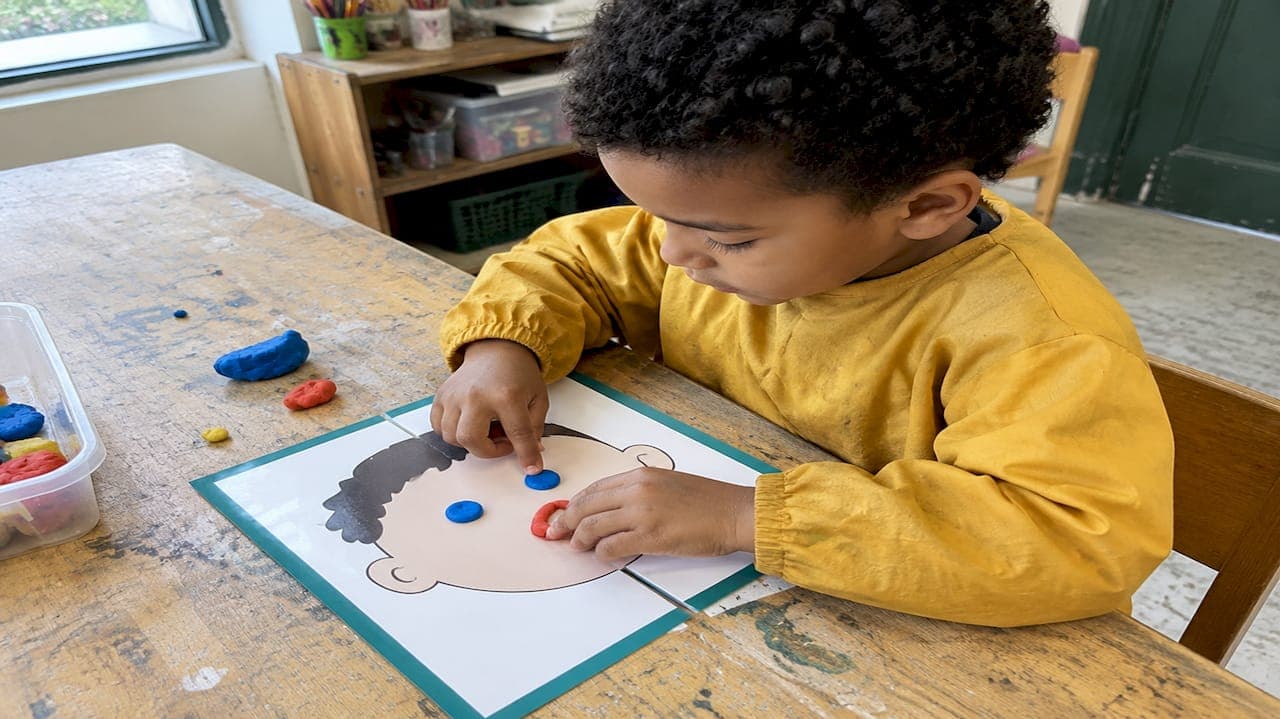
Feelings playdough mats are printed (or laminated) sheets with an outline of a face and a feeling word. A child builds the expression with dough: eyebrows, eyes, a mouth, maybe tears or a frown. The mat is the easy part. What makes it work is the talking you do while little hands squish and roll. This guide covers how to pick or print mats, how to prepare them, a session plan you can run today, and what to say at each step.
TL;DR
- Mats pair a hands-on task with feeling words, so children practice naming emotions while building fine motor strength.
- Laminate the sheets or slip them into dry-erase pockets so one set lasts all year.
- Ask open questions while the child builds. The conversation does more than the mat does.
- Start with four to six basic feelings for ages 3 to 4, and add subtler ones for ages 5 to 8.
- Supervise closely if you add loose parts like buttons, which are a choking hazard.
Table of Contents
- What feelings playdough mats are and why teachers and parents use them
- What to look for in a set
- Prepare the mats so they last
- A 15-minute session you can run today
- Matching the activity to age
- Let the face be imperfect
- Perspective: what we have learned about teaching feelings without lecturing
- Ways to extend the mats beyond faces
- When dough gets tricky: conflicts and big feelings
- Ideas for sensitive or shy children
- A note on Duckwave Decks
- Frequently asked questions
- Sources
What feelings playdough mats are and why teachers and parents use them
A typical mat shows a blank face, a feeling word such as happy, sad, angry, scared, surprised or tired, and sometimes a small picture cue. Children roll dough into snakes and balls and press them into place. Free printable sets often run from 10 emotions up to around 20, and many are written for preschool and kindergarten.
The reason the activity sticks is simple. Children are not born knowing the difference between frustrated and disappointed. The National Center for Pyramid Model Innovations notes that children need to learn to understand complex emotions, and that emotional literacy skills are linked to being more focused and doing better academically. A mat gives that learning something to hold.
There is a second benefit that has nothing to do with faces. NAEYC describes how pounding, flattening and squeezing dough gives sensory input that helps children release tension and cope with feelings like anger or frustration. So the same activity teaches vocabulary and offers a calm-down outlet.

What to look for in a set
Not every printable is worth your ink. Before you download or buy, check these points.
Face outlines that are easy to fill. A large oval with light guide marks for eyes and mouth works better for ages 3 to 4 than a detailed cartoon. Fussy artwork makes small hands give up.
Feeling words in plain type. Pre-readers benefit from seeing the word next to the face. Look for clear, large lettering you can point to as you read it aloud.
A sensible range of emotions. Six to eight is plenty to begin. Sets with 20 can be useful later, but a long list overwhelms younger children.
Room for variety. Some mats show a blank face, so the child decides which feeling to build. Others show a labeled target to copy. You want both over time: copying first, inventing later.
Black and white or color-light. Fewer colors means less ink and clearer contrast against bright dough.
Price varies a lot. Many sets are free, some digital sets cost a couple of dollars, and boxed physical sets cost more. Printing yourself is almost always the cheapest route. If you want a small, collectible, character-led companion to the mats, see the promo note further down.

Prepare the mats so they last
Playdough is greasy and salty. A paper mat will wilt after one session. Practitioners recommend laminating the printables or using dry-erase pockets, which also lets children reuse them with dry-erase markers for drawing or writing practice.
A simple setup:
- Print on white cardstock if you have it. Regular paper works inside a pocket.
- Laminate, or slide each sheet into a dry-erase sleeve.
- Sort the mats into a zip bag or a small bin, one feeling per mat.
- Keep a small tub of dough for each child, in two or three colors.
- Add a damp cloth or wipes so hands and mats can be cleaned between children.
If you use buttons, pipe cleaners or other loose parts for features, supervise the whole time. The same source flags choking hazards for young children, so for ages under 3 or any child who mouths objects, stick to dough alone.
A note on dough
Shop-bought dough is fine for most children. Wheat is a main ingredient in many brands, so check labels if a child has a wheat or gluten sensitivity. If you make your own, a salt and flour recipe cooked on the stove is a common toddler-friendly option, but it is still not food. Ask families about allergies before the first session in a classroom.
A 15-minute session you can run today
This works one-to-one at home, in a small group of three or four, or at a center. Adjust the timing to your group.
Minutes 0 to 3: warm up the hands
Give each child a ball of dough. Ask them to squeeze it, pat it flat, and roll it into a snake. Say, "Squeezing can feel good when you have a big feeling." No mats yet. This is also a quiet moment to model a deep breath next to the child, a calming move NAEYC suggests teachers can model while children work the dough.
Minutes 3 to 5: pick a feeling
Place two or three mats in front of the group. Name each feeling and make the face yourself. Let each child choose one. Choice matters: a child who picks has already begun to think about what that feeling is.
Minutes 5 to 12: build and talk
Children build the face. You move around and ask open questions rather than correcting. The Pyramid Model resources describe this as adult scaffolding: asking questions such as "What does this face feel?" or what situation might cause that feeling, instead of letting the child work in silence.
Try these prompts:
- "Tell me about your face. How is it feeling?"
- "What do the eyebrows tell us?"
- "What might have happened to make someone feel this way?"
- "When did you feel like this? What did your body do?"
- "What could we do to help a friend who feels this?"
The last two connect the mat to real life. NAEYC recommends using these sessions as conversation starters about everyday situations, such as what makes you feel excited.
Minutes 12 to 15: show and wrap up
Invite each child to show one face to the group if they want to. Skip forced sharing. Then squash the dough into a ball, which gives a natural finish. Ask one closing question: "Which feeling was easiest to make today? Which was trickiest?"
Matching the activity to age
| Age | Best mats | What you do |
|---|---|---|
| 3 to 4 | 4 to 6 basic feelings, large face, word plus picture | Name the feeling, copy the face, use short phrases like "sad face" |
| 5 to 6 | 8 to 12 feelings, including tired, proud, worried | Ask what could cause each feeling and what the body feels like |
| 7 to 8 | Blank face mats, or subtler feelings like disappointed or embarrassed | Let children choose the feeling, then tell a short story about it |
For older children in this range, add a writing step. If the mat is in a dry-erase pocket, they can write the feeling word or a one-line story under the face. Our guide to emotion vocabulary by age band has scripts for stretching word choice beyond happy, sad and mad.
Let the face be imperfect
Children often make a mouth that is lopsided or eyes that do not match. That is fine. Child development experts quoted by NAEYC stress that the goal is an open-ended, safe outlet for expression, not a perfect face. Whether a child builds a silly face or a scared one, acknowledging both the creation and the emotion attached to it validates their experience.
So avoid saying "that doesn't look sad." Try "Tell me about this one." If the face and the label do not match, get curious. A child who builds a grin and calls it angry might be telling you something, or might simply be experimenting.
There is a research angle here too. The Pyramid Model materials point out that children use words for emotions and thoughts more effectively during guided pretend play than during passive activities. Building the feeling is a kind of pretend play, and your questions are the guide.
Perspective: what we have learned about teaching feelings without lecturing
At Icon Literary we make emotional-literacy picture books, card decks and activity kits for ages 3 to 8, and we keep returning to one idea: children learn feelings best when no one announces that a lesson is happening. A mat is a good example. It gives a child a task, and the feeling vocabulary arrives sideways.
We would add three points to the usual advice.
First, pair the mat with a character. A child who builds a face for a duck who feels left out will talk more freely about being left out than a child asked about themselves. Characters give shy children distance. If a child will not say "I feel nervous," they may say "the duck feels nervous," and that is a real start.
Second, keep the tone playful. Feelings are not only serious. Silly, smug, goofy and grumpy are part of the range, and making room for them tells children that every feeling is allowed.
Third, repeat. One session will not change much. Ten short sessions over several weeks will. If you want a structure for that, our 6 to 8 week plan for teaching emotions shows how to build week by week.
— Derek Amarillas
Ways to extend the mats beyond faces
Once children are comfortable, vary the routine so it stays fresh.
- Feeling charades. One child builds a face, others guess. Or act out the feeling first with your own face, then build it. Our feelings charades scripts give you ready lines.
- Sorting. Mix mats and ask children to sort them into "feels good" and "feels hard" piles, then discuss why some feelings are in between. See these low-prep emotion sorting activities.
- Feelings wheel check-in. Start the day with a quick wheel, then pull the matching mat at center time. Here are 90-second feelings wheel activities to try.
- Color and compare. After building, children can color a matching face on paper. Our emotions coloring pages work well alongside the dough.
- A feelings corner. Keep a laminated mat and a small dough tub in a calm space where a child can go when upset. Here is how to design a feelings corner that kids actually use.
Homeschool families can fold the mats into a weekly rhythm. Our list of homeschool SEL activities has twelve ideas that pair well.
When dough gets tricky: conflicts and big feelings
Shared dough sometimes leads to grabbing. Resist naming a culprit and a victim. NAEYC's guidance on using guidance instead of discipline warns that conventional discipline slides toward punishment, which leaves young children stressed and hurt. The better move is to help children solve the problem themselves, which turns the squabble into a lesson on sharing and cooperation.
A script that fits a feelings session:
- "I see two friends who both want the red dough. How does Sam's face look? How about yours?"
- "What could we try so both of you get a turn?"
If a child becomes upset while building a hard feeling, such as sad or scared, slow down. Offer the squeezing part of the activity, breathe together, and let them stop. For a child who seems to carry intense or ongoing distress, talk with the school counselor or the child's pediatrician rather than relying on an activity. A mat is a teaching tool, not a therapy.
Ideas for sensitive or shy children
Some children freeze when asked to talk about feelings. These small changes help.
- Offer a side-by-side seat. Sit next to the child rather than across, and build your own face too.
- Use a third party. Ask what a stuffed animal or a book character would feel.
- Allow a nod or a point. Let the child choose from two or three mats without speaking.
- Start with pleasant feelings. Happy, calm and excited first. Move to harder ones when trust builds.
- Praise effort, not accuracy. "You worked hard on those eyebrows" lands better than "good job."
A note on Duckwave Decks
If your children like characters, our Duckwave Decks are collectible card decks priced at $7 each. They are a handy pocket-sized companion to a mat session: pull a card, talk about it, then build the feeling in dough. We also have picture books and story worlds in Socko's Universe, made for ages 3 to 8. Neither is required for the activity above, and free printable mats work well on their own.
Frequently asked questions
What age are feelings playdough mats best for?
Most sets are made for roughly ages 2 to 8, with the sweet spot at 3 to 6. Younger children copy faces and learn basic words. Older children can invent feelings and tell stories about them. Adjust the number of emotions and the depth of your questions to the child.
Do I need to laminate the mats?
It is not essential, but it helps a lot. Dough leaves oil on paper, and a laminated sheet or a dry-erase pocket wipes clean. If you only plan to use a mat once, plain paper is fine.
How many feelings should I start with?
Four to six is enough for ages 3 to 4: happy, sad, angry, scared, plus perhaps surprised and tired. Add more after children can name and build the first set without help. Too many at once makes the activity a memory test.
Can I use these mats without playdough?
Yes. Slide the mat into a dry-erase pocket and let children draw features with markers. You can also use loose parts such as buttons or pipe cleaners, though close adult supervision is needed because of choking risks.
Are feelings mats a substitute for therapy or counseling?
No. They are a classroom and home learning tool for building vocabulary and self-awareness. If a child shows persistent worry, sadness or anger that affects daily life, speak with a school counselor, a pediatrician or a licensed child therapist.
Sources
- Playdough Power, NAEYC
- Instead of Discipline, Use Guidance, NAEYC
- Talking with Parents About Play and Learning, NAEYC
- Playdough Mats, National Center for Pyramid Model Innovations
- Labeling Emotions, National Center for Pyramid Model Innovations
- Book Nook, National Center for Pyramid Model Innovations
- Free Printable Feelings & Emotions Playdough Mats, Finding Myself Young
- Emotions Playdough Mats for Hands-On Learning, Rock Your Homeschool
- Homemade Playdough Recipe, Happy Toddler Club