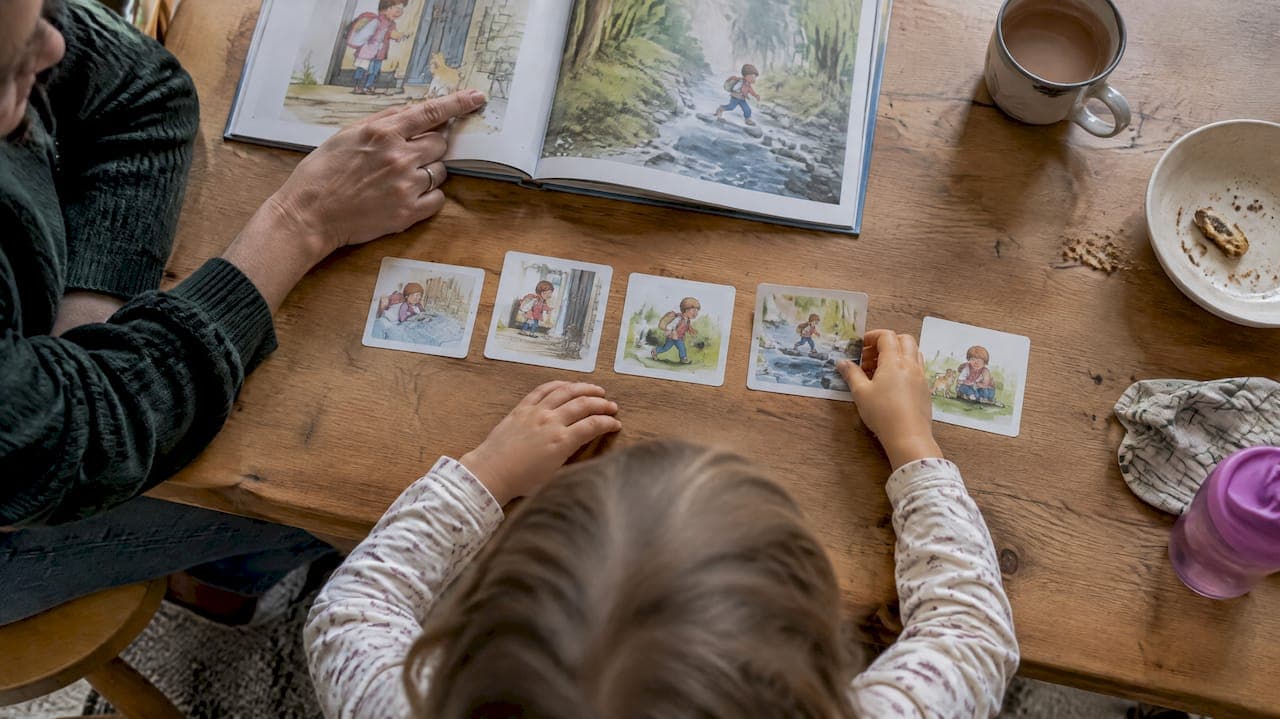
The best story sequencing activities do more than ask a child to put cards in order. You read a familiar story aloud, show how to find the beginning, middle, and end, let the child move picture cards into order, and then ask the child to retell the story and explain why each event goes where it does. This guide gives you that routine, versions for ages 3 to 5 and 5 to 8, game ideas, and the mistakes to avoid.
TL;DR
- Sequencing means ordering the events of a story. It supports retelling, summarizing, and later cause-and-effect reasoning.
- Start with a familiar picture book and 3 to 6 event cards. Too many cards or an unfamiliar story is the most common way these activities fail.
- The retelling is the lesson. Ask "What happened first?" and "Why does that come next?" after the cards are placed.
- For ages 3 to 5, use daily routines. For ages 5 to 8, add setting, character, problem, and resolution.
- You do not need to buy anything. Hand-drawn cards work fine.
Table of Contents
- What story sequencing is and why it matters
- What you need
- The core routine in four steps
- Story sequencing activities for ages 3 to 5
- Sequencing activities for kindergarten
- Activities for ages 5 to 8
- Story sequence games
- Act it out
- Digital sequencing: when it helps
- Common mistakes
- Our perspective
- Ready-made cards if you want them
- Frequently asked questions
- Sources
What story sequencing is and why it matters
Story sequencing is the skill of identifying the order of events in a narrative, usually as beginning, middle, and end. According to Reading Rockets, being able to recall and retell events in order helps children identify the main parts of a story, understand text structure, and summarize. Those are core parts of comprehension.
The skill builds in steps. Children first learn to order events. Then they use that order to retell, summarize, and reason about why things happened. The Institute of Education Sciences practice guide says instruction can begin in kindergarten. For that age, it suggests simple questions: who is the main character, where does the story take place, what happened, and how did it end?
The same guide stresses one more point. Tell children why a chart, picture sort, or story map helps them. The tool works best when children use the strategy while listening or reading, not only on a worksheet afterward.
What you need
Very little. A familiar picture book, 3 to 6 printed or hand-drawn event cards, and optionally paper, crayons, a pocket chart, or reusable adhesive are enough. Reading Rockets lists several formats that work: movable pictures, sentence strips, anchor charts, sequence sticks, story chains, retelling ropes, and story-sequence crafts.
Commercial decks and printable kits mostly save you preparation time and offer story sets that get harder step by step. They are a convenience, not a requirement.
The core routine in four steps
This routine works at home, in a classroom, or in a small group. It follows the explicit teaching approach in the IES Module 2 workbook: explain, model, practice with help, then step back.
- Read a short, familiar picture book aloud. Pick one the child has heard before. Re-reading removes the memory load, so the child can focus on order.
- Model one example. Say it out loud: "This is the beginning, because it's where we meet the character. I'll put this card first." Tell the child why you are doing it.
- Let the child reorder the cards. Offer 3 to 6 movable pictures or sentence strips. Help with prompts, then give fewer prompts each round.
- Retell with sequence words. Ask the child to tell the story using first, next, then, and last. Follow up with "What can you add to that?"
Step 4 is the most valuable part. Having the child retell the finished sequence and explain why each event belongs where it does turns card moving into comprehension and self-checking. A child who can only place cards correctly may be matching pictures, not understanding the story.
Story sequencing activities for ages 3 to 5
Younger children sequence best with things they live every day. Use familiar three- or four-step routines: washing hands, brushing teeth, bedtime, making a sandwich, or getting ready for school. A kindergarten teacher's getting-ready-for-school activity shows the pattern well: preview the vocabulary, find what must happen first, place the remaining pictures, and retell the whole sequence.
Routine cards
Draw or print three cards for a routine, such as shoes on, coat on, out the door. Start with two or three cards and add a fourth only when the child is steady. Ask: "What do we do first? What comes next?" Then mix them up and let the child fix your "mistake." Most children enjoy catching a grown-up who gets it wrong.
Body-count retelling
After a picture book, count the main events on the child's fingers: one event per finger. The IES guide mentions this kind of finger counting as a simple memory technique. Say the events together, then ask the child to say them alone.
Sequence sticks
Glue or tape a small picture to each of three craft sticks. The child lines them up left to right and retells. Mixed-up sticks make a quiet-time game for one child or a pair.
Sequencing activities for kindergarten
Kindergarten is where a story's beginning, middle, and end become the frame for everything else. Worksheets for this age range from 3- and 4-step sequences up to 9- and 10-step ones, but the best starting point is the short end of that range. Move up only when a child retells accurately without help.
- Three-box fold. Fold a sheet into three. The child draws the beginning, middle, and end of a read-aloud, then retells from left to right.
- Pocket chart sort. Put four picture cards on a pocket chart and have the group place them in order. Ask for a reason each time a card is placed.
- Story chain. Each child adds a paper link for one event. Hang the chain and retell it from the first link to the last.
- Sentence strip match. Pair a picture with one short sentence. Children match them, then order them.
If you are planning a center rotation, our post on classroom storytelling centers has three routines you can set up this week.
Activities for ages 5 to 8
Older children can handle more than order. Add setting, character, problem, plot, and resolution, and ask children to explain causes, infer missing information, summarize, or write a short retelling. Story maps can grow with the child, from a basic beginning-middle-end layout to organizers for character development, plot, theme, problem, and solution.
Cause-and-effect chains
After the cards are in order, draw an arrow between each pair and finish the sentence: "This happened because..." If an arrow is hard to explain, the order may be a guess. That is useful information for you.
Missing-card puzzles
Remove one event and ask the child what is missing. This asks for inference, not recognition. Start with an obvious gap, such as the end of the story, and work toward gaps in the middle.
Short written retelling
Give a sentence stem such as "First, ... Then, ... Finally, ..." and let the child write or dictate. For children who find writing hard, drawing or telling aloud shows the same understanding. The IES materials say children can show it orally, with pictures, through acting, or in writing.
For more on moving from simple order to full story structure, see our guide to teaching story structure by grade with dictation and acting.
Story sequence games
Games keep repetition fun, and repetition is what builds the habit. Each of these needs only the cards you already made.
| Game | How it works | Best for |
|---|---|---|
| Mix-up | You shuffle the cards and make a deliberate error. The child spots and fixes it. | Ages 3 to 5 |
| Human timeline | Each child holds one card and the group stands in story order. | Small groups, K to 2 |
| Quick flip | Turn all cards face down, flip one at a time, and decide if it is the beginning, middle, or end. | Ages 4 to 6 |
| Pass the story | One child tells the first event, the next adds the following one, and so on around a circle. | Ages 5 to 8 |
| Silent sort | Children order cards without talking, then explain their choices. | Ages 6 to 8 |
Story cubes also work well for the "pass the story" style of play. We have 30 prompts and 10 games for story cubes if you want ready-made ideas.
Act it out
The stickiest version of sequencing uses the body. Carole Cox's guidance on story dramatization describes how acting out a story makes children take on characters, settings, actions, and dialogue, which goes beyond recognizing a correct card order. It suggests picture books with repeated phrases that children can chant, which suit younger kids.
These formats also include children who find worksheet writing difficult. They give you natural moments to talk about how a character feels, what problem they faced, and what choice they made.
Try this: after you read, assign each child an event from the story. Without cards, they act out their part in order while the rest of the group says "first, next, then, last." Our post on 5 minute role play routines for kids offers short scripts to get you started.

Digital sequencing: when it helps
Online sequencing games and digital storybooks can help if you choose carefully. Look for clear illustrations, few distractions, and a plan for adult discussion afterward. Digital storybooks may combine text highlighting, visual cues, and narration. But evidence reviews, such as a summary of the dialogic reading evidence base, say that adult training, prompts, and follow-up discussion matter, and that a named method is not automatically done well.

In practice: let the child play, then close the screen and do an adult-led retell. The screen should not replace the conversation.
Common mistakes
- Starting with an unfamiliar story. Children then spend their effort understanding the plot, not ordering it. Begin with a read-aloud they know.
- Using too many cards. Three or four is plenty at first. Add more only after accurate retelling.
- Handing over a worksheet with no teaching. Explain why sequencing helps, model one example, practice together, and then reduce prompts, as the IES guidance recommends.
- Stopping at the correct order. If the child cannot say why a card goes where it does, keep going.
- Never removing support. Gradually take away the picture and sentence prompts so the child can retell independently.
- Skipping the feelings. Events in a story usually happen because someone felt something or made a choice. Ask about it.
Our perspective
We make picture books, card decks, and activity kits for children ages 3 to 8, and we think about sequencing a lot. Our view is simple: order is the doorway, not the room. A child who can line up four cards has done the easy part. The harder and more interesting part is explaining why the character did what they did, and how they felt along the way.
That is why we favor stories with distinct characters and a clear emotional thread. When a character has a problem a child recognizes, the child has a reason to remember what happened first, next, and last. Sequence becomes a way to follow someone's feelings. We also think it should never feel like a lecture. Playful, visually rich material gets children talking, and talking is where retelling happens.
If you want to connect sequencing to emotional learning, our posts on storytelling for emotional learning and SEL read-aloud classroom examples for K to 2 show how we approach it.
— Derek Amarillas
Ready-made cards if you want them
If you would rather skip the cutting and drawing, our Duckwave Decks are available for $7 one-off. You can also browse the characters and story worlds in Socko's Universe. Whatever you use, the routine above stays the same: read, model, order, retell.
Frequently asked questions
What age should children start story sequencing?
Children can begin around ages 3 to 5 with daily routines of three or four steps. Formal story sequencing with beginning, middle, and end fits kindergarten, and the IES practice guide says instruction can start at that level. Move at the child's pace and add cards slowly.
How many cards should I use?
Start with three or four. A 3- to 6-card range covers most lessons at ages 3 to 8. Only add more when the child retells the story correctly without help.
Do I need worksheets or a paid program?
No. A familiar picture book and hand-drawn cards are enough. Printable sets and decks mainly save preparation time and offer stories that get harder in steps.
How do I know the child understands, not just matches pictures?
Ask for a retell using first, next, then, and last, and ask "Why does this come next?" A child who can explain the connection between events is showing comprehension. If the explanation is missing, go back to a shorter, more familiar story.
Sources
- Story Sequence, Reading Rockets
- Helping Students Focus on Text Structure, Institute of Education Sciences
- Module 2 Participant Workbook, Institute of Education Sciences
- Story Maps, Reading Rockets
- Story Dramatization, Reading Rockets
- "Getting Ready for School" Sequencing Activities for Kindergarten, The Kindergarten Connection
- Dialogic Reading in Early Childhood Settings: A Summary of the Evidence Base