
The Mirrors, Windows, and Sliding Glass Doors framework describes three ways a book can relate to its reader: a mirror reflects a child's own life and identity, a window offers a view into someone else's experience, and a sliding glass door invites the reader to step fully inside another world. Dr. Rudine Sims Bishop coined this three-part metaphor in her 1990 essay, building on an earlier "mirrors and windows" phrase used by Emily Style for the National SEED Project. Right now, pick up one book from your shelf or read-aloud stack and ask: whose life does this reflect, and whose does it show from the outside? That single question is where the framework begins.
Key Takeaways
The Mirrors, Windows, and Sliding Glass Doors framework, coined by Rudine Sims Bishop in 1990, gives educators, librarians, and parents a practical lens for building collections that affirm identity, build empathy, and invite deep engagement.
| Point | Details |
|---|---|
| Three distinct functions | Mirrors affirm identity; windows build perspective; sliding glass doors create immersive empathy. |
| Bishop's 1990 origin | Dr. Rudine Sims Bishop expanded Emily Style's earlier "mirrors and windows" phrase by adding the sliding glass door metaphor. |
| Balance matters for all children | Overloading any one category distorts children's self-concept or world view; every child needs all three. |
| Audit before you buy | Count mirrors, windows, and doors by age band to identify gaps before adding new titles. |
| Icon Literary's role | Icon Literary's picture books and activity kits for ages 3–8 are designed to function across all three categories. |
Table of Contents
- Where the mirror-window-door framework comes from
- What mirrors, windows, and sliding glass doors actually mean
- Why this framework matters for children's development
- How to apply the framework in classrooms, libraries, and at home
- Common misconceptions and ethical cautions
- Trusted resources and annotated booklist
- A 6-step plan to build or redesign a diverse library
- What the framework reveals about storytelling itself
- Stories that reflect, reveal, and invite: Icon Literary's approach
- Sources
Where the mirror-window-door framework comes from
Understanding the framework means knowing who built it and why the third metaphor changed everything.
- Rudine Sims Bishop is professor emerita at The Ohio State University and one of the most cited scholars in multicultural children's literature. Reading Rockets describes her as a foundational voice for educators and librarians working to help children see themselves and others in books.
- The 1990 essay was titled "Mirrors, Windows, and Sliding Glass Doors" and published in Perspectives: Choosing and Using Books for the Classroom. Bishop argued that books are powerful tools for both affirmation and imagination, but only when a collection is balanced.
- Emily Style's prior phrasing matters for context. Style introduced "mirrors and windows" through the National SEED Project to describe curriculum that either reflects students' lives or shows them others'. Bishop expanded that metaphor by adding the sliding glass door, which captures something Style's two-part version could not: the moment a reader stops observing and starts inhabiting another perspective entirely.
- Why the third metaphor matters: a window keeps you at a distance. A sliding glass door removes the barrier. That distinction is the difference between intellectual awareness and genuine empathy, and it is what makes Bishop's version so durable in classroom practice.
What mirrors, windows, and sliding glass doors actually mean
Each category describes a relationship between a reader and a text, not a fixed property of the book itself. The same title can function differently for different children.
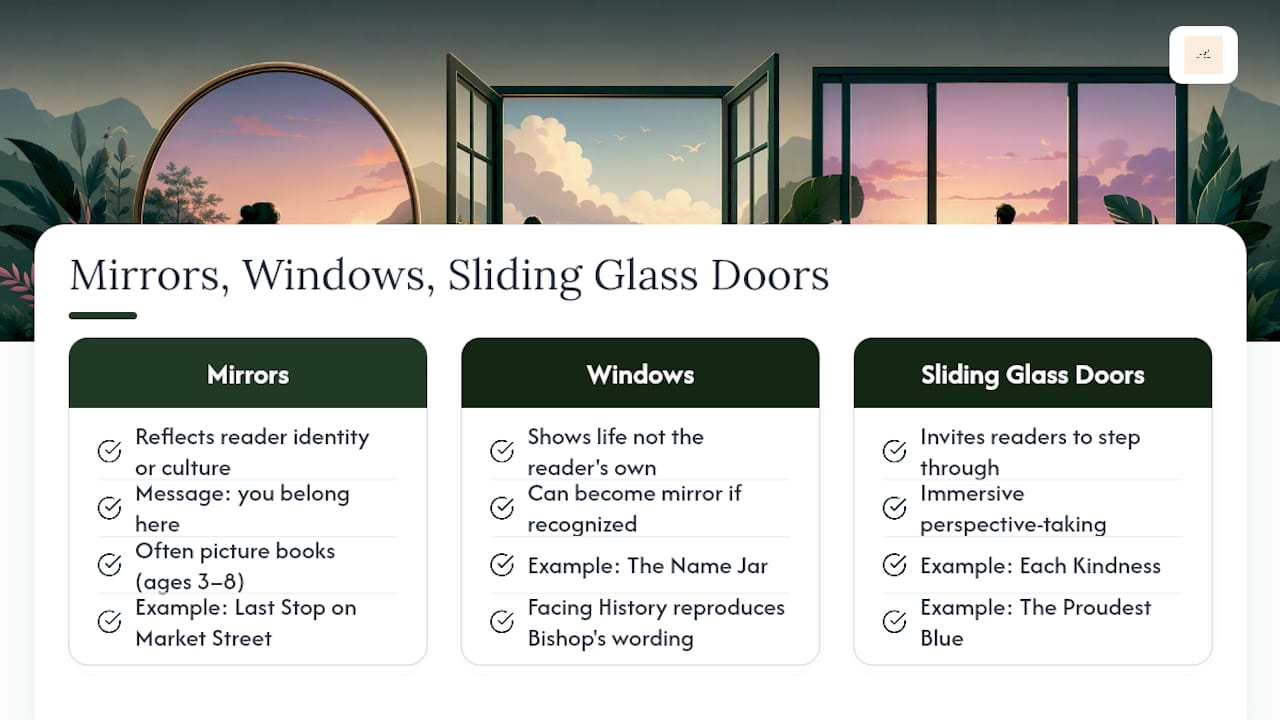
Mirrors reflect a reader's own identity, culture, family structure, or lived experience. When a child sees their own face, language, or home life in a story, the message is: you belong here, your story is worth telling. For early childhood (ages 3–8), picture books like Last Stop on Market Street by Matt de la Peña or Alma and How She Got Her Name by Juana Martínez-Neal serve as mirrors for many Latino children. For middle grade readers, Front Desk by Kelly Yang functions as a mirror for children of immigrants navigating American school systems.
Windows show readers a life that is not their own. The Facing History handout reproduces Bishop's original wording and clarifies that a window can become a mirror under the right conditions — when a reader unexpectedly recognizes something of themselves in a story they thought was "about someone else." The Name Jar by Yangsook Choi works as a window for children who have never navigated a name that others struggle to pronounce, and as a mirror for those who have.
Sliding glass doors go further. They invite readers to step through and imaginatively enter another world, not just observe it. Immersive perspective-taking is the goal: a child who has never experienced homelessness can read Each Kindness by Jacqueline Woodson and feel the weight of a missed chance at friendship as if it were their own. For older picture-book readers and early chapter-book audiences, The Proudest Blue by Ibtihaj Muhammad functions this way for children unfamiliar with the experience of wearing hijab on the first day of school.
A brief but important note: many strong books operate across categories simultaneously. Last Stop on Market Street is a mirror for some children and a window for others, and for a child who reads it alongside a discussion prompt, it can become a sliding glass door. The framework is a lens, not a sorting bin.
Why this framework matters for children's development
The case for balanced representation is not just philosophical. It connects directly to how children build identity, develop empathy, and engage with reading.

Mirrors matter most for children whose lives are rarely reflected in mainstream media. When a child never sees their family structure, skin tone, or home language in a book, the implicit message is that their experience is not worth narrating. That absence shapes self-concept. Consistent exposure to mirrors supports belonging and identity development, particularly for children from historically underrepresented groups.
Windows serve every child, including those whose mirrors are plentiful. A child who grows up reading only books that reflect their own experience develops a narrow model of the world. Experts note that consistent exposure to only one perspective can distort children's understanding of social complexity, which is the exact opposite of what good literacy education aims to achieve.
Sliding glass doors connect to social-emotional learning (SEL) in a specific way: they require a reader to suspend their own frame of reference and inhabit another. That cognitive and emotional work is the same skill underlying perspective-taking, conflict resolution, and empathy, three of the core competencies in SEL frameworks used widely in U.S. schools. Reading Rockets and other educator resources recommend pairing book selection with discussion prompts and programming to move readers from passive viewing to active engagement. For more on how inclusive books connect to SEL outcomes, this overview covers the developmental evidence in plain terms.
The risk of imbalance cuts both ways. A collection heavy on windows but light on mirrors tells underrepresented children their lives are curiosities for others to observe. A collection heavy on mirrors but short on windows leaves all children less prepared for a diverse world. The Great Schools Partnership describes this as moving from a "collection growth" mindset to systems thinking, where curriculum, display, and programming are reviewed together to avoid performative inclusion.
How to apply the framework in classrooms, libraries, and at home
The framework is most useful when it drives selection, display, and conversation, not just acquisition.
A quick checklist for evaluating a single book
Use these questions before adding a title to your collection or read-aloud rotation:
- Whose experience is centered, and is that group represented elsewhere in your collection?
- Is the author writing from lived experience (Own Voices), or from research and consultation? Both can produce quality work, but the distinction matters when evaluating authenticity.
- Are characters from underrepresented groups shown in full, complex roles, or primarily as problems to be solved by others?
- Does the book avoid stereotypes in language, illustration, and plot?
- Would a child from the represented group recognize their experience as accurate and dignified?
For a deeper selection checklist, this practical guide walks through evaluation criteria used by educators and librarians.
Five discussion prompts for read-alouds
- "Does anything in this story remind you of your own life? What?"
- "What did you learn about someone whose life is different from yours?"
- "If you could walk into this story, what would you do or say?"
- "Did anything surprise you about how the characters felt or acted?"
- "Whose voice do you think is missing from this story?"
Display and programming ideas
Shelf labels using mirror, window, and door icons give children and caregivers a shared vocabulary. Rotating featured titles monthly by theme (family structures, languages, abilities, cultural celebrations) keeps the collection feeling alive rather than static. For storytime, pairing a mirror book with a window book on the same theme, then asking children to compare, builds the habit of perspective-taking without making it feel like a lesson.
The NYS Library DEI toolkit notes that labeling shelves with mirror/window/door categories during storytime increases caregiver engagement and gives families language to discuss representation at home.
Starter diversity audit questions
- How many titles on this shelf center characters from underrepresented groups?
- Of those, how many are written by authors from those groups?
- Which age bands or subject areas have the fewest mirrors?
Implementation formats compared
| Format | Ease of setup | Impact on engagement | Resources needed |
|---|---|---|---|
| Shelf labels (mirror/window/door) | High | Moderate | Labels, brief staff training |
| Themed storytime pairing | Moderate | High | Two curated titles, discussion prompts |
| Classroom book club | Lower | Very high | Multiple copies, facilitation guide |
| Family take-home reading kit | Moderate | High | Printed prompts, curated title list |
Common misconceptions and ethical cautions
Misconception 1: The framework is only for underrepresented children
Every child needs both mirrors and windows. The framework was designed to correct a systemic imbalance, not to sort children into groups. A white child in a predominantly white classroom benefits enormously from windows into other lives. Framing the framework as "for diverse kids" misses the point entirely.
Misconception 2: Adding diverse books is enough
Buying a diverse title and shelving it is not implementation. The Great Schools Partnership describes this as the difference between performative inclusion and genuine systems change. A book that sits unread on a shelf serves no one. Programming, display, and discussion are what activate the framework.
Misconception 3: Own Voices is a simple binary
The Own Voices movement, which encouraged publishers to prioritize authors writing from their own lived experience, has evolved. Diverse Books now recommends a specificity-based approach: rather than a blanket Own Voices label, evaluate whether the author's specific background and the book's specific representation align. An author who is broadly "from the same community" may not share the precise experience the book depicts. Nuance matters more than a checkbox.
Misconception 4: Only mirrors are affirming
Windows and sliding glass doors are affirming too, just differently. A child who reads a window book and feels seen in an unexpected way, perhaps recognizing a shared emotion across a very different cultural context, experiences something just as powerful as a direct mirror. The goal is a collection rich enough that every child encounters both.
Pro Tip: When a child resists a window book ("that's not about me"), treat it as a sliding glass door opportunity. Ask: "What would you do if you were this character?" That single question shifts the experience from observation to participation.
Trusted resources and annotated booklist
Short annotated booklist
- Last Stop on Market Street by Matt de la Peña (ages 4–8): Mirror for many Latino and urban children; window into gratitude and community for others.
- The Name Jar by Yangsook Choi (ages 5–8): Window into the immigrant name experience; mirror for children navigating cultural identity.
- Each Kindness by Jacqueline Woodson (ages 5–9): Sliding glass door into regret and missed connection; strong for SEL discussions.
- The Proudest Blue by Ibtihaj Muhammad (ages 4–8): Mirror for Muslim girls; window and sliding glass door for children unfamiliar with hijab.
- Front Desk by Kelly Yang (ages 8–12): Mirror for children of immigrants; window into systemic barriers for others.
Authoritative resources
- Reading Rockets (readingrockets.org): Educator-facing video and article library; includes Bishop's framework explained for classroom use.
- ALA/ALSC: The Dr. Bishop selected bibliography is the standard professional reference for librarians applying the framework in collection development.
- DiverseBooks.org / Diverse Book Finder: Searchable databases for locating titles by representation category, age range, and author identity. Diverse Book Finder allows filtering by specific identity markers, which makes it practical for targeted gap-filling.
- Facing History: Their Windows, Mirrors, and Sliding Glass Doors handout is a one-page classroom-ready resource that reproduces Bishop's definitions.
Sourcing tips
Most titles in the annotated list above are available through U.S. public libraries and interlibrary loan at no cost. Used copies through ThriftBooks or Better World Books typically run under $5. For educators building a classroom set, the Diverse Book Finder and nonprofit lists from We Need Diverse Books are good starting points for identifying gaps before purchasing. For guidance on finding inclusive picture books on a budget, that linked resource covers search tactics in detail.
A 6-step plan to build or redesign a diverse library
This plan works for a classroom shelf, a school library section, or a home collection. Budget roughly three months for a full cycle.
-
Audit what you have. Pull every title and classify each as mirror, window, or sliding glass door from the perspective of your primary audience. Record counts by age band. Note which identity groups are represented and which are absent. The NYS Library DEI toolkit recommends tracking these counts over time to measure progress.
-
Set specific goals. Based on your audit, identify two or three gaps to address in the next 90 days. "Add more windows for ages 3–5" is more useful than "be more diverse."
-
Source strategically. Start with your public library's interlibrary loan system for titles you want to preview before buying. Use Diverse Book Finder and DiverseBooks.org to identify candidates. For purchasing, teacher-sharing networks, used-book sellers, and local literacy grants (check your district or state library association) can stretch a limited budget. For a step-by-step sourcing guide, this resource on building a diverse home library is built for ages 3–8 specifically.
-
Label and display intentionally. Add mirror/window/door shelf markers. Feature new acquisitions at eye level. Rotate displays monthly around a theme rather than leaving the same titles front-facing all year.
-
Build programming around the books. Schedule at least one mirror/window/door read-aloud per month. Use the five discussion prompts from the earlier section. For K–2 classrooms, SEL read-aloud examples offer structured lesson formats you can adapt. Practical classroom guides also recommend roleplay and perspective-writing activities to convert windows into sliding glass door experiences.
-
Review and adjust. At the end of each month, note which titles circulated most, which prompted the most discussion, and which sat untouched. A simple tally of circulation counts and a brief reflection prompt for students or children gives you enough data to adjust the next month's rotation.
Pro Tip: Track one simple metric per month: which mirror/window/door title generated the most unprompted conversation from children. That single data point tells you more about engagement than any formal assessment.
Sample 3-month rotation
| Month | Theme | Mirror focus | Window focus | Sliding glass door |
|---|---|---|---|---|
| Month 1 | Family structures | Alma and How She Got Her Name | The Name Jar | Each Kindness |
| Month 2 | Community and belonging | Last Stop on Market Street | The Proudest Blue | Front Desk |
| Month 3 | Identity and courage | Locally sourced title | Librarian-selected window | Student-chosen door |
For family and guardian engagement, send home a one-page prompt sheet after each read-aloud with two or three questions families can use at dinner or bedtime. The mirror/window/door vocabulary travels home when caregivers have the language to use it.
What the framework reveals about storytelling itself
The mirror-window-door concept is not just a selection tool. It is a theory of what literature does to a reader, and that is worth sitting with for a moment.
Most book-selection frameworks focus on content: is the representation accurate, is the author credible, is the language appropriate? Bishop's framework asks a different question: what does this book do to the reader's sense of self and other? That shift from content audit to relational analysis is what makes the framework genuinely useful rather than just politically correct box-checking.
The sliding glass door is the most underused category in practice. Educators tend to prioritize mirrors for underrepresented children and windows for majority-group children, which is a reasonable starting point. But the door is where the deepest learning happens, for every child. A child who walks through a sliding glass door in a book and comes out the other side having felt something real about another person's life is practicing the most transferable skill in human social life.
There is also a caution worth naming: the framework can become a checklist if practitioners are not careful. "We have mirrors, windows, and doors" can be said about a collection that is technically balanced but aesthetically thin, full of didactic, issue-driven books that children find joyless. Quality and joy are not separate from representation. The best mirror books are also just great stories. The framework works best when it is a lens applied to books chosen first for their craft, not a quota to fill.
The literary fiction craft perspective on immersive storytelling is relevant here: the sliding glass door effect depends on narrative craft, not just subject matter. A book about an underrepresented experience that is poorly written will not pull a reader through the door. Craft and representation are partners, not competitors.
Stories that reflect, reveal, and invite: Icon Literary's approach
Icon Literary publishes children's picture books, activity kits, and card decks built around original characters and immersive story worlds for ages 3–8. Every title is designed with the mirror-window-door concept in mind: characters that reflect the full range of children's identities, stories that open windows into unfamiliar experiences, and narrative worlds crafted to pull young readers through the door.
Parents, educators, and librarians looking for emotionally resonant, diverse picture books and SEL-aligned activity kits can browse the full Icon Literary catalog for titles that work as mirrors, windows, and sliding glass doors across the 3–8 age range. Physical books, digital downloads, and printable kits are all available. Visit Iconliterary to find a title that fits your next read-aloud or shelf rotation.
Sources
Rudine Sims Bishop's original 1990 essay remains the primary source; the NYS Library DEI toolkit summarizes it and explains how libraries use it for collection development and diversity audits. Reading Rockets offers a video and article format of Bishop's framework aimed at classroom educators. For professional collection development, the ALA/ALSC selected bibliography compiles Bishop's scholarship in one document. The Facing History handout is the most classroom-ready single-page resource. For title discovery, DiverseBooks.org and Diverse Book Finder are searchable and free. All primary sources are available online at no cost; most linked pages include additional reading lists and classroom tools.
- Mirrors, Windows and Sliding Glass Doors | Reading Rockets
- Windows, Mirrors, and Sliding Glass Doors (handout) - Facing History
- Dr. Bishop selected bibliography - ALA/ALSC