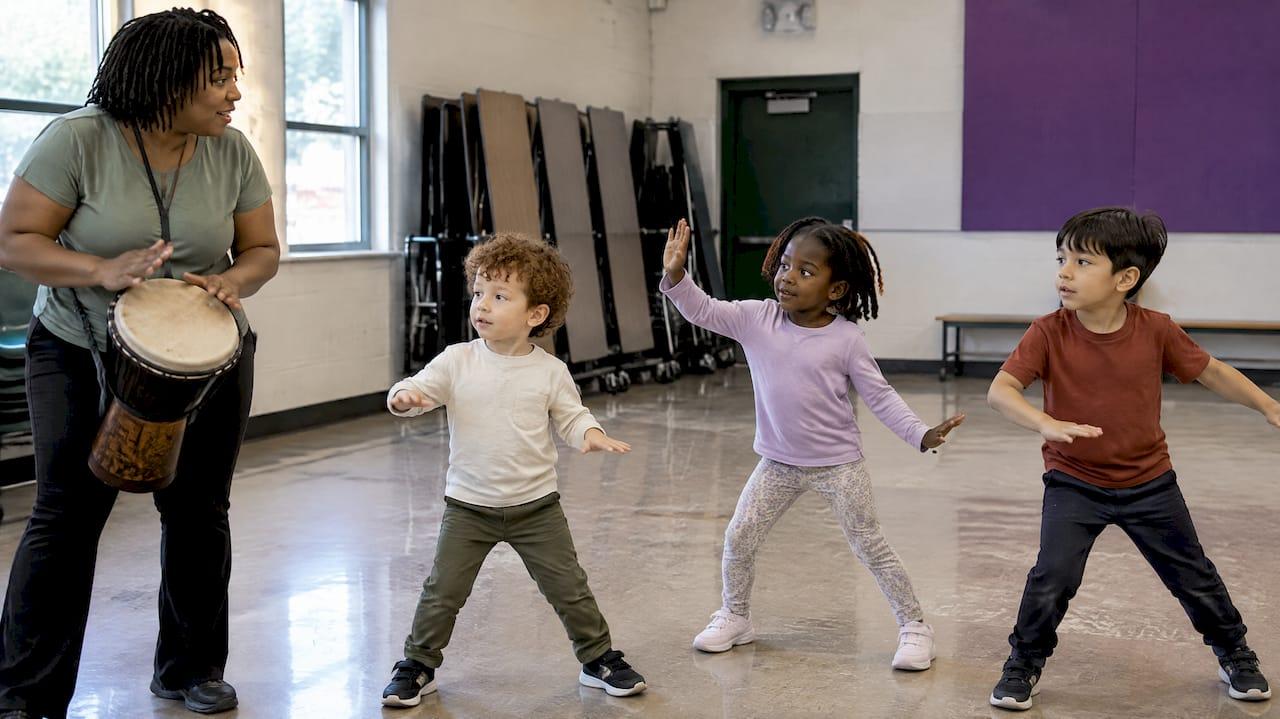
The best active listening games for kids ages 3 to 8 are short, physical and low pressure: Simon Says, freeze dances, mystery sounds and build-what-I-say games. They work because children have to hear, hold and act on what someone says, and they learn it faster in play than in a lecture about “good listening.” This guide gives you the rules, the setup, the changes for each age and the ways to keep shy or sensitive children comfortable. It also shows how to move from listening to sounds toward listening to feelings, which is where emotional literacy starts.
TL;DR
- Start with Simon Says. It needs no equipment and you can change it for any age in this range.
- Ages 3 to 4 do best with one-step directions, slow pacing and no “out” rule. Ages 6 to 8 can handle multi-step directions and memory games.
- Keep games cooperative where you can. A reset instead of an elimination keeps every child in the game.
- Give shy children a role that does not need an audience, such as a partner, a shaker or a pointer card.
- Finish with a story and a feelings question. That is where listening to words turns into listening to people.
Table of Contents
- What active listening means for a 3 to 8 year old
- Set up the game before you play
- Active listening games for ages 3 to 5
- Active listening games for ages 6 to 8
- Which game builds which skill
- Keep listening games cooperative
- Making listening games comfortable for shy, sensitive or differently abled children
- From listening to sounds to listening to feelings
- Our view on listening games
- Take listening games further with Duckwave Decks
- FAQ
- Sources
What active listening means for a 3 to 8 year old
For an adult, active listening means paying full attention, showing you heard and responding. For a young child it breaks into smaller jobs: noticing a sound, stopping to pay attention, keeping a few words in mind, acting on them, and later asking when something was unclear.

Games practice these jobs one at a time. A freeze dance trains noticing and stopping. Simon Says trains holding a rule and following a direction. A story trains staying with a voice for a few minutes. Once you know which job a game practices, you can pick the right one for the child in front of you.
The skills overlap with school readiness. A school readiness guide from Vanderbilt’s Consortium LEND suggests using picture naming and rhyming inside Simon Says, teaching careful listening through alliteration (noticing that “book, bag and ball” all start with the same sound), and giving specific, frequent praise when a child follows directions.
Set up the game before you play
A little structure before the first round saves most of the trouble later.
- Check the space. Each child needs room to move without touching anyone else. Childhood101’s Simon Says guide asks for enough room for each player to stand apart, indoors or outdoors.
- Run a practice round. Playworks recommends a practice round before real play, so children see what “Simon says” and a plain command look like.
- Agree on what happens after a mistake. Playworks lists gentle options such as ten jumping jacks, touching the ground for a round, or a high five from the leader. Choose one before you start so no mistake feels like a punishment.
- Keep it short. A group of 4 and 5 year olds can sustain attention for about five to ten minutes, according to Brightwheel’s guide to active listening activities. Stop while the children still want more.
- Let children lead. Rotating the leader role gives every child a turn at speaking clearly, not only at listening.
Active listening games for ages 3 to 5
Younger children need fewer words, bigger movements and quick turns.
Simon Says, one step at a time
One person is Simon. Everyone else follows only the commands that start with “Simon says.” Begin with a single direction such as “Rub your belly.” Once children are comfortable, build to two parts, such as “Pat your head, then wave,” a progression suggested in the ECE Resource Hub’s take-home listening strategies.
For 3 and 4 year olds, Childhood101 suggests dropping the “out” rule and slowing down and exaggerating the instructions. A Purdue early childhood lesson uses Simon Says to teach position words such as in front of, behind, under and over. It suggests action picture cards for younger children and a return to one-action requests if the order trips them up.
Sound Freeze Dance
Play music, a drum, a shaker or your voice. Children dance while the sound plays and freeze when it stops. Fuzzigram’s activity guide recommends starting with rounds of 5 to 10 seconds, adding moves such as stomping or tiptoeing, and afterward asking whether the sound was loud or quiet, fast or slow. The same guide notes that children need to notice sounds in general before they can notice sounds inside words, so this small game supports early reading too.
Mystery sound eggs
Fill plastic eggs or small containers with rice, beans, salt or paper clips. In the Tune In game from Reflections Sciences, children work out which egg makes noise, guess sounds with their eyes closed and name three sounds they hear in the room. The harder levels ask them to match an egg to a reference sound. Plan 10 to 15 minutes in a quiet space.

Listen with your eyes closed
A Purdue lesson for 3 to 5 year olds plays two very different sounds together, such as a stapler and a bell, or clapping and stomping. Then children close their eyes and guess which two they hear. The teacher makes sure different children get a chance to answer.
Stop, Go or Go Slow
Hold up red, green and yellow paper circles. Children run on green, freeze on red and move slowly on yellow. In this attention game for ages 3 to 6, the four levels gradually remove the colors, until children respond to spoken words alone. The visual cue helps children who are still learning to hold words in mind.
Listen and Build
Give the child a pile of blocks and say, “Put a yellow block on top.” After a few turns, swap roles so the child gives you the directions. The role swap is the active part: speaking clearly enough to be understood teaches children what a good listener needs. The ECE Resource Hub lists this one, along with Dictation Drawing, where you describe an object and the child draws it.

Active listening games for ages 6 to 8
Older children are ready for more to remember, more steps and more social play.
Simon Says with multi-step directions
Childhood101 suggests speeding up for ages 6 to 8, adding two-part actions like “clap twice and jump,” and including cross-body moves such as touching your left elbow to your right knee. The CID auditory skills guide shows a longer chain: “pat your head twice, turn around, then hop three times.”
I Went to the Store
The first player says, “I went to the store and I bought an apple.” The next repeats it and adds an item that starts with B, and so on through the alphabet. The same CID guide lists it as an auditory memory game. It needs no materials and works in a car or a waiting room.
Odd Man Out
Read a short list of words with one that does not belong, such as several zoo animals and then “racecar.” Children raise a hand when they hear it. This practices comprehension: the child has to hold the category in mind while listening for the exception.
Telephone
Whisper a short message down a line. The game teaches children to listen to quiet speech, and the funny result teaches why accuracy matters. Keep the message to a single sentence at first.
Marco Polo
One child with eyes closed calls “Marco” and the others answer “Polo.” The CID guide lists it as a localization game, since the child has to work out where a voice comes from. Add a timer if no one is caught so the game does not drag.
Snowman Says and other themed twists
Any Simon Says game can wear a costume. The Snowman Listening Game uses a top hat and printed action cards. The child in the hat reads the cards, and children act only when the snowman says “Snowman says.” Children who act too early step aside for a turn and are then brought back in.
Which game builds which skill
| Game | Ages | Main listening skill | Materials |
|---|---|---|---|
| Simon Says (one step) | 3 to 5 | Following directions | None |
| Sound Freeze Dance | 3 to 5 | Noticing and stopping | Music or a drum |
| Mystery sound eggs | 3 to 6 | Sound discrimination | Eggs and filler |
| Stop, Go or Go Slow | 3 to 6 | Attention and self-control | Colored paper |
| Listen and Build | 4 to 7 | Comprehension | Blocks |
| Simon Says (multi-step) | 6 to 8 | Working memory | None |
| I Went to the Store | 6 to 8 | Auditory memory | None |
| Odd Man Out | 6 to 8 | Comprehension | None |
| Telephone | 5 to 8 | Listening to quiet speech | None |
Age bands are practical guidance drawn from the sources above. Your group may need an easier or harder version, and that is fine.
Keep listening games cooperative
Elimination turns a listening game into a waiting game. The child who is out stops practicing, and the child who most needs the practice is often the first one out.
There are easy alternatives:
- Pause and reset. Childhood101 describes a cooperative Simon Says in which no one is out. After a mistake, players pause and reset, and the Simon role rotates often.
- Play as one team. The Maze Game from Playworks is a no-equipment game for grades 1 and 2. A leader hides a path on a 5 by 5 grid, players take turns stepping and the group signals silently with thumbs. Everyone wins when the group uncovers the path and walks it together.
- Skip the ranking. Freeze games can be played with no scoring at all. Name the creative poses out loud instead.
If you want more ideas in this spirit, our empathy games for kids ages 3 to 8 and screen-free SEL activities use the same low-pressure approach.
Making listening games comfortable for shy, sensitive or differently abled children
A game that asks a child to perform in front of a group can feel like a test. A few changes keep the practice and remove the spotlight.
- Offer a partner role. Pair a shy child with a trusted friend or adult for the first rounds. Listening beside someone is easier than listening alone in front of everyone.
- Let the child choose how to take part. A child can be Simon in whispers, point to a picture card or hold the shaker instead of speaking. Choice keeps the focus on listening.
- Add a visual cue. Brightwheel advises using visual cues alongside sound patterns for children with processing difficulties. Picture cards, hand signals or colored circles do this naturally.
- Model before you ask. Show the new word or move yourself first. The Purdue lesson suggests modeling unfamiliar position words and repeating a request to invite a redo when the order goes wrong, since children are learning new words and new movements at once.
- Lower the volume. Some children find sudden sounds hard. Use a soft shaker, tell them when the sound is coming and give them a way to step back for a moment.
- Praise the effort. Specific, frequent praise such as “You waited for Simon to say it” gives a child something concrete to repeat.
If you are working on following sequential directions and position words with a younger sibling or a child who is still building language, these early childhood lesson plans for listening offer an age-by-age view of what to expect. If you are concerned about a child’s hearing, speech or language, talk to the child’s pediatrician or a speech-language pathologist.
From listening to sounds to listening to feelings
The games above train the ear. Emotional literacy needs one more step: listening to what another person feels. You can bridge the two with a few questions after any game.
- “How did it feel when you froze and everyone else kept dancing?”
- “What did your friend’s face look like when they got the answer right?”
- “Was Simon being too fast? How could we tell?”
A read-aloud is the natural next move. Pause at a character’s big moment and ask what the character is feeling and how you know. Our guides to SEL read-alouds for K to 2 classrooms and social emotional games mapped to six SEL skills show how to do this in a few minutes. For a class that needs a reset after a noisy round, the calm down box rehearsal fits neatly after a freeze game, and the no-prep feelings games give you ready scripts.
Our view on listening games
We build stories and card decks for children ages 3 to 8, and we see listening as the first half of emotional literacy. A child who can stop, notice and hold on to what someone said is ready to notice how someone feels.
That is why we like games that stay playful. Our work blends luxury design with playful chaos, and we aim to bring emotional themes in subtly, without lecturing. A listening game works the same way: the child is laughing, moving and paying attention, and the skill sneaks in.
Characters help. When children have a funny, original character to follow, they listen for what happens next. Our Duckwave and Socko’s Universe worlds are built around characters like that, so a card, a short scene or a page can become the start of a listening game.
Our advice: play for five minutes, praise the effort, then ask one feelings question. Repeat it often. Small, regular practice beats a single long session.
Derek Amarillas
Take listening games further with Duckwave Decks
If you want a ready-made way to start a listening game, Duckwave Decks are our themed card decks at $7, a one-off price. Children can listen to a card read aloud, act it out, or take turns being the reader. They suit small groups, classrooms and family game time.
See Duckwave Decks or browse the rest of our Icon Literary catalog for picture books and activity kits for ages 3 to 8.
FAQ
What is the easiest active listening game for young kids?
Simon Says is the easiest. It needs no equipment, and you can adjust it for each age. For ages 3 and 4, give one slow direction at a time and drop the “out” rule. For ages 6 to 8, speed up and add multi-step directions.
How long should a listening game last?
Keep it short. For 4 and 5 year olds, five to ten minutes of sustained attention is a reasonable target. Some sound games run 10 to 15 minutes, but split them into rounds with a pause between. End while the children still want more.
Do I need to eliminate players for the game to work?
No. Elimination is optional, and a no-out version keeps every child practicing. Pause and reset after a mistake, rotate the leader often and name what children did well.
How can I help a shy child join in?
Start with a low-pressure role: a partner, a shaker, a picture card or a pointing job. Model the game first and add visual cues. Praise specific actions, such as waiting for the signal, rather than performance.
Can listening games help with emotional skills?
They build the attention and self-control that emotional skills rest on. To go further, add a short feelings question after the game, or pair the game with a read-aloud that asks what a character feels.
Sources
- Teaching School Readiness Skills to Preschool-Aged Children (Vanderbilt Consortium LEND)
- How to Play Simon Says: Movement and Listening Game
- Simon Says (Playworks)
- Active Listening for Kids: 10 Fun Activities (Brightwheel)
- Take-Home Listening and Understanding (ECE Resource Hub)
- Day 4, Week 3, Ages 3 to 5 (Purdue ELM)
- Day 4, Week 2, Ages 3 to 5 (Purdue ELM)
- Sound Freeze Dance Activity (Fuzzigram)
- Tune In: A Listening Game That Sharpens Attention
- Stop, Go or Go Slow: An Attention Game for Ages 3 to 6
- Listen Up: Auditory Skills Games (CID Professional Development)
- Snowman Listening Game Printable for Preschool
- The Maze Game (Playworks)
- Common Toddler Language Delay Signs: Age-by-Age Guide