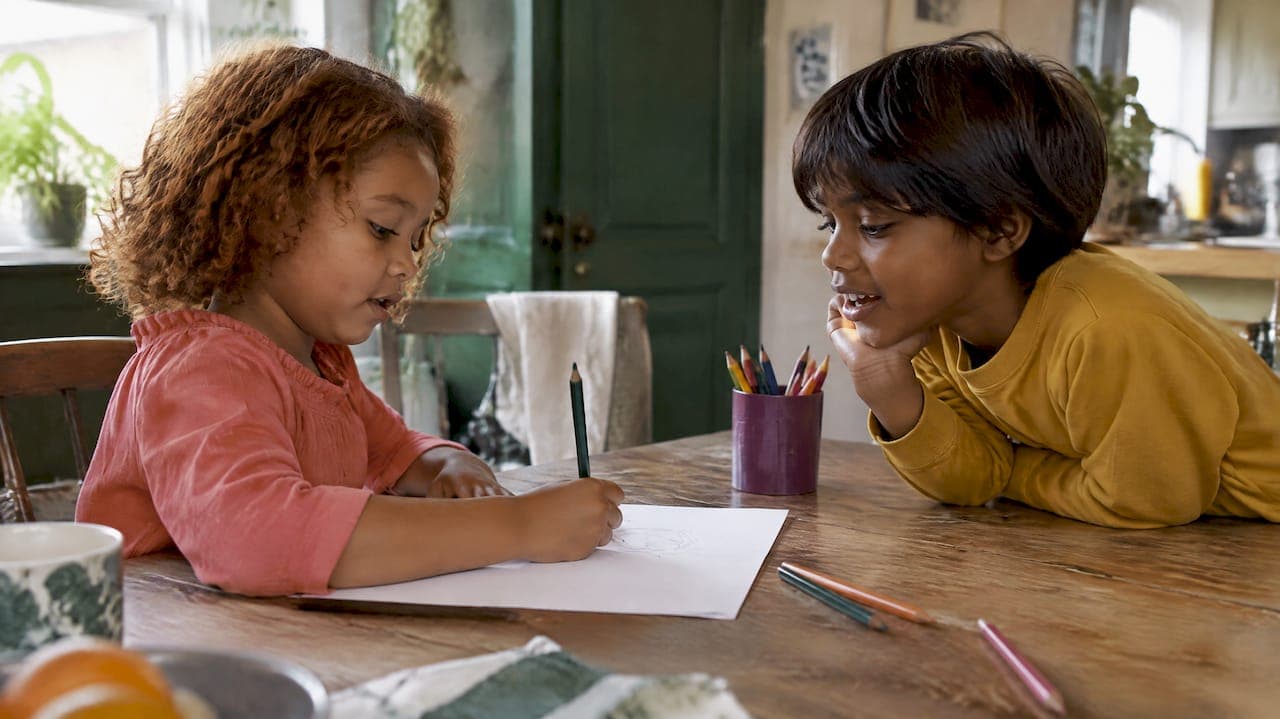
Feelings Pictionary is a drawing and guessing game where one player draws an emotion without writing the word, and everyone else guesses which feeling it is. You need paper, a marker, and a few minutes. The real work happens after the guess, when you ask the child what they drew and why. This guide covers setup, rules, feeling prompts by age, ways to adapt the game for shy or younger children, and the questions that turn a drawing into a conversation.
TL;DR
- Take turns drawing a feeling. Others guess. Then talk about what the drawing shows.
- You need paper, markers, and a timer. One-minute turns work well.
- Start with four to six basic feelings for ages 3 to 5. Add more nuanced words for ages 6 to 8.
- Let children choose whether and how to share. Never force a drawing or an explanation.
- The guess is not the goal. The talk after the drawing is.
Table of Contents
- What feelings Pictionary is and why it works
- What you need to play
- How to play, step by step
- Which feelings to use as prompts
- Questions to ask after each drawing
- Adapting the game for different children
- Variations to keep the game fresh
- Using the game at home and in the classroom
- Our perspective
- Take the game further with Duckwave Decks
- Related activities after the game
- FAQ
- Sources
What feelings Pictionary is and why it works
The game is simple. According to a guide to emotional regulation games from a professional therapy organization, players take turns drawing emotions, and the others guess which emotion is illustrated. The same guide says the group can then discuss why certain symbols or colors were chosen.
That second step matters most. A child who draws a storm cloud for "angry" has already told you something: how they picture the feeling. Asking "What is happening in your cloud?" opens a door that "How do you feel?" often does not.
There is a developmental reason this suits ages 3 to 8. NAEYC notes that preschoolers become better at expressing their own emotions and identifying other people's, and that they represent their world through pretend play, symbols, drawings, and words. Drawing a feeling fits right into that.
NAEYC's 2023 article on story circles, art, and play adds that storytelling, art, and play can help young children express and process fears, stress, and experiences they may be less able to talk about directly. For a child who goes quiet when asked about their day, a marker can be an easier way in.

What you need to play
Keep the setup light. National PTA's feelings activity recommends paper, a marker or other writing tool, a timer, and either an open area or a table. It uses one-minute turns.
Here is a practical kit:
- A stack of scrap paper or a small whiteboard
- Markers or crayons (one color is fine, but a few colors invite richer talk about color and mood)
- A timer, ideally one the children can see
- A set of feeling cards, or slips of paper in a bowl
- A "pass" card, so no one feels trapped
You can make the cards yourself in five minutes. Write one feeling per slip. Add a small face sketch next to each word for children who are still learning to read.
How to play, step by step
- Pick a feeling. The drawer chooses a card or slip without showing anyone.
- Set the timer. One minute is a good start. For ages 3 to 4, skip the timer or stretch it to two minutes.
- Draw. No letters, no words. Faces, colors, weather, animals, and scenes are all fine.
- Guess. Others call out feelings. Praise good guesses, even when they are wrong. "Frustrated is close to angry!"
- Reveal and talk. The drawer shares the feeling word. Then you ask a question or two (see the list below).
- Swap roles. Everyone, including the adult, takes a turn drawing.
That last point is easy to skip and worth keeping. When you draw "nervous" and explain it in one sentence, you show children how an adult names a feeling without drama.
A sample round
A six-year-old draws a small circle in the corner of the page and a huge empty space around it. Her dad guesses "sad." Her brother guesses "lonely." She says the word is "shy." Dad asks, "Where would you be in that picture?" She points to the circle and says, "Here, at the new school."
Nobody had to ask "Are you nervous about school?" The drawing did it.
Which feelings to use as prompts
Start where the child already is. Younger children do best with a handful of clear, distinct feelings. As they grow, add words that sit between the big ones.
A printable card set for ages 3 to 8 on Teachers Pay Teachers lists feelings such as happy, sad, angry, scared, excited, calm, surprised, shy, proud, and worried, plus twenty more. That is a useful range to borrow from.
| Age | Good starting feelings | Add when ready |
|---|---|---|
| 3 to 4 | happy, sad, angry, scared | surprised, sleepy |
| 5 to 6 | excited, calm, shy, proud, worried | silly, grumpy, lonely, jealous |
| 7 to 8 | frustrated, nervous, embarrassed, disappointed | left out, overwhelmed, hopeful, grateful |
If you want a longer progression with scripts, our guide to emotion vocabulary for kids breaks feeling words into three age bands.
Two tips on choosing prompts:
- Mix pleasant and hard feelings. A game with only happy words teaches children that the others are not welcome.
- Add situations once feelings are easy. "How would you feel if your tower fell over?" gives the drawer a scene to draw, not just a face.
Questions to ask after each drawing
The guess ends in seconds. The conversation can run a minute or two, and that is the part that builds language. NAEYC recommends exploring emotions through words and facial expressions, creating art that depicts feelings, and discussing ways children can regulate emotions. These questions follow that path.
Describing the drawing
- "Tell me about your picture."
- "Why did you choose that color?"
- "What is the person (or animal) in your drawing doing?"
Connecting to real life
- "Have you ever felt like this? What was going on?"
- "Where do you feel it in your body?"
- "What does this feeling look like on someone's face?"
Thinking about what helps
- "What could the character in your picture do next?"
- "What helps you when you feel this way?"
- "What would you say to a friend who felt like this?"
Pick one or two, not all nine. A child who has just drawn will answer best to a short, curious question.
NAEYC's guidance on process-focused art recommends noticing and commenting on children's work. So try "I see lots of red lines" before "What is that?" Describing what you see keeps the drawing from feeling graded.
Adapting the game for different children
No single version fits every child. These changes keep the game inclusive.
For ages 3 to 5
CASEL says preschoolers are still developing their understanding of basic emotional expressions and situations, often with adult help, and are beginning to follow social rules like taking turns. So:
- Pair the child with a helper. National PTA suggests pairing younger children with an older family member who can help them choose emotions and guess together.
- Use four feelings only, with pictures on the cards.
- Let scribbles count as drawings. A fast red zigzag is a real answer.
- Skip the timer, or use it as a friendly sand-clock rather than a deadline.
For ages 6 to 8
CASEL describes elementary-aged children as increasingly able to regulate emotions in peer settings and to solve more complex social problems with flexible solutions. They can handle more:
- Use nuanced words such as disappointed, embarrassed, or left out.
- Ask the guessers to explain why they guessed what they did.
- Add a second round where the drawer shows a feeling in a small scene, such as "a time you felt proud."
For shy or sensitive children
Some children will not want to draw in front of others. That is fine. NAEYC's trauma-informed article supports giving children agency over whether and how to share, using predictable structures, and keeping the setting emotionally safe. In practice:
- Offer a "pass" that has no follow-up questions.
- Let the child draw privately and show the picture only if they wish.
- Let them point to a card instead of speaking the word.
- Keep the routine the same each time: same table, same cards, same timer.
- Never ask "Why are you so shy?" Ask what the drawing needs, such as "Does it need more blue?"
If a child's drawings keep returning to fear, loss, or conflict in a way that worries you, bring it to your school counselor or the child's pediatrician or therapist. A game is not a screening tool.
For different communication abilities
Not every child will draw or speak the same way. Offer choices: pointing to a face chart, building the feeling out of clay, acting it out, or choosing a color. Our 10 to 20 minute feelings charades guide gives no-prep scripts for the acting version, which is a good swap when drawing is hard.

Variations to keep the game fresh
After a few rounds, children may want a twist. These are variations you can try as an adult leading the game. They are suggestions from practice, not research findings.
- Team relay. Two teams line up. Each child draws one line of a feeling, then passes the marker. The team guesses together.
- Color only. The drawer may use just colors and shapes, no faces. This is a good stretch for ages 6 to 8.
- One-line feelings. Draw the feeling with a single unbroken line.
- Silent gallery. Everyone draws the same feeling at once. Then you walk around and compare. Children see that one feeling can look many ways.
- Story step. After the guess, the drawer adds one sentence about what happens next in the picture.
- Body check. Before drawing, the child places a hand on the spot where they would feel the emotion.
- Mystery partner. Pairs draw back to back, then match drawings to the feeling cards.
For more structured options, see our collection of classroom feelings games and the longer list of social emotional games mapped to six SEL skills.
Using the game at home and in the classroom
At home
Play for ten minutes after dinner or before bed. Keep it short. Stop while the children still want more. A weekly game builds more than one long session.
It also pairs well with a small family routine, like the 1 to 10 feelings rating that lets everyone say how big a feeling is.
In a classroom or group
Use the game as a ten-minute morning meeting, a transition activity, or a small-group counseling warm-up. NAEYC says kindergarten teachers help children recognize, talk about, and express emotions, show concern for others, and develop self-regulation. A weekly feelings drawing round supports all of those.
If you want to build the game into a longer unit, see our 6 to 8 week plan to teach emotions to kids. Homeschool families can look at our homeschool SEL activities.
A structured program is another route. CASEL's program guide lists Yale's RULER Approach as serving grades K to 8, with evidence of effectiveness in pre-K and in grades 5 and 6, and says it addresses individual, cultural, social, and contextual differences in emotional expression. That last point is worth remembering in any group: children from different families and cultures may show the same feeling in different ways, so accept every drawing as valid.
Our perspective
At Icon Literary, we build stories and tools for children ages 3 to 8, and we think about feelings in a specific way. We do not want emotional learning to feel like a lecture. Children pick up on a lesson in the first ten seconds, and many of them tune out.
That is why a drawing game works so well. It is playful, it has no right answer, and the child is in charge. The adult's job is to be curious, not corrective. When we design characters and stories, we aim for the same thing: feelings shown with humor, color, and a little chaos, so children can recognize themselves without being told what to feel.
If you play feelings Pictionary, let the drawings be strange. A purple blob with eight eyes can be "nervous." Ask about the blob.
— Derek Amarillas
Take the game further with Duckwave Decks
If you want ready-made cards instead of making your own, our Duckwave Decks are $7 one-off. They come from the Duckwave Universe, our original character world for children. You can also explore Socko's Universe in our catalog, or see the member site for ongoing content. Picture books can pair well with the game too: read a story, then draw how a character felt. Our list of books for teaching kids empathy is a good place to start.
Related activities after the game
Once children are comfortable drawing feelings, you can move into other formats:
- Sorting. Cut the drawings out and sort them into groups (calm, big, wobbly). Our emotion sorting activities need about ten minutes of setup.
- Collage. Make a feelings collage from paper scraps. Our process art collage guide runs 20 to 40 minutes and suits ages 3 to 10.
- Feelings journal. Staple the week's drawings into a small booklet. Children can flip back and see how many different feelings they have named.
Process art matters here. NAEYC reports that process-focused art, which has no single right answer, can help children relax, focus, feel successful, express feelings, discuss their art, plan, problem-solve, and develop fine-motor skills. That is a good list of reasons to put the marker in a child's hand.
FAQ
What age is feelings Pictionary best for?
It works from about age 3 up to 8 and beyond, with changes by age. Use pictures and four feelings for the youngest, and nuanced words like embarrassed or disappointed for older children. Younger children do better when paired with an older helper.
How many players do you need?
Two is enough: one adult and one child. Larger groups can play in teams or in pairs. In big groups, keep turns short so no child waits too long.
What if a child will not draw?
Do not push. Offer a pass, let them choose a color or point to a face card, or let them act the feeling out instead. Children need to feel safe before they share, and the game should always allow them to say no.
Do you need special cards?
No. Slips of paper with one feeling word each are enough, and you can add a small face sketch for children who cannot read yet. Printed decks save prep time if you play often.
Sources
- 100 Emotional Regulation Games: A Guide for All Ages
- Animal Emotion Cards for Kids, 30 Printable Feelings Flashcards
- National PTA: Social Awareness, Feelings Charades
- CASEL: Keeping SEL Developmental
- CASEL Program Guide: RULER Approach
- NAEYC: Using Story Circles, Art, and Play to Support Children's Healing
- NAEYC: How Process-Focused Art Experiences Support Preschoolers
- NAEYC: Developmentally Appropriate Practice with Preschoolers
- NAEYC: What Do Children Learn in a High-Quality Kindergarten?
- NAEYC: Preparing Young Children for School