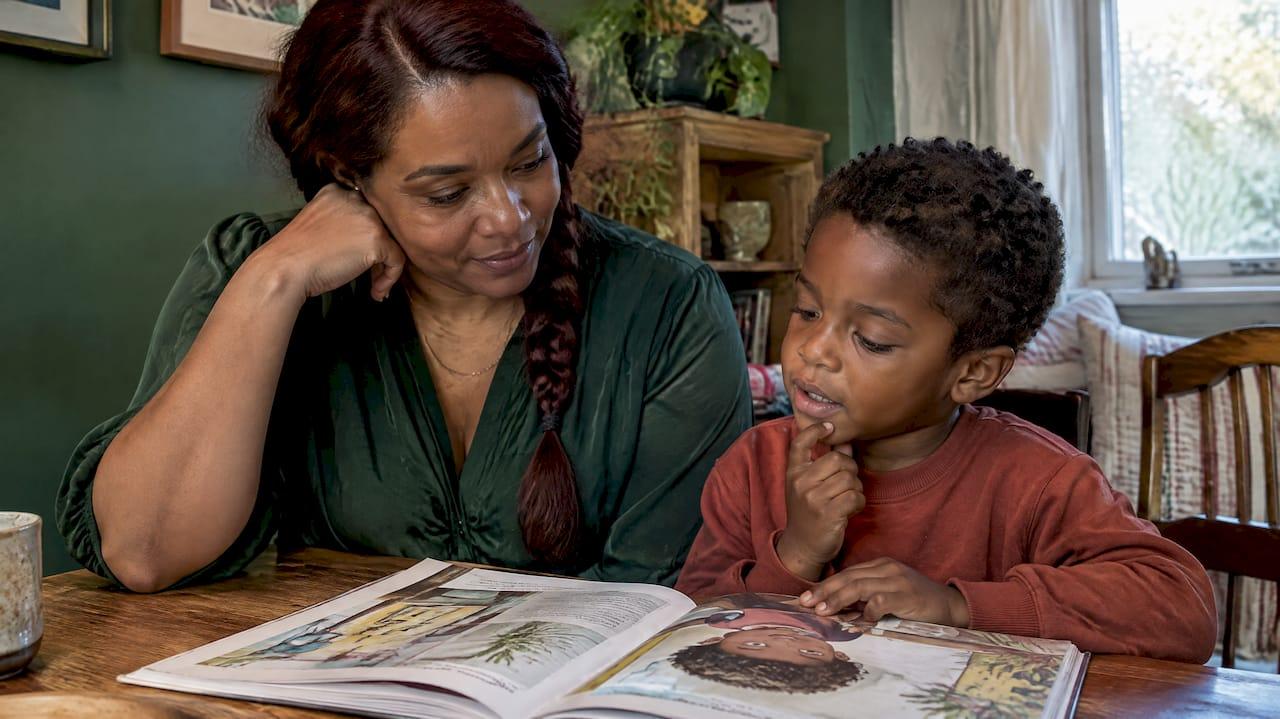
You teach empathy with stories by doing three things. Choose books with characters who feel real feelings. Pause while you read to talk about those feelings. Then connect the story to your child's or students' own lives. The book opens the door, and the conversation around it does the teaching. This guide shows you how, step by step, for children ages 3 to 8.
TL;DR
- Pick stories with expressive characters, including some who are different from your child. They give children a safe way to try on another person's view.
- Pause during the story. Ask how a character feels and how you can tell from the words or the pictures.
- Link the story to real life: "Have you ever felt that way?" Then wait for the answer.
- Look at the pictures. Faces and body language are a first lesson in reading feelings.
- Make it a habit. Short, regular read-alouds build more than one big talk.
Table of Contents
- Why stories work for empathy
- Choose stories that open windows and mirrors
- A simple read-aloud routine
- Questions that build empathy
- Connect the story to everyday life
- Let the pictures do the talking
- Adjust for age
- Make it a habit
- Our perspective
- Try Duckwave Decks at home or in class
- FAQ
- Sources
Why stories work for empathy
A story lets a child live inside someone else's day. A child can feel a character's worry about a first day at school without feeling that worry in their own body. That distance makes hard feelings easier to talk about.
The research points the same way. BBC Teach notes that storytelling helps children understand what others think and feel. It also notes that children who read fiction regularly tend to show more empathy and better-developed theory of mind. Theory of mind is the ability to understand that other people have thoughts and feelings different from your own.
A 2025 meta-analysis of storybook reading in children aged 2 to 10 found a medium positive effect on empathy skills (Cohen's d = 0.72). The clearest gains showed up in prosocial behavior, such as sharing, helping and comforting. That is useful for planning. When you read, point children toward what a kind action looks like, not only how a character feels.
The way you read matters too. The Crane Center at Ohio State University notes that research favors read-alouds where children ask and answer questions over those where they only listen. Analytic talk, such as predictions and inferences, is the most effective kind.

Choose stories that open windows and mirrors
Not every book does the same work. When you choose, think about what the story gives your child.
Ali Cashin of Harvard's Making Caring Common project describes stories in three ways:
- Windows open onto other people's lives.
- Mirrors let children see pieces of themselves in others.
- Sliding doors help children apply what they learn to everyday life.
A book list developed with the American Academy of Pediatrics makes the same point. It advises choosing books that work as both mirrors and windows. It also advises looking for diverse authors and illustrators, and for characters in everyday roles who are not reduced to stereotypes.
There is a reason to include characters who are unlike your child. Natalia Kucirkova's review of storybooks and empathy points out that identifying with dissimilar characters is among the most valuable things books offer. It challenges the biases children already hold. A shy child who reads about a loud, bold character, or the reverse, practices seeing the world from a new spot.
A quick checklist for picking a book
- Does the character show feelings in more than one way? Look for feelings shown in words, faces and body language.
- Is there a problem a child can recognize? Lost toys, left-out friends and big changes all work well at ages 3 to 8.
- Do the characters come from different backgrounds? Give children both mirrors and windows.
- Does the story avoid telling children what to feel? Good stories leave room for children to notice and decide.
- Do you enjoy it? You will read it more than once, and your interest shows in your voice.
For longer lists and criteria, see our guide to the best books for teaching kids empathy and our practical guide to selecting inclusive children's books. If you want to know why representation matters for all children, read why inclusive books benefit every child's growth.
A simple read-aloud routine
You do not need a lesson plan. This four-step routine fits a bedtime story or a circle-time book.
Step 1: Preview and pick a pause point
Skim the book first. Mark two or three spots where a character's feelings change. Those are your pauses. Fewer pauses are better than many, because too many questions interrupt the story.
Step 2: Read with expression
Let your voice show how the character feels. Slow down at a sad moment. Speed up when the character is excited. Children learn to link tone with feeling.
Step 3: Pause and name the feeling
At a marked spot, stop and look at the page together. Ask what the character is feeling and how you know. If your child is unsure, model it. The Crane Center suggests saying something like: "I think this character is angry. I can tell by her frown, and how she's clenching her fists." Then follow with a prediction question: "What do you think she's going to do?"
Step 4: Connect and close
After the story, link it to life. Ask what your child would have done, or whether anything like it has happened to them. Keep it short. One good question beats five rushed ones.
Adults who read with young children will find more on this in why reading aloud matters from the earliest days. The habit starts long before children can talk about feelings.
Questions that build empathy
The questions below come from several education and literacy sources. Use them as prompts, not a script. Change the wording to suit your child.
| Goal | Question to ask | Source |
|---|---|---|
| Read the clues | "Do you hear words that help you know how the character is feeling? Do you see a clue in the pictures?" | PBS Parents |
| Name the feeling | "Can you name some of the feelings the character might be feeling? Have you ever felt that way?" | Greater Good in Education, UC Berkeley |
| Infer thoughts | "What do you think the character is thinking in this situation? How do you know?" | Greater Good in Education, UC Berkeley |
| Look at faces | "How do you think she's feeling right now?" while looking at the illustration | North Carolina Department of Public Instruction |
| Take another view | How might a different character feel about the same moment, not only the hero? | Making Caring Common |
| Connect to self | "How would you have felt if that happened to you?" | BYU College of Liberal Studies |
The Reading Rockets article on dialogic reading describes this last kind of question as one that distances the child from the text and ties the story to their own life. Examples include asking who the main character was and how he felt, and how the child would feel if that happened to them.
Ask about more than the main character
It is easy to stay with the hero. Try asking about the friend who watched, the sibling who was left out, or the creature in the background. Making Caring Common recommends asking how different characters might feel about the same situation. This is perspective taking in its simplest form. For hands-on ideas, try our perspective taking activities for kids ages 3 to 8.
Connect the story to everyday life
A story teaches most when it touches something the child knows. The Hanen Centre calls linking a book to a child's life one of the best ways to build story understanding. It helps children see why characters feel and act as they do.
The Hanen Centre gives an example. A character's day goes wrong, and the adult says it is like the time your block tower fell and you lost your mitten, and you felt so frustrated, just like the character. Then the adult pauses so the child can add their own thoughts. The pause is the important part. Give the child time.
Here are some ways to make the link:
- Use a memory. "Remember when your friend couldn't come to the party? That might be how she feels."
- Use the classroom. Teachers can ask, "If that happened in our class, what could we do?" This turns a feeling into an action.
- Use other books. Reading Rockets notes that children can connect a book to their own life, to other books, and to big ideas. Adults can model a think-aloud so children hear how readers talk to themselves while reading.
- Use a routine. Harvard's Graduate School of Education describes a Story Reflections strategy. A parent reads, watches or listens to a story with a child, then uses a short list of questions about a character's feelings to relate the talk to the family's own experiences.
Listen and build on what children say
When your child answers, repeat and expand it. If she says, "He's sad," you might say, "He's sad because his friend didn't pick him." This shows you are listening. It also gives her more words for feelings. Modeling sincere listening is itself a lesson in empathy.
The same idea applies in group settings. The three characteristics of effective learning show how adults can support children by responding to what they do and say, rather than only leading.
Let the pictures do the talking
Children aged 3 to 8 read faces before they read words. Picture books give you a way to practice. EmpathyLab, a UK organization, says illustrations are especially good for "reading" other people and can show how a character feels.
Try this: cover the text on a page and ask, "What is happening here? How does she feel?" Then uncover the text and see whether the words match. You can also ask about the eyebrows, the shoulders and the colors. Our article on how illustrations shape literacy goes deeper. For a book with no words at all, see our wordless picture books and the questions that build empathy.
Adjust for age
These are practical guidelines, not fixed rules. Every child moves at their own pace.
Ages 3 to 4. Keep it to naming feelings. Point at the face and ask, "Is he happy or sad?" Offer two choices if open questions feel too hard. Repeat favorite books often.
Ages 5 to 6. Ask how you know. Children can start to point to clues in the words and pictures. Add "What do you think will happen next?" to build prediction.
Ages 7 to 8. Invite different viewpoints. Ask how two characters see the same event. Ask what the child would do and why. Children this age can often talk about fairness and about how actions affect others.
For group play that reinforces the same skills, our empathy games for kids are built for ages 3 to 8. Preschool teachers can also read about storytelling for emotional learning aligned with CASEL.

Make it a habit
Empathy grows through repeated practice. A five-minute story with one good question each day adds up more than a long talk once a month. Some ways to build the routine:
- Pick a regular time, such as after dinner or before nap.
- Let your child choose the book, then add one you choose.
- Reread favorites. Children notice new details each time, and a second reading lets them answer questions they skipped.
- Share your own feelings in plain words. When you say, "I felt nervous today," you show that feelings are normal to talk about.
For more on why this kind of reading pays off, see our overview of the benefits of reading emotional books to kids.
Our perspective
We make stories for children ages 3 to 8, and we start from one belief: children learn about feelings best when they are not lectured about them.
That is why our stories, decks and activities are designed to promote emotional literacy without didacticism. We build original, character-driven worlds. The emotional themes are subtle and indirect, so a child can notice a feeling, name it and talk about it in their own words. We aim for design that is visually engaging and developmentally attuned, because a child who enjoys looking at a page stays with it longer.
We also believe stories should celebrate individuality and creative expression. A child who sees a character who is quirky, shy or loud, and who is still the hero, learns that many ways of being are welcome. That is a first step toward empathy for others.
The best tool is still the conversation you have around the story. Our books and cards are made to start that conversation: a character to talk about, a feeling to name and a picture to study together.
Derek Amarillas
Try Duckwave Decks at home or in class
If you want a ready way to start the conversation, look at our Duckwave Decks. They are themed card decks set in the Duckwave Universe, available for $7 one-off. Characters and cards give children something to hold, look at and talk about. That makes them easy to use at the kitchen table, in a reading corner or in a small group.
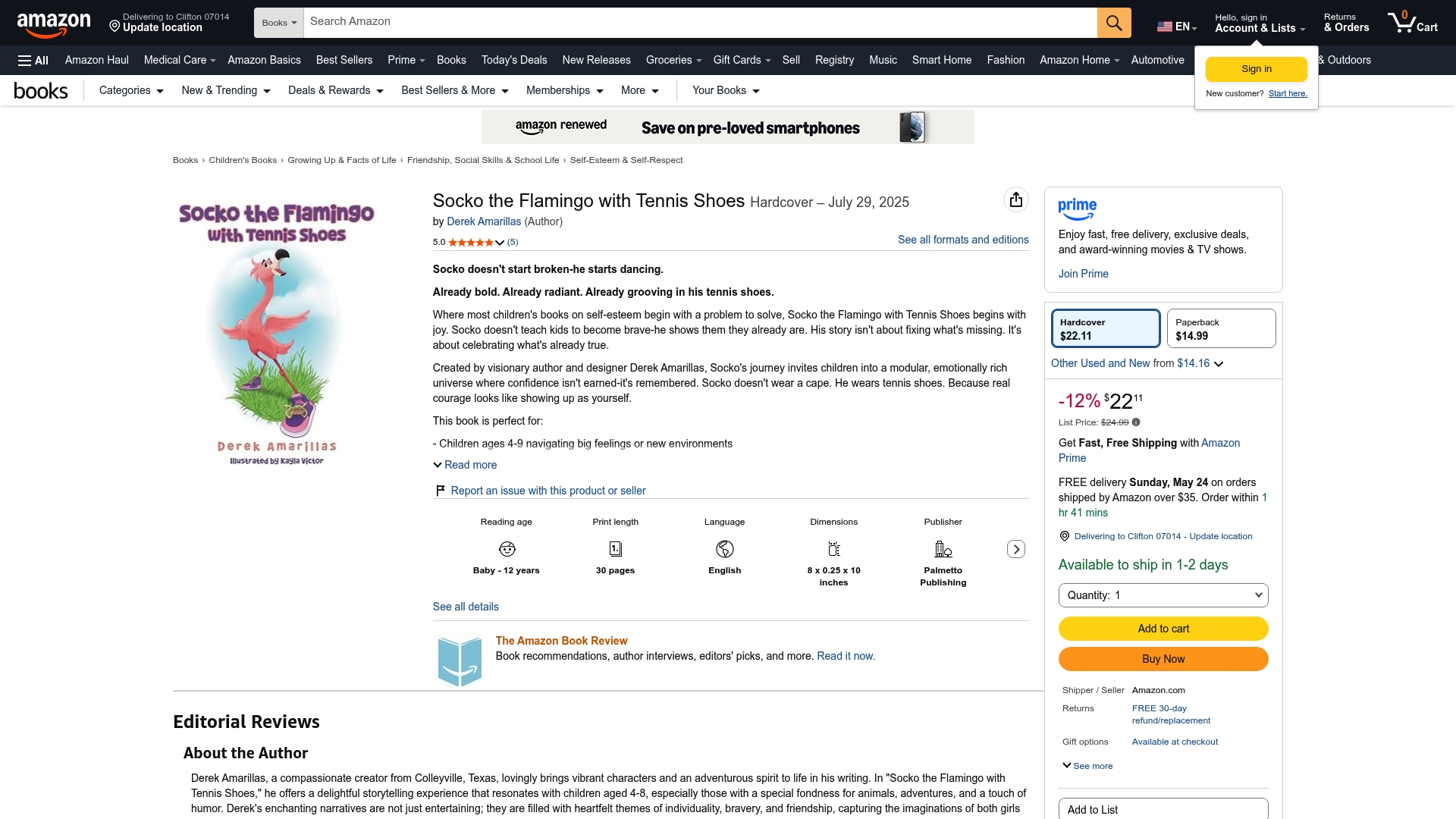
You can also browse more of our books and story worlds, including Socko's Universe, in the Icon Literary catalog. Educators and librarians who want ongoing material can visit the member site.
FAQ
What is the best way to teach empathy?
There is no single best way, but the most reliable approach combines modeling and conversation. Show empathy in how you listen and respond. Then use stories to practice it by asking how characters feel and how your child would feel in the same place. Do it often and keep it short.
How does storytelling build empathy?
Stories let children step into another person's view and see what that person thinks and feels. BBC Teach reports that children who read fiction regularly tend to show more empathy and better theory of mind. The conversation around the story strengthens the effect.
What type of stories promote empathy?
Choose stories with characters who show their feelings clearly and face problems children can relate to. Include both mirrors, which reflect your child, and windows, which show other lives. Characters who differ from the reader are especially valuable, because they challenge existing biases.
Do I need special books to do this?
No. Any story with emotion in it can work, as long as you pause, ask and listen. Books with strong illustrations make it easier, because children can read feelings from faces and body language. Wordless books work too, since the child tells the story.
How many questions should I ask during one story?
Two or three is plenty for most children. Choose moments where a feeling changes. If the child is absorbed, let the story run and save your question for the end.
Sources
- Why is storytelling important to children? (BBC Teach)
- How to Use Stories to Help Kids Develop Empathy (Making Caring Common, Harvard)
- How the Type and Context of Children's Storybook Reading Affect Empathy (Taylor & Francis, 2025)
- Interactive read alouds: tips for parents and caregivers (Crane Center, Ohio State University)
- Reading diverse and inclusive books (Reach Out and Read booklist, 2020)
- How Could Children's Storybooks Promote Empathy? (PMC, 2019)
- Practicing Empathy During Storytime (PBS Parents)
- Fostering Empathy Through Literature, Elementary Level (Greater Good in Education, UC Berkeley)
- Comprehension for Kindergarten (NC DPI)
- Questions to Ask Your Student Before, During and After Reading (BYU College of Liberal Studies)
- Dialogic Reading: Having a Conversation about Books (Reading Rockets)
- Relating to Children's Experiences with Franklin (The Hanen Centre)
- Reading Aloud to Build Comprehension (Reading Rockets)
- Read for Empathy 3-11 Guide (EmpathyLab, 2025)