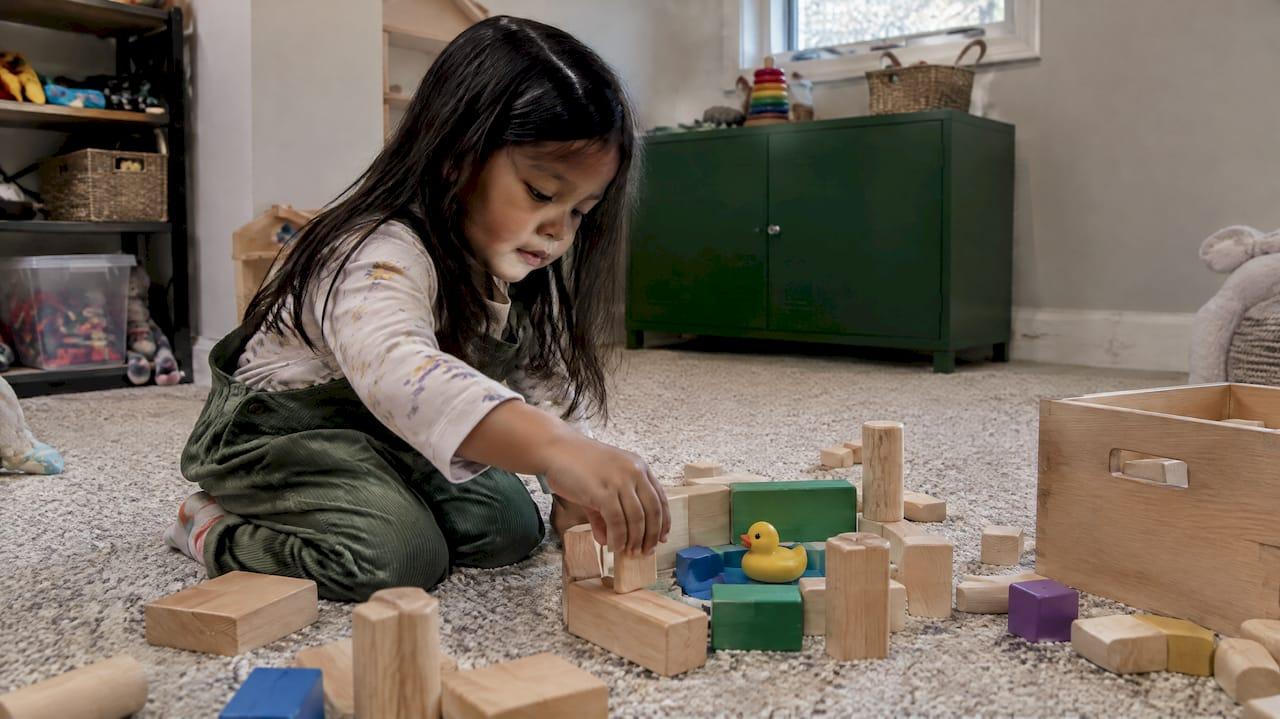
To build a story world with a young child, start small. Pick one place, one problem and two or three rules, then let the child's questions fill in the rest. A world is the place where a story happens, plus the rules that decide what can happen there. You do not need maps, invented languages or a binder of notes. This guide gives you seven steps you can finish in one sitting at the kitchen table, in a classroom center or in a library program.
TL;DR
- Start with a premise: one promise to the listener and one problem facing the main character.
- Give the world two or three simple rules, and keep them the same from page to page.
- Show the world through an ordinary day, with what characters eat, play and worry about.
- Check for contradictions at the end, then keep most of the extra details unused.
- Kids ages 3 to 8 can do every step with paper, crayons and a few good questions.
Table of Contents
- What a story world is, and why young children need one
- Step 1: Start with one promise and one problem
- Step 2: Give the world two or three rules
- Step 3: Decide where things happen
- Step 4: Fill in an ordinary day
- Step 5: Add characters who see the world differently
- Step 6: Check for contradictions
- Step 7: Keep most of it hidden
- A worked example: the pond world in 15 minutes
- What to expect at each age
- Our view: a world should carry feelings, not lessons
- Take your world further with Duckwave Decks
- FAQ
- Sources
What a story world is, and why young children need one
Worldbuilding is the work of creating a fictional world's history, geography, culture and social structures. That is how Reedsy's worldbuilding guide describes it for adult writers. For a child, the same idea is much simpler: where does this story live, who lives there, and what is normal there?
A story world is different from a setting. Writer's Digest notes that, per Merriam-Webster, the term is most often used for a component of a work of fiction, like plot or character. It also stresses that the world is entirely new, not just a backdrop.
Why does this matter for ages 3 to 8? A child who has a world to play in tells longer, more confident stories. The world holds the rules, so the child does not have to invent everything at once. Shy or sensitive children often find this freeing. They can try out big feelings through a character who lives in a made-up place, instead of talking about themselves directly.
A world can also be tiny. One pond, one bedroom, one bus stop or one cloud is enough.

Step 1: Start with one promise and one problem
Writers are told to begin with the premise. Fantasy author Taran Matharu says the foundation is the premise, such as a world where dragon riders war with necromancers. His advice is to summarize the world in a sentence or two, then build out the key elements.
For a young child, turn that into two questions:
- What kind of story is this? (Silly? Cozy? Spooky but safe? A big adventure?)
- What does the main character want, or what is going wrong?
Write the answers as one sentence. For example: "A very small duck lives on a very loud pond and wants one quiet afternoon."
Where it goes wrong: Adults often start with a map or a long list of names. Young children lose interest fast. Begin with the problem. Places and rules can come after.
If a child is stuck, offer two choices, not an open question. "Is the pond loud or silent?" is easier to answer than "What is your world like?" Our storytelling prompts for kids are sorted by age if you want ready-made starters.
Step 2: Give the world two or three rules
Every world runs on rules. Faustica's method calls this defining the rules of the extraordinary, and suggests capturing a rule in one sentence you can check, such as "what comes in pushes something out."
Kids can do this with a simple frame: "In this world, ___ always happens, and ___ never happens."
- In the pond world, puddles can talk, but only when it rains.
- In the pond world, nobody is allowed to shout after sunset.
- In the pond world, every duck has one lucky feather, and it changes color with its mood.
Three rules is plenty. Write them on a card or a sticky note and keep them where the child can see them. Children aged 3 to 5 can draw the rule instead of writing it. Children aged 6 to 8 can write it and add an example of what happens when someone breaks it.
Where it goes wrong: Too many rules. If a child makes up a rule and then forgets it two minutes later, that is normal. Do not correct it. Just ask, "Is that a new rule, or should we change the old one?" That small question is the beginning of consistency.
Step 3: Decide where things happen
Now add three places the character can go. Winter Signal Press points out that a world does not have to be a whole continent: its framework applies to one city, region, institution or journey inside a smaller story. A child's world works the same way.
A good starting set:
- A home place: where the character feels safe.
- A busy place: where things go wrong or get loud.
- A mystery place: somewhere the character is curious about or a little afraid of.
Have the child draw each one on a separate sheet of paper. Ask what you can hear, smell and feel there. Writer Elizabeth Carlton recommends exploring a new place through a character's senses, such as sight, touch, weather, sound and smell, rather than fixing every detail at once. For a 4-year-old, "What does the mud feel like?" works better than "Describe the setting."
If you teach a group, our post on classroom-ready worldbuilding activities using only paper lays out ways to turn these drawings into a shared wall map.
Step 4: Fill in an ordinary day
A world feels real when ordinary life is in it. We Need Diverse Books advises showing what normal looks like for an average citizen on an ordinary Wednesday: where the captain buys sweets, which tea the admiral prefers. Small daily details make a whole society believable.
Try these questions with a child:
- What do the characters eat for breakfast?
- What do they do when they are bored?
- What do they wear when it is cold?
- What is the best thing to do on a Saturday?
- What is a bad day like here?
That last question matters for emotional learning. When a child decides what a bad day looks like in their world, and how characters cope with it, they are practicing the language of feelings. They are also doing it from a safe distance.
For teachers and counselors, this step is a gentle way to hear what a child thinks about worry, anger or loneliness without asking them directly.
Step 5: Add characters who see the world differently
The same place looks different to different people. Faustica suggests letting different characters, such as a blacksmith, an archivist or a knight, experience the same city differently, which shows more of the world than any description.
In a child's world, this can be as simple as asking: "What does the loud pond feel like to the tiny duck? What does it feel like to the big goose?" One finds it exciting. The other finds it exhausting. Neither is wrong.

This is also a natural place to include different kinds of characters: shy ones, bold ones, ones who learn in different ways, ones with different families and traditions. A world with many kinds of characters teaches children that people feel and cope in different ways. If you want help, see our guide to co-creating a character with kids in 10 to 20 minutes.
Step 6: Check for contradictions
We Need Diverse Books gives a clear test: no element of worldbuilding should contradict another. Its example is a mayor who bans Sunday business, so the hero cannot get a Sunday haircut five chapters later.
The kid version is a quick read-aloud check:
- Read the three rules out loud.
- Read the story so far.
- Ask, "Did anyone break a rule? Was it on purpose?"
Breaking a rule on purpose can be the best part of a story. Breaking it by accident is just confusing. Teaching a 7-year-old to tell the difference is a real writing skill.
You can also tie this to story shape. Our post on teaching kids story structure by grade shows how beginning, middle and end fit with a world's rules.
Step 7: Keep most of it hidden
You will end up with more ideas than the story needs. That is fine. Faustica calls this the iceberg principle: record more than appears in the book. Brandon Sanderson warns about the opposite problem, which he calls worldbuilder's disease: overdeveloping elements that do not serve the story until writing never starts. His fix is to pick a few elements to develop deeply and let the rest stay unseen.
With children, the sign you are overdoing it is simple: they stop playing. If the child is drawing the ninth map and has not told a story yet, say, "Let's go meet the duck."
A worked example: the pond world in 15 minutes
Here is how one short session might go with a 5-year-old.
| Minutes | Step | What the child says or draws |
|---|---|---|
| 0 to 3 | Premise | "A little duck wants one quiet afternoon on a loud pond." |
| 3 to 6 | Rules | Puddles talk only when it rains. No shouting after sunset. |
| 6 to 9 | Places | Home reeds, the Splash Dock, the Whisper Log. |
| 9 to 12 | Ordinary day | Breakfast is bugs on toast. A bad day is when the puddles gossip. |
| 12 to 15 | Characters | A tiny duck who loves quiet and a goose who loves noise. |
After that, the child tells the story aloud while you write it down, or draws it as a short comic. Our step-by-step plan for making a comic with kids picks up from here.
What to expect at each age
| Age | What works | Adult role |
|---|---|---|
| 3 to 4 | Drawing one place and naming one character | Ask two-choice questions and write down what they say |
| 5 to 6 | One premise sentence, two rules, three places | Keep the rule card visible and ask about rule changes |
| 7 to 8 | Written rules, a map, a cast of characters | Ask about consequences: "What happens if someone breaks it?" |
These are starting points, not tests. Some 4-year-olds will invent whole kingdoms, and some 8-year-olds will want to stay with one drawing. Both are fine.
Our view: a world should carry feelings, not lessons
We build story worlds for a living, and the lesson we keep returning to is this: children do not need to be told how to feel. They need a place where feelings can be tried on.
That is how the Duckwave Universe is designed. Its characters, places and rules are meant to let a child recognize a feeling in a funny, strange or beautiful setting, without a lecture attached. Our approach to emotional literacy is subtle and indirect, and it is developmentally attuned to ages 3 to 8.
So when you build a world with a child, resist the urge to make it teach something. Ask what the character wants, what the rules are, and what a bad day looks like. The emotional learning arrives on its own, and it sticks because the child made the world.
Playful and polished can sit together. A world can be a little chaotic and still be carefully made. Children can tell when something has been designed with care, and they respond to it.
Derek Amarillas
Take your world further with Duckwave Decks
Once a child has a world, the next question is how to keep it going. We made the Duckwave Decks for that: themed card decks set in the Duckwave Universe, available for $7 as a one-off purchase. They give children original characters to draw from, mix and play with, and they can sit beside the world your child has just built.

You can see the decks on our Duckwave Decks page. If you are looking for picture books to read alongside your own world-building, browse our list of diverse fantasy picture books for SEL. For ongoing printables and fresh content, visit the member site.
FAQ
What is the easiest way to start building a story world with a young child?
Begin with one sentence that names a character and a problem, such as a small duck on a loud pond. Then add two or three rules and one drawn place. Offer two-choice questions to younger children, because open questions can be hard to answer at ages 3 and 4.
How many rules does a children's story world need?
Two or three is enough. More rules are harder for a child to remember, and a world only needs to be consistent with itself. If a rule changes, talk about it out loud and decide together whether it is a new rule or a mistake.
Can a story world be small, like one room or one pond?
Yes. A world can be one place, one journey or one group of characters inside a smaller story. A small world is often easier for a child to keep consistent, and it leaves room to add places later.
How do I use story worlds in a classroom or library program?
Work in small groups or whole-class circles. Have each child draw one place, then combine them into a shared map and agree on three class rules for the world. Our classroom storytelling center routines show three ways to run this in a week.
Sources
- Worldbuilding: Create Brave New Worlds, Reedsy
- What Is World-Building? Writer's Digest
- 6 Stages of Building a Story Within an Intricately Designed World, Writer's Digest
- Worldbuilding: How to Create a Fictional World, Step by Step, Faustica
- How to Build a Fantasy World That Holds Together, Winter Signal Press
- How to Begin Fictional World-Building, Elizabeth Carlton
- Worldbuilding 101: Writing Consistent Characters and Building Realistic Worlds, We Need Diverse Books
- Worldbuilding Tools from Brandon Sanderson, Lecture Notes 2025