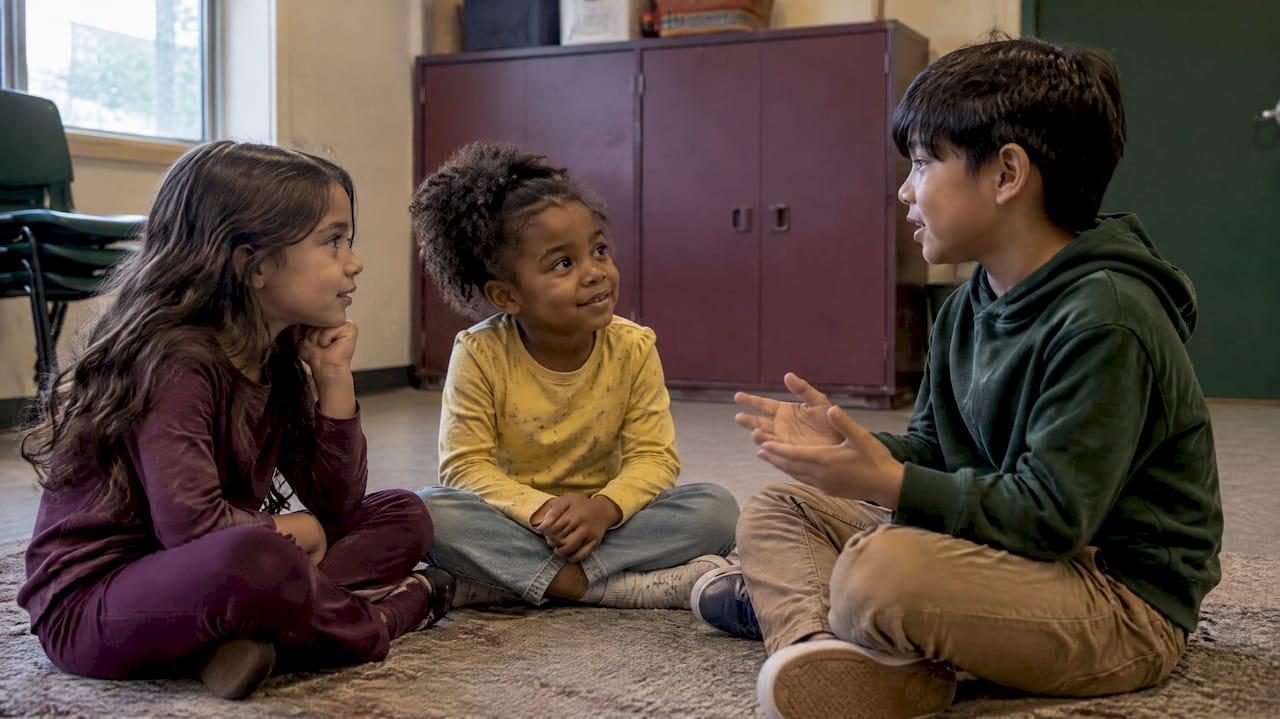
Narrative play is pretend play with a storyline: a child picks a role, invents a problem and acts out what happens next. The best activities give children a small prompt, a few loose materials and an adult who follows their lead. Below you will find activities for ages 3 to 8, what to put in a story kit, how to join the play without taking over, and how to adapt it for shy or sensitive children. Our own story worlds, card decks and activity kits at Icon Literary are built for the same purpose: giving children a way into feelings through character and story.
TL;DR
- Narrative play means children use pretend play and storytelling to make sense of the world, and it lays groundwork for reading.
- Start with a prompt: a story bag with about three small objects, a puppet made from a sock, or a "Then what happened?" game.
- Follow the child's ideas and extend them. Give time, space and loose materials rather than a script.
- Shy or sensitive children often do best with a puppet or character that speaks for them.
- Ages 3 to 5 favor adventure, home life and even scary themes. Ages 6 to 8 are ready for dice, dramatizing books and longer plots.
Table of Contents
- What narrative play is and why it matters
- How to join the play without taking it over
- Narrative play activities by age
- What to put in your narrative play kit
- Adapting narrative play for shy or sensitive children
- Using narrative play in classrooms and libraries
- Where our decks and kits fit
- Our view on narrative play
- FAQ
- Sources
What narrative play is and why it matters
Narrative play is a symbolic activity. Children use storytelling and pretend play to make sense of the world, and researchers describe it as a universal medium for learning and a foundation for emergent literacy. Children think "as if": they assume roles and build possible worlds with words and action (Cremin and colleagues, Open University, 2016). Emergent literacy simply means the early skills, such as oral language and story sense, that come before conventional reading.
The form you see most in classrooms is sociodramatic play, where several children create roles, storylines and dialogue together. The Victorian Government's early-childhood literacy toolkit calls it the most advanced form of play (vic.gov.au, 2026).
What do children get out of it?
- Language. Narrative play draws on imagination, emotion, cognition and group life, and it supports the oral-language skills that underpin emergent literacy (Nicolopoulou, 2006).
- Reading for meaning. Narrative skills built in the preschool years help children move beyond decoding words toward understanding them, according to the same chapter, which cites Dickinson and Tabors (2001).
- Making sense of experience. The Open University describes how children reconstruct lived events, such as a visit to the doctor, into scenarios they can understand (OpenLearn).
That last point matters for parents, therapists and counselors. A child who replays a doctor visit with a stuffed bear is not just playing. They are organizing their personal world and their sense of who they are.
How to join the play without taking it over
Most adults ask the same question: how do I take part without turning it into a lesson? Three habits cover most of it.
Follow the child's lead, then extend
Caregivers support play by following the child's lead and extending it in response to the child's ideas (Resources for Early Learning). In practice: if your five-year-old announces that the blocks are a bakery, you become a customer. You do not announce that the bakery needs a sign and a price list. Once the bakery is running, you can wonder aloud: "What happens when the oven breaks?" The child decides the answer.
Give time, space and materials
Penn State's Better Kid Care program notes that substantial time for self-directed play, plus plenty of space and materials, can reduce the conflicts and frustrations that limit children's play (Penn State Extension). A fifteen-minute slot squeezed between other tasks rarely lets a plot develop. If you can protect 30 to 45 minutes, the story gets a middle and an end.
Step in as a character when you have a goal
Educator Margit McGuire describes "guided play," where a teacher joins a child's narrative as a character, such as a postal worker in a classroom post office. This lets the adult introduce a specific concept, like addressing mail or solving a problem, while the child's interest stays at the center (Social Studies School Service blog, 2019). Teachers and homeschool parents can use this when a learning goal is in mind. The rule: your character asks questions and has needs. Your character does not give orders.

Narrative play activities by age
Between ages 3 and 5, pretending becomes more complex, with more roles, more elaborate storylines and richer themes (Penn State Extension). By 6 to 8, children can hold a plot across a whole session and want rules, props and an audience. The activities below are grouped to match.
Ages 3 to 5: small prompts, big imagination
Story bags. Put about three small, unrelated items in a paper lunch bag and let the child pull them out and invent a story. The Nemours Foundation suggests items like a tennis ball, an iguana and a toy man for 4-year-olds (Nemours). Keep it to three items. More choices make younger children freeze.

Guided imagery. Ask children to pretend to eat an ice cream cone that suddenly starts to melt, or to walk across hot sand. Edutopia describes this kind of game as a way for preschoolers to practice visualization and body awareness (Edutopia, 2025). It takes two minutes and works at a circle time or in a waiting room.
"Then what happened?" One person starts with a sentence starter, and each child adds a line. Edutopia recommends this drama game because children build a narrative together (Edutopia, 2025). Write the story down as you go and read it back. Children love hearing their own words.
Story sacks. A story sack holds a picture book plus supporting objects, such as figures or fabric, to help young children retell and reimagine the tale (OpenLearn). Retelling is a good first step because the plot is already there. Once children know it, invite a new ending.
Home and adventure scenes. Penn State notes that for ages 3 to 5, pretend play often centers on adventure and home life, and sometimes on fear or danger (Penn State Extension). A monster in the story is normal. Let the child decide how the monster is handled. If you want more on which themes suit which ages, this overview of pretend play development in toddlers is a good place to start.
Ages 6 to 8: dice, drama and longer plots
Storytelling dice. PBS KIDS for Parents suggests storytelling dice to inspire unique tales for this age group (PBS KIDS for Parents). Roll three, then build a beginning, middle and end around the pictures. Let children roll for you too.
Dramatize a book, movie or song. The same PBS guidance encourages adults to have 6-to-8-year-olds act out stories they already know (PBS KIDS for Parents). Assign roles, then ask the group: "What does your character want in this scene?" That one question teaches motive, which is the heart of story structure.
Puppet shows. The Los Angeles County Library suggests socks, towels, oven mitts or paper bags as DIY puppets, for shadow or traditional puppet shows that help children share stories (LA County Library, 2025). A puppet show also gives you a natural audience: family members, a stuffed-animal crowd or the rest of the class.

Role-play routines. Short, repeatable scenes work well after school. Our five-minute role-play routines with printable scripts are one way to start. If you want children to put a story in order afterward, try these story sequencing activities for ages 3 to 8.
What to put in your narrative play kit
You do not need to buy much. Everyday objects are often better because a child can decide what they are.
| Material | How children use it | Source |
|---|---|---|
| Paper lunch bag plus about three small items | Story bag: pull out items and invent a tale | Nemours |
| Plastic measuring cups, scarves | Stand in for different objects and characters | National Endowment for the Arts |
| Socks, towels, oven mitts, paper bags | DIY puppets for puppet or shadow shows | LA County Library |
| Cardboard boxes, tubes, boards, natural materials | Loose parts for building sets and props | Penn State Extension |
The NEA publication Imagine notes that very young children naturally use common household items, such as plastic measuring cups or scarves, to represent different objects and characters. That is the idea behind loose parts: an open-ended object lets a child invent, while a toy with one fixed use tends to end the story.
Two tips for the kit:
- Rotate, don't pile. Keep a small box out and swap items weekly. Novelty restarts stalled stories.
- Add a character. A single figure or puppet with a name gives children someone to speak for. Characters are what children return to day after day.
If your group likes art alongside pretend play, these storytelling art projects for ages 3 to 8 turn a character into a drawing, a model or a prop.
Adapting narrative play for shy or sensitive children
Some children do not want to perform in front of anyone. That is fine. Narrative play does not require an audience, and there are gentle ways in.
- Let a puppet or character do the talking. A child who whispers as themselves may narrate happily as a fox or a duck. The character takes the pressure off.
- Start with retelling. A story the child already knows has no wrong answers. A story sack is a good low-risk start.
- Offer a choice of ways to join. A child can narrate, move the figures, draw the scenery or just watch. Watching counts.
- Let hard feelings in through the story. Because 3-to-5-year-olds often pretend with themes of fear or danger, a worried child may play out worries through a character. Respond to the character ("Fox seems nervous. What would help?") rather than to the child directly.
- Keep sessions short and predictable. Five minutes at the same time each day beats a long, high-stakes session.
For counselors and therapists who use story with children, our guides to narrative therapy activities for kids ages 3 to 8 and therapeutic storytelling for ages 3 to 8 go deeper. If a child's play shows repeated distress that worries you, talk with the child's pediatrician or a licensed child therapist or school counselor.
Using narrative play in classrooms and libraries
Group settings need a little structure so every child gets a turn.
Centers. A dedicated corner with a few open-ended props and a story sack lets children drift in and out. Here are three classroom storytelling center routines you can start this week.
Story cubes and prompts. Dice or cubes with pictures give hesitant children something to point to. We have 30 prompts and 10 games for story cubes, plus ready-to-use storytelling prompts by age.
Emotional learning goals. Teachers who track social-emotional learning goals can connect story play to them. See our guide to CASEL-aligned storytelling for preschool teachers.
Story structure. Older children in the 6-to-8 range can move from play to craft. Our post on teaching story structure with dictation and acting shows how.
Library programs. A puppet-making table followed by a short show fits a 30-minute drop-in. The LA County Library activity above is written for ages 5 to 8 and uses materials most branches already have.
Where our decks and kits fit
Icon Literary makes children's emotional-literacy picture books, graphic narratives, themed card decks, creative activity kits and printables for ages 3 to 8. Our stories and decks are designed to promote emotional literacy without lecturing, through original characters and story worlds that celebrate individuality and creative expression.
The Duckwave Decks are $7, one-off. Our Socko's Universe books and characters live in our catalog. Our printables and memberships bring ongoing fresh content, and you can see the member area on the member site. If you want a ready-made character to anchor your next story session, start at Icon Literary.

Our view on narrative play
We build characters first, because children do not tell stories about ideas. They tell stories about someone.
That is why our work centers on original, character-driven worlds. A child who meets a character they love, such as a duck with a flair for chaos, has a ready-made partner for pretend play. The emotion can then arrive indirectly, through what the character does, instead of through a lesson. We design our stories, decks and activities to be developmentally attuned and visually engaging so that the feelings stay in the story and the child stays in charge.
We also believe design matters in children's materials. Luxury aesthetics and playful chaos can sit together, and a beautiful card or a well-drawn page invites a child to pick it up and make something of it. Our printables and memberships keep fresh material coming, so a story session never has to repeat itself.
Use whatever prompt gets a child talking: a bag, a sock puppet, a card. The point is the story the child tells next.
Derek Amarillas
FAQ
What are some fun narrative play activities for preschoolers?
Try a story bag with about three small items, a "Then what happened?" group story, guided imagery such as eating an ice cream cone that melts, or a sock-puppet show. Keep prompts small and follow the child's ideas as the story grows.
What does "narrative play" mean?
It is another name for pretend or make-believe play that has a storyline. Children take on roles, build scenes and act out what happens, using words and movement to make sense of the world around them.
How do I join my child's story without taking over?
Follow your child's lead and extend what they begin. Take a small role, ask a question your character would ask, and let the child decide the answer. Leave plenty of unhurried time and simple materials around.
What can I do for a shy child who won't act out stories?
Offer a puppet or character to speak for them, start with a familiar story, and let them choose how to take part: narrating, moving figures, drawing scenery or watching. Short, regular sessions help a shy child feel safe.
Sources
- Cremin and colleagues, Laying the foundations: narrative and early literacy (Open University)
- Sociodramatic play, Victorian Government literacy teaching toolkit
- Nicolopoulou, Narrative Play and Emergent Literacy
- OpenLearn, Developing Reading for Pleasure
- Penn State Extension, Nurturing Learning in Three- and Four-Year-Olds
- Social Studies School Service, The Power of Guided Play through a Narrative
- Nemours, Story Bags
- Edutopia, Drama Games for Preschool
- PBS KIDS for Parents, Act It Out
- LA County Library, Tell Your Story
- National Endowment for the Arts, Imagine