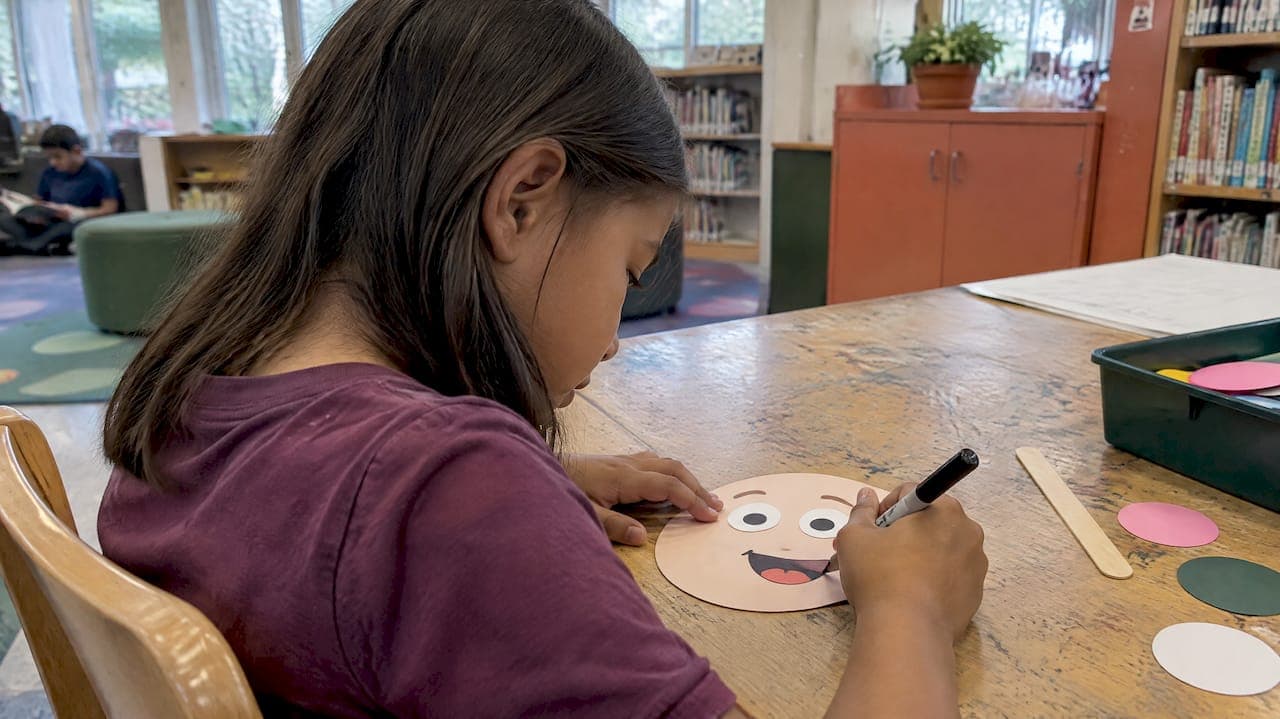
An emotion puppet craft takes about 20 minutes and needs only paper, crayons, popsicle sticks, tape and an adult with scissors. Children draw a face for a feeling, cut it out (or have you cut it), tape it to a stick, and then use the puppet to talk about how it feels. The craft is the warm-up. The real value comes from the play afterward, when the puppet gives a child a safe way to say what they cannot yet say about themselves.
This guide covers the materials, the steps, a printable option, which feelings to start with, how to play with the finished puppets, and how to adapt the activity for ages 3 to 8 and for different abilities.
TL;DR
- Draw or print faces, cut them out, tape them to popsicle sticks. PBS Parents' popsicle-stick puppet activity uses just paper, crayons, sticks, tape and scissors, with adults handling the scissors.
- Start with two to four feelings (happy, sad, angry, scared) and add more over time.
- Use the puppets in play: act out a situation, ask the child what the puppet feels, then let the child pick a way to help it feel better.
- Match the craft to the child. Younger children can scribble and sort. Older children can build characters and write short scenes.
- A printable saves time when you are working with a group, but a child-drawn puppet is often the one they care about most.
Table of Contents
- Why puppets work for talking about feelings
- What you need
- Step-by-step: make popsicle-stick emotion puppets
- Which feelings to make
- Using a printable instead
- How to play with the puppets
- Adapting the craft for ages 3 to 8 and different abilities
- Ideas to extend the craft
- Our perspective
- A deck to keep the play going
- FAQ
- Sources
Why puppets work for talking about feelings
Many young children cannot yet say "I felt left out at recess." They can often say "the little bear felt left out." A puppet puts a little distance between the child and the feeling, which makes it easier to talk about.
Head Start, the federal early childhood program, suggests using puppets to act out situations, asking children to name the feelings, and having the puppet model a way to cope. The same guidance encourages adults to speak at the child's eye level and to make facial expressions that match the emotion the puppet is showing. That second part is easy to forget. If the puppet is sad and your face is cheerful, the message gets muddy.
The craft itself also does work. Drawing a face for "frustrated" makes a child look closely at what frustration looks like: the eyebrows, the mouth, the shape of the eyes. That is emotional vocabulary building through hands-on making. If you want more on the vocabulary side, our guide to emotion vocabulary for kids breaks it down by three age bands with scripts.

What you need
The basic kit follows the PBS activity: construction paper, crayons, popsicle sticks, tape and scissors, with scissors for adult use only. A few extras make the puppets sturdier and more fun, though none are required:
- Markers or colored pencils for older children who want finer detail.
- Glue stick if you prefer gluing to taping.
- Cardstock or an old cereal box to back the paper face so it does not flop.
- Clear tape or a laminator if the puppets will be reused in a classroom.
- A small mirror so children can copy a feeling with their own face before drawing it.
- Paper cups or paper bags as a stage or a puppet "home."
For a group of ten children, plan on about 30 pieces of paper, since some children will want to make more than one face, and at least 15 sticks so there are spares.
Step-by-step: make popsicle-stick emotion puppets
- Pick the feelings. Choose two to four to begin. Ask the child, "What feelings do you know?" and start with their answers.
- Warm up with faces. Take turns making a face for a feeling in the mirror or across the table. Ask, "What does your forehead do when you're mad?"
- Draw the characters. Each child draws a character, which can be a person, an animal or a made-up creature, showing one feeling. PBS describes this step as having children draw their characters before anything is cut.
- Cut them out. An adult handles the scissors. Leave a small border around the drawing so the face does not get chopped.
- Attach to sticks. Tape each picture to a popsicle stick. Put the tape on the back and press the paper flat.
- Name the puppet. A name makes it a character. "Grumbly Gus" is easier to talk about than "the angry one."
- Play. This is the most important step, covered below.
Whole process time: roughly 15 to 20 minutes for children 5 and up, and closer to 25 to 30 for a group of 3-year-olds who need help at each step.
A useful shortcut: one puppet, many faces
If drawing six puppets feels like too much, make one big stick puppet with a blank round face and draw a set of removable faces on separate paper circles. Children swap the face to show a new feeling. This is a good approach for a single child at home, and it also teaches that feelings change.
Which feelings to make
Feelings you can cover with these puppets are broad. The Raising Children Network, an Australian parenting resource, lists happiness, anger, frustration and jealousy for puppet play. The PBS activity adds sadness, excitement, disappointment and feeling thrilled.
Here is a simple way to stage them by age:
| Age | Start with | Add next |
|---|---|---|
| 3 to 4 | Happy, sad, mad | Scared, sleepy |
| 5 to 6 | Frustrated, excited, worried | Jealous, proud, disappointed |
| 7 to 8 | Embarrassed, left out, nervous | Mixed feelings (excited and scared at once) |
The older group is where puppets get interesting. A puppet with two faces, one on each side of the stick, lets a child show "excited on the outside, nervous on the inside."
Using a printable instead
Printables are a good fit when you have a class, a limited prep window, or a child who gets discouraged when their drawing does not look right. Common formats include emoji faces to tape on sticks, finger puppets you roll into a loop, and character templates.
One option from a mainstream source is HP's Print Pals puppet templates, which were designed by puppeteer Stacey Gordon of Puppet Pie. The page includes step-by-step instructions and notes that the activity supports fine-motor strength and emotional expression.
A few tips for any printable:
- Print on cardstock if your printer allows it. Regular paper wilts once it is taped to a stick.
- Let children color the printable. A pre-colored face is easy to name. A child-colored one becomes theirs.
- Print two copies of each face. Children often want to keep one and share one.
- Leave one blank puppet in the set so children can invent a feeling you did not list.
If you need more structured sets for sorting and matching, our emotion sorting activities are designed to be set up in about ten minutes.
How to play with the puppets
A finished puppet that sits in a drawer teaches nothing. Here is a short play routine drawn from the Head Start and PBS guidance.
Act out a small situation
Use a puppet to show something a child might meet in a day. "Mo wanted the blue marker, but someone else had it." Keep it short, one or two sentences. Then pause.
Ask how the puppet feels
Ask, "How does Mo feel?" PBS suggests adults ask how the puppet feels, and the Head Start guidance suggests asking children to identify the feeling. If the child names it, say it back with the matching face: "Mo feels frustrated. His face is scrunched up."
Let the child pick a calming strategy
PBS describes sharing calming strategies such as deep breathing or counting to 10, then having the child choose one to help the puppet feel better. Have the puppet try it. Breathe in together. Count together. Then ask, "Does Mo feel a little better?"
Choice matters here. A child who chooses the strategy is practicing it. A child who is told to use it is just hearing about it.
Hand over the puppet
Once a child is comfortable, let them run the scene. Do not correct what the puppet says. If the puppet says "I hit him because he's dumb," that is information. Respond with, "Puppet was really angry. What could Puppet do next time?"
Sample three-minute script
- You (as Bear puppet): "Oh no. My block tower fell down."
- You to the child: "How does Bear feel?"
- Child: "Sad."
- You: "Bear looks sad. His eyes are down. What could help Bear?"
- Child: "Build it again."
- You: "Let's try. Should Bear take a deep breath first?"
That is the whole thing. Repeat it with a different feeling tomorrow.
Adapting the craft for ages 3 to 8 and different abilities
The best adaptation is the one you make after watching the child for a minute. These are practical starting points based on common craft and classroom practice, not a prescription. For a child with a diagnosed need, check with their teacher, occupational therapist or speech-language pathologist about what fits.
Ages 3 to 4
- Pre-cut the faces or use thick printed circles, and let the child color them.
- Use a big stick or a craft stick wider than a standard popsicle stick, which is easier to hold.
- Offer only two feelings at a time. Happy and sad are plenty.
- Do the play yourself. Young children enjoy watching a puppet and answering questions long before they can run a scene.
Ages 5 to 6
- Let them draw and cut with child-safe scissors only if an adult supervises closely. The PBS activity keeps scissors for adults, which is a good default.
- Add a "puppet home" made from a paper cup, so the puppet can go away when the feeling is over.
- Ask them to give each puppet a name and one thing it likes.
Ages 7 to 8
- Invite them to write a two-line scene: what happens, what the puppet feels, what it does.
- Make two-sided puppets for mixed feelings.
- Have them perform for a younger child, which builds empathy and confidence.
Fine-motor differences
If cutting, drawing or gripping a stick is hard, change the task rather than skipping it. Use printed faces, stickers or stamps for features, a thicker handle such as a paper-towel tube, or tape the face to a glove or a mitten so the child can wave a hand instead of holding a stick.
Sensory preferences
Some children dislike the feel of tape residue, glue or crayon wax. Offer a choice of materials, such as a marker or crayon, and let the child skip the sticky step by handing the taping to you. Others love texture, so felt scraps and yarn hair can make the face more inviting.
Language and communication differences
For a child who speaks little or is learning English, the puppet face is the message. Ask the child to point to the puppet that matches how they feel, or hold up the one that matches a picture in a story. No words are needed. You can add the word yourself: "Sad. Mo is sad."
Shy or anxious children
A shy child may not want to speak in front of a group. Let them hold the puppet and whisper to you, or have the puppet "talk" to a stuffed animal. Never force a performance.
Ideas to extend the craft
- Feelings weather report. Each morning the child picks a puppet for how they feel today. Our 1 to 10 feelings rating ideas pair well with this.
- Story time puppets. Pick a feelings book and hold up the puppet that matches the character on each page. Our guide to reading feelings books aloud together has questions for ages 3 to 8.
- Charades round. Put the puppets down and have children act out the feeling instead. See our feelings charades scripts.
- Playdough faces. Make the same feelings with clay, using feelings playdough mats.
- Collage faces. For a messier, slower version, try the feelings collage.
- Homeschool rotation. Puppets fit neatly into a weekly routine. See 12 homeschool SEL activities.
- A longer plan. If you want puppets as one part of a multi-week routine, the 6 to 8 week plan to teach emotions shows how to sequence it.
Our perspective
We make picture books, card decks and activity kits for children ages 3 to 8, and the same pattern keeps showing up: children learn about feelings best when the lesson does not feel like a lesson. A puppet that gets frustrated about a fallen block is a story. A worksheet that asks "What is frustration?" is homework.

That is why we lean on character. When a child cares about a character, they will sit through a surprisingly honest conversation about worry or jealousy, because it is the character's worry, not theirs. Our studio's work puts original characters first for this reason, and we keep the emotional themes light and indirect rather than preachy.
Our advice for any adult making puppets with a child: let the child's drawing be messy, let the puppet say odd things, and resist the urge to wrap every scene in a moral. The learning is in the noticing, not the lecture.
— Derek Amarillas
A deck to keep the play going
Homemade puppets are the start. Many families and classrooms also like having a set of characters that stays the same from day to day, which makes it easier for a child to recognize them and return to them. Our Duckwave Decks are themed card decks built around the original characters of the Duckwave Universe, and they cost $7 each, one-off.
You can see the Duckwave Decks and pair them with the puppet play above: pull a card, then have your puppet respond to it.
FAQ
What are the basic emotions to start with?
Start with happy, sad, mad and scared. They are easy to show in a face and easy for young children to recognize. Once they are comfortable, add feelings from the sources above, such as frustrated, jealous, excited and disappointed.
How long does an emotion puppet craft take?
Plan on 15 to 20 minutes for children 5 and older, and 25 to 30 minutes for a group of 3-year-olds who need help at each step. Add another 10 minutes for the play part. Pre-cutting or using a printable saves the most time.
Do I need a printable, or should children draw their own?
Either works. Printables are quicker and help children who get frustrated with drawing. Child-drawn puppets tend to feel more personal. Many adults use both: a printed set for the group, plus a blank puppet each child decorates.
How can puppets support social-emotional learning?
Head Start recommends using puppets to act out situations, asking children to name the feelings, and having the puppet model coping. The puppet lets a child practice naming and managing a feeling without having to talk about themselves directly.
Is the craft safe for young children?
It is, with one rule: adults handle the scissors, as in the PBS activity. Keep tape and small decorations such as googly eyes away from children who still put things in their mouths, and stay close while they work.
Sources
- Make Popsicle Stick Puppets, PBS Parents
- Puppet play and activities for kids, Raising Children Network
- Everyday Ideas for Increasing Children's Opportunities to Practice Social Skills and Emotional Competencies, Head Start
- Print Pals Templates, HP Printables